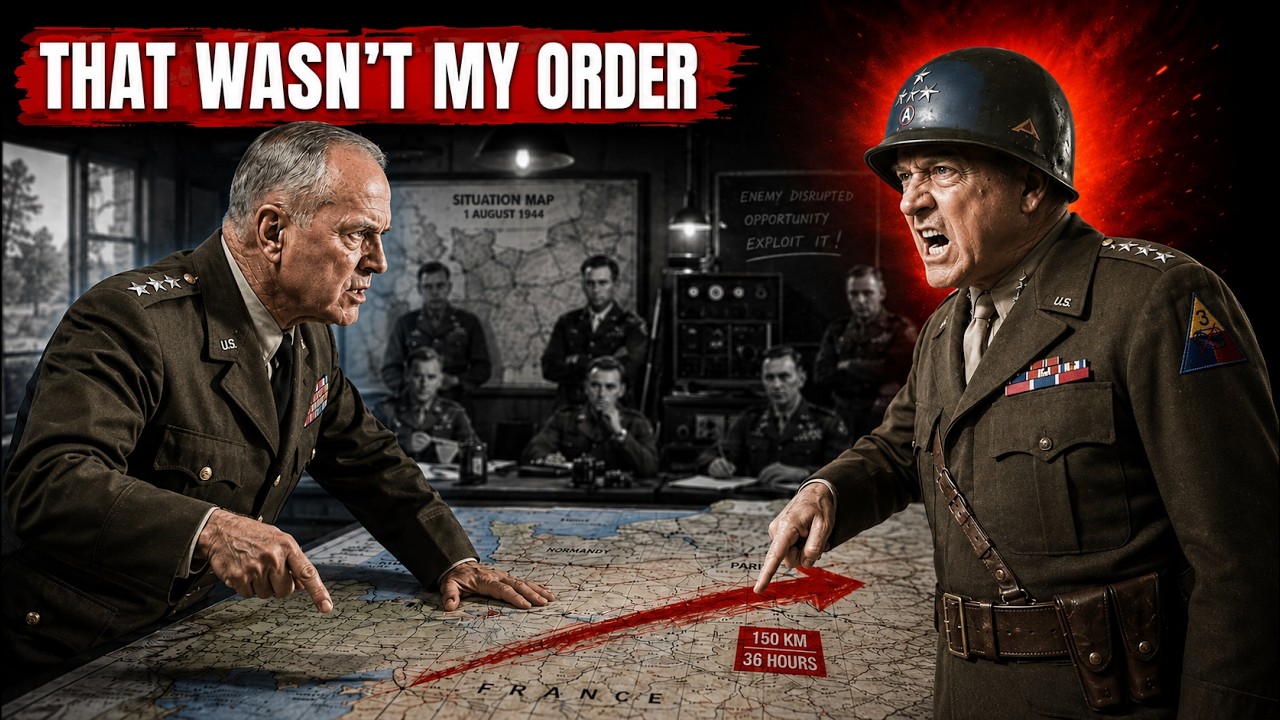
On August 4, 1944, inside a stone farmhouse serving as the Allied headquarters in Normandy, an angry commander slammed his hand on a map table. Before him stood a general who had just done the unthinkable. He had taken an army of tanks and thousands of men, and advanced 150 kilometers into enemy territory in just 36 hours.
Without stopping. Without permission. Without hesitation.
The German Seventh Army, once the pride of Hitler’s western front, was being hunted like wounded animals across the French countryside. But this was not supposed to happen. Not this way.
Not this fast.
The commander raised his head, his voice dry and cold. "That was not my order, General."
Silence filled the room. Every officer present knew what those words meant. Careers had ended over far less.
The accused general did not look away. He did not apologize. Because he knew something his superiors refused to acknowledge: the war would not be won by following the plan.
It would be won by breaking it.
This is the story of George Patton, the general too dangerous to control and too brilliant to dismiss, and the 36 hours that changed how America fought the rest of World War II.
### The Breakthrough
In late July 1944, the Allied invasion of Normandy had been stalled for nearly two months behind a wall of fortifications and blood. Every field had become a fortress. Every crossroads had become a graveyard.
But something finally broke.
Operation Cobra punched through the German defensive lines near Saint-Lô. Through that gap flowed a torrent of American steel. The German Seventh Army, the force that had bled the Allies for weeks, was no longer a wall.
It had become a mob of terrified men fleeing east, abandoning trucks, weapons, and discipline itself.
At a farmhouse serving as an advanced command post, Lieutenant General George S. Patton Jr. stood over a map table, watching the reports come in.
Roads clogged with withdrawing Germans. Villages evacuated overnight. Prisoners surrendering by the hundreds to units no larger than a platoon.
Patton had waited over a year for this moment, and he was determined to make sure no one forgot it.
### The Exile
Patton was 58 years old, a cavalryman by instinct in an age of engines, and a man who had spent most of the past year in professional exile. In the summer of 1943 in Sicily, he had slapped two soldiers suffering from battle fatigue in field hospitals, calling them cowards to their faces. The scandal nearly ended his career while other commanders led men onto the beaches of Normandy.
Patton was given command of a phantom army in England, a fictitious force created entirely to deceive the Germans into believing the invasion would come at Calais. He spent months commanding ghost soldiers while real soldiers bled without him.
He remembered those months in England with a bitterness that never fully left him. He would wake each morning to read in the newspapers about other men crossing the beaches, other men reaping both the casualties and the glory. Meanwhile, he sat behind a desk arranging fake radio traffic for an army that existed only on paper.
Now, on August 1, that exile was over. The Twelfth Army Group was activated under General Omar Bradley, and beneath it, Patton's Third Army came to life. He finally had a real command, and he intended to use it as a weapon, not a leash.
### The Orders
Bradley summoned Patton to his command post that morning. The two men had known each other since West Point, though their temperaments could not have been more different. Bradley was cautious, methodical, a soldier's general who thought in terms of logistics and coordination.
Patton was human fire.
Bradley spread a map on the table. "George, the German Seventh Army is disintegrating before us. This is the opportunity we've been waiting for since June.
Your Third Army will advance south toward Brittany to secure the ports. Then turn east toward the Seine River. You will coordinate closely with the First Army on your left flank and with Montgomery's forces in the north.
Protect your flanks. Don't overextend your supply lines. We move as one force, not as individuals chasing glory."
Patton studied the map without answering immediately. "Understood, sir," he said finally.
Bradley had heard those two words from Patton before, and he had learned they rarely meant what they seemed to mean.
"George, I want you to hear this clearly. This is not Sicily. There will be no grandstanding, no unauthorized advances, no incidents that embarrass this command.
Is that also clear?"
"Perfectly clear," Patton answered, his eyes steady and his voice calm.
Bradley didn't fully believe him. But he didn't have a better option. Patton was, by every measure that mattered on the battlefield, the best tank commander the Allies had.
Perhaps the best in the world. You don't bench a weapon like that. You aim it.
"The Third Army is yours. From this hour," Bradley said, "don't make me regret giving it to you."
"You won't regret it."
"We'll see."
Patton saluted and walked out into the July sunlight, climbing into his jeep. As the vehicle bounced along roads still scarred by weeks of fighting, Patton opened the intelligence reports his staff had gathered overnight.
Bradley's plan was sound. It was cautious, coordinated, and safe. It would eventually push the Germans back toward their borders, liberate France mile by mile, and win the war in due time.
But it was slow. And slowness was the one thing Patton could not tolerate.
He studied the reports closely. This was not an organized retreat. Entire German columns had been found without fuel, without ammunition, without officers to give them orders.
The once-feared German army, the machine that had conquered most of the continent in under two years, was coming apart before his eyes.
Bradley saw a withdrawing enemy that needed to be pushed back carefully. Patton saw something else entirely. He saw prey.
### The Decision
When Patton arrived at the Third Army's forward headquarters, a cluster of tents near the town of Avranches, his senior staff was already waiting. Major General Hugh Gaffey, his chief of staff, stood beside Brigadier General Hobart Gay, his deputy army commander.
Patton spread his map on a rough wooden table. "Gentlemen, as of this hour, the Third Army is fully operational. Our official mission, assigned by General Bradley, is to clear Brittany, then advance east toward the Seine.
In close coordination with the First Army and Montgomery's forces, we will protect our flanks. We advance systematically."
He paused, letting the silence stretch. "Those are our official orders. Now let me tell you what's actually happening out there.
The Germans aren't withdrawing. They're fleeing. They've lost their cohesion, lost their leadership, lost their will to hold.
This is not a moment for caution. This is a moment to destroy them before they find a way to regroup. We are not pushing the German army back.
We are chasing it."
General Gaffey spoke cautiously, noting that Bradley's instructions were explicit: systematic advance and close coordination.
"Bradley gave those instructions based on yesterday's situation," Patton answered. "Today the enemy is collapsing faster than anyone expected. If we move cautiously, they'll escape to fight us again on ground of their choosing.
If we move now, at speed, we'll end this months before anyone in London or Washington thinks possible."
"Sir, if we advance too quickly," another officer said, "we risk our flanks, risk our supply lines, risk encirclement."
"The best defense is a rapid offense," Patton said. "If the Germans can't find our flanks, they can't exploit them. As for fuel, we'll take what the enemy leaves behind.
We improvise. We adapt. But we do not stop moving.
Not for fatigue, not for caution, not until this army collapses completely."
Silence settled over the tent. Every officer understood exactly what Patton was proposing: a pace of advance no modern mechanized army had ever attempted, day and night, without stopping, deep into contested territory with supply lines stretched to the breaking point.
"We move at first light," Patton said. "I expect our spearheads to be far beyond their start positions by this time tomorrow. And after that, any commander who tells me his men need rest will be relieved of command.
Any commander who tells me he's out of fuel will be ordered to go capture some."
The officers left the tent into the evening air. Some felt excitement at what they had just heard. Others felt deep unease.
Patton was proposing something reckless in its ambition, and every man in that tent knew there would be severe consequences if things went wrong.
### The Advance
At 6:00 AM on August 2, 1944, four armored divisions of the U. S. Third Army crossed their start line.
This was not an advance in the traditional sense. It was closer to an explosion, one that kept expanding outward hour after hour.
The 4th Armored Division, led by Major General John Wood, led the way. Wood was a man his soldiers called "The Professor" for his sharp mind and sharper temper. He pushed his tank columns forward with fierce patience, bypassing towns that could be dealt with later, ignoring pockets of resistance that didn't block his direct path, and pushing fuel trucks to their absolute limits just to keep the tanks moving.
German commanders watching their maps in growing horror couldn't understand what they were seeing. One report would place American armor near a town. Two hours later, another report would place it 40 kilometers away.
Distances that should have taken a full day were being covered in hours. Some German officers initially dismissed the reports as exaggerations born of panic among withdrawing units.
They were not exaggerations. The American tanks were not advancing like a traditional army settling into new positions. They were moving like raiders, striking fast and then disappearing forward toward the next objective before the enemy could organize a response.
When tank crews radioed about fuel shortages, the answer from command was always the same: find a German supply depot and capture it. And they did, again and again, discovering abandoned depots along the roadside, draining fuel intended for the retreating enemy and using it to continue chasing that same enemy.
When exhausted crews requested rest, they were told to take turns driving and sleeping in shifts inside their vehicles while the column kept moving through the night. The tanks did not stop.
By the evening of August 2, 24 hours after crossing the start line, the leading elements of the Third Army had covered approximately 60 kilometers, an exceptional distance for mechanized forces moving through contested territory.
Patton was not satisfied. "Only 60? We should be doing better than that."
At Bradley's headquarters, staff officers stared at the situation map in a mixture of disbelief and alarm. The markers representing the Third Army's forward positions kept moving at a rate that matched nothing in the doctrine they had trained on.
One aide finally spoke. "Sir, this must be a reporting error. No unit moves this fast."
Bradley studied the map in silence for a long moment. "Verify it. Get me exact coordinates from the units themselves, not from secondary reports."
Confirmation arrived within the hour. The positions were real. Bradley rubbed his eyes.
Sixty kilometers in one day. "What the hell is Patton doing out there?"
An officer nearby suggested sending orders to slow the advance, warning that the Third Army was outpacing the First Army on its flank, creating a gap that concerned everyone.
Bradley considered it, then dismissed the idea. "For now, we watch him closely. If his flanks become a real danger, I'll order him to stop and dig in.
For now, let him run. He's tearing apart the German Seventh Army faster than anyone in this command thought possible."
By August 3, 36 hours after the offensive began, the spearhead units of the Third Army had advanced approximately 150 kilometers from their start positions. A pace that military planners on both sides would spend years afterward trying to fully explain. Even the German blitzkrieg of 1940, which had remained for years the fastest offensive in modern military history, had not sustained such a pace.
Towns were falling at a rate of nearly five per day. Rennes fell. Vitré fell.
Laval soon followed. German units couldn't form a defensive line because by the time they identified where to dig in, the American tanks had already passed them.
Liberation arrived faster than anyone could process. Church bells that had remained silent for four years of occupation rang within hours of the first American tank entering a village square. Women pushed bottles of wine they had hidden from German confiscation into the hands of dust-covered soldiers who hadn't slept properly in two days.
Old men who remembered the last war wept openly at the sight of the stars and bars painted on the sides of the tanks.
### The Confrontation
News of the Third Army's advance had now reached far beyond Bradley's headquarters. Field Marshal Bernard Montgomery, commanding Allied forces to the north, raised sharp concerns about the widening gap between the American advance and the rest of the Allied line. He argued through official channels that an uncoordinated rush of this kind risked leaving a hole in the Allied front that a German counterattack could exploit.
Bradley found himself caught between two undeniable facts. Patton was ignoring the spirit of his orders, and in some places, their letter as well. And Patton was also destroying German forces at a rate no one thought possible when those orders were written.
On the morning of August 4, Bradley sent a message to Third Army headquarters. He wanted Patton at his command post that day to explain his position in person.
Patton received the message with his usual calm. He shaved carefully, put on a clean uniform despite the dust and grime of the advance, and prepared for what he knew would be an uncomfortable conversation.
The drive back to Bradley's headquarters passed through newly liberated territory. French civilians lined parts of the road, waving improvised American flags. Children ran barefoot alongside the jeep, cheering for men they had never met.
Patton waved to them, visibly moved by the reception.
He arrived just before 9:00 AM. Bradley's staff watched him enter, many exchanging glances, knowing some kind of reckoning was about to occur.
Bradley did not stand when Patton entered his office. He simply gestured to a chair and asked him to explain the current disposition of the Third Army.
Patton stood before a wall map instead of sitting, tracing his army's line of advance with his fingers. "The Third Army is currently spread from positions near Rennes in the west to positions approaching the outskirts of Le Mans in the east. In 36 hours, our spearhead elements have advanced approximately 150 kilometers.
We have liberated dozens of towns and villages. We have captured more than 10,000 German soldiers. We have effectively destroyed several German divisions as organized fighting forces."
Bradley's expression did not change. "And what were your original orders, George? Advance toward Brittany, then turn east toward the Seine, in close coordination with the First Army and Montgomery's forces, protecting our flanks and supply lines at all times."
"And did you follow those orders as given?"
Patton hesitated only for a moment. "I achieved the objective those orders were designed to accomplish."
"That's not what I asked you," Bradley said quietly. "Did you follow the orders as given?"
"No, sir. I did not."
Silence filled the room. Every officer present understood exactly what had just happened. An admission like that, spoken with such directness, could end a career, even one as brilliant as Patton's.
Bradley regarded him for a long moment before speaking again. His voice was calm, but it carried a sharp edge that hadn't been there before. "That was not my order."
General Patton did not look away. "No, sir. It wasn't.
But it was the right decision given what was actually happening on the ground."
For a moment, neither man spoke. The silence stretched so long that junior officers in the room began to shift in their positions, unsure where to look.
Bradley had known Patton since their days as young cadets at West Point. He had watched him claw his way back from public disgrace more than once. He understood better than anyone else in that room how much pride was wrapped up in the man standing at the map.
That understanding didn't make the conversation easier. It only made the stakes feel heavier.
Bradley's jaw tightened. "Do you believe you have the authority to decide which of my orders you will follow and which you will not?"
"I believe I have a responsibility to adapt orders to battlefield conditions. When those conditions change faster than command can be informed. And these conditions changed within hours of receiving your instructions."
An officer beside Bradley cut in sharply, reminding Patton that he had received explicit instructions regarding coordination and flank protection, and that he had ignored both.
Patton turned to face him directly. "I ignored the method. But I achieved the objective.
The objective was to destroy the German Seventh Army and liberate French territory. That is exactly what is happening now. Whether it happened the way this command originally planned or not."
Bradley walked slowly to the map himself, studying the deep, narrow salient the Third Army had carved into German-held territory. The exposed flanks. The thin, overextended supply lines feeding it.
"George," Bradley said finally, "I understand your instinct. You saw an opportunity and you seized it. And by every measure I see on this map, you were right to seize it.
But you are not a private army operating on its own account. Your decisions affect Montgomery to the north. They affect the First Army beside you.
They affect the entire strategic picture the high command is trying to manage. If you continue advancing at this speed without informing this command in advance, you risk creating a gap that can be exploited. And if that happens, the Third Army won't pay the price alone."
"Montgomery thinks I'm too slow and too cautious," Patton said. "He's advancing as if we're still in peacetime maneuvers. The Germans are collapsing.
This is the moment to finish them, not the moment to wait for every unit in the line to move in perfect harmony with every other."
"That may be true," Bradley replied. "And it may also be the most dangerous sentence a general in this army can utter. You cannot unilaterally decide that the overall plan has become obsolete.
George, that decision belongs to those above your rank, not beside it."
Patton leaned forward slightly. "Then let me ask you honestly, sir. How long would it have taken to achieve what the Third Army has achieved in the past three days if we had advanced exactly as originally ordered, at a precise, coordinated pace?"
"Two weeks," Bradley admitted. "Perhaps three."
"And in two or three weeks, how many German divisions would have escaped east of the Seine to dig in and fight us again on ground of their choosing? How many American lives would that delay have cost later this year? Speed saves lives in the long run.
Even when it looks reckless up close."
Bradley did not answer immediately. He returned to his desk and sat down, studying Patton with the tired, appraising look of a man who had just been handed a genuinely difficult problem with no clear solution.
Finally, he spoke. "I am not relieving you of command. George, your results are too significant to ignore, and I won't pretend otherwise.
But I will set conditions for how the Third Army operates from now on."
Patton's expression remained steady, though he was internally calculating what those conditions would cost in flexibility.
"First," Bradley continued, "you will provide daily reports on your positions and intentions before you act, not after. I will not learn where the Third Army is from German radio intercepts again. Second, you will maintain direct coordination with me and with the units on your flanks.
You do not simply act and then inform this headquarters as a courtesy. Third, if I give you a direct order to stop, you will stop immediately. No creative interpretations.
No delays. Is that understood?"
Patton allowed a brief pause before answering. "Understood, sir."
"Do I have your word on that?"
"You have my word. Because if I break it, you'll relieve me of command. And we both know that.
I'd rather keep winning under your command than lose my position by pushing my luck too far."
Bradley studied him for a moment longer. Then he nodded. "Return to your command.
Continue the advance within the limits I've just set for you. Dismissed."
Patton stood, saluted, and moved toward the door. Bradley's voice stopped him before he reached it.
Patton turned back. "What you did was not what I ordered," Bradley said, choosing his words with obvious care. "But it was brilliant work.
Don't let that convince you that you're above the chain of command that put you in a position to do it."
Patton allowed himself a very faint smile. "No, sir. Thank you, sir."
After he left, one of Bradley's staff officers voiced what many in the room were clearly thinking. "Sir, are we simply going to let this pass? He ignored direct orders.
He should face far more serious consequences than a firm conversation."
Bradley looked at the map for a long moment before answering. "He advanced 150 kilometers in 36 hours. He destroyed several German divisions as fighting forces.
He captured more prisoners in three days than we expected for the first two weeks of this operation. And he did it while keeping his casualties relatively low. Do you want me to court-martial a general for being too effective at winning?"
"He violated explicit orders," the officer insisted.
"Yes," Bradley said. "And it's entirely possible he was right to do so. Which is exactly what makes this so difficult.
I built those orders on the assumption that the German army would attempt an organized withdrawal. It didn't. Patton recognized the reality on the ground faster than we did at headquarters, and he acted on it before we could reach the same understanding.
That doesn't mean I can simply let every officer under my command decide for himself which orders to follow. It means I face a genuinely difficult balancing act with this particular general. And I intend to manage it carefully rather than lose the best tank commander in this army over a matter of pride."
### The Aftermath
Patton returned to Third Army headquarters that evening in noticeably high spirits. He gathered his staff, placed his helmet on the map table, and allowed himself a rare moment of open satisfaction. "Gentlemen, the Third Army remains fully operational.
General Bradley has graciously agreed to let us continue winning his war for him."
There was visible relief in the room. Colonel Harkins asked what conditions had been imposed. "Daily reports, closer coordination, and if Bradley says stop, we stop.
No exceptions. Otherwise, we still have room to operate as we see fit."
But even as the Third Army celebrated its survival as an independent force, the advance itself was beginning to suffer from the weight of its own success. Fuel, that quiet constraint behind every bold maneuver, was running dangerously low across multiple divisions. Tanks that had covered 150 kilometers in a day and a half were pulling off to the sides of roads, waiting for supply convoys that couldn't keep up with their speed.
His supply officer warned him bluntly that entire divisions risked running completely out of fuel within 48 hours. While they were stuck deep in still-hostile territory.
Patton's response was consistent with everything he had said since the offensive began. "Then we won't slow down to conserve fuel. We'll reach our next objectives before we run out.
Speed is the solution to this problem, not the cause of it."
The tanks kept moving, using captured German fuel wherever it was found, rationing strictly everywhere else, and relying on the momentum of an offensive that had rewritten what commanders on both sides believed a mechanized army could achieve in a single week.
By August 10, nine days after the Third Army crossed its start line, its leading elements had advanced approximately 400 kilometers, an unprecedented pace in the history of mechanized warfare.
Then on August 12, the advance finally stopped. Not because the German army had found a way to hold its positions, but because the Third Army had simply outrun its ability to supply itself. Tanks sat idle on the roadside, their fuel tanks completely dry, waiting for a supply system straining to catch up with an advance that had exceeded every pre-war expectation of what could be achieved in a week.
Patton was furious in a way his staff rarely saw. "We destroyed the German army in the field. And now we're stopped by our own supply columns."
Bradley, when informed of the situation, was characteristically measured. "George, you consumed nearly a week's worth of fuel allocation in three days of fighting. The supplies will catch up.
Resume the advance the moment logistics permit."
"Give me the fuel and I'll be at the German border within a week," Patton answered. But even he recognized, reluctantly, that his own success had become his limiting factor. An army can only move as fast as the fuel trucks following it.
No amount of willpower can fill an empty tank.
For nearly two weeks, the Third Army held its position while the supply system reorganized behind it. A new network of truck convoys operated around the clock to catch up with an advance that had rewritten the rules of the game. Drivers slept in shifts in their cabs.
Engines never stopped, hauling fuel and ammunition over roads still pockmarked with weeks of fighting.
It was, in itself, a quiet lesson as important as the advance itself. Boldness alone doesn't win wars. Boldness combined with a logistics system capable of supporting it is what wins wars.
### The New Understanding
On August 20, Bradley visited Third Army forward headquarters in person. The meeting carried none of the tension of the confrontation two weeks earlier.
"What you accomplished was unprecedented," Bradley said, studying the map that traced the Third Army's advance across nearly the entire width of France. "Historians will spend years trying to understand exactly how it happened."
Patton allowed himself a small, satisfied smile. "We could have gone further with better supplies."
"Perhaps," Bradley said. "Or perhaps you would have overextended and gotten your lines cut entirely. Either way, you've proven something.
This command needed to learn that the German army can be beaten with speed and aggression rather than caution alone. That lesson will shape how we fight for the rest of this war."
Patton regarded him carefully. "So you agree my methods were correct."
"I agree they succeeded in this situation, at this moment," Bradley answered. "That doesn't necessarily mean I approve of you ignoring my orders to get there. You saw an opportunity before I did.
I built my orders on caution because caution is what protects an army from disaster. You ignored that caution because you correctly judged that the enemy wouldn't punish you for it this time. That doesn't mean the next general who tries the same thing will be equally lucky."
Patton considered this. "So what happens now, sir?"
"When supply conditions permit, you'll continue the advance east. Keep pressing the German army wherever you find it. But coordinate with this command as agreed, and if I give you a direct order to stop, you'll obey it immediately."
"Agreed, sir," Patton said.
As Bradley regarded him for a moment longer, he allowed himself something resembling a smile. "I know, George, that your agreement comes with its own definition. Don't test me on this."
After Bradley left, one of Patton's staff officers asked whether the general thought he would truly be given the same freedom of action as before.
Patton thought about the question seriously this time, without his usual bravado. "Omar has learned something about me over the past three weeks. Some generals need strict limits.
Some need to be given free rein to do what they were born to do. He knows now which kind I am. As long as I keep winning, I'll keep getting the freedom to do things my way.
The day I stop winning is the day that freedom disappears. And I have no intention of ever giving him a reason to take it back."
The Third Army resumed its advance in late August once fuel supplies arrived. Over the following weeks, it pushed another 600 kilometers east, reaching the western edge of the German border by mid-September. A combined advance of approximately 1,000 kilometers in just six weeks.
An average speed that would have seemed fantastical to any general studying mechanized warfare just a few years earlier.
The relationship between Patton and his superiors had changed fundamentally during this operation. Bradley learned to give Patton objectives rather than detailed methods, trusting him to find his own way to the goal rather than dictating the path in advance. Patton, for his part, learned to communicate his intentions more clearly and quickly, even if his execution style remained as unconventional as ever.
The daily reports continued exactly as promised: terse, often optimistic to the point of understating the difficulties. But they arrived, and Bradley came to trust that what Patton omitted from those reports was usually the part where he was improvising his way past the next obstacle.
By December 1944, the Third Army had liberated vast stretches of French territory, destroyed or captured entire German formations, and reached the very doorstep of Germany itself. American newspapers had taken to calling Patton "Old Blood and Guts." German intelligence reports referred to him with a mixture of fear and grudging respect as one of the most dangerous commanders on the western front.
His soldiers spoke of him with a complex mixture of fear, exhaustion, and genuine pride. They knew that serving under his command meant relentless demands, but it also meant being part of an army that consistently won.
### The Legacy
The moment that defined this entire chapter of the war remained August 4, 1944, when Bradley looked across the map table and spoke the words that could have ended Patton's career entirely: "That was not my order."
And Patton replied without hesitation or apology, simply acknowledging that it wasn't, but that it had worked.
In his later writings, Bradley reflected that Patton was the most difficult subordinate he had ever commanded, but also the most effective. A general who ignored orders when he believed he understood the battlefield better than the command behind him, and who was right often enough to be genuinely unsettling.
Bradley wrote that managing such a general meant accepting that the most brilliant commanders rarely fit neatly into the traditional chain of command. The task of leadership was not to force them into that mold, but to point them at the enemy and know when to step aside.
For his part, Patton always insisted that the lesson of those 36 hours in early August had nothing to do with disobedience for its own sake. It was about recognizing faster than his superiors that the rules written yesterday no longer matched the battlefield in front of them today, and having the courage to act on that recognition before it was too late.
The advance across France in August 1944 became one of the defining case studies of the entire war, studied for decades afterward as an example of what opportunistic offensive maneuver warfare could achieve against a collapsing, disorganized enemy. But it also endured in memory for another reason: as the story of a difficult, flawed, endlessly ambitious general, and the equally difficult decision his commander faced between reining him in or letting him run.
Patton would go on to prove the wisdom of that choice once more just a few months later, when he drove his army north at breakneck speed to relieve the besieged town of Bastogne during the brutal winter battles of the Battle of the Bulge. Once again, he moved faster than anyone thought an army could move, forcing his superiors once more to decide how much freedom a victorious general deserved.
In the end, those 36 hours that carried the Third Army 150 kilometers into German-held territory stood as proof of something neither Patton nor Bradley ever fully resolved between them: that results and obedience do not always point in the same direction, and that the general who breaks the plan is sometimes exactly the general the desperate moment requires.
It was not his order. No, sir. It wasn't.
But it worked. And in the final months of the bloodiest war in human history, that distinction mattered more than either man was willing to admit out loud.