Martha “Sunny” von Bülow was born into a world of immense privilege, but her life became one of the most haunting and unresolved mysteries in American high society. Her story is a tangle of wealth, glamour, heartbreak, and a decades-long coma that left the world asking one question: was it an accident, or was it murder?
Sunny was born in 1932 on a family private rail car traveling through Virginia. Her father, George Crawford, was a utilities tycoon, and her mother, Annie Laurie, had not expected to give birth during the journey. The unusual circumstances inspired the family to give her the nickname “Sunny,” a name that perfectly captured her bright and warm personality.
She was known for her charm, her genuine kindness, and her ability to make everyone around her feel at ease.
Tragedy struck early. When Sunny was just three years old, her father died suddenly, leaving her an enormous inheritance worth roughly $100 million in today’s terms. She grew up surrounded by luxury, but the absence of her father left a quiet void.
Her mother remarried, yet Sunny’s early life was marked by a sense of longing beneath the surface of her glittering world.
As a young woman, Sunny attended finishing school and traveled frequently to Switzerland, where wealthy families sent their children to refine their skills in skiing and tennis. It was during one of these trips that she met Prince Alfred von Auersperg. He was an Austrian prince from an ancient noble family, though the empire that once gave his title meaning had long since dissolved.
He was tall, handsome, and carried an air of aristocratic grace. For Sunny, the romance felt like a fairy tale. For Alfred, the appeal of an American heiress with vast wealth was undeniable.
They married in 1957, when Sunny was 26. The couple had two children: Princess Annie Laurie, known as Ala, born in 1958, and Prince Alexander, born in 1959. To outsiders, their life seemed perfect.
But behind the scenes, the marriage was crumbling. By 1965, the couple divorced, citing irreconcilable differences. The fairy tale had ended in less than a decade.
Just one year later, in 1966, Sunny married again. Her second husband was Claus von Bülow, a Danish aristocrat who served as a top adviser to oil magnate J. Paul Getty.
Claus was sophisticated, well-connected, and deeply familiar with the world of the ultra-rich. For Sunny, he seemed like the ideal partner. In 1967, she gave birth to their daughter, Cosima.
For a time, the von Bülows were the picture of high-society success. They divided their time between a Manhattan apartment on Fifth Avenue and Clarendon Court, a grand estate in Newport, Rhode Island. They dined with tycoons, attended exclusive clubs, and hosted lavish summer parties.
But the polished exterior hid a deeply troubled marriage.
By the late 1970s, the relationship had soured. Claus spent most of his time in New York, often away on business or, as rumors suggested, involved with other women. Sunny remained in Newport, increasingly isolated.
Friends noticed that the couple barely spoke at dinner parties. Claus reportedly resented depending on Sunny’s fortune, even as he enjoyed its benefits. There was also talk of his affair with Alexandra Isles, a former soap opera actress who was pressuring him to leave his wife.
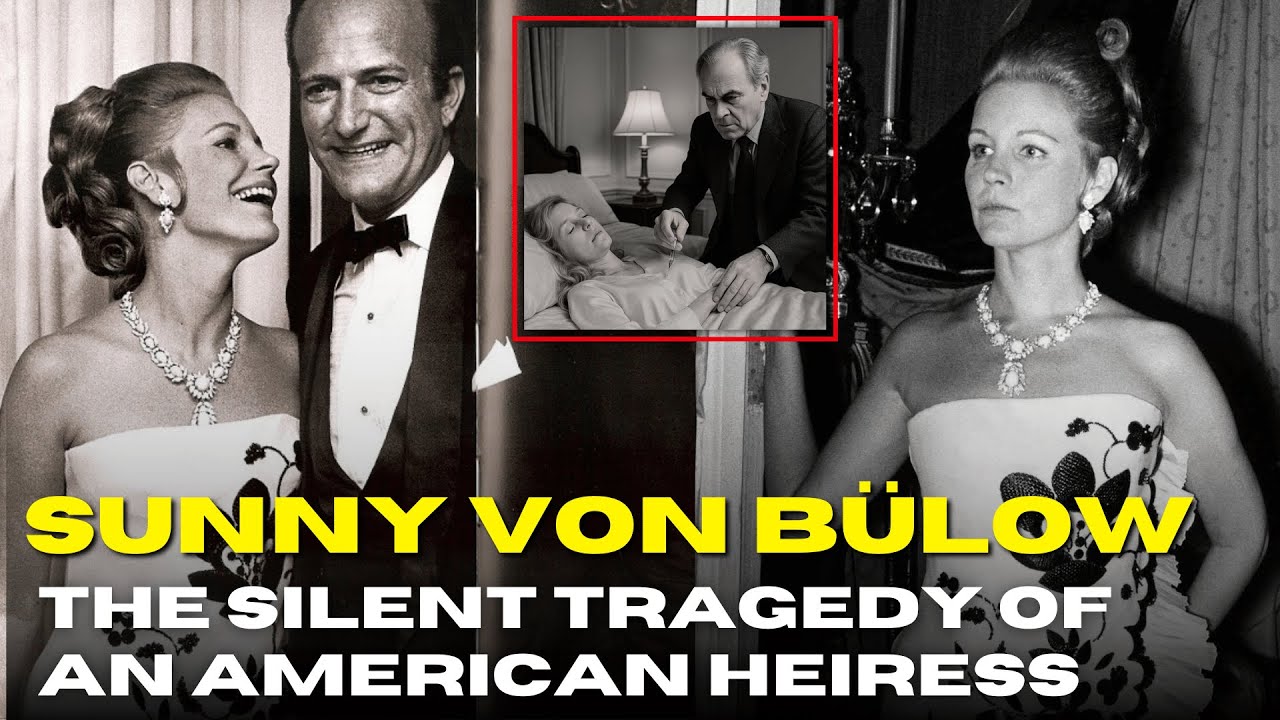
Divorce, however, would mean losing the financial security that Sunny’s wealth provided.
Then came December 1979. The family gathered at Clarendon Court for the holidays. Sunny’s adult son, Alexander, was there, and the mood was festive.
Sunny and Alexander spent part of the day drinking eggnog, possibly laced with alcohol. Sunny had a known weakness for drinking and often lost control. That night, she became disoriented and unsteady.
The family assumed she simply needed to sleep it off. But by the next morning, she was deeply unconscious.
She was rushed to the hospital, where doctors diagnosed her with hypoglycemia. Her blood sugar had dropped to dangerously low levels. She was treated and eventually regained consciousness.
Doctors advised her to change her diet and avoid sugary foods. It seemed like a warning, but no one suspected the dark turn that lay ahead.
In the months that followed, life at Clarendon Court was eerily quiet. But troubling discoveries began to surface. A longtime housemaid named Maria found sleeping pills in Claus’s travel bag.
Then she found a syringe containing insulin. No one in the family had diabetes. Maria quietly told Alexander, and both grew uneasy.
Still, there was no proof of wrongdoing.
Sunny’s health continued to fluctuate. She experienced dizziness, confusion, and multiple hospital visits. At one point, she was admitted to intensive care after an aspirin overdose.
Many assumed she was falling apart under the strain of her failing marriage, mixing alcohol and medications. But others wondered if something more sinister was at play.
In December 1980, the family gathered again at Clarendon Court for Christmas. On December 21, they went to a local cinema to see a movie. Sunny mentioned she was feeling unwell, possibly with sinus trouble.
Later that evening, Alexander saw her in the living room holding a glass that he believed contained ginger ale. She asked Claus to bring her chicken soup. Soon after, her voice became faint, her muscles went limp, and she slipped into a semi-conscious state.
Alexander, thinking she was simply exhausted from medication or drink, left to meet friends at a local pub. It was the last time he saw his mother awake. The next morning, Sunny did not appear for breakfast.
Claus, who claimed he had slept beside her, eventually checked on her and found her unresponsive in the bathroom. Her lips were bleeding, and her body was cold. By the time she reached the hospital, her brain showed almost no measurable activity.

She had fallen into a deep coma from which she would never wake.
Doctors ran every test available. CT scans, blood work, and neurological exams all pointed to severe brain damage. There was no hope of recovery.
Sunny, once the brightest presence in any room, was now trapped in a vegetative state.
Her children were devastated. Ala and Alexander spent days at her bedside, struggling to comprehend the tragedy. Cosima, still young, was overwhelmed but lacked the maturity to fully understand the chaos around her.
As grief settled in, suspicions began to harden into accusations. The insulin syringe, Claus’s behavior, and his potential financial motives all pointed in one direction. A leading neurologist told the children that Sunny’s condition was consistent with an insulin overdose.
The family hired attorney Richard Kuh to investigate quietly. They hoped to gather proof without turning their private tragedy into a public spectacle. But in the world of the super-rich, secrets rarely stay hidden.
Within months, a grand jury indicted Claus von Bülow on two counts of attempted murder, one for each December incident.
The case exploded into the headlines. The media painted a lurid picture of a handsome European aristocrat poisoning his wealthy wife. Sunny’s name became synonymous with scandal.
The trial began in February 1982 and became a tabloid sensation. Prosecutors presented a damning narrative: Claus’s affair, his financial interest in Sunny’s fortune, and the suspicious timing of her collapses. The syringe found in his bag tested positive for insulin.
The defense countered by portraying Sunny as a troubled woman who abused alcohol and prescription drugs, possibly even attempting suicide.
In the end, the jury convicted Claus von Bülow on both counts of attempted murder. It seemed like a rare moment of justice in the gilded world of the elite. But Claus was not a man to accept defeat quietly.
He hired Alan Dershowitz, a renowned Harvard law professor and defense attorney, to handle his appeal.
Dershowitz tore into the prosecution’s case. He questioned the lab procedures, challenged the chain of custody for the syringe, and cast doubt on the reliability of key witnesses. He argued that Sunny’s coma could have been caused by her own combination of sleeping pills, alcohol, and other substances.
Step by step, he dismantled the prosecution’s narrative. In a stunning reversal, the appeals court acquitted Claus von Bülow.
He walked free, but his reputation was shattered. He could never return to the golden circles he once inhabited. Meanwhile, Sunny remained in a coma, kept alive on life support for nearly three decades.

Her children were left to navigate a painful and uncertain reality. Some believed Claus had committed the perfect crime. Others felt the justice system had corrected a grave error.
A civil lawsuit followed. Sunny’s adult children sued Claus on her behalf, seeking damages for the harm he had caused. The case was settled out of court.
Claus agreed to relinquish any claim to Sunny’s fortune, finalized their divorce, and removed himself from the family’s American assets. He moved to England, where he lived quietly for the rest of his life.
The family was permanently fractured. Alexander and Ala remained convinced of Claus’s guilt. Cosima, however, refused to blame her father.
The rift between the siblings lasted for years. Sunny’s mother was so angered by Cosima’s stance that she temporarily cut her out of her inheritance. The entire family was consumed by the tragedy, bound together only by the sorrow of the woman lying motionless in a hospital bed.
One of the strangest twists came in 1983, when Sunny’s first husband, Prince Alfred, suffered a similar fate. A fall left him permanently unconscious. He died in 1992.
The prince and princess, once married to each other, had both ended up trapped in parallel tragedies, unaware of each other’s fate.
Sunny von Bülow died in December 2008, after nearly 28 years in a coma. She was 76 years old. Her heart simply gave out after decades of being suspended between life and death.
By then, the world had largely moved on. Occasionally, a documentary or retrospective would revisit the case, stirring old memories and reopening old wounds.
Claus von Bülow lived on in London for another decade. He rarely gave interviews and offered few public statements about the case. He died in 2019 at the age of 92, outliving Sunny by more than ten years.
To some, his longevity was an insult. To others, it was simply the final chapter of a story with no clear resolution.
Even those who followed the case closely remained divided. Jim Cramer, a prosecutor who worked on Claus’s appeal, later said he remained convinced of Claus’s guilt. But many legal experts believed the prosecution never had conclusive proof, especially given Sunny’s documented struggles with alcohol, sleeping pills, and depression.
For those closest to Sunny, the pain never fully faded. Alexander and Ala spent years watching their mother’s unresponsive body, then buried her knowing she had lived half her life in the darkness of a coma. Cosima had to endure the loss of her mother and the burden of choosing a side that alienated her from her own family.
None of them could bring back the warm, radiant woman who had once lit up every room she entered.
Sunny von Bülow’s story endures as a cautionary tale about the limits of wealth and the fragility of happiness. She was a princess in a gilded cage, brought down by forces she never fully understood. Her life reminds us that the rich are not immune to tragedy.
In a world where money distorts relationships, trust becomes a commodity, and secrets fester behind ornate facades, the stakes can be even higher.
Her legacy is one of silence and unanswered questions. Was she the victim of a calculated plot, or of her own self-destructive habits? The truth may never be known.
What remains is the image of a woman who had everything, and lost it all in the most heartbreaking way imaginable.