The number 48 hours reached the Allied command in the last week of February 1943, while smoke still rose from the Kasserine Pass in western Tunisia. It was attached to the name of the most feared soldier in the German army. Six days had been all it took to break the U.
S. II Corps. More than 6,000 men were killed, wounded, or captured.
More than 100 tanks were left burning in the mountain passes. The German conclusion was simple arithmetic: if six days did all that, 48 more hours would finish what remained.
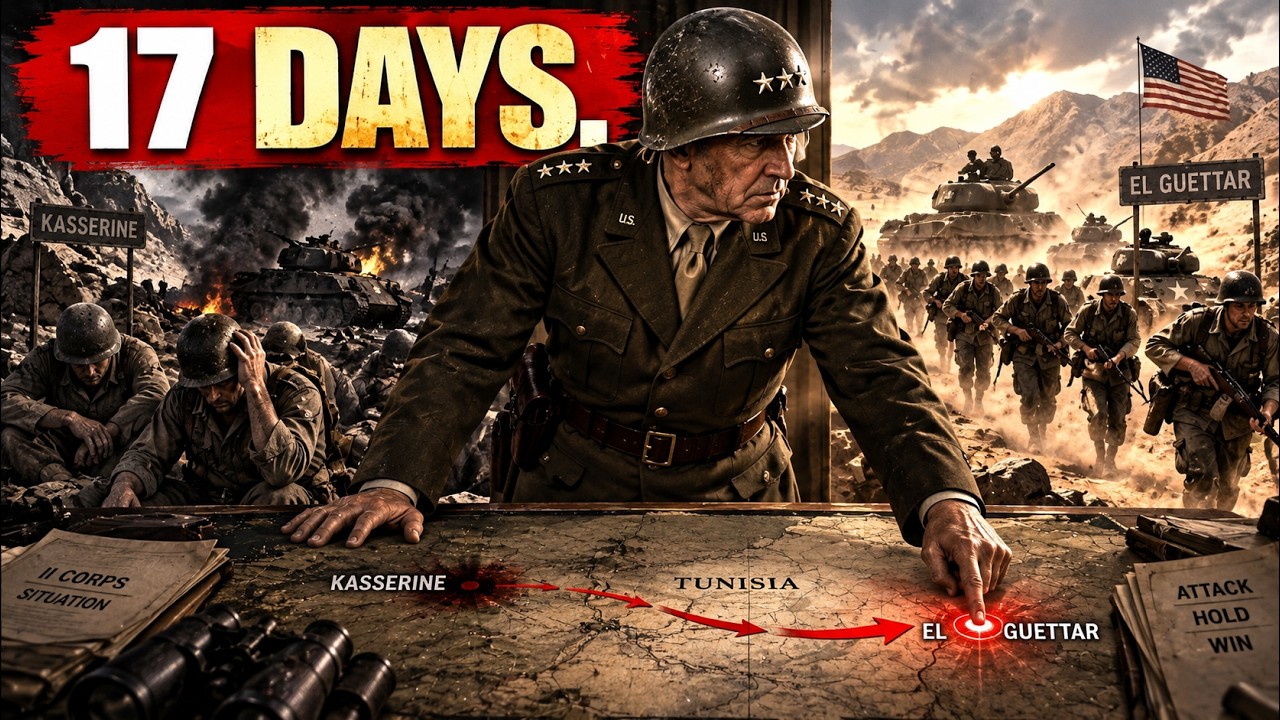
On March 6, 1943, a 57-year-old general with two pistols on his hips stepped out of a reconnaissance car at a dusty headquarters near Djebel Kouif. George Patton took command of an army already written off by the men who had defeated it. He had 17 days.
The first thing Patton saw when he reached the Tunisian front was not the enemy. It was a traffic jam. Supply trucks stretched for miles along the road east of Tebessa.
Ambulances tried to push west against the flow. Men sat on the edges of trucks, helmets off, shirts open, smoking, waiting, not moving. No one was organizing it.
A full American corps was sitting in the sun in the middle of a war that had simply passed it by.
Two weeks earlier, that same corps had been crushed in the mountains to the east. The losses at Kasserine told only half the truth. Most of an infantry division and a full armored combat command had been gutted.
Tanks burned in the valleys until columns of smoke became navigation markers for pilots. Artillery pieces were abandoned where they stood. Fuel dumps were burned.
Field hospitals were overrun. But what terrified Allied high command was not the casualty count. Armies absorb losses.
What cannot be replaced easily is the belief in victory.
The men themselves felt it before anyone wrote it down. They came west from the passes in small groups, not organized units. Platoons that had lost their companies, companies that had lost their battalions.
They were not in a panic. They were quieter than soldiers usually are, with the quiet of men who had just learned something about themselves they did not want to know. They had been told for a year they would be the ones to end this.
Then they met the Afrika Korps, and the Afrika Korps had not been informed.
The man who led them through that was Major General Lloyd Fredendall. He was 58 years old. He had never held field command before, and he spent the battle nearly 70 miles behind the front in a headquarters his engineers spent weeks digging into a ravine.
He never visited the front line. He issued orders over the phone in a local code of his own invention that his subordinates often could not decipher. He spread his armor across 40 miles of mountains in small packets.
When the Germans advanced, the pieces were destroyed one by one.
Dwight Eisenhower had already sent officers to evaluate him. One of them, Major General Ernest Harmon, returned from Tunisia and was asked directly what should be done. His answer was blunt enough that Eisenhower did not ask for clarification.
Eisenhower relieved a man he liked. Then he summoned the one general in the entire U. S.
Army who had built his whole life around the possibility that such a moment would eventually come.
Patton arrived the way a man arrives when he has decided that his arrival itself is the first order he intends to give. Not a single command car but a convoy. Armored scout cars front and back, motorcycles on the flanks, sirens wailing, a flag flying over the lead vehicle, dust rising a quarter mile behind.
The men sitting on the stalled supply trucks stood to watch him pass. They did not know who he was yet. But they knew he was someone important.
Within hours of stepping out of that reconnaissance car, he did three things. He relieved officers, not many, but enough, and fast enough that the news spread through the corps before the day ended. He issued an order on uniform.
Every man in the II Corps, at every hour of the day, in every location, would wear his steel helmet, his leggings, and his tie. A tie in the desert. There would be no exceptions and there would be fines, large enough to hurt.
And he told his division commanders what would happen next.
The uniform order is the thing everyone remembers and almost always tells as a joke. It was not a joke. Patton walked through the corps area that morning and saw unshaven men in open shirts sitting on vehicles they had not maintained, waiting for orders from officers they had stopped respecting.
He saw what Kasserine had left behind, and what it left behind was not cowardice. It was something more dangerous: sloppiness. His theory, held for thirty years, was that a man forced to shave in a place where shaving is difficult has been told something about himself.
He has been told someone is watching. He has been told he is still in an organization, and that organization still has standards. Patton did not believe a tie would stop a bullet.
He believed a tie was the cheapest available way to inform thousands of demoralized men, all at once, that the adults had arrived.
The men hated it. That was acceptable to him. He said more than once that he would rather be hated than have them fear the Germans, because he was the one close enough to reach them.
Here is the part of the story almost no one tells, and it changes the shape of everything that follows. On that same day, March 6, 1943, while Patton walked among the wreckage of American morale near Djebel Kouif, the man whose name was attached to that wreckage was 300 miles to the southeast, losing the worst battle of his career.
Erwin Rommel was 51 years old. He had been in Africa for a little over two years. By that spring he was a sick man, worn down by desert sores and stomach problems.
On March 6, he threw three armored divisions against the British Eighth Army at a place called Medenine, in the last offensive he ever led on the African continent. It was a disaster. Montgomery knew the attack was coming.
He knew the axis of advance. He knew the hour. The British anti-tank guns were already sighted and waiting behind the ridges.
Rommel's tanks drove into a prepared killing ground and came out having achieved nothing, leaving behind nearly 50 tanks that could not be replaced because almost nothing crossed the Mediterranean without being sunk on the way.
Three days later, on March 9, Rommel handed command of Army Group Africa to General Hans-Jürgen von Arnim and flew out of Africa. He was on sick leave. He intended to argue with Hitler about evacuating the entire theater.
He would lose that argument, and he would never set foot in North Africa again.
No American soldier in the II Corps knew this. No American newspaper published it. German high command had every reason to keep it secret, and they did.
For weeks afterward, in briefing tents, in chow lines, and in newspapers back home in Ohio and Texas and Pennsylvania, the enemy behind those hills had a name, and that name was Rommel. Patton took command of a shattered corps to fight a ghost, and he had 17 days to do it.
That number was not his choice. The II Corps did not belong to Patton the way a corps usually belongs to its commander. It was operationally under General Sir Harold Alexander, who had taken command of all ground forces in the Tunisian front in late February, and who had formed his opinion of American soldiers by reading the after-action reports from Kasserine.
Alexander's plan for the coming offensive gave the British Eighth Army the main effort against the Mareth Line in the south. The Americans were given a supporting role. Advance east out of the mountains, threaten the enemy rear, draw off some armor.
Do not, under any circumstances, attempt anything decisive.
Patton read that plan and understood exactly what it was. It was not an assignment. It was containment.
The Americans were being given a job small enough that they could not lose it in a way that would affect the situation. He accepted it in writing, then began looking for the loophole. Because the thing about a supporting attack is that no one specifies exactly how much success a supporting attack is allowed to have.
In the 17 days between March 6 and March 23, Patton did not fight one major engagement against German armor. What he did instead was field command. He was on the roads before dawn.
He appeared at battalion command posts unannounced and without aides to announce his arrival. He stopped at field kitchens and looked at how the food was served and how long the line was. He relieved men who could not tell him where their flanks were.
He stood in the open under shellfire with no operational reason at all and let the men watch him do it, which was theatrical and dangerous and entirely deliberate.
On March 17, the II Corps moved. The 1st Infantry Division, the Big Red One, led by Major General Terry de la Mesa Allen, took Gafsa in one day. There was almost nothing to take.
The Italian garrison had withdrawn before they arrived, leaving behind mines and some demolition work and an eerie silence. Then it rained. The rain lasted two days and turned the wadis into rivers and the tracks into channels of red mud that pulled the boots off marching infantry.
Trucks sank to their axles. Artillery pieces had to be towed by winches. The airfields in the rear turned to mud and the fighters could not fly, which meant that when the weather finally improved, the German planes arrived first and without opposition.
On March 18, the 1st Infantry Division entered El Guettar and found it empty too. Then they looked east toward the ground they were ordered to cross, and the ground looked back. The valley behind El Guettar is not a valley in the gentle sense.
It is a corridor about eight miles wide with a mountain wall on each side. To the north, Djebel Orbata rises steeply and keeps rising. To the south, Djebel Berda is lower but cracked into ridges and ravines that swallow an infantry company the way a sponge swallows water.
Between them runs the road to Gabès, straight and flat and visible from every high point on both sides.
At the northern edge, where Orbata slopes down toward the road, there is a pass called Djebel El Guessa. That was the only practical way to reach the high ground on the left flank, and the Italians held it. They were men of the Centauro Division, dug into the rocks.
Their positions covered the pass and its approaches with machine guns, mortars, and anti-tank guns sighted to sweep the road. A direct attack through that pass would be a massacre, and every American officer who studied it through binoculars on March 19 and 20 said so.
Darby proposed something else. On the map, and according to the estimates of the French colonial officers who knew the country, the northern shoulder of Djebel Orbata was impassable at night. Not just difficult.
Impossible. Loose rock, vertical outcrops, no water, no trail, no way for a mule to climb it, let alone a battalion carrying weapons and ammunition. Darby had walked part of it himself.
He walked it in daylight, then came back and looked at it again.
On the night of March 20, 1943, the 1st Ranger Battalion entered those mountains. They marched 12 miles in the dark. Twelve miles is nothing on a paved road.
But 12 miles across the slopes of Djebel Orbata at night, in single file, carrying disassembled mortars, with an Arab guide in front, a compass, and a great deal of faith, is a different kind of number. The men climbed rock faces using their hands, then reached down to help the men behind them. Equipment was passed up in human chains.
No one spoke above a whisper. They were above and behind the Italian positions before dawn.
With first light on March 21, the Rangers fell on the rear of the Centauro positions from the direction that had been considered safe, and as they advanced, Darby ordered the bugler to sound the attack. A bugle in 1943. The men who were there later said it was the most disorienting sound they ever heard on a battlefield, and they were the ones who knew it was coming.
The Italians in that pass were not cowards, and they did not collapse immediately. But a fighting position is a machine designed to face one direction, and every gun at Djebel El Guessa was pointed west. The Rangers came from the east and northeast down through their trenches, and the battle was over in a few hours.
Two hundred prisoners came out of that pass. The road through Djebel El Guessa was open, and the American left flank now held the high ground. For that night and that morning, the 1st Ranger Battalion received the first Presidential Unit Citation.
By March 22, Terry Allen's division controlled the Gabès road, with infantry regiments pushing east along both mountain walls. The division was spread across a front that widened every hour, because the valley widens the deeper you go into it, and a division advancing into a widening valley gets thinner with every mile. Patton knew it.
Allen knew it. There was nothing to do but keep advancing, because stopping in the middle of that valley with both flanks exposed was the worst option available.
Forty miles away, Fritz von Broich received the order to solve the problem. Von Broich was 47 years old. He had commanded cavalry regiments before the war and converted to armor as most German cavalrymen did, late and out of necessity.
He had taken command of the 10th Panzer Division only weeks earlier in February after his predecessor was killed. The 10th Panzer was not what it had been. It was the division that had fought at Kasserine, and it had been fighting continuously since.
By the third week of March, it could muster no more than 50 tanks for battle. Fuel was rationed. There were no replacement engines.
But it was still the 10th Panzer Division.
On March 22, orders came from Army Group Africa to break the American advance in the El Guettar valley before it reached the coastal plain. Von Broich made his plan the way a professional makes a plan against an enemy he has already beaten once. He would come up the Gabès road at dawn, straight into the valley, led by armor, and hit the American infantry in the open before they could dig in.
He had every reason to expect success. It had worked in February. The Americans had collapsed in February under conditions exactly like these, and the men in his tanks had watched them collapse.
Nothing in the world builds a soldier's confidence like the memory of an enemy who runs.
And nothing in the world is more dangerous to a soldier than that same memory. Because on the night of March 22, while the German tank crews were receiving their orders, the Americans in that valley were doing something they had not done in February. They were preparing.
Terry Allen had spent the day looking at the same valley von Broich was looking at, and he had reached the same conclusion about where the armor would come from, because there was only one place it could come from: the Gabès road at the bottom of the valley. Everything else was mountains. So he laid mines in the valley floor.
The engineers worked all night planting anti-tank mines across the likely approaches in patterns that would not be visible at dawn. He positioned his artillery where it could reach that ground, and he set his coordinates. Every battalion in the division artillery, plus the corps guns Patton had pushed forward, was laid on pre-registered points across the open valley, with data recorded and set on the guns so the forward observer would not have to adjust fire while German tanks covered the last 800 yards.
And he put the tank destroyers on the hills. That was the decision that decided the battle, and it was not an obvious one. The II Corps had no American tanks available in that valley in any strength.
What it had was a tank destroyer battalion, the 601st, and a tank destroyer battalion in March 1943 was an experiment that had not worked anywhere yet. The principle was a theory invented in Washington. The theory said you do not stop tanks with tanks.
You stop tanks with a fast, lightly armored, hard-hitting vehicle that races to the point of penetration, destroys enemy armor from a concealed position, then withdraws before the enemy can respond. On paper, the idea was brilliant. In practice, in March 1943, it meant the 601st was equipped with M3 gun motor carriages: a 75mm field gun of French design from the previous war, mounted on the back of an armored personnel carrier.
A personnel carrier with about a quarter inch of armor, open on top and rear, with a crew of five men standing behind a piece of steel that would not stop anything but rifle fire from a distance and would not stand up to a Panzer IV.
The 601st had met German armor twice that winter, at El Guettar and Sbeitla. Both times, the M3 crews did the only rational thing a man in an open-topped vehicle can do when a German tank turret turns toward him. They ran.
Their commander was a lieutenant named Herschel Baker. On the night of March 22, Terry Allen ordered Baker's battalion forward to the hills called Les Djebel on the south side of the valley overlooking the road, and put them on the forward slope, visible or nearly visible to anything advancing on that road in daylight. Baker put his remaining 31 vehicles in position under cover of darkness, ordered his crews to take cover among the rocks, then walked the line and told his men what would happen in the morning.
What he told them has come down to us in several versions, and the versions differ in wording but not in substance. He told them they had run twice. He told them there would be no running this time.
He told them the infantry in the valley below had nothing else, and that if the tank destroyers withdrew, the German armor would reach Allen's artillery by eight in the morning. And that would be the end of the II Corps for the second time in five weeks. Then he asked them to check their ammunition and try to sleep.
Very few of them did.
March 23, 1943. Six in the morning. Daylight comes fast in that country.
The men in El Guettar heard them before they saw them. You do not hear the engine of a tank first. You hear the tracks.
It is a sound like dragging an entire factory over gravel, and it carries for long distances in the still desert air. It does not sound like one machine. It sounds like a weather phenomenon.
Then the dust rose at the eastern end of the valley, and the 10th Panzer Division came out of the pass.
Tanks in front, spread wide across the valley floor, moving at the deliberate pace of armor that is not in a hurry because it does not expect to be stopped. Behind the tanks, half-tracks carrying panzer infantry. Behind them, self-propelled guns.
About 50 tanks and nearly 6,000 men crawling west up the Gabès road in the early morning light. It was, by every account written later by the Americans who witnessed it, the most frightening thing they had ever seen.
Then the first tank hit a mine. The engineers had done their work in the dark and done it well. The mines were laid where the armor had to pass, and the armor passed there.
The leading tanks began to break apart in a way that was not comprehensible to the crews behind them, because there was no flash of an anti-tank gun, no sound, nothing. Tracks flew off, wheels spun away, hulls veered sideways and stopped. The formation slowed.
Some tanks stopped completely while their commanders tried to understand what was happening to them. That pause lasted a minute or two. It was the most expensive pause the 10th Panzer Division ever took, because the American artillery was ready.
Every gun in the 1st Infantry Division artillery, plus the corps battalions Patton had pushed into that valley, had data set on pre-registered coordinates across that exact piece of ground. There was no need for ranging. There was no need for adjustment.
A forward observer on the high ground called for a concentration by number, and every American gun fired within seconds, then shifted position and fired again.
Artillery does not usually destroy tanks. What it does is destroy everything around them. It kills the grenadiers riding on the open half-tracks.
It sets fire to fuel trucks. It cuts radio antennas off command vehicles and kills the men standing in the turret hatches. And a tank commander who closes his hatch is a tank commander who can no longer see.
A tank that cannot see inside a minefield becomes a stationary object, not a weapon. The valley floor came apart. Smoke, dust, and a continuous muffled roar of full-division artillery fire, a sound with no gaps in it at all.
But the German armor did not stop. This is the thing that must be said clearly, because it is what gives everything that followed any meaning. Von Broich's tanks crossed the minefield and survived the artillery and kept coming west toward the southern wall of the valley, where Terry Allen's infantry was spread in thin lines across the ridges of Djebel Berda.
If they reached those infantry in the open, the morning would end the way February ended, when Herschel Baker's half-tracks came down from El Guettar.
There is no formula for this that makes sense tactically on paper. The M3 weighed about nine tons. It had a quarter inch of steel around the gun and nothing at all over the crew's heads.
Its main armament was a 75mm gun designed in France before the last war, mounted so high and so far forward that the vehicle rocked back on its suspension with every round. Its crew stood to operate the gun, shoulders exposed above the armor in plain sight. A Panzer IV could destroy one from 2,000 yards.
The M3 had to get close.
And they did get close. The 601st came down the forward slope to the valley floor and engaged the German tanks at ranges where the old French gun could penetrate their armor, which meant ranges where the Germans could not miss. What followed was not a duel.
It was a confrontation in which one side had armor and the other side had courage and a flat-trajectory gun, and both sides paid heavily. The half-tracks were hit and burned. A 75mm gun carrier does not explode like a tank when hit by a direct round.
It comes apart in pieces, and the crew standing exposed dies with it. Gunners fell dead behind their sights, and other men stepped forward over their bodies to take the aiming. Vehicles that lost their tracks kept firing from where they stood, because a gun that cannot move can still fight, and a gun that keeps firing remains a danger to the man inside the German turret 800 yards away.
Crews whose vehicles were destroyed did not withdraw to the rear. They ran toward other vehicles whose crews had been killed, and they put those guns back into action.
By the end of the morning, the 601st had lost 21 of its 31 gun carriages. Fourteen of its men were dead. And somewhere on the floor of that valley, in the middle of the smoke, the men who had run at El Guettar and Sbeitla stopped running.
Around mid-morning, the 899th Tank Destroyer Battalion reached their flank, and it had what the 601st did not. It had the new M10, a fully tracked vehicle with sloped armor and a 3-inch gun in a rotating turret, the first American tank destroyer that could face a Panzer IV head-on with a reasonable expectation of winning. They went into the fight alongside the gun carriers.
By nine in the morning, the 10th Panzer Division was retreating east up the Gabès road, leaving nearly 30 tanks burning in the valley behind them.
A lull lasted about seven hours. During that lull, the Americans did the least glamorous and most important work of the day. Ammunition was brought forward.
Gun positions were shifted. The wounded were carried down from El Guettar on stretchers by men who turned around and went back up again. Forward observers walked the ridges with their field glasses and adjusted their fire, registering new coordinates on the ground the Germans had just occupied, because a forward observer who watched the enemy attack in the morning knows exactly where that enemy will assemble in the afternoon.
Patton came forward to the front lines during that day. He did it constantly, and his staff hated it, but it was one of the very few things about him the soldiers never complained about.
At about quarter to five in the afternoon, the 10th Panzer Division attacked again. This time, von Broich led with infantry. The armor had been too badly damaged in the morning to lead another attack.
So the panzer grenadiers advanced on foot across the open valley floor in a formation the men who watched through their field glasses described as parade-ground perfect, and they marched upright across ground the American artillery had spent seven hours measuring. Every gun in that valley was ready. Every fire coordinate was registered.
The observers on the high ground had only to read the numbers. What happened in the next hour was not a battle. The German infantry marched into a wall of steel that came down on them from the front and the flank at once, directed by men who could see every step they took.
Some of them reached the forward American positions. Most of them did not. The attack broke somewhere on the floor of that valley, and the survivors came back the way they had come, through their dead, in the fading light.
By nightfall on March 23, 1943, the El Guettar valley belonged to the U. S. II Corps.
Five weeks earlier at Kasserine, German armor had destroyed an American corps in six days, and the entire Axis command had concluded from that that the American soldier was a well-equipped amateur who would not stand. That conclusion was not propaganda. It was a professional military judgment based on direct observation, and it was correct based on the evidence available at the time.
At El Guettar, a German panzer division attacked an American infantry division twice in one day with armored force on ground of its own choosing, and was stopped both times and thrown back with heavy losses. That was the first time in World War II that an American ground force defeated a German armored attack. Not slowed it, not survived it, but defeated it.
The fighting did not end on March 23. It continued for ten more days and got worse. Patton pushed east, trying to force the valley open, trying to get a mobile force to the coast and close the trap on the southern Axis army.
The Germans held the hills of Djebel Berda and the heights on the northern wall. American infantry climbed those hills again and again in daylight against fortified positions, and came back with their companies at half strength. The casualty list for the first week of April was longer than the list for March 23.
On April 1, a German plane came over a stretch of road four miles east of El Guettar at exactly the wrong moment. The war took from George Patton something it had never taken from him before. His name was Richard Norman Jenson.
Everyone called him Dick. He was 27 years old, from South Pasadena, California, and he had been George Patton's military aide for three years. Three years is a long time to stand next to a man like that.
Jenson was with him at the desert training centers in California. He was with him in Casablanca during the landings and in Tunisia. He was the young man who carried the maps, who knew which of the general's moods meant something and which meant nothing, who could tell a visiting colonel that now was not a good time without being relieved for it.
Patton, who was not a friendly man by any conventional measure and who had spent his whole life building an exterior designed to keep people at a distance, loved him. There is no honest way to describe the relationship otherwise, and Patton's own writings about it leave little room for a different reading.
On April 1, 1943, Jenson was at a forward command post about four miles east of El Guettar. With him was Omar Bradley, then serving as Eisenhower's eyes in the field, who would take command of the corps himself within weeks. The German planes came in low.
There had been very little Allied air cover over that sector for days, a matter Patton had already written about and was about to write about again in language that would cause an international incident within his own alliance. The attack lasted less than a minute. Bradley was thrown to the ground and got up alive.
Jenson did not.
Patton arrived shortly afterward. He looked at the body of the young man he had known for three years, and did what men of his generation and background did in those moments: nothing that anyone could see. He arranged the funeral himself.
Before they closed the grave, he cut a lock of the boy's hair to send home to his mother in California. He wrote about it that night. What he wrote was not the prose of a general.
It was the simplest thing he ever wrote.
There is a particular cruelty in the way that kind of death comes in war. Not in battle. Not while doing anything that will be written about.
A young officer standing next to a vehicle on a stretch of road at the wrong minute of the wrong morning. Then the sound of an engine coming from the east at lower altitude than it should have been. And then nothing.
No enemy to fight. No decision anyone could have made differently. Patton had spent more than 30 years preparing himself to spend the lives of other men.
He had a whole philosophy ready for it, built on history and scripture and a firm fatalistic faith he genuinely believed. None of it helped him standing in that dust with his cap in his hand.
The men at headquarters noticed the change in the days that followed. It was not loud. It was quieter, which for him was more alarming, and he began pressing his subordinates in a way that had a sharpness that had not been there in March.
This is the thing about the story you have been told about this campaign. The version most people carry comes from a film made in 1970, a great film, but a film. In it, an American general stands on a hill above El Guettar with a field glass and watches a German armored attack collapse, then delivers a line every American over 60 can quote by heart.
The one about reading the other man's book. He never said it. There is no record in his diary, no letter, no eyewitness testimony, no official record.
It was written for the film script. And the man he was supposed to have said it about had left the continent two weeks before the shooting started.
That is worth pausing on. The most famous duel in American military memory never happened. Rommel left Africa on March 9.
Patton attacked on March 17. They were never on the same battlefield at any point in the war, not at El Guettar, not anywhere else. Patton's diary does not tell us whether he knew that at the time, and the people who knew him well did not record him saying so.
What we know is that after Jenson's death, Patton stopped being careful.
In the days that followed, his situation reports stated plainly that his forces were being attacked from the air without effective protection. That language reached high command and landed on the desk of Air Vice-Marshal Sir Arthur Coningham, who commanded the tactical air forces in that theater. Coningham responded with a memo accusing the II Corps of using the air force as an excuse for its own failures.
He circulated it widely. He distributed it to the Americans. It nearly broke the Allied command structure.
The chief air marshal, Tedder, had to intervene personally. Eisenhower, fighting the same battle on dozens of other fronts, spent capital he could not afford to waste to hold things together. Coningham was compelled to come to Patton's headquarters and apologize in person.
According to the account of officers who were in the room, the apology was interrupted by a German plane bombing the building. No one planned that. Some stories do not need help.
Two days later, on April 5, Patton relieved Major General Orlando Ward of command of the 1st Armored Division. Ward was a capable and respected officer, given impossible tasks on terrain unsuited for armor, who had advanced himself and been wounded doing it. That did not save him.
Patton decided the division was not being pushed hard enough, so he removed the commander responsible and replaced him with Ernest Harmon, the same officer whose blunt assessment had helped remove Fredendall. That was Patton. Winning at El Guettar did not soften him by a single degree.
If anything, it made him harsher; he now had proof that his beliefs about soldiers were correct, and it is harder to argue with a man who has proof than with a man who has only an opinion.
On April 15, 1943, three weeks after the battle of the valley, Patton handed the II Corps to Omar Bradley and left North Africa. He did not leave in disgrace, and he did not leave in triumph. He left because he was needed elsewhere.
The invasion of Sicily was being planned. He had been assigned to command an army for that operation, and the planning could not wait for the end of the Tunisian campaign. He boarded a plane and left, and he did not see the last month of the war in Africa.
Bradley finished the job. The II Corps turned north toward the hills above Bizerte and fought the last four weeks of the campaign as a competent, confident, professional formation. No one in the Axis command dared write anything disparaging about American soldiers again.
On May 12, 1943, Major General Fritz von Broich surrendered what remained of the 10th Panzer Division to British forces at Grembalia on the Cap Bon peninsula. The division that had come down the Gabès road at dawn on March 23 with 50 tanks ended up in captivity as a few thousand hungry men sitting on the ground beside empty fuel vehicles. The next day, May 13, Axis forces in Tunisia surrendered.
Nearly a quarter of a million German and Italian soldiers were marched into prisoner-of-war camps. It was a catastrophe on the scale of Stalingrad, and it happened in the theater that Erwin Rommel had begged Hitler to evacuate two months earlier.
Rommel was in Europe by then. He never commanded in Africa again. He took command in Normandy in 1944.
He was seriously wounded when a fighter plane strafed his car in July of that year. On October 14, 1944, two generals arrived at his house with a cyanide capsule and a choice that was not really a choice. He took the capsule to protect his wife and son.
He was 52 years old.
Which brings us back to the number we started with. 48 hours. Did Rommel really say it?
Did he stand before his staff and promise to wipe out the American army in two days? There is no record that he did. Not in the captured German files, not in his letters, not in the papers his family kept.
The specific words that have stuck to his name for eighty years cannot be traced to him. Anyone who tells you otherwise is passing on a story, not a source.
But the belief behind those words was real, and it was universal. It was written in a hundred places during the last week of February 1943. The Axis command looked at what happened at Kasserine and concluded that the American soldier could not stand against German armor.
That was not arrogance. It was the correct reading of the only evidence that existed.
After the war, an English military historian named Basil Liddell Hart gathered Rommel's remaining papers, his letters, and the notes he had been making for a book he intended to write about his campaigns. They were published under the title The Rommel Papers. In the chapter he called "The Sky Becomes Dark," writing about the Americans he had fought and the Americans he had heard about later, Rommel wrote these words.
He wrote about Tunisia: "The Americans had to pay a heavy price for their experience, but it brought rich dividends." He added: "Even at that time, the American generals showed themselves to be very advanced in the tactical handling of their forces." Then he wrote that they had to wait until Patton's army in France to see the most astonishing achievement in mobile warfare.
Patton's army. He named it. Of all the Allied formations that defeated the German army and defeated his country, the army the Desert Fox chose to mention by name in his book, using the word "astonishing," was the army of the man American legend insists swore to destroy him in 48 hours.
He never faced him. He never had the chance. But he was watching, and he wrote it down, and he did not have to.
The men who made that possible are not in that quotation. Fourteen of them were killed on the morning of March 23 standing in open half-tracks, with a French field gun from the First World War, at ranges where they could hear the German turrets rotating. Their comrades stepped over them and kept firing.
More than 200 of Darby's Rangers marched 12 miles across a mountain in the dark, over a route the French surveys had declared impassable, and came down through a pass at dawn to the sound of a bugle. Infantry of the Big Red One climbed the hills of Djebel Berda in daylight again and again in the first week of April, for ground that has no monument and no name on most maps.
They are buried in the North Africa American Cemetery in Carthage, Tunisia. If you go there, you will find nearly 3,000 of them in white marble in straight rows, with a wall for the missing with thousands of names. The place is very quiet.
There are cypress trees and mown grass, and the Mediterranean is close enough to smell on the wind. There was nothing orderly about the morning of March 23. There was nothing orderly about the death of a boy from South Pasadena beside a road in April.
Those rows are a courtesy we pay to ourselves, because the alternative is looking directly at the real cost, and most of us cannot do that for very long.
Walk those rows and you will find dates from February, from March, from April, from May. Men who died believing the Germans were invincible, and men who died a few weeks later knowing they were not. The stone does not tell you which was which.
48 hours was a number someone invented. 17 days was the truth.