The old scout said the trail was three days old. The officer, twenty years younger and fresh from West Point, laughed quietly and ordered his men to prepare for a long ride. The scout said nothing. Instead, he bent down and stayed motionless for a full minute.
His knee never touched the dust. His hand hovered over a single blade of grass bent at its base, its tip barely yellowed. Then he lifted his eyes. Not east, where the officer expected the trail to run.
North. Straight into a valley no one in that patrol had even considered. A canyon so narrow and choked with pine that a man could pass within twenty feet of a hidden rider and never see him. In a voice low enough that only the officer heard, he said: “They came through here yesterday before noon.
Four horses, one of them lame. And one of them, as he said, is not a horse at all. It’s a mule packed with something the rider doesn’t want anyone to see. ” The officer stared at him.
He did not ask how. He would not have understood the answer if he had, because the answer was not written anywhere. It was in the bend of a grass blade, in the dryness of one side of that bend but not the other, in the crescent shape left by a mule’s shoe, which is shallower than a horse’s, and in a hundred other things a man needed twenty years in the dust of the Southwest to learn how to see. That old scout was a man named Al Sieber, and the story took place somewhere along the Arizona-Sonora border during the pursuit of the Chiricahua leader Geronimo, around the summer of 1886.
Sieber himself might have waved the matter off entirely. He would have said the Apache scouts he worked with, men like Alchise and the young sergeant later known as the Apache Kid, saw twice as much as he did in half the time. And in a strange way, he was right. The tracking skills of the American frontier were not magic.
They were the last remnant of a way of seeing the world that the native peoples of the plains, deserts, and mountains had perfected over countless generations. Then it was borrowed, imperfectly and often ungratefully, by the white scouts, buffalo hunters, rangers, and mountain men who followed them into that country. Ten of those skills stand out as the core of the tracker’s craft. The first, and the one every other skill rested upon, was reading a single hoofprint.
A modern hunter looks at a print and sees a shape: deer, horse, cow. He might guess how fresh it is by whether rain has fallen. That is where his reading ends. A frontier scout in the 1870s did not see a shape.
He saw a sentence, and that sentence had a subject, a verb, and an object. The subject was the animal itself. Inside the print were dozens of clues to its kind, age, weight, and condition. The verb was the animal’s manner of movement: walking, trotting, running, stumbling, being led.
The object was the load, if any. A loaded animal leaves a noticeably deeper print on the front hoof than an unloaded one, because the load shifts the center of gravity forward. The scout would measure the print with his fingers, comparing the width of the shoe to the width of his palm, because cavalry horses, mustangs, and mules all left different signatures. He looked at the toe and the heel.
If the toe was deeper, the horse was climbing or being driven. If the heel was deeper, the horse was descending or resisting the rein. If both were even, the animal was walking easily and the rider was not in a hurry. If one side of the print was worn forward, the horse was tired and dragging its feet, meaning the rider had pushed it hard and would soon have to stop.
And that meant the scout, on his fresh mount, was closer than the rider thought. Frederick Russell Burnham, born in 1861 near a Dakota Sioux reservation and raised learning to track from the masters themselves, wrote in his memoirs that a hoofprint was to a scout what a face was to a photographer. Every print was different. He said he could identify a particular horse from its print alone after seeing it only twice, and that he had followed men for weeks through country he did not know, guided only by the memory of a particular hoof’s shape.
A horse’s hoof wears unevenly. The farrier who shod it drove the nails in a pattern no other farrier duplicated exactly. The horse walked with its own habit, favoring one side, creating a crack in its shoe at a specific angle. Add to that the style of trimming, the notch that formed on the outer wall, the chip worn into the toe from miles of rocky ground, and a hoofprint became almost as clear as a signature.
Working for the U. S. Army in Arizona Territory in the 1880s, Burnham could track riders across ground crossed by dozens of men and pick out the horse he sought as easily as a modern police officer picks a face out of a crowd. The second skill, and the one that earned Sieber his greatest respect, was a technique the rangers and scouts called “cutting for sign.
” When a scout followed a group of riders across a vast stretch of country, he did not follow their tracks step by step. That took too long, and any wind or rain could break the trail and force him to hunt for it again. Instead, he predicted their route. He asked himself where those riders were heading.
Were they looking for water, a mountain pass, a gap in the hills, any landmark they could not avoid? Then he mounted and rode ahead of them, sometimes for miles, cutting a straight line across the country perpendicular to their likely direction of travel. That perpendicular line was the “cut. ” As he rode along it at a slow, careful pace, he watched the ground on both sides of his horse for any disturbance, any sign.
When he crossed the trail, he crossed it at a right angle, and it showed clearly in the dust or grass. Then he turned and followed it. In this way, a skilled scout could cover fifty miles in a day to catch a group that was two days ahead, because he was not chasing them along their entire route. He was riding fast and picking up their sign at the choke points.
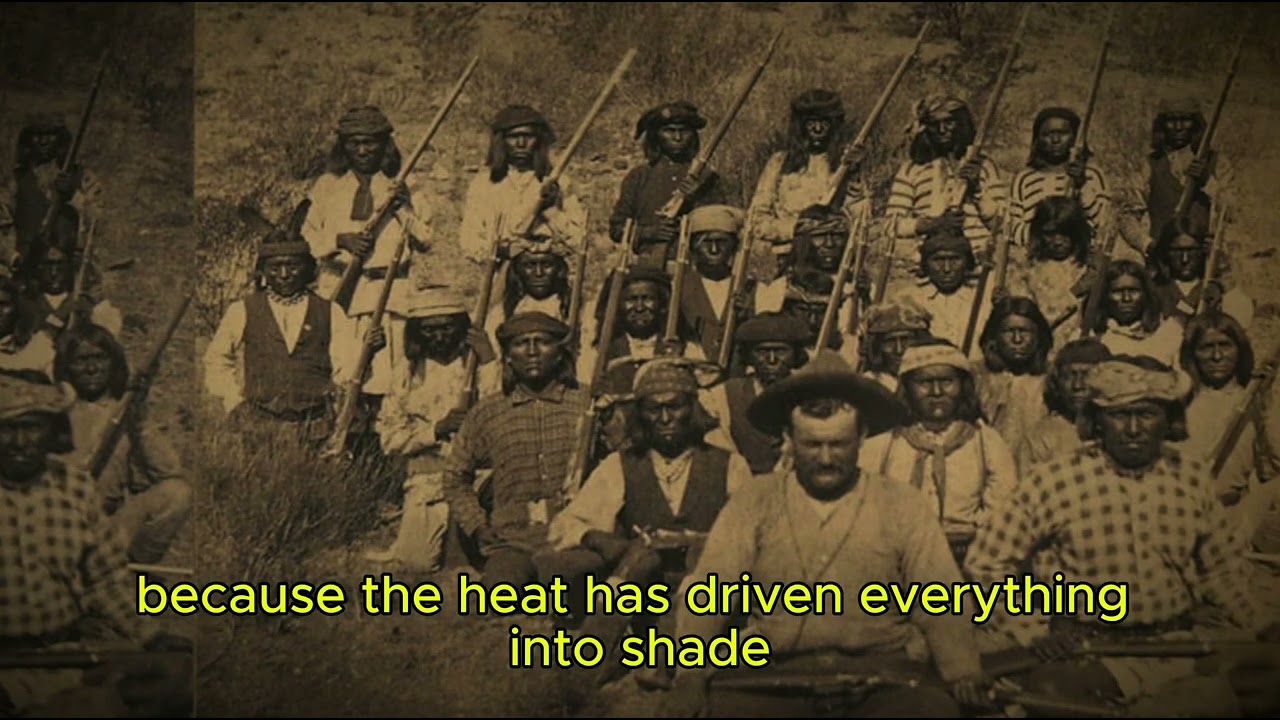
Sieber and the Apache scouts used this method in hunting Geronimo through northern Mexico in 1885 and 1886. The Chiricahua Apache, by almost all accounts of the men who chased them, were the finest guerrilla fighters and most skilled plains riders ever to set foot on that land. They could cover seventy miles a day on foot through brutal, almost waterless terrain, leaving behind less sign than a coyote. They knew how to walk on the balls of their feet over bare rock.
They knew how to erase their trail with a broken branch and how to double back to mislead pursuers. What finally defeated them was that other Apaches, men who spoke their language and knew their tricks, were serving in the U. S. Army.
Those Apache scouts knew where the water was, knew where the passes were, and knew that even a Chiricahua warrior would eventually need a drink. So they looked for sign at the water. And Geronimo, for all his cunning, could not outrun them. The third skill was reading grass and small plants.
A hoofprint in dust or mud is obvious. But a rider crossing a stretch of prairie or mountain meadow leaves almost no mark on the hard ground. The only trace is in the grass: bent stems, broken twigs, scattered leaves. A skilled scout could read these traces and tell you not just the direction of travel but the time.
When a boot or hoof presses down a blade of grass, the blade bends. It begins to straighten almost immediately, but slowly. In hot, dry country at summer noon, a bent blade returns to its natural position in about two hours. In cold, wet weather, it might take a full day.
So a scout who knew his country and the weather of the past forty-eight hours could look at a patch of grass, judge how far the blades had recovered, and fix the time of a rider’s passing to within an hour. Burnham wrote that a scout in the Arizona hills could tell a two-hour-old sign from a four-hour-old one simply by the color of the underside of the bent grass, because the underside of a blade is slightly paler than the top. Once bent, it darkens as it dries. After two hours, the underside was still pale.
After four, it was beginning to match the surrounding grass. After six, the sign was nearly invisible unless the light hit it at a particular angle. A rider breaking through brush left broken twigs. A twig snapped in the morning was still moist and pale at the break.
By the end of the day, that same break was dry and brown. Spider webs stretched across a trail told a similar story. Any desert spider spins its web across an animal trail at night, because the trail is a highway for the small flies and moths it feeds on. A trail covered by unbroken webs had not been used since dark.
A trail with freshly torn webs had been used within the past hour, because the spider had not yet had time to repair them. A modern hunter walks through a web without a thought. The old scout stopped and treated it as a message. It told him whether he was following a trail at all, and it told him he still had time to prepare.
The fourth skill was reading fire. Wherever a group stopped to camp, they left a fire behind. A scout who came upon an abandoned fire could estimate its age with startling precision. First, he tested the ashes with the back of his hand about an inch above the surface.
If any warmth remained, the fire had gone out less than four hours earlier. Then he pushed the ash aside and looked at the coals beneath. A well-burned fire held its inner heat far longer than the surface ash. He broke a coal with a stick.
If the inside was still black rather than gray, the fire had gone out within a day. If the coal crumbled into cold gray dust, three days had likely passed. The color and moisture of the ash mattered too. Fresh ash was still soft and light, lifted by any breath of wind.
Ash more than a day old had settled and packed. Ash that had been rained on and dried again wore a distinctive gray crust. The tracker read that crust as a farmer read a plowed field, and he knew when the last rain had fallen so he could match the crust against it. But there was more inside a campfire than heat and ash.
There was food. The scout kicked through the coals and looked for bones, fish heads, fruit pits, and burned corn husks. Each told something about who had made camp. Deer bones cracked open for marrow meant a group with time to butcher and eat carefully.
Rabbit or squirrel bones meant a group in a hurry, eating whatever they could kill in five minutes. Corn husks meant a group carrying dried provisions, which meant they came from a place where corn was plentiful, narrowing the possibilities. Peach pits in a fire pit in Arizona in the late 1870s almost certainly meant an Apache raid, because the Chiricahua had orchards deep in the Sierra Madre that no one else could reach. The fire itself was another marker.
A campfire built in the middle with wood stacked vertically was a white man’s fire. A fire built with flat sticks laid crosswise and pointing outward like the spokes of a wheel was an Apache fire, since the sticks could be pushed in as they burned without changing the shape. A hunter’s fire dug into a small pit to hide the light told the scout that those who built it were afraid of being seen. A large, open fire on high ground said the opposite.
Every choice a man made when building a fire carried information. The fifth skill was the strangest, and it sounded like superstition until understood. Frontier trackers could read the silence of a country the way a musician reads rests in a score. They listened to the absence of familiar sounds, because an empty country had its own sound.
Birds sang, insects hummed, deer moved through the brush in a quiet rhythm. But a country inhabited by strangers, hidden but present, fell silent in specific ways. The birds stopped first, then the small mammals. Deer lay down.
That silence, if you knew what it should sound like, was deafening. Sieber taught his young scouts, including Tom Horn and the men who came after him, to sit on a hilltop for a full hour without speaking, just listening. He did not tell them what to listen for. He left them to discover it.
After enough time in the wilderness, they did. They learned the difference between the noonday stillness, when the desert quieted naturally because the heat drove everything into the shade, and the stillness of an ambush, when everything went quiet because a predator, one on two legs, lurked in the valley below. The noonday stillness still carried faint sounds, the movement of wind through brush, the occasional buzz of a locust. The stillness of an ambush had nothing, even the insects held their breath.
Frank Hamilton Cushing, the ethnologist who lived with the Zuni in the 1880s and studied their hunting practices in detail, wrote that the Zuni elders called this method “the watching ear. ” They said a skilled hunter did not chase noise. He chased the shape of the silence around it, because the animal, or the man, he hunted stood at the center of a halo of quiet, and that halo had size and direction. If you could feel the edge of the halo, you already knew where its center lay.
The sixth skill was water. In the Southwest, the deserts of Arizona, New Mexico, west Texas, and vast Chihuahua, water was everything. A man could go three days without it in that country, maybe only two on horseback. No one, hunter or hunted, could stay away from water for long.
A scout who could read water, who could find it where others could not, and who could tell whether other men had stopped at a watering hole and when, was worth ten armed soldiers. The first thing a frontier tracker knew about water was that wild animal trails always led to it. Not usually, always. Every deer trail, every javelina path, every rabbit run in that country ended at water.
So a scout riding through unfamiliar land watched the junctions where animal trails crossed. He followed them downhill, and they led him to whatever spring, well, or hidden seep existed in that part of the country. The Apache knew hundreds of small water sources in the Sierra Madre that no map showed: high rock basins in the cliffs that held rainwater for months, cracks in the sandstone where a man could wet a cloth and wring out a sip, even plants that stored water in their pulp if you knew which ones and how to open them without wasting the moisture. Sieber learned some of this during his years with the Apache scouts, though not all of it.
The scouts kept some knowledge to themselves. But he learned enough to lead his men, on more than one campaign into Mexico, across country the officers had declared impassable, because he knew the locations of three drinks of water between one long stretch and the next. Telling whether other men had visited a spring was an art of its own. The tracker looked first at the mud around the edge.
Fresh footprints or hoofprints in that mud, their edges still sharp, meant visitors had come and gone within hours. Prints beginning to crack and dry meant a day or more. Then he looked at the water itself. If it was clear and still, no one had drunk from it recently, because horses and men alike stirred up sediment when drinking, and it took time for that sediment to settle.
Slightly cloudy water with dead leaves floating undisturbed meant a quiet drink. Heavily cloudy water with leaves pushed to the edges meant someone had waded in to fill canteens. The seventh skill was reading weight and pressure. A visible hoofprint or footprint had depth, and each part of it had a different depth.
The heel might sink an eighth of an inch, the ball of the foot a quarter, the toe another eighth. Those slight differences revealed the condition of the person walking. A tired man dragged his feet, leaving a small scuff behind the print. A wounded man favored one side, pressing one boot deeper than the other.
A man carrying a load leaned forward, pressing the toes of both boots harder than the heels. A man walking backward to mislead pursuers pressed harder on his heels, leaving a print with the heel and toe depths reversed. Yes, they did that. Native trackers in the West documented cases of men walking backward for a mile or more to confuse a pursuit, and the scouts always caught it, because a man walking backward could not accurately imitate the depth of a natural forward step.
Horses left the same information. A horse carrying a heavy rider left a deeper front print than one carrying a light rider. A horse led on a rope without a rider left even prints, since there was no change in weight distribution. The eighth skill was night tracking.
It seemed impossible at first, since a man cannot see the ground in darkness. But frontier scouts had an entire set of techniques for after sunset, and some worked only in low light. Burnham wrote about this in detail, saying the great trick was to get down to the ground itself. The scout, bent over on hands and knees, sometimes on his belly, put his eyes at the level of the surface he was reading, because at ground level, in moonlight or a small lantern held at an angle, every raised edge of a disturbance in the dirt cast a small shadow.
Shadows the human eye could not see from a standing position. A hoofprint invisible from above became a small dark crescent when the light fell flat across it. The scuff of a boot on rock, invisible in daylight from any angle, appeared as a soft gray line when a lantern was held six inches above the stone. Burnham said he had tracked men across exposed granite by lantern light at night using the faint scuff of their boot soles on the stone, when no one could see anything in daylight.
Another night trick was touch. A tracker who could not see a sign could sometimes feel it. Bent grass, barely a sign in daylight, was noticeable to the fingertips at night, because the bent blades lay in one direction against the natural growth. Fingers passed lightly over a patch of prairie could tell, by resistance and texture, whether that patch had been walked on recently.
It was slow, hard on the hands, but effective. Night listening was entirely different from daytime listening. Sound carried farther in cold air, and cold air settled into low places after sunset. A scout in a valley after dark could hear a horse walking on the hills a mile above him, clearly, even the click of a bridle chain.
In daylight, the same sound would be lost in the wind. Frontier scouts learned to plan their movements around this, stopping and listening at every depression, every draw, every narrow canyon. The ninth skill was reading the wind. Not just its direction, though the tracker knew that too, but what it carried.
On a calm, dry morning on the border, the wind carried the smoke of a cooking fire eight miles. It carried the dust of a moving column of horses three miles. It carried the smell of sweat and leather from a man on horseback about two hundred yards, if you knew how to breathe deeply and separate the scent from the noise of your own body. Native trackers had discipline in this, a discipline white scouts sometimes learned and sometimes did not.
They would stop their horses on high ground before sunrise and sit for half an hour, breathing slowly and steadily, recording every scent the air brought. Wood smoke meant a fire, and the type of wood, cedar or mesquite or pine, indicated the elevation of the fire, since those trees grew at different heights. The smell of horses without wood smoke meant riders passing without stopping. The faint, sweet smell of coffee meant a white man’s camp, because native travelers did not usually carry coffee.
Even tobacco was information, since kinnikinnick, the blend of tobacco and bark and herbs many native people smoked, could be distinguished from the cut plug a white rider carried if the scout had a strong nose. Sieber, by the accounts of fellow scouts and officers, had an almost superhuman sense of smell. He once rode under a hillside in New Mexico, stopped his horse, and told the young lieutenant with him that there were men and horses in the valley below, at least ten of them, probably Chiricahua, because the smell of the animals was different from cavalry horses. He was right on every point.
When the lieutenant asked how he knew, he shrugged and said the air had told him. The dust column was another method of reading the wind. In the dry Southwest, a column of moving horses raised a fine red dust that rose about fifty feet into the air and drifted a mile or more before settling. A tracker sitting on a peak in the early morning watched the horizon for these columns.
By their color, height, and shape, he could estimate the number of horses in a moving group, their speed, and their direction of travel. The Apache Kid, the young sergeant under Sieber, was famous among the officers for this. There is a documented account, published in Arizona newspapers in the 1880s, of the Apache Kid spotting a group coming through a field glass that the officers could barely make out, and telling the commander not only how many men were coming, but how many were white, how many were native, and how many mules they had. When the group arrived, his estimate was exact.
He had read it all from the shape and color of a dust cloud. The tenth skill was reading rock. This was the skill the Apache trackers were especially known for, because there was a running debate among frontier scouts about whether a man could be tracked across bare stone. Most white scouts said no, because rock held no track.
The Apache scouts said yes, and they proved it again and again. What they read on the rock was a set of signs so subtle that a modern eye, even a trained one, might miss them all. The first was the rub. A moccasin on rock, or even a hard boot, left a faint mark when the sole dragged.
On dark stone, this mark was a light line. On light stone, it was a dark line, because the sole picked up traces of soil and deposited them on the clean rock. The deposit was such a light dust that most people could not see it. An Apache scout could see it from about two yards away.
The second was the turned pebble. Any loose stone on a rock surface had an upper face, which had been exposed to the sun, and a lower face, which had stayed damp and shaded. When a man or a horse crossed the rock, they kicked the loose stones and turned them over. A turned pebble, its damp underside facing the sun, was a noticeably different color from the stones around it, and it stayed that way for hours, sometimes a full day, until it dried or the sun faded it.
A scout crossing a rocky pass looked for these pale patches. Each one meant something had passed here recently. The third was disturbed lichen. Lichen grew on old rock in thin colored patches, taking decades to grow.
When a hoof or boot stepped on a patch of lichen, it broke the crust, and the broken area was a slightly different color, grayer than green, lighter than dark. That mark stayed visible for weeks, sometimes months. Frontier trackers used it to identify common routes that appeared on no map. A scout entering a valley he had never seen could look at the lichen on the rocks and know within minutes whether that valley was a busy trail or a rarely visited dead end.
The fourth was dark dampness. On any rock, in any climate, a tiny amount of moisture rose from the ground at night and clung to the underside of overhanging stones. When a man touched such a stone, or a horse’s flank brushed against it, he transferred a small dark smudge of oil and sweat that soaked into the porous rock and remained visible for hours after he passed. Apache scouts read these smudges the way modern investigators read fingerprints.
They could tell not just that someone had passed, but their approximate height, by the level of the smudge on the stone. A walking man touched the rock at hip height. A mounted man touched it at knee height. A man leading a loaded mule left marks at both levels side by side.
There were other skills, always more. There was reading horse dung, how the moisture and temperature of fresh dung could tell a tracker within thirty minutes when a horse had passed. There was reading the fat cooked onto a stone used as a griddle, and how the age of the fat indicated when the meal had been eaten. There was reading animal bones dragged from a kill, and what the direction of the drag marks said about the predator that had made them.
There was reading a single hair caught on a low branch, how its color and length identified the animal, and how its freshness indicated how much more was nearby. But these ten were the foundation, and a scout who mastered them all was a man who could find any group in any country if given enough time and persistence. Why, then, has so little of this survived? A modern hunter sits in a heated blind with a scoped rifle, a rangefinder, and a phone full of weather apps, knowing almost nothing about how his great-grandfather read the woods.
Part of the answer is technology. When you can see a mile through a scope, you do not need to see two feet in front of you with your bare eyes. Part of it is opportunity. When there is nothing to track because your supplies come from the store, tracking becomes a hobby, and hobbies do not build the skill that Sieber, Burnham, and the Apache scouts possessed.
And part of it is honest: the people who mastered this craft were forced off their land, killed, or scattered by the very westward expansion that made the frontier scouts famous. Most of the Chiricahua Apache, who could read a valley like a book, were dead or sent as prisoners of war to Florida, then later to Alabama, by the end of the 1880s. Their knowledge went with them. The white scouts who learned from them died off one by one.
A hundred and forty years later, the craft has almost vanished. A few remain. There are trackers working in modern search-and-rescue in the Southwest who deliberately study the old Apache methods, and some of them are very skilled. There are professional trackers working with border patrol who can read animal sign in the desert as Sieber’s scouts once did.
But they are a handful, probably fewer than a hundred, across the entire American Southwest. In September 1886, two Chiricahua Apache scouts named Kayitah and Martine, both serving under Lieutenant Charles Gatewood, walked into Geronimo’s camp deep in the Sierra Madre. Unarmed. They had tracked him across country no U.
S. cavalry unit had ever penetrated, following him for weeks using every skill described here and dozens more besides. When they entered his camp, they did not attack. They spoke to him.
They told him what would happen if he did not surrender. Geronimo listened, exhausted and hungry, with fewer than forty fighting men left. Three days later, he surrendered. That was how the last major armed resistance of the native peoples of the American Southwest ended.
Not with a battle, but with a conversation made possible by two men who could read the earth better than anyone in the U. S. Army. Kayitah and Martine were rewarded for this service by being shipped east on a train with Geronimo and the rest of the Chiricahua warriors as prisoners of war to Florida.
They spent the next twenty-seven years in captivity, most of it in Alabama, before being finally released. The knowledge they carried, the knowledge of the trackers, went with them into that captivity. Very little of it ever came out. Al Sieber, the German-born chief of scouts who spent twenty years learning from these men and working alongside them, retired from the U.
S. Army in 1890. He spent his later years in gold prospecting and road building. In February 1907, while supervising a work crew building a road along the Salt River in central Arizona, a large boulder rolled down a slope.
Sieber, who had survived twenty-eight wounds in battle over his lifetime, could not move fast enough to get out of its way. The old scout died there on the mountainside in a country he had known for forty years. He was sixty-three. The Apache workers on his crew, some of whom had known him for decades, buried him where he fell.
The road they were building was for a dam that would flood the valley below. A man who could read a single blade of grass and tell you when a horse had passed was killed by a rock he never saw coming. A man who spent forty years learning to sense suspicious silence died in an ordinary moment of work in a country he knew, which then sank beneath the water. The scouts, the trackers, the sign-cutters, the fire-readers, the wind-listeners, are all gone now.
The land they read is mostly fenced. The animals they followed have been hunted out or replaced. What remains is the memory of a memory. But perhaps that memory matters.
Perhaps the point of telling this story is simply to remember that people once looked at the world with a sharpness we have almost forgotten. There were men and women in this country who could look at the ground and read a complete story from it, hear the echo of silence around a hidden stranger, and smell a distant fire in a still morning air. Those people existed. They walked the same country we walk.
Their eyes were sharper than ours because they had to be.