In November 1944, in the Hürtgen Forest southeast of Aachen on the German side of the border, a soldier of the 275th Infantry Division received what he recognized as the best news of the entire war. The Americans could not use their artillery properly. The pine trees stood fifty to sixty feet high and grew so close together that any shell bursting above that canopy threw its splinters directly down on everyone beneath, including the men who had called for the barrage. The Americans could not use their fighter-bombers, because from three thousand feet the forest looked like a solid green blanket revealing nothing underneath.
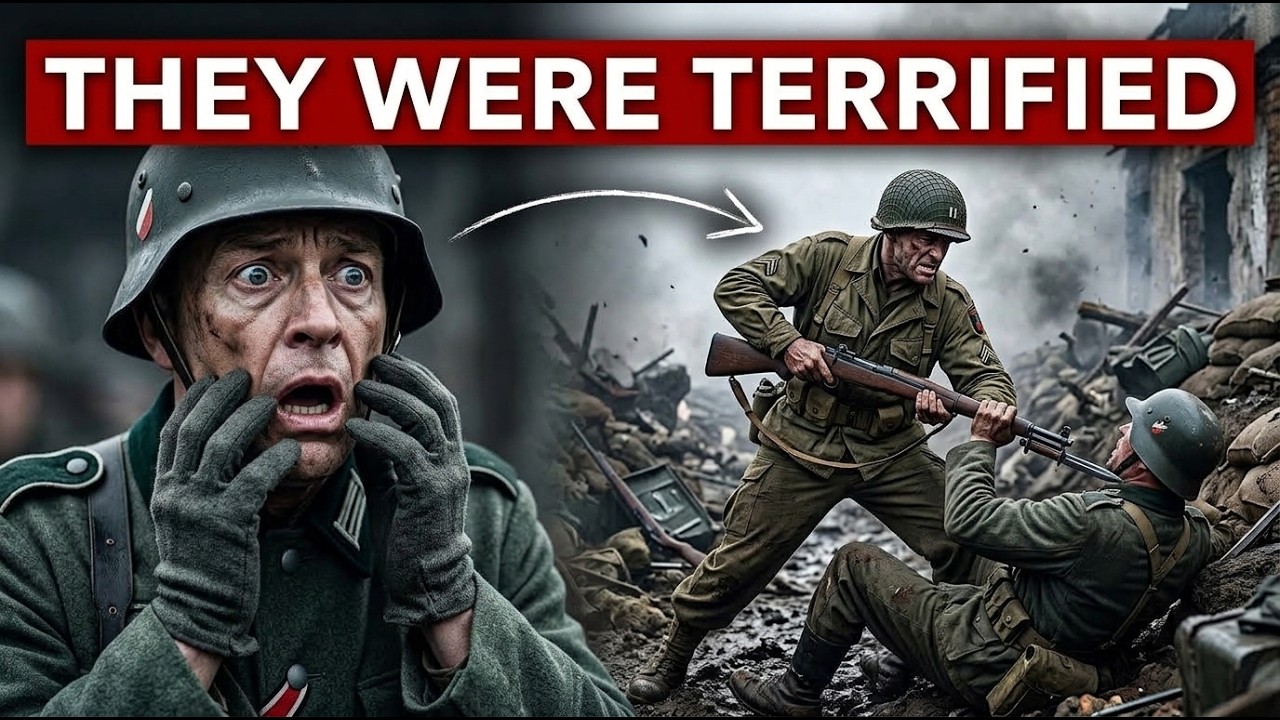
They could not use their tanks, because the only roads were muddy tracks a Sherman could not turn around on, and every one of them was mined. Everything the Wehrmacht had destroyed in France had vanished. The heavy bombardments, the synchronized timing of strikes, the endless truck convoys parked forty kilometers to the west. What remained was a rifle, a squad, and visibility of no more than thirty meters.
This was the battle the German infantryman had spent his entire career training to win. He was a more accurate marksman than the American facing him. His squad was built around a machine gun firing 1,200 rounds per minute, the best infantry weapon of the Second World War by a wide margin. He was supposed to win this fight.
Between September 1944 and February 1945, the United States Army suffered nearly 33,000 casualties in that forest. It was the longest single battle the American Army ever fought, and the closest it came to defeat in Western Europe. The Germans held, bled their opponents, and through that winter German units in the forest reported something their command found difficult to read. The reports were not about American artillery or American aviation, but about what happened in the last thirty meters.
When the Americans got close, the Germans were losing. The German infantry squad was superior to the American infantry squad at every range that mattered except one. Below fifty meters, the German squad stopped functioning as a squad entirely. The reason had little to do with courage, training, doctrine, or tenacity, all qualities the Germans possessed in abundance.
The reason was a decision made in a Massachusetts arsenal in 1936 by a Canadian-born toolmaker most Americans had never heard of. The argument had already been settled quietly eight years before the first American soldier stepped off a landing ramp. Modern close combat was a German invention. In the spring of 1918, the German army solved a problem that had destroyed an entire generation.
Trenches could not be taken by walking toward them. They created specialized assault detachments, storm troops equipped for fighting measured in meters. Satchel charges, flamethrowers, sharp entrenching tools, and the MP 18, the first true submachine gun, made for one purpose: killing men inside a trench at five meters. The Germans wrote the manual on how to approach and survive.
Then came the Treaty of Versailles, an army limited to 100,000 men, and a generation of German staff officers asking one question. If we cannot have large numbers again, how can a small unit generate the firepower of a large one? Their answer was the machine gun, not just any machine gun, but the machine gun itself, universal and at the center of everything. Light enough for one man to carry on a bipod, deadly enough on a tripod to control a kilometer of ground.
The MG 34 arrived in 1934, and the MG 42 in 1942, made of stamped metal, cheaper, faster, and better. The German infantry division was rebuilt around it. The doctrinal language was blunt. The rifle squad is the carrier of the light machine gun.
Read that again. The squad is the carrier of the weapon, not the squad has a weapon. The squad exists to transport, feed, position, and protect a single weapon. In a full-strength squad of ten men, there was a squad leader with a submachine gun, a gunner, an assistant gunner, an ammunition bearer, and six riflemen.
The gunner was the core of the entire organization. The riflemen were the logistics and security support for the man on the trigger. At four hundred meters this was devastating, and no one seriously argued otherwise. On its tripod with an optical sight, the MG 42 could control open ground beyond a thousand meters by firing on coordinates in the dark.
American infantry learned to recognize its sound instantly and stop moving when they heard it, because moving in front of that weapon was a path to death. But look at what the Germans sacrificed for that. Those six riflemen carried the Karabiner 98k, a bolt-action rifle holding five rounds in an internal magazine loaded by stripper clip. A magnificent weapon, accurate, powerful, finely made, descending directly from a design that entered service in 1898.
The German soldier standing in the Hürtgen Forest in November 1944 carried a rifle whose operating principle had not changed since the Spanish-American War. The reason no one in the German army considered this a crisis was that German doctrine did not expect the rifleman to do the killing. The machine gun did the killing. The rifleman carried ammunition belts.
That logic worked at four hundred meters. At thirty meters, it collapsed entirely. In 1936, the United States adopted as its standard service rifle the caliber . 30 M1, designed by John Cantius Garand, born in Saint-Rémi, Quebec.
A toolmaker who spent his career at the Springfield Armory. Gas-operated, semi-automatic. Eight rounds in an en bloc clip. One trigger pull, one shot, and the hands never leave the rifle.
Every major power used a semi-automatic rifle somewhere. The Soviets had the SVT-40. The Germans had the G43. Both were distributed by the tens or hundreds of thousands to selected snipers and chosen units.
No one else did what the United States did. The United States issued a semi-automatic rifle to every infantryman in the army as the standard weapon. Nearly five and a half million M1s were built before the end of the war. If you were American infantry, you had one.
Not the best marksman, not your squad leader, you personally. Now put the two squads side by side and do the math, because the math is the entire story. A full-strength German squad, one MG 42, one submachine gun, and six to eight bolt-action rifles. An American infantry squad, per the 1944 organization, twelve men, one Browning Automatic Rifle, and eleven M1 Garands.
The sustained aimed rate of fire from a trained soldier with a Kar98k is ten to fifteen rounds per minute. He must lift his cheek from the stock, work the bolt back and forward, close it, and reacquire his target. Under fire, in the cold, with wet hands, that means two or three seconds during which the soldier is not looking at the enemy. With the M1, the rate reaches forty to fifty rounds per minute, and his eyes never leave the enemy position during those shots.
Eight German riflemen firing about a hundred aimed rounds per minute. Eleven Americans and a Browning firing between four hundred and five hundred rounds. A four-to-one advantage in the rifle line, achieved before the machine gun ever fired. But rounds per minute is not the number that killed German infantry.
The number that mattered was rounds per exposure. In a forest with thirty meters of visibility, or a hedgerow field three hundred feet wide, no one stays in the open for a full minute. A soldier comes out of cover, crosses a gap, and remains visible for one second, maybe two. That is the entire engagement.
In a second and a half, the man with the Kar98k fires one shot. In a second and a half, the man with the M1 fires three shots, watching each one land. The German response to close attack was correct, studied in every manual. When the enemy comes within the effective range of your machine gun, you must move it.
You must relocate the gun. That is when the structure began to break, because moving an MG 42 is not a decision. It is a complex procedure. The gun weighs about twenty-five pounds with its bipod.
The gunner lifts it. The assistant gathers the ammunition belt so it does not snag. They move. They hit the ground.
They reposition. They load. They set up. Twenty to forty seconds at best, with a trained crew, in daylight, on ground they know.
For twenty to forty seconds, the German squad has no machine gun. And a German squad without its machine gun was not just a weakened squad. It was a different, far worse squad. Six or seven men with rifles from 1898 facing eleven semi-automatic rifles and a Browning.
The Americans never had to defeat the MG 42. They only had to force it to move. None of this would have mattered if the war in Western Europe had been fought in open country. It was not.
From the moment American infantry left the beaches, the terrain itself reduced every engagement to the range at which the German system was weakest. First the bocage, four-foot earthen banks topped with hedges and trees, fields three hundred feet wide. A single German machine gun could cover one field. Just one.
The engagement happened at twenty to fifty meters without warning. Then the towns, then the Hürtgen Forest, where thirty meters was a long view. American units noticed, being American units, and began to improvise. The 1944 table of organization allocated one Browning Automatic Rifle per squad.
In Normandy, squads searched, traded, and quietly acquired a second, often a third. There were no directives, no written doctrine. Sergeants realized that a weapon with a twenty-round magazine in a hedgerow was worth more than a paper table, so they went and got more of them. The firepower of the American squad rose by a third beyond what was officially authorized, and official headquarters was never consulted.
Then the hand grenade, the tool that actually decides close combat. The German Model 24 stick grenade, the potato masher. One hundred seventy grams of explosive inside a thin sheet-steel can on a wooden handle. It was an offensive weapon, designed for a man advancing.
It produced a blast and shock, designed to stun men in the trench you are about to enter, so your own fragments do not kill you when you jump in behind it. To make it a killing weapon, you had to attach a serrated steel sleeve over the head, and that sleeve was an extra accessory, not standard issue. The American Mk 2 fragmentation grenade was the exact opposite in every way. A heavily notched cast-iron body, built for one task only.
It did not stun the men in the room. It killed the men in the room. American grenade training drew directly on a motion nearly every American male already possessed. The overhand baseball throw.
The stick grenade used a completely different mechanism, a throwing motion that sent it farther, forty meters against thirty, making accuracy far harder. In an open field, distance wins. Through a window, into a bunker opening, over a hedgerow at a specific machine gun, accuracy wins. Millions of American boys spent their childhoods learning to place a small object exactly where they wanted it from thirty feet, and then the army handed them a ball of cast iron and told them to do the same thing.
One myth deserves dismissal. The M1 Garand made a distinctive ping when its empty clip ejected, and German soldiers supposedly listened for that sound to attack the American during the seconds it took to reload. That is not true and never was. The sound is real.
But an MG 42 firing twelve hundred rounds per minute creates a hundred-and-twenty-decibel tearing noise. Artillery is falling, men are screaming. The ping of a small piece of compressed steel cannot carry ten meters through all of that. No German training document orders soldiers to listen for it.
The claim appears in postwar American memoirs, gun magazines, and films, but not where it would need to appear to be true. The real reason it is nonsense is more instructive than the myth itself. American riflemen never fought alone. They were eleven soldiers.
When one man’s clip ejected, the other ten were still firing. The story depends on a duel between one Garand and one Mauser, exactly the fight that never happened, because the American squad was designed so it never had to. When American infantry exploited this advantage, they performed actions that seem like fiction but are documented in official records. On September 13, 1944, outside the city of Brest, Technical Sergeant Sherwood Hallman of Company F, 175th Infantry Regiment, 29th Division, was pinned down in front of a German position that had stopped his entire company.
Hallman ordered his squad to cover him, then jumped over the hedgerow alone with his rifle and grenades, killed or wounded four Germans in the trench behind it, and shouted for the rest to surrender. Twelve came out. Seeing that, seventy-five more German soldiers emerged from surrounding positions and surrendered as well. One sergeant, one hedgerow, one rifle, eighty-seven prisoners, and a stopped company moving again.
Sherwood Hallman was killed the next day. He was twenty-eight years old and had worked in a mill in Pennsylvania. Men like Hallman were not professional soldiers and were never destined for the textbooks. In the fall of 1944, the Wehrmacht began forming a new type of unit, the Volksgrenadier division.
These units have a reputation as formations thrown together from the elderly and the very young, and many of them were. But look at how they were built, because the design itself is an argument. A Volksgrenadier division had fewer men than a standard infantry division, fewer rifles, and far more automatic weapons per soldier, with submachine guns allocated at squad level. Into the best of those units went the weapon Germany developed under three different names to get around Hitler’s personal objections.
The MP 43, then the MP 44, finally the Sturmgewehr 44. The first assault rifle, with an intermediate cartridge, a thirty-round magazine, and selective fire, in the hands of an ordinary infantryman. Every service rifle carried by any army on earth today descends from that design. It was made to solve a problem.
Germany’s infantry, in Russia first and then in the West, kept losing battles within two hundred meters that their rifles could not decide. The Sturmgewehr was the German army’s answer to the exact calculations laid out above. They produced about 425,000 of them. The Americans built five and a half million M1s, but the number that actually decides the matter is not production.
It is the calendar. The United States adopted its answer in 1936. Germany introduced its answer to the field in 1944. A gap of eight years.
The Germans never admitted that the American rifle had defeated them. They did something far more expensive than admitting it. In the middle of a losing war, with their industry bombed and their manpower exhausted, they dismantled their infantry organization and rebuilt it around automatic fire at close range. That is what an army does when it loses an argument.
It showed in prisoner reports that puzzled American interrogators. German prisoners captured in Normandy and the Ardennes repeatedly described American squads as entirely armed with automatic weapons, not partially, entirely. The interrogators corrected them, and the prisoners often refused to believe the correction. They were not lying and they were not confused.
They were describing what it feels like to be on the receiving end of eleven semi-automatic rifles fired rapidly by frightened men at thirty meters. The sound does not resemble ordinary rifle fire. It resembles machine guns, and there seem to be absurdly many of them. The honest verdict begins by fully acknowledging the German case.
They were right that the German rifleman was better at hitting targets. He was. German training devoted more ammunition and hours to individual marksmanship than the American replacement system could achieve by 1944. They were right that German fire discipline was superior.
It was. Americans fired frantically, clumped under fire, and consumed ammunition at rates a German NCO considered closer to profligacy. They were right that the MG 42 was the best infantry weapon of the war. It was, and it remains.
They were right that the German squad doctrine, judged purely as doctrine, was more coherent and elegant than anything in the American manuals. But they were wrong about what close combat measures. Close combat is not a marksmanship test. It does not reward the better shot, because at thirty meters everyone is a good enough shot.
It does not reward the more elegant doctrine, because there is no time to execute doctrine. Close combat measures one thing only. How much of your squad’s firepower survives the engagement? The German squad concentrated its lethality in a single weapon.
The right decision for eight hundred meters, a fatal decision for thirty, because concentrated things can be displaced, suppressed, flanked, or stopped. The American squad distributed its lethality across twelve men. Inefficient at long range, but unbeatable up close, because you cannot stop twelve men. You have to kill them one by one, and while you are killing them one by one, each of them is firing forty rounds a minute at you.
The Germans designed the ideal infantry squad for the range they expected to fight at, and then were forced in the last eleven months of the war to fight at the range they had designed to avoid. A German officer whose composite figure was drawn from several real officers of the 275th Division recorded the same observation that winter. When he heard American voices thirty meters away, he did not fear American skill. He knew he was the better shot.
He was afraid because he understood, in the way a man understands something with his body before his mind catches up, that the next fifteen seconds would be decided by how many rounds each side could put into the air. And he had only five.