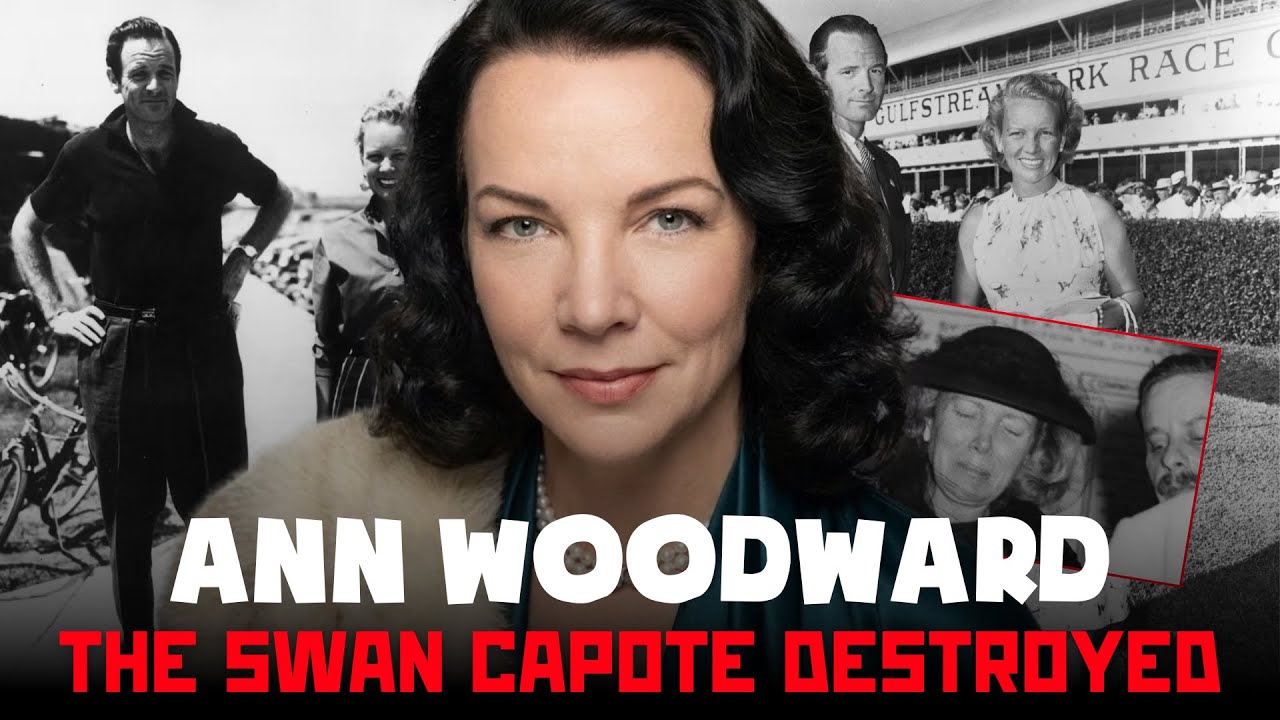
Anne Woodward’s life ended on October 10, 1975, in her Fifth Avenue apartment, not with the shotgun blast that had defined her two decades earlier, but with a cyanide pill. She died just days before Esquire magazine published Truman Capote’s “La Côte Basque, 1965,” a thinly veiled account of her husband’s shooting that branded her a cold-blooded murderer. The man she had trusted as a confidant had turned her trauma into literary ammunition, and the betrayal proved fatal.
Her story began far from the gilded world she would later inhabit. Born Angeline Crowell in Pittsburgh, Kansas, she was raised by a mother, Ethel, who viewed her daughter’s beauty as a means of escape from a life of poverty and instability. The family moved constantly, and young Angeline learned early that survival depended on charm and appearance.
In 1937, she boarded a train for New York City, shedding her past along with her name. She became Anne Eden, a model and radio actress who was voted the most beautiful girl in radio in 1940.
It was in the nightclubs of wartime New York that Anne met William Woodward Jr. , the only son of one of America’s most storied banking families. Billy was handsome, wealthy, and profoundly directionless, a man who had spent his life controlled by his formidable mother, Elsie Woodward.
Anne was electrifying, ambitious, and utterly unsuitable by the standards of old money. For Billy, she represented rebellion against his mother’s suffocating grip. For Anne, he represented the security she had chased her entire life.
They married in 1943 in a small ceremony in Tacoma, Washington. Elsie Woodward did not attend. The matriarch, one of the famed Krider triplets, viewed Anne as a gold digger and a contaminant.
She launched a private investigation into Anne’s past and presented her findings to her son as evidence of the marriage’s folly. But Billy, for the first time in his life, defied his mother. The marriage was his act of independence, and he clung to it.
The reality of life as a Woodward was brutal. Elsie controlled the family’s finances, and Billy had no career or income of his own. The couple was installed in an apartment at the Waldorf Towers, just floors below Elsie’s own residence, turning their marriage into a supervised arrangement.
Anne was never accepted by New York’s old guard. She wore too much jewelry, laughed too loudly, and her hunger for approval was too visible. She was the showgirl who had crashed the party, and the guests were waiting for security to escort her out.
Anne responded with a campaign of self-reinvention. She studied the style of the era’s most celebrated women, hired speech coaches to erase her Midwestern accent, and built a wardrobe of couture armor. By the late 1940s, she was one of the most striking women in the city, photographed and chronicled by gossip columnists.
But the inner sanctum of true aristocracy remained closed to her. She was “that woman Billy married,” a temporary amusement.
The marriage deteriorated quickly. Billy’s initial passion for Anne curdled into contempt. He mocked her in public, reminded her of her background, and conducted affairs with the very type of women Anne had once been: showgirls, actresses, women of the night.
He drank heavily. She drank to match him. Their home became a war zone, and their dinner parties became spectacles of barely concealed hostility.
The birth of two sons, Woody in 1944 and Jimmy in 1947, did nothing to stabilize the marriage. Anne approached motherhood with the same detached, managerial style she had learned from her own mother. The boys were dressed in perfect suits, paraded for photographers, and handed back to nannies.
They became pawns in the cold war between Anne and Elsie, who doted on her grandsons as the future of the dynasty.
By the mid-1950s, divorce was no longer a rumor but an imminent threat. Billy had consulted lawyers and told his mistress he would be free by Christmas. For Anne, divorce was a death sentence.
A divorced woman of her background would be cast out of society, stripped of her lifestyle, and left with an insulting alimony. The terrified girl from Kansas woke up inside the couture gown of the society matron, her beauty fading and her enemies closing in.
The couple moved to a sprawling estate in Oyster Bay, Long Island, hoping for a fresh start. Instead, it became the stage for the final act. Anne became fixated on the idea of a prowler, telling anyone who would listen that a burglar was stalking the neighborhood.
She insisted that loaded shotguns be kept in both bedrooms.
On the night of October 30, 1955, the Woodwards attended a dinner party in honor of the Duke and Duchess of Windsor. It was the kind of social coup Anne had dreamed of, but the evening was a disaster. She drank too much, laughed too loudly, and flirted aggressively with the Duke.
Billy spent the night sullen and withdrawn, making cutting remarks about her to his cousin.
They returned home after midnight in silence. They went to their separate bedrooms, connected by a hallway. Around 2 a.
m. , the dog began to bark. Anne later claimed she woke, grabbed the shotgun by her bedside, and stepped into the dark hallway.
She saw a figure, fired, and killed her husband. She fired a second shot that went wild. Billy was naked, unarmed, and had stepped out of his room, perhaps to quiet the dog.
The immediate aftermath was chaos. Anne was found screaming over the body, wailing that she thought he was a prowler. The police treated her with deference befitting the Woodward name.
She was taken to a hospital, sedated, and treated as a patient rather than a suspect. The evidence was thin: no forced entry, no footprints, a naked victim who was clearly not a burglar. In a Bronx tenement, she would have been booked for murder before sunrise.
But this was Oyster Bay, and the machinery of wealth was already grinding into gear.
Elsie Woodward made a calculation that night. A dead son was a tragedy, but a murderer for a daughter-in-law was a disgrace. To save the family name, she had to save the killer.

Lawyers descended on the police station. The accident theory was polished until it gleamed. A petty criminal named Paul Wirths, arrested for prowling in the neighborhood that night, provided the grain of truth the lie needed.
The grand jury returned a no bill. Anne Woodward walked free.
But society delivered its own verdict. She was branded with the cruel nickname “Bang Bang,” a punchline that reduced the most traumatic moment of her life to a cartoon sound effect. The old guard crossed the street to avoid her.
Former friends found their calendars full. She fled to Europe, drifting through grand hotels and taking transactional lovers, but she was entirely alone. Her sons were sent to boarding schools, exiled from the house of horrors.
It was in this vacuum of loneliness that Anne made her second fatal mistake. She befriended Truman Capote. By the late 1950s, Capote was the darling of the literary world, the genius imp who had written “Breakfast at Tiffany’s.”
He was the confidant of the very women who shunned Anne, the swans of New York society. But Capote was also a misfit, a gay man from the South who had clawed his way into the citadel through talent and charm. He saw in Anne a mirror.
He courted her friendship with warmth and gossip, defending her loudly to the swans. For Anne, starved for a friend who understood the language of outsiders, it was water in the desert. Late at night, fueled by stingers and wine, she poured out her soul.
She told him about the poverty, the humiliation, the rage. She told him about the night of the shooting. She gave him the keys to her soul, believing he would keep them in a velvet box.
Capote didn’t befriend secrets. He harvested them. By the early 1970s, his career was stalled.
After the massive success of “In Cold Blood,” he hadn’t published a major work in years. He was partying, drinking, and drugging, becoming a caricature of himself. He needed a masterpiece.
He called it “Answered Prayers,” a non-fiction novel that would strip the masks off the swans and expose their crimes.
For the centerpiece, he turned to Anne Woodward. In the manuscript, she became Anne Hopkins, a vulgar, grasping woman who traps a wealthy banking heir. In Capote’s retelling, there was no prowler and no accident.
The Anne character, facing divorce and poverty, deliberately kills her husband to secure the inheritance. She fires a warning shot into the wall to establish an alibi, then executes him when he rushes in.
Capote used the intimate details Anne had confided in him to give the story the ring of absolute truth. He took her trauma and turned it into a tawdry anecdote to sell magazines. Advanced copies of Esquire began circulating in early October 1975.

Anne obtained a copy and read the words of her friend. She saw the betrayal in black and white. She realized there was no coming back from this.
The story would be read by everyone, including her sons.
She couldn’t call Truman. He was the assassin. She couldn’t call Elsie, who would read the story with grim satisfaction.
She was trapped in the spotlight again, stripped naked with the crowd jeering. The showgirl had survived the Depression. The duchess had survived the shooting.
But the woman sitting in that apartment in October 1975 had run out of identities. She reached for a small pill, cyanide, a relic she had reportedly kept since the days of the investigation.
When Capote heard she was dead, he went into frantic denial. “She was my friend,” he wailed. “I didn’t kill her.”
But the connection was undeniable. The swans read the story, looked at Anne’s body, and realized Capote was not their pet. He was a predator.
They closed ranks and excommunicated him. Babe Paley, dying of lung cancer and the great love of his life, refused to ever speak to him again.
Capote never recovered. He spiraled into drugs and alcohol, never finished “Answered Prayers,” and died in 1984. But the curse did not end with him.
Jimmy Woodward, the younger son, returned from Vietnam damaged, drifting into heroin addiction. In 1976, a year after his mother’s suicide, he stripped naked and jumped from a hotel window. He was 29.
Woody Woodward, the older son, tried to outrun the shadow. He married, had a daughter, and attempted a normal life. In 1999, he also jumped to his death from a Manhattan window.
He was 54.
Elsie Woodward died in 1981 at the age of 98, outliving her son, her daughter-in-law, and one of her grandsons. She died in her bed at the Waldorf Towers, the last survivor of the war she had started.
Anne Woodward wanted to be a legend. She wanted to be immortal. In a cruel, twisted way, she got her wish.
She is remembered as the gold digger, the killer, the Mrs. Bang Bang. But strip away the couture and the jewels, and you see the girl from Kansas running as fast as she could from a life of dust and despair.
She killed her husband, whether by accident, reflex, or murder, we will never truly know. She killed herself because the alternative was to be stripped naked in the public square. The prowler was the ambition that lived in her heart.
And in the end, it was the only thing she couldn’t shoot.