In the years after the Battle of Thermopylae, a man walked through the streets of his hometown in central Greece. His name was Ephialtes, and his head carried a price. The story of how a local farmer came to be hunted by the entire Greek world begins a decade earlier, in the summer of 480 BC, at a narrow pass between a mountain and the sea. Leonidas, king of Sparta, marched north not expecting victory, but accepting its opposite.
He led three hundred carefully chosen men, each of whom had already fathered a son, so that no Spartan bloodline would end at Thermopylae. Behind them came several thousand allies from cities whose names most people today could not place on a map. Against them stood the army of Xerxes, King of Kings, an invasion force that dwarfed anything Greece had ever seen. Many of those who marched with Xerxes were conscripts from dozens of subject peoples—Medes, Bactrians, Lydians, farmers and herdsmen forced to travel hundreds of miles under the August sun.
Most had no quarrel with any Greek. They would die in a pass they could not pronounce for a king they would never see, because of a man they would never meet: a Malian named Ephialtes. The Greeks fortified a narrow point in the pass where the road between mountain and sea narrowed to perhaps fifty meters. There stood an old, half-ruined wall, which they rebuilt.
The terrain forced any attacking enemy into a kill zone barely as wide as a village street. Behind them, the Greeks cooked, slept, and sharpened their bronze. Leonidas, however, identified the one weakness in his position: a mountain path called Anopaea that wound through the slopes of Mount Kallidromos and descended behind the Greek line. He sent the Phocian contingent, about a thousand men, to guard it.
This was not an oversight. He had already imagined the disaster before it came. On the first day, Xerxes waited, expecting the Greeks to see his numbers and withdraw. They did not.
He sent the Medes forward in waves, but the terrain squeezed their attack into a front only a few dozen men wide. The Greek phalanx, with interlocking bronze shields and extended spears, held against them like a machine. Persian arrows bounced off Greek bronze. Persian spears, shorter and lighter, could not penetrate the wall.
By the end of the day, hundreds of Persian bodies lay before the Greek wall. Herodotus records that Xerxes, watching from a throne on a hillside, leapt to his feet three times in fear for his army. On the second day, Xerxes sent his best soldiers, the Immortals, ten thousand elite troops. They fared no better.
In a pass fifty meters wide, ten thousand men became one hundred at a time, and those hundred died on Spartan spears. The Persian losses during those two days were in the thousands. The Greeks even executed deliberate feigned retreats, luring their pursuers forward only to turn and cut them down. Then Ephialtes entered the camp of Xerxes.
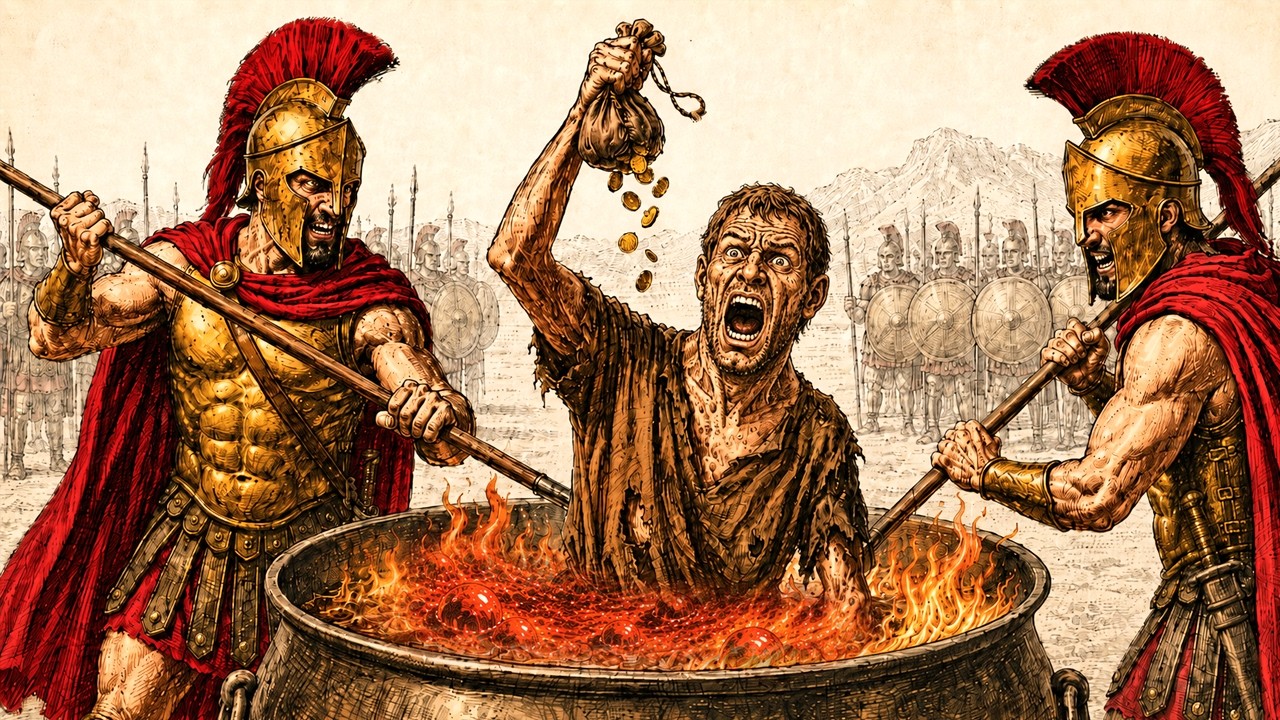
Herodotus gives only the outline: Ephialtes, son of Eurydemus, a Malian, came to Xerxes, expecting a great reward from the king, and told him about the path leading through the mountain to Thermopylae. That is the entire sentence that changed the course of the battle. A local man traded a piece of geography for a piece of gold. He had to persuade a suspicious king that he was not leading the Persians into an ambush.
He had to explain the terrain, the timing, the presence of the Phocian guards, and he had to offer himself as a guide, because no Persian could find that path in the dark without him. Xerxes listened, agreed, and summoned Hydarnes and the Immortals. They would march that very night. Ephialtes would walk ahead of them, torch in hand, leading an empire around the back of a king.
The march took the entire night, a ten-to-fifteen-kilometer climb through terrain designed to break formations. At some point in the early hours, the column reached the ridge where the Phocian contingent was camped. The Phocians heard the sound of footsteps on dry leaves and the clatter of equipment, and reasonably assumed they were the target of a night attack. They grabbed their weapons and formed ranks.
But Hydarnes’ Persians simply marched past them. The Immortals did not stop to fight. They had a guide, and the guide knew where he was going. Someone ran down the mountain.
Before the light of the third day touched the pass, a scout reached Leonidas, gasping, and told the Spartan king that the Persians were behind him. Leonidas called his commanders to a council. There was disagreement; some wanted immediate withdrawal, others wanted to hold. Herodotus records that the council did not last long.
Leonidas dismissed most of the Greek allies, the Locrians and Corinthians, sending them away. Then he did the opposite of waiting behind the wall. He ordered his men to advance beyond the narrow point into a wider part of the pass, where they could kill more Persians before they were overwhelmed. This was not a defense.
It was a chosen death, executed with maximum ferocity. The Persian officers had to whip their own men forward to face the Greek advance. Herodotus records that the Greeks fought until their spears shattered, then drew their swords, then fought with their hands and teeth. Persian corpses piled up so thickly that men were trampled under the feet of their own advancing comrades.
Some Persians were pushed off the path into the sea and drowned under the weight of their armor. Leonidas fell somewhere in the front. We do not know exactly how—an arrow, a spear, a sword stroke. When he fell, the battle took a new shape.
His men saw their king die, and every Spartan and Thespian in that pass made the same instinctive decision: they fought to reach him, not to save him, but to recover his body. They formed a circle around his corpse. The Persians surged forward to seize it, because the body of a hostile king was a prize of enormous value to the Persian king. The Greeks pushed them back.
The Persians regrouped and pushed again. This exchange, according to Herodotus, happened four times. Four separate attacks, four desperate defenses around the body of a man already dead. Men on both sides died for a corpse, and the Greeks, though outnumbered and exhausted, managed to drag their king toward their lines every time.
Then Hydarnes arrived. The Immortals descended to the road behind the Greek position, and the pass was closed. There was now no direction a Greek could face without finding a Persian in front of him. The surviving Greeks withdrew to a small hill in the pass and formed a final cluster.
They had no spears left. They fought with swords, then daggers, then the butt ends of their weapons, then with rocks torn from the ground. Herodotus records that they fought with hands and teeth until the Persian archers were finally ordered to fall back and simply fire arrows into the hill until everyone on it was dead. Xerxes walked the field afterward.
He found the body of Leonidas. He ordered the king’s head cut off and the body crucified. This was not standard Persian practice for defeated enemy commanders. The most respected king in Greece was beheaded in a Persian camp because a farmer had taken a bribe.
Ephialtes was absent from the final scene. He was not in the pass. He was not with Hydarnes’ Immortals descending the mountain. He had done his job, guided the Persians through the path in the dark, and now he simply vanished from the story.
Herodotus does not tell us where he was during the final battle. But we know he felt fear, because his next recorded action is flight. Not celebration, not settling into the Persian court. Flight.
North to Thessaly, beyond the reach of anyone who might come looking for him. Herodotus writes: “After this, fearing the Spartans, he fled to Thessaly. And when he fled, a price was proclaimed on his head by the Pylagoroi, when the Amphictyons met at Pylae. ” The Delphic Amphictyony, the council of Greek states, had declared him outside the protection of the Greek world.
He could not go to Delphi. He could not attend the great Greek festivals. He could not enter any temple or appear at any public gathering. Every road he took was a risk.
Every stranger was a potential executioner. The reward was not just a piece of paper; it was a slow strangulation of every social space a Greek man was expected to live in. Ephialtes waited in Thessaly. Herodotus says he stayed there for some time, which most modern scholars interpret as several years, perhaps up to a decade.
He waited for the anger to cool, for the generation that fought at Thermopylae to age, for the world to forget. The world did not forget, but he apparently convinced himself it had. At some point, probably in the late 470s BC, perhaps ten full years after the battle, Ephialtes made the decision that ended his life. He decided to return home.
Not to Malis specifically, but to Anticyra, a town in Phocis near his original region. Maybe he had family there. Maybe he could not bear another day of exile. Maybe he calculated that enough time had passed for the actual pursuit of a reward for a war a decade old to have stopped.
He was wrong about that last part, but right in a strange way, because what killed Ephialtes was not the reward. Not exactly. Herodotus gives his exact words: “Then after a time, and after he had returned to Anticyra, he was killed by Athenades, a man of Trachis. It was for another reason that Athenades killed Ephialtes, which I will relate in the latter part of my history, but for all that he was honored by the Lacedaemonians for it.
” A local man from Trachis, the same region as Ephialtes himself, killed the traitor in what appears to have been an ordinary personal quarrel: a dispute over money, land, a woman, or an insult. We do not know. We will never know. What we know is that when the traitor of Greece finally died, he did not die as a symbol.
He died as a neighbor. The Spartans learned of it. Word reached Sparta that Ephialtes was dead, killed by a man of Trachis in a private feud. Sparta did not care about the feud.
Sparta did not care that Athenades acted for personal reasons. Sparta did not care that the killing had nothing to do with Thermopylae. The Spartans honored Athenades for killing Ephialtes. That was the Spartan way of settling debts: not a hired assassin, not a public execution, not a formal trial, but patience and institutions, and the certainty that if you make a man’s life impossible long enough, he will eventually make an enemy who will do the job for you.
The real punishment of Ephialtes was not his death. It was the ten years he spent waiting for it. One correcting detail reframes everything commonly believed about Ephialtes. In every modern film, novel, and comic book, he appears as a physically deformed man, a hunchback, grotesque and outcast, his betrayal depicted as a psychological reaction to social rejection.
This image has no basis in Herodotus at all. The historical Ephialtes was, by every available indication, an ordinary Malian farmer, middle-aged, unremarkable in appearance, with no deformity mentioned in any ancient source. His motive was money, not a psychological wound. The hunchback of the films is a modern invention, a narrative shortcut that makes explaining betrayal easier by making the traitor visibly different.
The real story is far more disturbing. An ordinary man walking in ordinary hills sold seven thousand of his countrymen for a bag of gold. There was nothing wrong with him. That is the point.
His name, Ephialtes, had already begun to become a Greek word meaning nightmare. It still is. In modern Greek, the word “efialtis” means exactly that: a troubling dream. The man became the language.
That was a punishment Sparta did not need to design. Every Greek, in their own tongue, has a word for nightmare, and if they trace its origin far enough, they will find a Malian farmer, a mountain path, a reward proclaimed at a sanctuary, and a personal quarrel in a small town called Anticyra.