Billy the Kid died in a dark room on July 14, 1881, wearing only his socks and holding a knife. He had walked into the bedroom of Pete Maxwell’s house at Fort Sumner, New Mexico, believing he was safe among people who had sheltered him for months. He sensed someone in the darkness and asked twice, in Spanish, who was there. Pat Garrett, the sheriff who had once drunk with Billy in the same saloons and played cards at the same tables, answered with two shots.
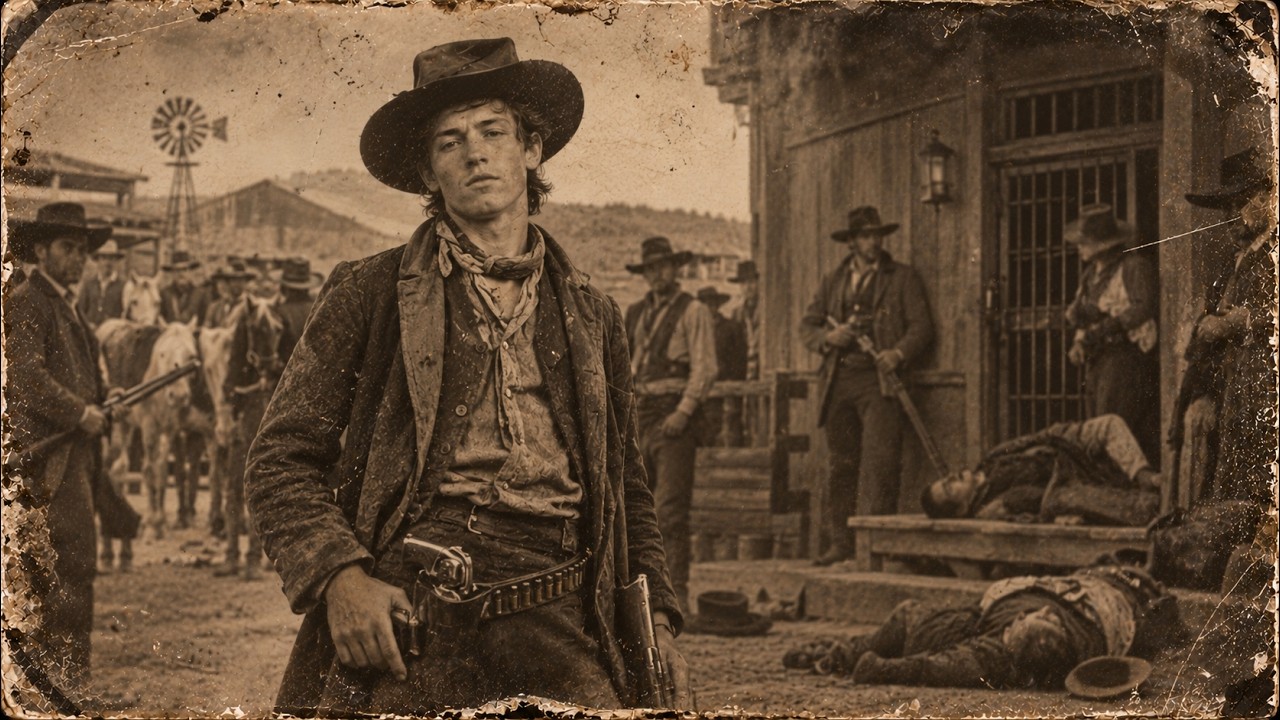
The first struck the young man in the chest above the heart. Billy fell to the dirt floor and died within seconds, never having seen his killer. There was no duel, no last stand, no cinematic recognition between two old acquaintances. There was only confusion, darkness, and a man he could not see.
The identity of the man who died that night had never been entirely stable. Born Henry McCarty sometime around 1859 or 1861, with a birthplace variously given as New York City, Indiana, or Ireland, he entered the world in near total historical silence. There is no surviving birth certificate and no baptismal record conclusively tied to him. His mother, Katherine McCarty, raised Henry and his older brother Joseph largely on her own through the turbulent years after the Civil War, moving the family frequently through Indiana, Kansas, Colorado, and New Mexico.
In 1873, she married a man named William Antrim in Santa Fe, and Henry became Henry Antrim. The stepfather did not stay long. By the late 1870s, Henry was calling himself William H. Bonney, a name whose origin has never been explained.
The newspapers and lawmen eventually gave him the nickname that stuck, Billy the Kid, a label that at first simply described an obvious truth. He was young, and almost everyone around him was older. The real turning point in his life came in September 1874, when Katherine died of tuberculosis in Silver City, New Mexico. Henry was about fourteen.
His stepfather soon withdrew from the boys’ lives, leaving them to survive on their own. Henry found work washing dishes at a hotel called the Star Hotel, run by a woman named Sarah Brown, for almost no pay. The frontier of the 1870s had no juvenile justice system, no social services, no child welfare infrastructure. Children fell through the cracks regularly, becoming laborers, beggars, or criminals.
Henry McCarty was one more kid the system could not see, because the system barely existed. The slide into violence happened in stages. In the fall of 1875, Henry was arrested for possession of stolen property, clothing and butter taken by a local man called Sombrero Jack. Henry’s role was at best minor.
Held in a jail cell for two days, he escaped on the third by climbing up the chimney, a feat requiring the thin, wiry frame he apparently possessed. He did not return to Silver City. He drifted to Arizona Territory, working ranch jobs in the Sulfur Springs Valley, learning to be good with horses and, like almost every man in that country, learning to handle a gun. The first killing happened in August 1877 at a cantina near Camp Grant, Arizona.
The man who died was a civilian army blacksmith named Francis Cahill, a physically imposing bully who had been harassing Henry for months, calling him a pimp and physically manhandling him. On the night of August 17, the confrontation escalated. Cahill wrestled Henry to the ground and pinned him. Henry managed to draw his gun and fired once.
Cahill died the following day. The coroner’s jury ruled the killing criminal, though a modern assessment would likely land somewhere near self-defense or manslaughter. Henry did not wait for the legal process to decide. He ran back across the border into New Mexico Territory.
He was seventeen years old. What pulled him into the conflict that would define him was the Lincoln County War, a business war between two factions for control of the county’s commercial life. Lincoln County in the late 1870s was one of the largest counties in the United States by land area, and its economy was dominated by Lawrence Murphy and James Dolan. Through their company store, known locally as “the House,” they controlled the supply of goods, held lucrative contracts with the U.
S. Army to supply beef to Fort Stanton and food rations to the Mescalero Apache Reservation, and manipulated the territory through a political network called the Santa Fe Ring. Farmers and ranchers who needed credit had to get it from the House, which charged whatever it chose. Those who could not pay lost their land and cattle through mechanisms that were technically legal because Murphy and Dolan had enough political friends to make them so.
Two men threatened to break the monopoly. John Henry Tunstall was a young English rancher with money and ideals. Alexander McSween was a lawyer with similar ambitions. Together they opened a competing store and bank in Lincoln, offering lower prices and competing for the army contracts.
Murphy and Dolan decided to end it through legal harassment, property seizure, and eventually open killing. In February 1878, Tunstall was shot from his horse on a quiet road by a posse operating under legal authority but serving the Murphy-Dolan interests. The sheriff, William Brady, was deeply in the House’s pocket. Tunstall had treated Billy with a degree of basic human decency rare in his experience, giving him work on his ranch and speaking to him without contempt.
When Tunstall’s allies organized their response, Billy joined them. The group called themselves the Regulators, and at the beginning they were not outlaws. They were legally deputized. Dick Brewer, who managed Tunstall’s ranch, was appointed special constable by a justice of the peace aligned with the McSween faction, giving the men riding with him legal authority to arrest those connected to Tunstall’s murder.
Billy the Kid rode as a deputized agent of the law. That changed in April 1878, when the Regulators killed Sheriff William Brady and his deputy on the streets of Lincoln. Brady was corrupt and had obstructed justice in the Tunstall case, but he was also the county sheriff. Killing him crossed a line that could not be uncrossed.
The violence escalated through the spring and summer, culminating in a five-day battle in Lincoln in July that left McSween dead and the anti-Murphy-Dolan cause broken. The House’s faction won because it had more political backing, more financial resources, and more powerful friends. Billy and the surviving Regulators were left in an impossible position. The side they had fought for had lost, and the legal authority they had operated under was now void.
The men controlling Lincoln County had every reason to see Billy charged, convicted, and hanged. The territorial government in Santa Fe, infiltrated by the Santa Fe Ring, was not going to intervene. Billy became an outlaw not because he chose that life, but because the political machinery of New Mexico Territory decided that was what he was. The number that made him a legend, 21 kills, one for every year of his life, was almost certainly untrue.
Modern historians who have examined the coroner’s reports, witness accounts, and newspaper coverage estimate that Billy personally killed between four and nine men, with some counts reaching eleven depending on contested incidents. The famous 21 had no credible historical foundation. It appeared in Pat Garrett’s own account, a book ghostwritten by a journalist named Ash Upson and published just months after the killing. Garrett had reasons to inflate the legend.
Killing an ordinary young man was a modest achievement. Killing the most dangerous outlaw in the Southwest was a career-making act. The number 21 felt meaningful, narrative symmetry that made the story feel mythological, and newspapers syndicated it without verification. Billy himself understood publicity.
He granted interviews and spoke to reporters because he understood they could be useful. Researchers at the University of New Mexico have described his management of his own public image as resembling genuine press agentry. He leaned into the “Kid” nickname, which framed him as young and sympathetic rather than a seasoned criminal. His reported quotes carried a dry wit that read as charming.
He knew how to make a journalist leave with a good story. In the Hispanic communities of Lincoln County, Billy moved with an ease most Anglo settlers lacked. He was fluent in Spanish, having grown up around Hispanic communities and worked alongside Hispanic cowboys. He was known there by a nickname rarely mentioned in American popular history, El Chivato, “the kid goat,” a term of rough affection.
Among many Mexican families, Billy was not seen as a monster but as an ally. The Murphy-Dolan monopoly had squeezed Hispanic ranchers and farmers hardest, and Billy, who could speak their language without condescension, was a figure many families were genuinely glad to shelter. When he was on the run, it was often Hispanic families who hid him, fed him, and kept his location to themselves. In 1878, the governor of New Mexico Territory was Lew Wallace, the author of Ben-Hur, who had been sent to bring order to a territory at war.
Billy had information about murders and corruption that Wallace desperately needed. The two men made contact. Wallace offered immunity. Billy would testify about the Lincoln County killings and provide evidence to prosecute those most responsible.
In exchange, the charges against him would be dropped. Billy agreed. He gave himself up to a staged arrest and met with Wallace at night in a private house in Lincoln. Wallace was impressed with him, finding him intelligent and credible.
Billy testified and held up his end. Wallace did not hold up his. The reasons were political. Wallace was navigating a territorial government still influenced by the Santa Fe Ring, and pushing for the prosecutions Billy’s testimony could support meant picking an expensive fight with powerful men.
Wallace left New Mexico in 1881 to become U. S. Minister to the Ottoman Empire. Before he left, Billy sent him letters, careful, articulate letters reminding the governor of his promises, asking with increasing urgency when the immunity deal would be honored.
They went unanswered. The prosecutions never materialized. Billy had trusted the government, testified at personal risk, and found out in the loneliest possible way that the system could not be dealt with honestly. After that, Billy tried to change.
During 1880 in Fort Sumner, he worked cowboy jobs on surrounding ranches, danced at the fandangos that brought together Anglo settlers and Hispanic families, played cards, and sat around fires with people he liked. By multiple accounts, he was good company, funny, easy to be around, someone who remembered your children’s names. Given something resembling stability and community, he was capable of living quietly. The violence that defined his legend was a response to conditions, not something intrinsic to him.
But the conditions were about to change again. Pat Garrett was not always a lawman who hunted Billy. Before he was elected sheriff of Lincoln County in November 1880, he had been someone Billy drank with, played cards with, and shared meals with in the same frontier establishments. They knew each other in the way frontier life forged connections between men operating in the same narrow social world.
Garrett ran for sheriff on an explicit platform of capturing or killing Billy the Kid. The people with money and political influence wanted Billy gone, and Garrett knew his habits, his hiding places, the families who sheltered him. He had gathered that knowledge during the years when they had been on the same side of the social ledger. Garrett captured Billy at Stinking Springs in December 1880.
Billy was tried, convicted, and sentenced to hang. Then he escaped again, killing two guards in the process, men named Bob Olinger and James Bell. He rode back toward Fort Sumner, toward the people he knew, toward the last place that had felt like home. Garrett followed.
The escapees and the killings had added new weight to the legend, but they also shortened the timeline of his actual life. On the night of July 14, 1881, Garrett rode into Fort Sumner quietly with two deputies. He received information that Billy was still in the area, still moving between families who sheltered him. Garrett went to Pete Maxwell’s house late in the evening and sat on the edge of the bed in Maxwell’s dark room.
Billy walked over from where he had been sleeping, perhaps intending to cut meat from a side hanging near the room. He noticed the deputies outside in the darkness, did not recognize them, and backed toward Maxwell’s doorway. He stepped into the dark room, sensed someone, and asked who was there. Twice.
Garrett drew his pistol and fired. Billy never saw his killer. He never had the chance to draw. The myth did not begin after his death.
Billy had been shaping it while he was alive, and the machine that manufactured the legend was already running within weeks. Garrett’s book, The Authentic Life of Billy the Kid, was published within two months and presented the 21 kills as established fact. The telegraph had already spread exaggerated accounts across the country. Dime novels picked it up and added details that never happened.
Cinema rebuilt Billy into whatever version of the Wild West each generation needed, from silent-era excitement to countercultural symbol to the MTV style of the 1988 film Young Guns. Each version reflected the era that produced it far more accurately than it reflected the historical record. The real story is not a western. It is a story about a child abandoned into poverty, drifting toward violence not by choice but by circumstance.
A teenager with no name he could fully claim and no institution that saw him as worth protecting. A young man handed a gun and legal authority by one side of a corrupt business war, then discarded when that side lost. A person who, given a brief window of peace, demonstrated that the violence was not who he was but what he had been shaped into.
The real Billy the Kid was shaped by poverty and political betrayal, trusted a governor and was abandoned, found something like peace, and then heard two shots in a dark room and never knew who fired them.