She was thirty-one years old and weighed one hundred and twelve pounds. On the evening of August 11th, 1994, she walked out the back door of the Milbrook Hotel in Glenorchy, a suburb of Hobart, Tasmania, and was never seen alive again. It would take twenty-nine years, two retired detectives who refused to close the file, and a single smear of DNA on a piece of fabric sealed in an evidence bag to finally put a name to what had been done to her. Karen Ellison grew up on the eastern shore of the Derwent River in the kind of suburb where families left their doors unlocked through spring and summer and only locked them again when the Antarctic winds came in off the water in May.
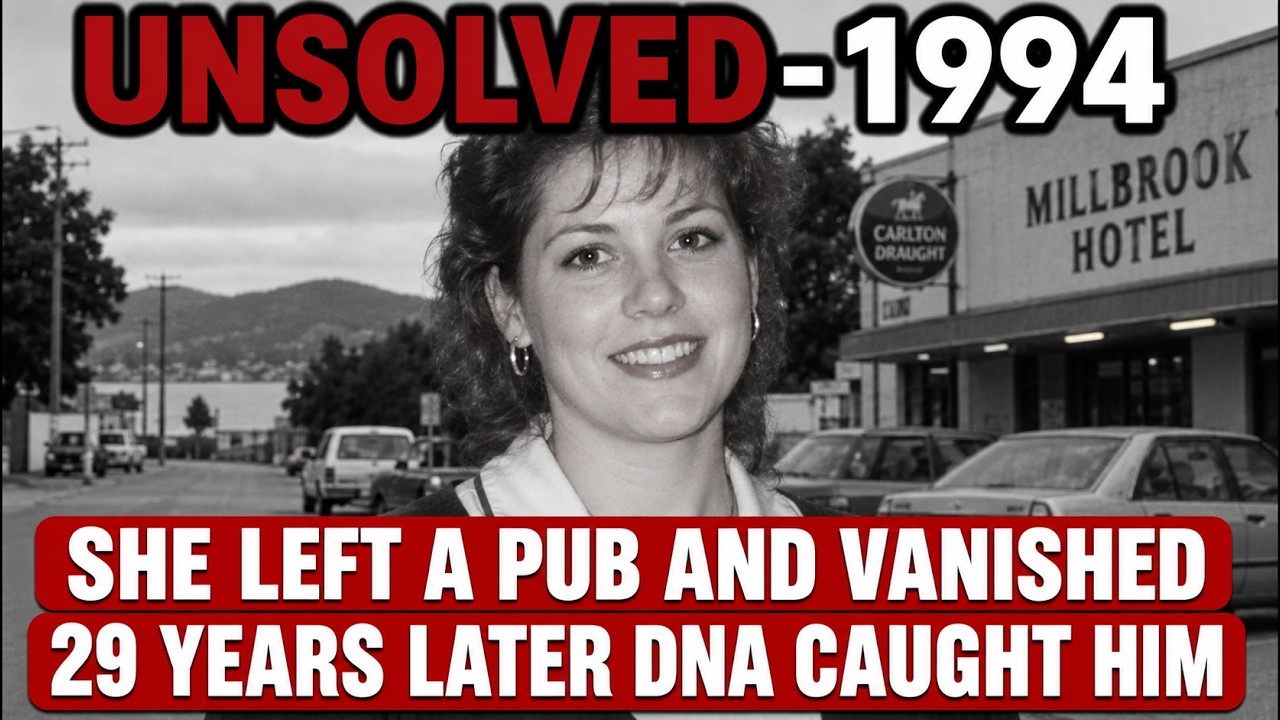
She was the middle child of three, raised by a mother who worked the early shift at the Cadbury factory in Claremont and a father who drove a delivery truck for a hardware company. By the time she disappeared, Karen had been a nurse at the Royal Hobart Hospital for six years, working the surgical ward. She was the nurse who remembered your name the second time you came in, the one who sat with elderly patients during the night shift when the fear got to be too much. She had a daughter, Mia, who had just turned four years old.
She had a green Datsun she had bought secondhand and was paying off in installments. And every Friday night after her shift, she stopped at the Milbrook Hotel to have a beer with two nursing colleagues before driving home along the quiet roads back to her flat in Moonah. It was 1994. Australia was still in the tail end of a long recession.
In Glenorchy that winter, the nights came early and the streets emptied by eight o’clock. It was the kind of place where a woman walking alone to her car felt perfectly safe. That Friday, August 11th, Karen had worked a long shift, covering four extra hours for a colleague who had called in sick. She arrived at the Milbrook at 7:15, still in her work clothes.
She stayed for one drink, about an hour. She said good night to her friends in the car park. She said she would call when she got home. That was the last anyone saw of her.
She never called. At 9:47 that night, Karen’s flatmate rang the hotel. The bar staff said she had left over an hour ago. At eleven, she called the hospital.
At midnight, she rang the police. The sergeant who took the call told her to wait until morning. Adults go missing. Adults come back.
It was standard advice, and in most cases, the right advice. This was not most cases. By the time officers attended in person, nearly fourteen hours had passed since Karen was last seen. Her Datsun was still in the hotel car park, parked exactly where she had left it, unlocked, her handbag on the passenger seat with her wallet and keys still inside.
The keys. That detail struck the first detective on scene. Senior Constable Dennis Pharaoh of Glenorchy CID knew immediately that you don’t leave your keys in an unlocked car unless something went wrong before you reached it. The car park at the Milbrook backed onto a narrow service lane running alongside a light industrial block, a couple of warehousing units and a smash repair place.
The lane connected to a side street that fed out toward the Brooker Highway. There was no lighting along that stretch and no houses facing it. Whatever had happened to Karen Ellison had happened in a place designed almost architecturally for invisibility. A search began on the morning of August 12th.
Over the following three days, 241 people walked grids through bushland north of Glenorchy, along the river banks and through the light industrial estates. Karen’s mother walked every one of those days. Mia stayed at a neighbor’s house, kept busy with crayons and picture books, too young to understand and old enough to know her mother had not come home. On August 14th, a maintenance worker clearing drainage at the back of the smash repair yard found a woman’s nursing shoe, a white clog, size seven.
It had been pushed under a loose sheet of corrugated iron behind a dumpster. One shoe, nothing else. Inside it, barely visible on the inner lining, was a dark smear. The shoe was bagged, tagged, and sent to the Forensic Science Service of Tasmania.
Investigators got a blood type from that smear, type A positive, consistent with Karen’s. But without a DNA match and without a body, the evidence was suggestive and nothing more. Dennis Pharaoh drove the case through the winter of 1994 and into 1995. He had two names on his list: a local man seen near the hotel that night and a former partner of Karen’s who had made contact with her several months earlier.
Both were interviewed. Both cooperated. The former partner provided an alibi confirmed by two separate witnesses. The other man was eliminated after a thorough background check.
By Christmas of 1995, the leads had gone quiet. The man who had actually been watching Karen Ellison every Friday night for three months was never on the list. He had never made himself visible enough to be remembered. By 1997, three years had passed.
The Milbrook Hotel had changed hands once. The smash repair yard had been demolished and a storage facility built in its place. Mia had started school. Karen’s mother, Roberta, had moved in with Karen’s sister to help with the school runs.
Pharaoh had moved into a supervisory role. He did not close the file. He kept it in a cabinet in his office, and every six months he read through it again, looking for something he had missed. By 2001, seven years had passed.
Mia was eleven. She had started asking questions that Roberta did not know how to answer. Pharaoh had retired from Tasmania Police but kept informal contact with the detective who had taken on the file, a younger officer named Sergeant Lisa Nueman. She had requested the case specifically after reading about it in the department’s unresolved homicide review.
She became the second person who refused to let it be buried. The nursing colleagues who had that last drink with Karen still met for a meal every August 11th. They kept the date. They ordered a beer they did not finish.
In February 2023, the Tasmanian cold case unit received access to a newly configured national forensic DNA database that cross-referenced with samples held in state evidence archives. The initiative, a joint program between the Australian Federal Police and state forensic services, had been developed specifically to retest biological evidence from unresolved cases using current sequencing technology and run the results against the most comprehensive genetic database ever assembled in Australia. Nueman had submitted the shoe for retesting in October 2022. She had done this twice before, in 2004 and 2011.
Both times the technology had not advanced far enough to produce a usable profile. She submitted it a third time without announcing it to anyone. She did not want to raise Roberta Ellison’s hopes again. On a Wednesday morning in early March 2023, Nueman received a call from the forensic laboratory in Hobart.
The analyst told her they had a full male DNA profile from the inner lining of the shoe. That profile had returned a familial match in the national database, a genetic relative who had provided a voluntary sample during an unrelated police matter three years earlier in Queensland. The genealogical investigation that followed took eleven weeks. The familial line traced back to a family from the Hobart suburb of New Town, a family that had lived there in 1994.
One male in the family structure, currently aged sixty-three, had relocated to Queensland in the late 1990s. He had no criminal record. He had been employed for twenty years as a property maintenance contractor. He was, by every measurable external standard, unremarkable.
His name was Jeffrey Allen Marsh. In the weeks before his arrest, investigators built the picture of his life in Glenorchy in 1994. He had worked a casual contract at a commercial laundry company that serviced several businesses on the Brooker Highway corridor, including a contract that took him past the Milbrook Hotel and the surrounding industrial block on a near weekly basis. He had not been a regular at the pub.
He had not known Karen Ellison by name. But surveillance records from his employment placed him in that part of Glenorchy on the evening of August 11th, 1994. Former colleagues described him as quiet, competent, the sort of bloke who did what was asked and was not much for conversation. One woman who had worked with him for two years paused when detectives asked about his manner around women.
“He watched,” she said. “I always felt like he watched. ”
On May 19th, 2023, Queensland detectives attended Jeffrey Marsh’s home in a suburb of Ipswich. He answered the door in a work shirt with his company’s logo on the chest.
He was asked to accompany them to the station. He did not resist. According to the arresting officer’s account, he said nothing during the drive. The DNA comparison from a swab taken upon arrest was a definitive match to the profile recovered from Karen Ellison’s shoe.
Marsh was charged with murder and extradited to Tasmania in June 2023. He had been living in Queensland for twenty-five years. He had a partner of eighteen years and two adult children who had no knowledge of what he had done in that car park in the winter of 1994. Jeffrey Marsh pleaded guilty in February 2024 in the Supreme Court of Tasmania.
He was sentenced to life imprisonment with a non-parole period of twenty-five years. He made no statement to the court. He did not look at Roberta Ellison, who sat in the gallery with Mia beside her. Mia, who had turned thirty-three the month before and had grown up without her mother, stared straight ahead as the sentence was read.
Karen Ellison would have been sixty-one years old in 2024. There are people from her surgical ward who still speak about her in the present tense. She checked the door lock twice before she left for the night. She kept a jar of mints on the nurse’s station that she restocked every Monday.
She had planned to take Mia camping in the Cradle Mountain area when the weather warmed. She had the dates picked out. She had been waiting for August to end. Roberta Ellison spoke briefly after sentencing.
She said she had never stopped believing the truth would come out. She said she had always known someone new and that it had just been a matter of time and technology. “I hope he thinks about her name every single day,” she said. The case changed the way the Tasmanian cold case unit approaches forensic resubmission timelines.
Following the Ellison case, Tasmania became the first Australian state to implement a mandatory five-year forensic review cycle for all biological evidence in unresolved homicides, a policy championed by Lisa Nueman. She retired from Tasmania Police in late 2023 after thirty-one years of service. She attended the sentencing. She did not speak to the press.
She drove home along the highway that runs past where the Milbrook Hotel used to stand. There is something important in the specific quietness of how this case ended. Not a dramatic confession. Not a lucky eyewitness who finally came forward.
Just a piece of fabric in an evidence bag and technology that finally caught up to what a pair of detectives had known all along. The truth was there, waiting for the right question.