On the afternoon of September 4th, 1991, Thomas Parsons walked into his kitchen and smelled warm bread. Molasses and flour. He called his wife’s name. The radio was on.
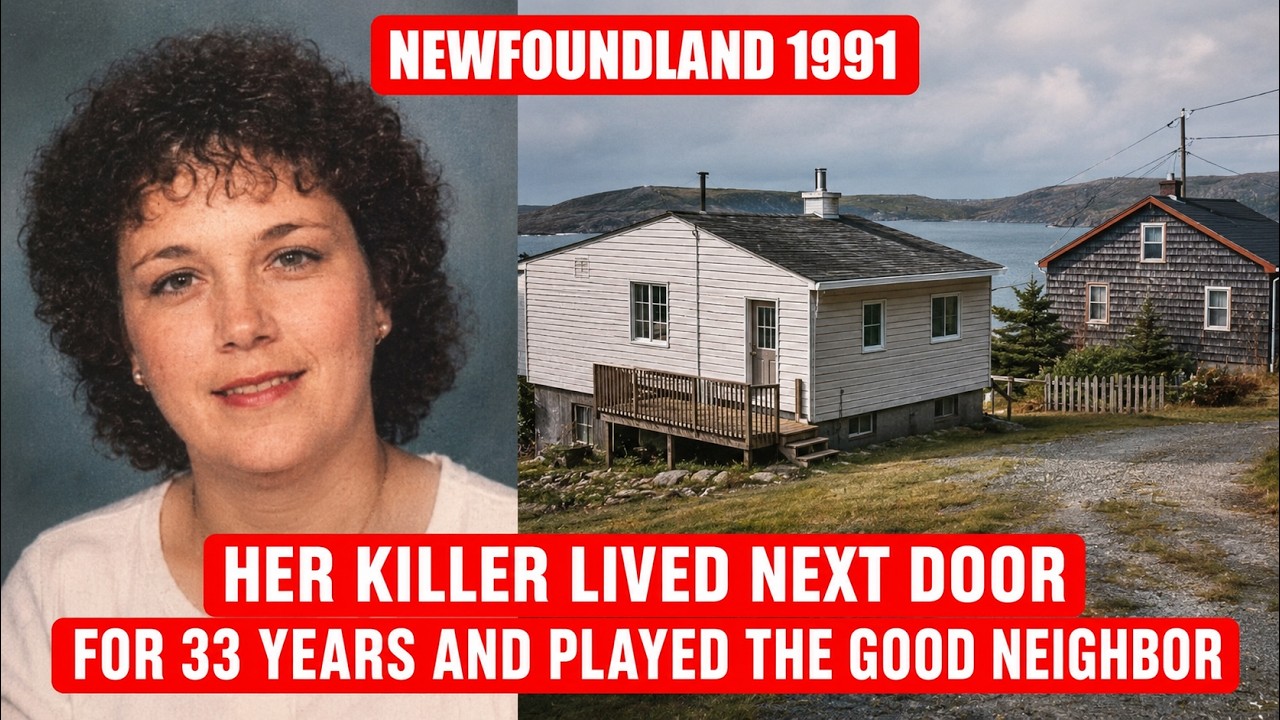
He called again. What he found in the hallway between the kitchen and the back porch would go unexplained for thirty-three years, while the man responsible lived next door the entire time. Bernadette Parsons was thirty-eight years old. She had spent that Wednesday morning alone while Thomas was out on the water and their two sons were at school.
She had made the molasses bread a few days early because Thomas was going back out to sea soon. By 2:20 that afternoon, she was dead. The community of Merton’s Cove sat on a sheltered inlet of the Avalon Peninsula in Newfoundland, close enough to St. John’s that a clear-day drive took under an hour but far enough to keep its own character.
Roughly eight hundred people lived there in the autumn of 1991. The cod moratorium that would devastate the fishery was still eight months away. Boats still left before dawn. The processing plant still ran.
It was a place organized around the sea for three generations, where houses were painted bright colors against the Atlantic sky and nobody needed to explain the foghorn at four in the morning. Bernadette had been born in Merton’s Cove and never had a serious reason to leave. She was the daughter of a fisherman, the wife of one, and the mother of two boys who were beginning to learn the water the way their grandfather had taught their father. She worked five mornings a week as the cook at the community school, so every child in town had grown up eating her food.
She sang in the church choir, as she had since she was twelve. She left vegetables from her garden on neighbors’ back steps without announcement. She knew the names and ages of every child on the lane. Her Friday molasses bread was so well known that neighbors admitted to timing walks to catch its smell.
Thomas worked the North Atlantic fishery with the steady patience of a man who had never imagined a different life. Daniel was fourteen that September, serious, moving toward adulthood. Michael was ten, gap-toothed, still at an age when the world had not yet become complicated. The family did homework at the kitchen table while Thomas listened to the CBC and Bernadette wrote grocery lists in a small notebook on the windowsill.
On the morning of September 4th, Thomas left the house in the dark at five o’clock, kissing Bernadette on the forehead without waking her. She stirred and said his name. At half past eight, the boys ate and went out the door with their bags. Bernadette stood on the front step and watched them turn the corner.
A neighbor, Doreen Walsh, saw her hanging laundry in the side yard around twenty past nine and called over from the road. Bernadette called back. After that, nobody who could be located saw her again. The Royal Newfoundland Constabulary arrived within the hour.
Constable Eileen Doyle, thirty-one, four years in, known for methodical notes, was assigned. The postmortem returned blunt force trauma to the back of the skull. Time of death was established between 8:47 and 10:00 that morning, the window when Thomas was on the water and the boys were inside the school building three hundred meters away. There were no signs of forced entry.
The back porch door appeared to have been the access point. On the wooden frame of the interior kitchen doorway, bagged and labeled by Doyle that afternoon, was a partial palm print with biological material preserved against the dry wood. At the time, nothing in any existing database matched it. The print went into the evidence kit.
The kit went into the archive. In the first two weeks, a name emerged that pulled most of the investigation for six months. Gary Foote was a seasonal road worker from Nova Scotia who had been contracted to repair a section of highway that summer. He had a prior conviction for break and enter and had been seen in the general store twice in August.
Investigators found him in Cape Breton in late October. His alibi was thin but held. Doyle recorded her reservations in her notes and watched his file for years afterward. Nothing came.
The man next door had been interviewed in the first forty-eight hours. Harold Vincent Mercer, Vince to anyone who knew him, was forty-five, retired from the fishery since an injury to his right hand in 1988, widowed since 1985. He lived alone in the gray shingled house that had stood beside the Parsons home since the early seventies. He said he had been at his cousin Raymond’s house, twenty minutes away, from seven in the morning until past noon, working on a truck engine.
Raymond confirmed it without hesitation. Doyle filed the interview. In her working file, she noted that Mercer’s composure had been either unremarkable or deliberate, and she could not determine which. She wrote a question mark.
Then she went back to Gary Foote. Raymond died of a heart attack in 2003, eleven years before anyone thought to question him again. While the investigation stalled, the Parsons family lived with what it could not resolve. Thomas went back on the water because he had a mortgage and two boys to feed.
Daniel, old enough to understand what had happened and not old enough to know how to carry it, watched his father age through that first winter in a way that had nothing to do with years. Michael grieved with the clean, frightening completeness of a child who has not yet learned how adults distribute grief across time. The community brought food, sat, walked the boys to school. No arrest came.
The following spring, the cod moratorium was announced, the largest layoff in Canadian history. Merton’s Cove, like outport communities across the island, began to hollow. A third of working families left within five years, moving to Fort McMurray, to Toronto, wherever wages could be found. Daniel left for Alberta in 1999 at twenty-two.
His life moved to the mainland the way so many Newfoundland lives did after the fishery collapsed. Michael stayed. He grew up in that house and lived in it as an adult the way those who remain in outports tend to live, holding the place together by being present in it. Every September 4th, he drove to the church and sat in the pew where his mother had sung.
The house next door was sixty feet away. Vince Mercer lived in it. Michael saw him most weeks and absorbed him into the ordinary texture of life on the lane the way you absorb a fence post or a particular turn in the road. In the winter of 2007, an ice storm damaged the roof of Mercer’s back shed.
Michael and a friend went over with shovels and cleared it. Mercer brought them each a cup of tea and a bottle of beer. Michael thought nothing of it. He had no reason to think anything of it.
Thomas Parsons died in the spring of 2011, cancer that had progressed quietly for two years. He died still carrying the question, not loudly, not in any way he had ever named, but present in him the way a splinter that goes in too deep becomes part of the tissue around it. He never received an answer. In 2023, the Royal Newfoundland Constabulary launched a provincial cold case initiative, a systematic review and resubmission of biological evidence from unsolved homicides, prioritized in part by the age of surviving family members.
The Parsons case was on the list. Sergeant Kevin Hann, thirty-eight, raised in an outpost on the Bonavista Peninsula, requested the evidence kit. Doyle’s original bagging and labeling, meticulous even thirty-two years later, had kept the biological material viable. The palm print and the associated skin cell sample were submitted to the Centre of Forensic Sciences in Toronto.
In 2021, an expansion of the national DNA databank had required retroactive submission of genetic profiles from a wider category of convicted offenders, including those sentenced for assault causing bodily harm. In 2009, Harold Vincent Mercer had been involved in a confrontation at a bar in Corner Brook that left another man hospitalized. He had pleaded guilty to assault causing bodily harm. His DNA had been taken and submitted to the national databank.
His profile had been sitting in the system for twelve years. The match result came back to Hann’s unit on a Thursday morning in November 2023. Hann read the name on the screen. He pulled the address and read it a second time.
The name was Harold Vincent Mercer. The address was a house in Merton’s Cove on the same lane as the Parsons family. He had never moved. Hann called Michael Parsons that afternoon and said he had news that needed to be shared in person.
The arrest was executed on a Monday morning in December 2023. Two RNC officers knocked on the door of the gray shingled house. Harold Vincent Mercer opened it. He was seventy-seven years old.
He looked at the officers, then past them to the house sixty feet across the side yard. He said, “I figured someone would come eventually. ” He said nothing further without a solicitor present. The investigation established the sequence.
Mercer had developed what his own eventual statement characterized only as a prolonged and unrequited fixation on Bernadette Parsons over years of proximity. He had made an approach on at least one occasion that she had clearly rejected. Thomas had not been told. In the weeks before September 4th, a dispute over the property boundary between the two houses had escalated in ways none of the neighbors had registered as significant at the time.
On the morning of September 4th, Mercer had watched Thomas leave in the dark before dawn. He had waited. His cousin had provided a false alibi in 1991 and carried it to his grave. Mercer had been a fixture of Merton’s Cove for five decades.
He had attended Bernadette’s funeral in September 1991 and sat three rows behind the family. He had brought a covered dish to Thomas in the weeks after. He had watched Daniel and Michael grow up, watched Thomas age and grieve and eventually be buried. All of it from sixty feet away, from inside the house where he had always lived.
Mercer was charged with second-degree murder. Facing the evidence in October 2024, he entered a guilty plea. He was sentenced to life imprisonment with no eligibility for parole for twelve years, a sentence the court acknowledged was, given his age and health, likely to constitute a natural life sentence. He did not speak at sentencing.
Michael Parsons did. His victim impact statement, read aloud in a St. John’s courtroom, described in plain language what it had meant to grow up next door to the man who had killed his mother. He said he had borrowed Mercer’s ladder in 2004 to repair his own gutters and returned it with a handshake.
He said he did not know yet what to do with that fact except to put it somewhere outside himself. He said his mother had made bread that was still warm when his father came home to find her, and that he thought about that every time he baked anything, which was often, because she had taught him. He said he was going to try to figure out how to live in the house now that he knew what the house contained, and he wasn’t certain he was capable of it, but he believed he owed it to her to make the attempt. Daniel flew in from Alberta.
It was the first time he had been back in four years. The residents of Merton’s Cove underwent the specific and disorienting work of re-examining every ordinary exchange they had ever had with the man next door. Every cup of tea, every wave, every winter afternoon when he had helped someone pull a car out of a ditch. All of it had coexisted with the knowledge he had kept inside the gray shingled house for thirty-three years.
Michael Parsons still lives in the house on the lane. He told a journalist after the sentencing that he sometimes opens the kitchen window on Friday mornings when the wind is right. He says the smell of bread from someone else’s house will sometimes travel that far.
He says he is learning, slowly, to let it reach him.