On the morning of July 3, 1863, thousands of Confederate soldiers formed up along Seminary Ridge, their bayonets glinting in the sun. Across a mile of open fields, the Union army waited on Cemetery Ridge, entrenched with artillery loaded and ready. This was the moment before Pickett’s Charge, the attack that would become the Confederacy’s greatest glory and the moment it began to sink. One man knew in advance how it would end.
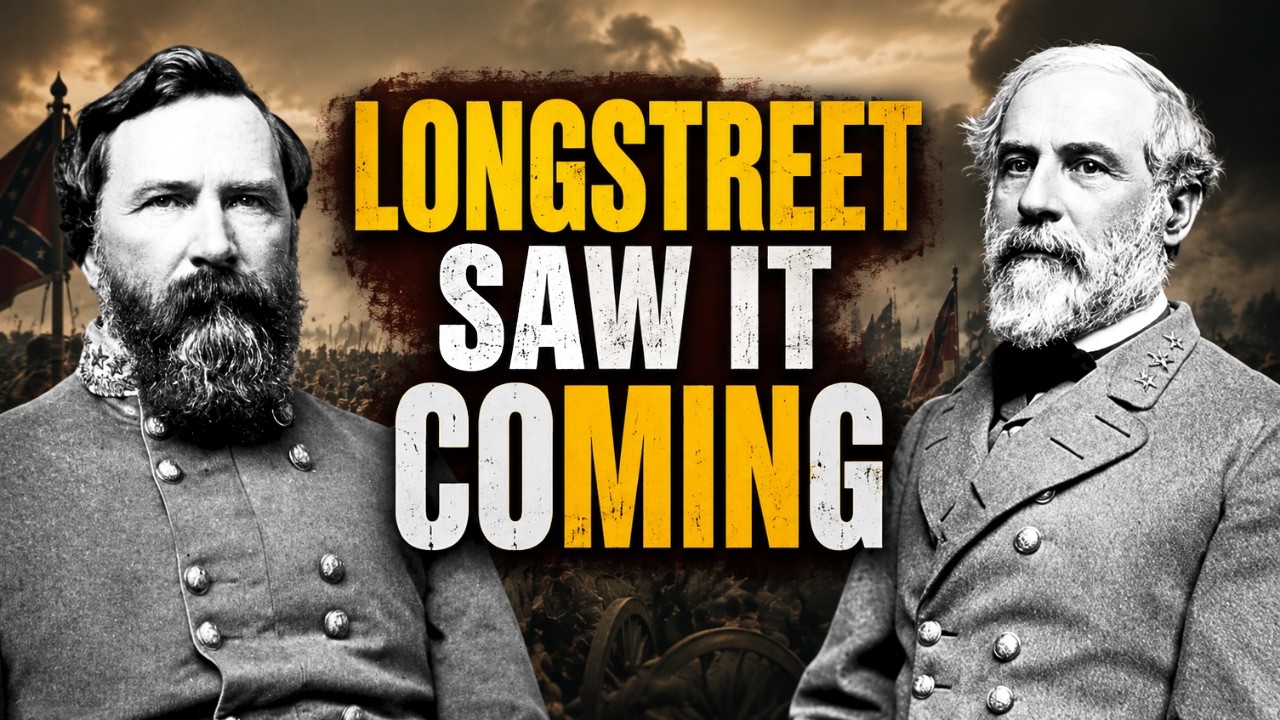
Lieutenant General James Longstreet looked across that field and saw a slaughter before a single soldier took his first step. He told his commander, Robert E. Lee, in three separate conversations over three different days. And he was not guessing.
Twice before in this war, he had stood in the middle of that exact kind of ground. Once on the winning side, once on the losing side, and he had seen what war does to men. He told Lee that fifteen thousand men could not take that position. He was not offering an opinion.
He was telling him an inevitable result. Lee listened every time. And every time, he sent the men forward anyway. This is not a story about a warning that went unheard.
It is a story about a man who said exactly what would happen to the only person who could stop it, and was overruled by a commander who heard every word. Longstreet was not an ordinary general. Lee called him his “old war horse,” and he was his most trusted subordinate. Born in 1821 in South Carolina and raised on a Georgia plantation, Longstreet was tall, broad-shouldered, quiet, and patient.
A man whose accomplishments spoke instead of his tongue. He barely scraped through West Point in 1842, relying on his leadership skills more than his academic studies. At the Battle of Chapultepec during the Mexican-American War, he charged through enemy fire and emerged limping, with the reputation of a brave hero. When war broke out in 1861, he resigned his commission in the United States Army and rose rapidly through Confederate ranks.
At the Seven Days Battles, his corps helped save Richmond. At Second Manassas, his counterattack shattered Union lines. At Antietam, he held under unbearable pressure. Then came December 13, 1862, at Fredericksburg, Virginia.
Longstreet’s men held a sunken road at the base of a rise called Marye’s Heights, packed in ranks behind a low stone wall. In front of them stretched four hundred yards of open ground. Above them, the guns were sighted. Before it began, his artillery commander, a colonel barely past twenty, told him the ground was so completely covered that a chicken could not survive on it.
That was Edward Porter Alexander’s later account of what he said. No one wrote it down that afternoon. What happened next is not in dispute. Wave after wave of Union soldiers crossed that field throughout the afternoon.
Not one reached the wall. By dusk, the Federals had suffered nearly thirteen thousand casualties, most of them on that slope. Lee, watching beside him, said the words everyone remembers. It is well that war is so terrible, or we should grow too fond of it.
Longstreet spent that evening on the winning side of the very thing Lee would one day order him to attempt. Remember the colonel’s name, Edward Porter Alexander. He would appear again. There was a deeper knowledge beneath professional experience.
In January 1862, scarlet fever swept through Richmond. Longstreet’s wife Louise was in the city with their four children, and all four fell ill. Mary Anne went first on the twenty-fourth. She was thirteen months old.
James died the next day. He was four. Gus, Augustus, was eleven. He held on for another week and died on February first.
Only Garland, aged thirteen, survived the illness. Their bodies were placed in a borrowed vault at Hollywood Cemetery. The kind of arrangement you make when you cannot manage anything more permanent. It was supposed to be temporary.
But it lasted eight years. Longstreet who returned to the army that February was not the same man who had left it. Before Richmond, his headquarters had been the liveliest in camp. Poker every night, whiskey, and officers’ laughter until late.
Afterward, he stopped drinking and turned to church. He became quiet, and that quiet never really left him. None of this is speculation about what was in his mind. It is the documented shape of a man’s life after burying three children in eight days.
What it points to is something more specific and more useful. A man who had already learned in Richmond how heavy a cost estimate becomes when you are the one who has to carry it. His creed was summed up in a sentence he wrote himself. Offensive strategy, but defensive tactics.
Carry the war to the enemy, then make the enemy come to you. That was the application of Marye’s Heights. At Gettysburg, that creed would collide head-on with Lee’s. This time, being right would not be enough to be heard.
After the costly victory at Chancellorsville in May 1863, which cost the life of Stonewall Jackson, Lee proposed something bold. Take the war out of devastated Virginia, feed the army from Pennsylvania farms, and possibly force Washington to negotiate by threatening it directly. Longstreet disagreed. He wanted to send troops west instead, to reinforce Bragg in Tennessee or break the siege around Vicksburg.
Lee rejected his proposal. Longstreet agreed to the invasion, but with one condition, at least according to his later account, that the campaign remain defensive. That Lee had promised to maneuver the Federal forces into attacking a position of Confederate choosing. Lee would later deny saying this, and no written order exists to prove which man remembered correctly.
What the two men agreed on did not need a promise. Both knew the army was marching into enemy territory with no support behind it, no supply line, no railroad. Every morsel of food came from farms they would eventually have to abandon. Lee looked at that and concluded he had to force a decision while forcing one was still possible.
Longstreet looked at it and concluded the opposite. An army in that condition cannot sacrifice men on ground the enemy has chosen, because it has no way to replace them. The argument they would have at Gettysburg had already been settled before either man saw the town. They marched north blind.
Jeb Stuart had taken the cavalry on a raid, and without it, Lee had no way to screen the Army of the Potomac. They also marched north under orders Lee meant to be taken seriously. Guards were posted at prominent houses. Soldiers caught entering towns without permission faced disciplinary action.
Supply officers paid for what they took with Confederate currency, worthless as it was, but with signed receipts, not outright seizure. Lee understood that the behavior of an invading army was itself a weapon. If the Confederacy hoped for European recognition, or for northern peace advocates to see this as a legitimate war rather than a raid, his men had to act like an army, not a mob. Through towns like Chambersburg, where civilians openly mocked the passing columns, that discipline mostly held.
It held toward white civilians. The very army distributing signed receipts to Pennsylvania farmers was, in those same weeks, kidnapping free Black people from Pennsylvania’s population. Men, women, and children who had never been enslaved or who had escaped and built their lives in the North, sent south into bondage. This was not random misconduct winked at by officers.
It was organized, and the officers did the organizing. The free were treated as fugitives and driven off as property. The battle began by accident. A.
P. Hill’s men collided with Union cavalry west of Gettysburg on July first, and what began as a skirmish turned into a full engagement. Union General John Reynolds was killed while rushing up reinforcements. By evening, Ewell’s corps had pushed the Federals back through town toward the heights behind it, Cemetery Hill and Culp’s Hill.
Lee arrived that evening and told Ewell to take the hills if practicable. Ewell hesitated. He did not take them, a decision that would shape everything that followed. Meanwhile, Meade, the new Union commander who had been in his position only three days, entrenched his army in a fishhook-shaped line running from Culp’s Hill to Cemetery Heights to the Round Tops south of town.
Longstreet reached the field that evening, ahead of his troops, and watched the Federals settle onto those heights. He had built a similar position himself seven months earlier, using a sunken road and a stone wall. So he gave Lee his first of three warnings. Swing around the Union left flank.
Get between Meade and Washington. Force Meade to attack on ground of Confederate choosing. Longstreet said, all we have to do is move around his left and secure good ground. At least according to his 1896 memoir, published three decades later, a point at which he had every reason to want history to remember that sentence.
Lee heard him and disagreed. If the enemy is there tomorrow, we must attack him. Longstreet pressed again. If he is there, it is because he is anxious that we attack him.
A good reason in my judgment for not doing so. Lee did not give ground. He simply moved on. The first warning, heard and ignored.
By the morning of July second, Longstreet’s divisions under Hood and McLaws had arrived, exhausted from a forced march. Lee’s plan called for successive attacks. Longstreet against the Union left, Ewell against the right at Culp’s Hill. Longstreet made his case a second time, tracing a route around the Round Tops that would avoid Union artillery entirely.
But Lee’s finger settled on a different line, up the Emmitsburg Road into the heart of the Union position. He said, attack up the Emmitsburg Road. A final decision. Longstreet set about executing an order he did not believe in, and according to his subordinates’ later accounts, the tension showed.
Hood recalled him saying, as I rode beside him before the attack, the general is a little nervous this morning. He wishes me to attack. I do not wish to do so without Pickett. I never like to go into battle with one boot off.
Hood wrote that in his own 1880 memoir, eighteen years after the event, with a pen of a man who, like Longstreet, had his own reasons for wanting history read a certain way. Treat it as Hood’s memory of that moment, not a verbatim quote, but it is consistent with everything Longstreet said about that morning closer to the day itself. Pickett’s division was still on the road, the last of Longstreet’s three divisions, four thousand five hundred men who had not yet fired a shot in Pennsylvania. He had been asking for it since the day before, and he would keep asking until he got it.
He should have been more careful what he wished for. The fighting that evening gave Longstreet the final piece of what he thought he needed. Hood’s men surged hard into the Devil’s Den and the Wheatfield. Bayonets, rifle butts, and rocks were used when nothing else remained.
Hood himself fell early, his arm shattered. McLaws slammed into the Peach Orchard, where Union General Dan Sickles had pushed his corps forward without orders and left it exposed in the open. They drove the Union line back violently. Then they stopped.
Little Round Top held, where Colonel Joshua Chamberlain and the Twentieth Maine met them with bayonets after running out of ammunition. On the Union right, Ewell’s attack gained ground at Culp’s Hill and Cemetery Hill, but it stalled in the dark. Longstreet rode along that line under fire, steadying his men through the worst of the battle. He later called it the best three hours of fighting he ever saw any troops do on any field.
And yet the attack failed to break the line. A full-strength striking force hitting a weaker part of the Union position on ground offering some cover, and the line bent without breaking. That was the evidence in front of him. His own casualty reports against a position that had not moved.
He did not go to Lee that night, and by his own repeated later account, he received no orders either. A fact he spent the rest of his life clarifying to those who accused him of ignoring a dawn order, orders for which no paper survives to prove they were ever issued. What he did that night is the point at which the records become less clear than popular accounts suggest. Longstreet later insisted he sent scouts south in the dark to find a route around the Union left, and that by morning he still believed or hoped that maneuver was possible.
No maps, orders, or staff records survive to confirm exactly what those scouts found, how far south they went, or whether a usable road existed to reach the Union rear at that hour on that ground with Union cavalry protecting the flank. What is certain remains more limited. This was the alternative Longstreet kept proposing on July first, again that night, and one final time the next morning. Lee kept refusing it.
By dawn of July third, Lee had different news anyway. Ewell had lost the ground he gained at Culp’s Hill overnight. All that remained of the second day’s plan had evaporated. Longstreet spoke first.
He told Lee his scouts had been out all night, and he believed there was still a way to swing around the Union left and force Meade to come out and attack them instead. Lee raised his hand and pointed northeast toward the ridge. He said, the enemy is there, and I am going to strike him. Everything concentrated in the center.
Longstreet said, General, I have been a soldier all my life. I have been with soldiers engaged in fights by couples, by squads, companies, regiments, divisions, and armies, and should know as well as anyone what soldiers can do. His 1896 memoir records the conclusion he reached, that the fifteen thousand men who could make a successful attack across that field had not been assembled for battle. This is one of the most documented complaints in the entire story, not only because Longstreet repeated it in his official writings.
A British officer traveling with his staff, Arthur Fremantle, recorded Longstreet making almost the same argument aloud the night before, that the error was attacking with fifteen thousand men on ground requiring thirty thousand. Fremantle’s diary was published before the war even ended. Two accounts, years apart, from two different men, agreeing on the same number. He warned that pulling Hood and McLaws from the flank to support the attack would leave the Confederate left open to the twenty thousand Union troops who could crush the column from the side.
He said if this was to happen at all, it would require thirty thousand men, not twelve and a half. Lee heard the number and waved his hand dismissively. He said, they will break anywhere. Three warnings, heard three times, ignored three times.
Longstreet would command the attack. The division at the heart of it, the fresh division he had spent two days requesting, would be Pickett’s. Pettigrew’s and Trimble’s brigades from Hill’s corps would complete it. About twelve thousand five hundred men behind the largest artillery bombardment the army could muster.
As Lee presented this plan, Longstreet recognized it because he had helped design it once before. A year and two days earlier, on July 1, 1862, at a place called Malvern Hill outside Richmond. Lee had sent Longstreet to reconnoiter the Union position on the right personally while Lee took the left. They met back at headquarters at noon to settle the plan, and both returned to say the same thing.
Those Federal guns had to be smashed by Confederate artillery before any infantry approached. So that was the plan. Two large batteries placed to hunt Union guns in a crossfire. Bombard until the enemy artillery was broken.
Then send the infantry up the slope with Lewis Armistead’s brigade carrying the signal. Every part of that plan had failed at Malvern Hill. The Confederate guns were never massed. Most never reached the field, and those that did came in piecemeal and were crushed.
One of Lee’s generals called the performance ludicrous. The signal was given, but half the brigade commanders never received it. The infantry went up the slope anyway against guns that had not been touched. About fifty-six hundred Confederates fell that afternoon.
Another general who walked that field later said it plainly. It was not war. It was murder. The Union artillery at Malvern Hill had been arranged by a Federal officer named Henry Hunt.
Hunt was now Meade’s chief of artillery at Cemetery Ridge, directly in front of where the Confederate infantry would advance in a few hours. Longstreet had direct experience of what happens when that exact plan fails. Lee had studied the same disaster and drawn a different lesson. The orders had been wrong.
The guns had stayed silent. Fix the coordination, mass the guns properly this time, and the result would change. Two men watched the same failure seven years earlier and each learned something different. That, as much as anything, is the argument that decided July third.
Longstreet later told his staff, I never felt so depressed as on that day. Bound to duty, he tried to install one safeguard. He sent word to his artillery commander, Colonel Edward Porter Alexander, the same officer who had promised him at Fredericksburg that a chicken could not stay alive in an open field. This note still survives in Alexander’s papers, in Longstreet’s own handwriting.
One of the few moments in this story where we do not have to take anyone’s later word for anything. If the cannonade does not disable the Union guns, it read, do not advise Pickett to make the charge. It did not stop there. Longstreet continued that he would rely greatly on Alexander’s judgment to decide the matter and expected him to notify Pickett when the moment arrived.
The corps commander had just handed the launching of the war’s largest attack to a colonel under thirty, asking him to make that judgment half-blind while reading entrenched Union lines through the gunsmoke that would obscure most of the field. Alexander understood the weight immediately and objected in writing. He wrote that if there was any alternative to this attack, it should be studied carefully before a single gun was fired. Longstreet did not withdraw the note.
Later, standing beside Alexander as the guns worked, he spoke the rest of his mind aloud. He did not want to make this attack. He did not think it could succeed. He would not make it but that General Lee had ordered it and expected it.
Alexander, by his own account written fourteen years later in 1877, said nothing in reply. At one o’clock, the bombardment began. Between one hundred fifty and one hundred seventy Confederate guns fired for nearly two hours, the largest bombardment of the war. Longstreet knew the distance.
He knew what shrapnel did to formed ranks in the open. He knew from Malvern Hill that a preparatory bombardment could look successful from a mile away while being worth nothing at all. There was only one thing about that battle he did not know. The bombardment missed.
July third was hot and still, and the smoke from one hundred fifty guns settled over the field and did not move. The Confederate gunners could not see where their shells landed, so they could not adjust their aim. The shells sailed harmlessly over the Union infantry and landed in the rear. They wrecked wagon parks.
They hit reserve batteries. They hit Meade’s own headquarters hard enough that the commander of the Army of the Potomac had to pack up and move, while the men those shells were aimed at lay behind their wall waiting for the bombardment to end. Henry Hunt had about eighty guns to reply with, and he was not going to waste them. He wanted every shell for the infantry he knew was coming.
So he ordered his gunners to stop firing. Not all at once, that was the trick. Hunt let his batteries fall silent one by one, unhurried, spaced apart. The same rhythm a gun line makes when it is being dismantled piece by piece by a victorious enemy.
Through the smoke, Alexander watched the Union fire fade and vanish battery by battery, and he read it the only way possible from his position, the impossible interpretation Longstreet had warned him he might have to make. The ammunition was nearly gone. At 1:25, he sent a message to Pickett. The guns had not fallen silent enough yet, but come quickly or I cannot support the charge at all.
Fifteen minutes later, a second message. The guns in front of him had fallen silent. Ammunition was almost gone. Come now.
Note what that second message claims and what it does not. Eighteen guns had stopped firing, but Alexander had already told Longstreet he could only judge by the counter-battery fire through the smoke that obscured the entire field. Withdrawal was his best interpretation of the silence, not a confirmed count of anything. The sentence carrying the real meaning was the one that followed.
Ammunition nearly exhausted. That deadline was the real engine of the decision, not evidence that Union defenses had broken. Pickett mounted and rode toward the lines, Alexander’s note in his hand, to ask whether he should advance. What happened next has more than one account from men who were there, with no obvious reason to lie.
Longstreet, in his 1896 writing, remembered trying to answer and failing. The effort to speak the order failed, and I could only indicate it with a nod of assent. Alexander, in his 1877 writing, remembered hearing no words and seeing no nod at all, only a silence that Pickett took as answer enough. The two accounts do not agree on the nature of the gesture.
But they agree on everything essential. The second-highest military rank in the Army of Northern Virginia was asked a direct question before witnesses on the most important afternoon of the war, and no clear words came out. Pickett mounted and rode down the lines. At three o’clock, about twelve thousand five hundred men stepped out of the tree line, flags raised, bands playing, dressed in parade-ground formations across open farmland.
Union artillery tore the ranks apart with shrapnel and airbursts, the ammunition Hunt had spent two hours refusing to use. The ranks closed gaps and kept walking. The fences and the Emmitsburg Road channeled them into a crossfire. Pettigrew’s brigades collapsed on the left under enfilading fire.
Pickett’s Virginians veered right toward the Angle. Lewis Armistead led the final rush with his hat on his sword, the same Armistead who had carried his brigade’s signal up the slope at Malvern Hill and brought it back down. For a few minutes, Confederate soldiers stood inside the Union lines, the farthest point the Confederacy ever reached, measured in yards and minutes. Then Hancock’s Second Corps closed around them from every side, thirty minutes of close-range fighting.
Armistead fell, mortally wounded, his hand on a Union cannon. More than six thousand Confederates were killed, wounded, or captured. Nearly eleven hundred of them never rose from that field. Two-thirds of Pickett’s division did not return.
Every one of its brigade commanders was killed or wounded. The division Longstreet had spent two days asking for was lost in twenty minutes, and Pickett never forgave anyone for it as long as he lived. As the survivors retreated slowly, Lee rode out to meet them. He told them, all this has been my fault.
I have lost this battle. Longstreet watched it happen from the ridge exactly as he had predicted. Three separate times to the only man who could have stopped it. There was no satisfaction in being right.
The retreat began the next day in cold rain and deep mud. Meade let Lee’s army leave rather than risk destroying it. The three days at Gettysburg cost both armies fifty-one thousand casualties combined. On the same day the Confederates retreated south, Vicksburg fell in the west, splitting the Confederacy in two.
Lee, at least, was honest about his role. He accepted the blame himself in writing in his official report. He never claimed he had not been warned. He admitted the decision and the error were his own.
Three weeks after the battle, in a private letter to his wife, he went further than any report required. He told her the army had labored hard, acted nobly, and accomplished all that could reasonably be expected of it. Then he added another line, quieter than anything in the official record. It ought not to have been expected to perform miracles or to meet the expectations of the rash and unreasonable.
That is as close as Lee ever came, even in private, to admitting he asked his men for more than they could give. It should have ended there. Instead, in the postwar years, Lost Cause writers, led by Jubal Early, rewrote what happened and blamed Longstreet, claiming he had been sluggish, that he had deliberately delayed, that he had disobeyed an order to attack at dawn on July second, an order for which no evidence exists that it was ever issued. The mechanism was elegant in its own way.
You cannot blame Lee. Lee is the center of gravity of the Lost Cause, and blaming his military leadership risks blaming the cause itself. So you blame the man who disagreed with him instead. And conveniently, that man became a Republican after the war, supported Reconstruction, wrote his own account of Gettysburg instead of leaving Lee’s untouched, and publicly stated the South had been wrong about slavery, something no other senior Confederate officer was willing to say.
The irony is sharp. A man destroyed for something he did not do by people who knew perfectly well what he actually did. Thinking clearly about this battle while it happened, and thinking clearly about slavery after the war ended. Honesty was uncomfortable in both cases.
There is a second thing the myth itself needed to erase, and it belongs to this story too. The Lost Cause needed Lee’s army to be a specific thing, disciplined, honorable, defeated only by bad luck and Union numbers, not by anything the army itself did. Longstreet’s foresight threatened that story from one direction. A general who saw the disaster coming does not fit a narrative built on flawless leadership.
What happened to the free Black people of Pennsylvania on the march north threatened it from another. An army that kidnapped people to return them to slavery does not fit a narrative built on Confederate honor. Neither truth was ever refuted. They were simply ignored.
One man’s reputation was deliberately smeared to protect the myth. One atrocity was simply never included in the story. Different mechanisms, the same purpose. That generation did not stop at its battle or at that omission.
You may have heard the story that Longstreet’s family was so shattered by grief that they could not arrange their children’s funeral, and that a friend stepped in and handled the whole thing, burying the children himself. And that the friend was George Pickett. It is a beautiful story, and it comes from a single source, a condolence letter written in 1904 on Longstreet’s death by Pickett’s widow. A woman whom one of the most respected researchers in Confederate history concluded fabricated or reshaped much of what she published under her husband’s name.
The truth is in the records of Hollywood Cemetery, and no one put it in a book because there is nothing beautiful in it. Those three children stayed in a vault borrowed from a stranger for eight years, alongside twenty-nine other unclaimed bodies. They stayed there through the rest of the war. They stayed there when Richmond burned.
They stayed there through Appomattox. In 1870, the cemetery finally emptied the vault, and that June, James Longstreet bought a burial plot for twenty-eight dollars and buried his children himself. Eight and a half years after the first of them died. None of this settles every question this campaign still raises.
Historians still argue about how much terrain delayed July second, how slow Longstreet was to execute an order he hated, and how much autonomy he actually had on July third once Lee’s plan was set. Those are real and reasonable disputes, and nothing here claims otherwise. But those arguments are different from disobedience, and disobedience is the charge that does not hold. What actually happened?
A general who clearly objected three times through proper channels, then executed the order he opposed, was never a scandal. It became a scandal only when postwar defenders of the Confederacy needed a scandal, and had to pin it on someone other than Lee. Longstreet’s own defense never changed from his earliest writings on the subject to the end of his life. I made my objections to Pickett’s charge, and they were overruled.
The casualty figures, Lee’s own report, and the ground itself all eventually lined up in support of his position. It took historians a century to return to where he had left it. He lived until 1904, a diplomat and railroad commissioner, an old man who lived long enough to see everyone who stood with him on that ridge pass away. And he never got past those three days in Pennsylvania.
He knew. He knew from Fredericksburg what open ground does to men who cross it. He knew from Malvern Hill what happens when you trust an artillery bombardment to do the work of infantry. He realized by the evening of July second that that specific position would not break, based not on hope but on his own casualty reports.
He said all of it aloud three times to the only man on earth who could act on it. And when the moment came, twelve thousand men crossed that field on a nod whose meaning no one entirely agrees on. Because the words, whatever they were supposed to be, never came. Being right, in his view, had no power to stop the thing he was right about.
That is what is worth considering even now. More than a battle re-fought or a reputation reclaimed. A careful, specific warning delivered three times through proper channels, which turned out to be the only account in this entire story that the evidence never had to catch up with.