In the summer of 1973, a sixteen-year-old boy was dragged off a Rome street and thrown into a car. His name was John Paul Getty III, and he was the grandson of Jean Paul Getty, the richest private citizen alive. The kidnappers, members of the Calabrian ‘Ndrangheta, demanded seventeen million dollars for his safe return. They assumed the family of a man worth over a billion dollars would pay without hesitation.
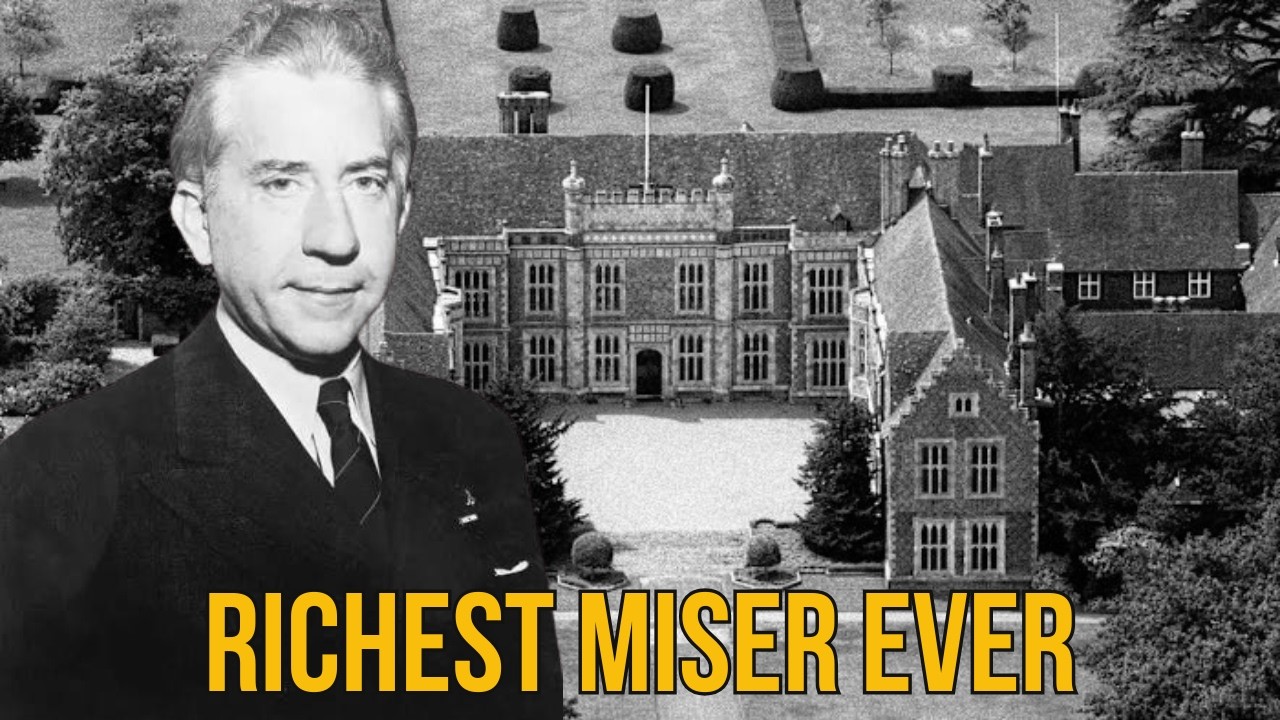
They were wrong. Jean Paul Getty had built his fortune on a simple, unyielding principle: money was the only thing he could trust. He had grown up the son of a successful oilman in Oklahoma, but he wanted more than his father’s success. He wanted control.
In the oil boom of the early twentieth century, he bought leases no one else wanted, drilled where others were too cautious, and waited with extraordinary patience while lesser men panicked and sold. He made his first million young, moved to Europe, and returned more ambitious than ever. By the 1950s, his greatest gamble came in the deserts of the Middle East, where he poured enormous sums into oil concessions in the neutral zone between Saudi Arabia and Kuwait, a barren region most oilmen considered a graveyard for money. For years, it produced nothing but bills.
He held on. Then the wells began to pay out richly, and in 1957, Fortune magazine confirmed what the world was beginning to suspect: Jean Paul Getty was the richest private citizen on earth, with a fortune exceeding a billion dollars at a time when that figure seemed almost mythical. He bought Sutton Place, a sixteenth-century estate in the English countryside, and filled it with priceless art and antiquities, a collection so vast it would one day become a museum bearing his name. He owned more than most governments.
He had reached the summit of wealth. And yet, in the midst of that palace of masterpieces, Getty installed a pay phone, a coin-operated telephone, in his own home so that his guests could not run up his bill. Journalists mocked him as the stingiest billionaire in the world. But it was not a joke.
It was a warning. The man who installed a pay phone to save a few pennies from his friends had revealed, in miniature, what he would do when something far more precious than pennies was at stake. Getty had married five times and fathered five sons, then grandsons after them. To the outside world, the Gettys were oil royalty, beautiful and rich, photographed in Rome and London and on the Riviera.
But the money that Getty loved so completely was a cold inheritance, and it was quietly damaging the men who carried his name. By his own admission, Getty was a distant and difficult father, a man who could not easily love those closest to him because he had taught himself that loving money was safer. His sons grew up seeking approval that never came. One of them died young in 1973 under circumstances the family tried hard to conceal.
That burden was nowhere clearer than in the line that produced the kidnapped grandson. John Paul Getty Jr. , named after his father, was an artistic, sensitive man who fled to the glamour of Rome in the 1960s. He married a beautiful woman named Talitha Pol, and together they became fixtures of high European society.
But the glamour masked a slow slide into heroin. In 1971, Talitha died of an overdose at the age of thirty. Her husband, shattered, retreated deeper into addiction and grief. Their son, John Paul Getty III, born in 1956, grew up with almost no supervision in the streets of a foreign city, carrying the name of the most kidnap-worthy family in the world.
He was a handsome, rebellious teenager with red hair, known in some circles as the “golden hippie,” wandering Rome’s bohemian nightlife alone while dangerous people watched. In the early hours of July 10, 1973, in Piazza Farnese, the sixteen-year-old was seized from the street, forced into a car, and driven south to the mountains of Calabria. His captors hid him in caves in the harsh hills and demanded seventeen million dollars. To anyone watching, the outcome seemed certain.
Seventeen million was a pittance to a man worth over a billion. The grandfather could write that check without noticing its absence. But the family knew something the kidnappers did not. They knew the man who held the checkbook.
When the demand reached Jean Paul Getty, the richest man on earth said no. His reasoning was cold, logical, and brutal. “I have 14 other grandchildren,” he said. “If I pay one penny now, then I will have 14 kidnapped grandchildren.
” In a single sentence, he had reduced his sixteen-year-old grandson, bleeding and terrified in a Calabrian cave, to a line item in a risk calculation. Pay the ransom and you set a price on every living Getty. Refuse, and you protect the fortune. The same patience and arithmetic that had made him a billionaire now turned against his own blood.
Months passed. One month, two, three. The boy stayed in the hills. The family was paralyzed between a kidnapping gang and a grandfather who refused to move.
Rumors spread that the reckless teenager had staged his own abduction to squeeze money from a grandfather who gave him nothing. Getty seized on the doubt as justification. In the mountains, the captors grew impatient, then angry at a family so rich it would not pay for one of its own. They decided to prove they were not bluffing.
In November 1973, after months of captivity, they held the boy down with a knife and cut off his right ear, mailing it with a lock of his hair and a threat to send more body parts to a daily newspaper in Rome. The package was delayed for weeks in the Italian postal system. When it finally arrived, it carried a message: send the money, or the next package would contain the other ear, then the rest of him piece by piece. Even then, even with his grandson’s severed ear on a newspaper editor’s desk, even with the photographs and the threats to return the boy in pieces, Jean Paul Getty did not simply pay.
He negotiated. He talked the ransom down from seventeen million to about three million. Then he revealed his true nature. Of that amount, he would personally pay only about 2.
2 million dollars, because his advisors had determined that was the maximum tax-deductible amount. The rest, he lent to his son, the boy’s father, at four percent interest. He took the largest deduction the tax law allowed and charged his own son interest on the money needed to free a kidnapped child. The man who could buy art collections destined for museums and English estates had structured his grandson’s rescue to improve his tax position.
The pay phone in the palace had been a prophecy. In December 1973, after five months of captivity and the loss of his ear, John Paul Getty III was finally released. He was found trembling at a gas station in the rain in southern Italy. He was alive.
The world assumed the ordeal was over. But the boy who came down from those mountains was not the same boy who had gone up. The hardest part of this story was not the ear, the bargaining, or even the tax deduction. It was what happened to the survivor over the next thirty-eight years.
After his release, the traumatized, disfigured teenager tried to call his grandfather. Some say it was to thank him for paying the ransom that brought him home. Jean Paul Getty refused to take the call. The boy had been mutilated and held in a cave for five months because of the old man’s money, and when he tried to reach the grandfather whose name had made him a target, the richest man in the world would not pick up the phone.
John Paul Getty III returned to a life that did not know how to hold him. He was sixteen, scarred by the past and the present, famous for the most horrible reason imaginable, surrounded by the same glittering, cruel, drug-filled world that had failed to protect him. There was no real treatment for what we now call severe trauma. There was only Getty money, the Getty name, and the curse of being alone with it.
So he did what many in that family did with their pain. He tried to drown it. He drank. He used heroin, methadone, a destructive mix of substances and alcohol.
He married young and had a son. But he never escaped the memory that no amount of anything could numb. The caves, the knife, months of believing his grandfather had decided he was not worth the price. The trauma of being the boy the richest man in the world had refused to save did not fade.
It sank into him. In 1981, eight years after walking out of those mountains alive, he nearly completed what the kidnappers had begun. He took a near-fatal overdose of drugs and alcohol. He survived, but the damage was catastrophic.
The overdose caused liver failure and a stroke that left him almost completely paralyzed. He lost the ability to speak clearly, lost most of his sight, and became confined to a wheelchair, requiring full-time care for the rest of his life. He was twenty-five years old. The kidnapping had taken his ear and five months of his life.
What followed, the trauma, the abandonment, the slow self-destruction that family wealth could fund but never heal, took everything else. He survived the caves only to spend the rest of his life trapped in a body destroyed by the pain of surviving. The ransom had been paid with a tax deduction. But the real price was still owed, and the boy paid it in installments over the next thirty years.
The founder, the grandfather whose refusal had set it all in motion, died in 1976, three years after the kidnapping, at Sutton Place, surrounded by his priceless art and his coin-operated telephone. He died the richest private citizen in the world, proving there was no sum too large for him to accumulate and no sum too small for him to fight over, even when the price was his grandson’s ear. His fortune, billions of dollars, went mostly to a museum bearing his name, the Getty Museum in Los Angeles, where millions of people pass before the masterpieces he bought with money he loved more than his own blood. His name is carved in marble, admired, immortal.
He got exactly what he wanted. The money outlived everyone. The money won. The grandson sat in a wheelchair for thirty more years, cared for by those who loved him, a living witness to the value of all that money when it was needed most.
He died in 2011 at the age of fifty-four, having spent more than half his life paralyzed by the aftermath of five months in a cave. But the dynasty did not end at that wheelchair. When John Paul Getty III was kidnapped, he already had a son, a child born in 1975 in the middle of the wreckage. His name was Balthazar Getty, and his story is the closest thing to a thread of hope in this dark history.
Balthazar grew up watching his father in a wheelchair, unable to speak clearly, a living symbol of what the family fortune had achieved and what it had failed to achieve. He inherited the same beautiful, cursed name, the same vast wealth, the same long shadow of the cold old man at Sutton Place. By the logic of this family, he should have been the next victim. But Balthazar did something different.
He became an actor, building his career on his own work rather than his inheritance. He married and had four children, defining his life by the family he built, not the fortune he was born into. He had struggles, public ones, as ordinary people do. But he did not disappear into the pattern.
He raised his children. He stayed. The grandson of the man who refused to pay quietly broke the cycle his grandfather’s money had started a century before. There was no Getty curse in any supernatural sense.
There was something more ordinary and more horrifying. A man at the beginning decided that money was more worthy of trust than people, and built an empire and a family on that rigid belief. Everything that followed came from that decision: the distance from his sons, the drugs in Rome, a sixteen-year-old left unguarded in the streets because no one in that fortune had ever learned to care for a child instead of an investment portfolio. Then came the moment of truth, the ransom, when Jean Paul Getty was asked to choose between his money and his grandson’s flesh, and he chose the money, then tried to deduct part of it from his taxes.
The curse was not magic. The curse was a worldview, the belief that everything, even the people we are supposed to love, has a negotiable price. That is the real horror of the Getty story, and why it still fascinates the world fifty years later. Most of us will never have a billion dollars, but everyone knows the quiet temptation at the heart of that family: to treat love as a transaction, to measure the people closest to us by what they cost and what they are worth, to put a pay phone where a heart should be.
Jean Paul Getty simply had enough money to follow that temptation to its end, and to show everyone, in the clearest possible image, where it leads. It leads to a severed ear in the mail, to a grandson in a wheelchair, to a phone call refused, to a death surrounded by art instead of family. Balthazar Getty and the children he chose to raise proved the one thing the founder never believed. That the name could mean something other than a price.
That you could carry the Getty fortune and still refuse the Getty bargain. That the curse was always a choice, and any choice can be unmade. Four generations. One cold decision behind it all.
And in the end, one descendant decided his family was worth more than the accounts. The pay phone was never a joke. It was a confession.
Its true cost became clear sixteen years later, when the richest man in the world received his grandson’s severed ear in the mail and his first instinct was to check the tax code.