By early July 1863, Robert E. Lee had stripped the Confederacy of its best troops and marched into Pennsylvania, carrying the war to Union soil. But he moved blind. His cavalry commander, Jeb Stuart, had gone off on a glory-seeking raid, leaving Lee’s army groping through enemy territory without intelligence.
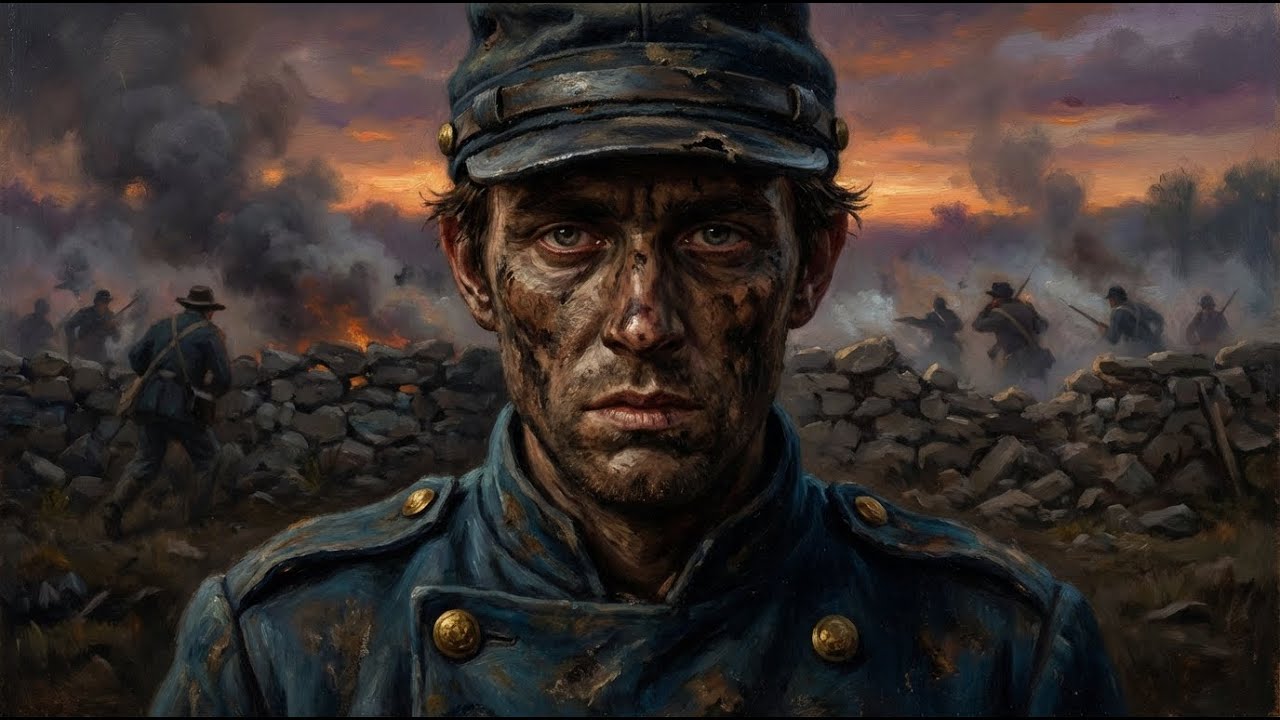
On the morning of July 1, Confederate General Henry Heth marched his division toward the small market town of Gettysburg, expecting to brush aside local militia. Instead, he met Brigadier General John Buford, a tough cavalryman who instantly recognized the strategic value of the ridges curving around the town. Buford dismounted his troopers and held the line with their breech-loading carbines, buying precious time until Union infantry arrived under Major General John Reynolds. Reynolds galloped onto the field and threw his men forward, but within the first hour a bullet struck him dead.
The Union line collapsed under Confederate reinforcements, sending thousands of blue-clad soldiers stampeding through the streets of Gettysburg. They regrouped on Cemetery Hill south of town, digging in among the gravestones. Lee saw the danger and ordered General Richard Ewell to take the hill if practicable. Ewell hesitated, judged it not practicable, and stopped.
Under cover of darkness, the rest of the Union army arrived and fortified the heights. Lee had won the ground but lost the advantage. On the morning of July 2, the Union commander George Meade held a nearly perfect fishhook-shaped line anchored on hills at both ends. He needed only to wait.
But Major General Dan Sickles, a Tammany Hall politician with no military discipline, looked at his assigned position, hated the low swampy ground, and ordered his entire Third Corps to advance nearly a mile forward to a slightly higher patch of ground blooming with peach trees. Without a word to Meade, ten thousand men marched out of the prepared line, creating an isolated, exposed salient. Sickles had handed Lee the vulnerable target he desperately needed. Lee planned a massive en echelon attack against the Union left, and he chose his old warhorse James Longstreet to lead it.
Longstreet urged a flanking maneuver instead of a head-on assault. Lee refused. The assault began at four in the afternoon, and the fighting devolved into a primeval struggle at a jumble of boulders known as Devil’s Den. Men fought with bayonets, clubbed muskets, and bare hands in the crevices of the rocks.
The violence spilled into a wheat field that history would remember as the whirlpool. For three hours the field changed hands six times, the grain trampled flat by the weight of falling bodies. A Confederate cannonball shattered Sickles’ right leg, and as he was carried off on a stretcher, Meade was forced to strip his center to save his left. The Confederate momentum was flagging, but one piece of the puzzle remained: a rocky hill called Little Round Top.
If the Confederates placed artillery there, they could rake the entire Union line. Union chief engineer Gouverneur Warren stood on the summit and saw Confederate bayonets glinting in the woods below. The hill was completely unoccupied. He sent messengers galloping for help, and Colonel Strong Vincent responded, turning his brigade toward the hill without waiting for written orders.
At the very end of the line, Vincent placed the 20th Maine, commanded by Joshua Lawrence Chamberlain, a college professor of modern languages with no formal military training. Vincent gave him a terrifying directive: hold this ground at all costs. The men from Maine barely had time to stack stones into a makeshift wall before the 15th and 47th Alabama, hardened veterans who had marched twenty-five miles without water, emerged from the woods. For nearly two hours the Alabamians charged five times, and five times they were pushed back.
Chamberlain’s men were down to their last rounds, stripping cartridge boxes from the dead and wounded. When the Confederates gathered for one final rush, Chamberlain did something that defied every rule of defensive warfare. He didn’t retreat. He drew his sword and shouted one word: bayonets.
His exhausted regiment leapt over the stone wall and charged down the steep, rocky slope, catching the Confederates by surprise. The extreme left had held. A college professor and a few hundred woodsmen from Maine had saved the Union flank. That night, while a separate fight raged in the darkness of Culp’s Hill, Meade gathered twelve of his generals in a cramped farmhouse and asked three blunt questions: should the army remain, should they attack or wait, and if they waited, for how long?
The consensus was unanimous: stay and fight. Meade pulled aside General John Gibbon, whose division held the center, and made a chilling prediction. Lee had failed on the left and failed on the right. Tomorrow he would hit the center.
Across the valley, Lee was indeed wrestling with his own strategy. Longstreet urged retreat or a flanking maneuver, but Lee believed his southern infantry was invincible. He decided that the next morning he would launch the largest cannonade in the history of the Western Hemisphere, then send twelve thousand men across a mile of open ground to deliver the killing blow. At ten in the morning on July 3, two signal guns fired, and 150 cannons erupted simultaneously, the loudest man-made sound ever heard on the North American continent.
The Confederate gunners quickly lost sight of their targets in the thick black powder smoke and began firing long, leaving the Union infantry behind the stone walls largely untouched. Henry Hunt, the Union’s chief of artillery, played a dangerous game. He ordered his guns to fire slowly, then to stop altogether, tricking the Confederates into believing their bombardment had succeeded. When the young Confederate officer Edward Porter Alexander sent a frantic note saying the charge must come now or the ammunition would be gone, Pickett took it to Longstreet.
Longstreet, paralyzed by his own foresight, couldn’t bring himself to speak. He simply nodded. Twelve thousand five hundred men stepped out of the trees on Seminary Ridge in parade-ground formation, a line of gray and steel nearly a mile wide. As they reached the halfway point, the silenced Union guns roared back to life with canister shot, sweeping holes twenty feet wide through the charging regiments.
The survivors closed the gaps and kept marching, funneling into a concentrated kill zone. At the Union center, the men of the Second Corps held their fire until they could see the brass buttons on the Confederate uniforms, then unleashed a volley of rifled musketry that stopped the charge like a physical wall. At the center of the storm was a twenty-two-year-old Union lieutenant named Alonzo Cushing, holding his intestines in with one hand while leaning against his last remaining cannon. When a sergeant begged him to go to the rear, he whispered that he would stay and fight it out or die.
As the Confederates reached the wall, he fired his final shot and was killed instantly by a bullet to the mouth. Confederate General Lewis Armistead placed his hat on his saber and vaulted over the stone wall with about two hundred men. For a few chaotic heartbeats, the Confederate flag flew over Cemetery Ridge, the furthest north the rebellion would ever reach. But Armistead looked around and realized he was alone.
He fell mortally wounded near Cushing’s gun. The momentum of the Confederacy shattered. The men still in the field turned and began the long, agonizing walk back to Seminary Ridge, cut down by Union artillery as they retreated. Lee rode out among the survivors, telling them it was all his fault.
When Pickett reached him, Lee told him to look to his division. Pickett replied that he had no division. When the smoke cleared, the town of Gettysburg had become one vast, interconnected hospital. Medical science was decades behind the ballistics of the mini ball, and the only solution to a shattered limb was the saw.
Outside every field hospital grew piles of discarded arms and legs stacked like cordwood, while surgeons worked for forty-eight hours straight. Over seven thousand men lay dead in the open fields, and within hours the bodies began to swell and blacken in the July heat. The water was poisoned by shallow graves and dead horses, and disease spread among the civilians. As torrential rain began to fall on the evening of July 4, Lee gave the order to retreat.
He summoned Brigadier General John Imboden and gave him a task that would haunt him for the rest of his life: escort the army’s wounded back to Virginia. The convoy stretched for seventeen miles, a collection of proper ambulances and stolen farm carts with no suspension, packed with men with shattered hips, men holding their own intestines, men whose faces had been erased by canister shot. Every jolt sent shockwaves of agony through the wagons, and the moaning rose into a collective wail that drowned out the thunder. Men begged to be thrown out onto the side of the road so they could die without the vibration.
Blood leaked through the floorboards, leaving a trail for Union pursuers to follow. When Imboden finally reached the Potomac at Williamsport, he found the river flooded and the pontoon bridge destroyed. The Army of Northern Virginia was trapped. Lee ordered his engineers to tear down abandoned houses and build a bridge from the scraps.
In Washington, Lincoln saw the opportunity and urged Meade to attack, but Meade hesitated, called more councils of war, and waited for the river to recede. By the time the Union army moved to strike on July 14, Lee had slipped across the river in the night. The war would go on for two more agonizing years. The town of Gettysburg was left with a debt it couldn’t pay.
Thousands of Union soldiers lay in shallow, hasty graves, and when heavy rains came, the soil washed away, exposing the dead. A local attorney named David Wills began the gruesome work of creating a soldiers national cemetery, buying seventeen acres of the ground the Union had defended. By November 1863, the cemetery was ready for dedication. Edward Everett, the most famous orator in America, spoke for two hours.
Then a tall, gaunt man in a black frock coat stood up. Lincoln spoke for just over two minutes, didn’t mention the tactical errors or the names of the generals, and didn’t even say the word Gettysburg. He spoke about a new birth of freedom. Some thought the speech was a failure.
Lincoln himself called it a dud. He had no idea he had just written the most important text in American history. Fifty years later, in 1913, the survivors returned. Over fifty thousand veterans from both sides, now old men in their seventies and eighties, converged on the field.
At the angle, a group of Union veterans stood behind the stone wall while their former enemies in gray walked slowly up the slope one last time. When they reached the wall, the men in blue reached out their hands and pulled them over the stones, embracing them and weeping openly. The peace Lincoln had prayed for had come, but it came with a heavy silence, for the millions of African Americans whose freedom had been secured by those hills were largely excluded from the celebration. The new birth of freedom remained unfinished work.
The guns fell silent, but the ground refused to forget. For decades, farmers continued to harvest iron instead of wheat, plowing up mini balls and rusted bayonets as if the earth itself were trying to purge the metal that had shredded so much human life.