In 1948, a seventeen-year-old girl was admitted to a state hospital in Danvers, Massachusetts. Someone wrote a word in her file: schizophrenia. Her name was Mary Balter. She had been living at a boarding school, but a severe depression had made it impossible for her to stay there.
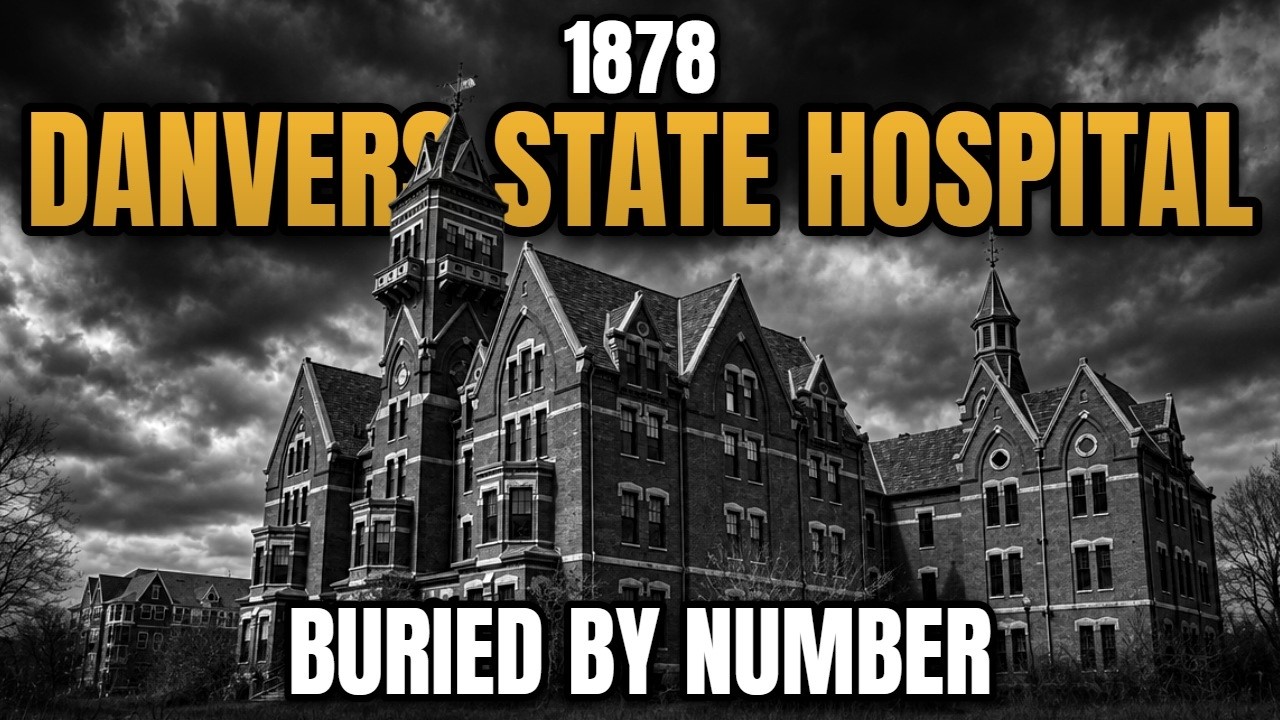
So she was sent up the hill to the massive brick building that everyone in the region called the Castle. That word in the file was, in 1948, close to a life sentence. It meant a ward and a bed in that ward. It meant a file that followed you from doctor to doctor with the word already written on it.
Every new person who read that file began by assuming the previous person was right. She was treated for schizophrenia. The treatment made her worse, and her decline seemed to confirm the word, because a patient who gets worse looks like a patient who was correctly diagnosed. Mary Balter spent most of the next twenty years inside that building.
She was not schizophrenic. Someone wrote the wrong word, and it took eighteen years for anyone to sit down and check. This is the story of Danvers State Hospital, told through its own records: the Kirkbride plan on which it was built, the annual reports of its trustees from 1891 to 1937, in which the hospital documented its own failure, the lobotomy story that is not true, and the cemetery record that the state lost. Start with the idea, because the idea was good.
For most of human history, there was no such thing as a hospital for the insane. There were jails, poorhouses, back rooms, attics, and asylums where the mad were held alongside the destitute and the dying. In the early nineteenth century, a reform movement spread through Europe and then America. It was called moral treatment, and its claim was radical for its time.
Insanity was a disease, not a moral failure. Diseases could be treated in the right place by the right people with kindness, routine, and work. Massachusetts was at the forefront of that movement. So was a Philadelphia physician named Thomas Story Kirkbride.
In 1854, Kirkbride published a book describing what a mental hospital should look like. His argument was architectural. He believed the building itself was part of the treatment, just as a splint is part of treating a broken arm. He specified the design: a central administrative building with long wings branching off on both sides.
The wings receded from each other in a zigzag line, like a staircase seen from above. No wing blocked light from the next. Each corridor was open at both ends so air could flow through. Sunlight reached every ward.
Farmland surrounded the institution, with views from the windows. Kirkbride believed sunlight and air were the medicine. He also set a limit. A hospital built on his plan should hold a maximum of 250 patients.
That number was the heart of the entire argument. Kirkbride was not just designing a warehouse that looked nice. He was saying that after a certain size, the building stopped functioning because the superintendent could no longer know the patients by name. In his model, that knowledge was the essence of treatment.
Hold onto the number 250, because everything that follows is the story of a number that slipped out of the hands of the men who set it. Seventy-four years before Mary Balter entered the hospital, there was only a farm on that hill. Massachusetts already owned Kirkbride hospitals in Worcester, Taunton, and Northampton, and they were filling faster than the state could build new ones. In 1873, the legislature voted to build another.
A committee searched for land north of Boston and settled on a farm in Danvers, about twenty miles from the city along the coast. In October 1873, the state bought 197 and a quarter acres of the Dodge farm for $39,542. The land included a hill, a drumlin, the long low hill that a glacier leaves behind when it crawls over the ground and stops. The hill rose 240 feet above sea level, and on clear days you could see Boston from its summit.
The hill already had a name: Hawthorne Hill, after the family that had owned it in the seventeenth century. That family produced John Hawthorne, the magistrate who interrogated the accused in Salem Village in 1692. Salem Village is now the town of Danvers. The witchcraft trials happened on this ground.
Then a hospital for the mentally ill was built on a hill bearing the name of the man who ran the interrogations. Hawthorne was the examining magistrate; when the governor formed the court that actually tried and executed people that year, Hawthorne was not appointed to it. His interrogations were described at the time as harsh. That is the accurate account, and it is sufficient without embellishment.
Construction began on May 1, 1874. The consulting engineer was Nathaniel Jeremiah Bradley of Boston, with James F. Ellis supervising the work on site. The bricks were made locally, the dark red Danvers brick for which the town was known.
They were hauled up the hill by wagon for four years. The estimated cost was $1,099,000. The final cost was $1,464,940. 57.
That increase of nearly $400,000 was the first appearance of a pattern that continued for the next century. The plan and the reality did not match, and the reality was always bigger. What the money bought was one of the largest buildings in Massachusetts: a central block topped by a tower, with eight patient wings receding from it on both sides. Three and a half stories tall, with a floor area of about 313,000 square feet.
The building stretched end to end for about 1,100 feet, a quarter mile of corridors under one roof. People in nearby towns could see it from the road for miles, and they began calling it the Castle on the Hill. Inside the grounds there were a farm, a laundry, a boiler room, a water supply, and a water tank. The hospital grew its own food and burned its own coal.
Patients worked in the fields. Staff lived on site and raised their children there. It was built to be self-sufficient, which is also a description of a place no one outside had any particular reason to visit. It opened its doors to patients on May 13, 1878, under its first superintendent, Dr.
Calvin S. May, and its early record was better than people expect. In 1879, its second year, Danvers hired a female physician, the first mental hospital in Massachusetts to do so. In 1889 it opened a training school for nurses, the second in the state.
In the 1890s, superintendent Dr. Charles Page publicly argued that mechanical restraints were unnecessary and harmful, an opinion that was not settled at the time. Mechanical restraints meant specific things: leather cuffs, mitts that enclosed the hands, straitjackets, and straps that fastened a person to a chair or bed frame. In many institutions in the 1890s those things were used daily and no one thought twice.
A sentence in the 1891 annual report puts a precise number on Page’s claim. Mechanical restraints in their various forms were used on eleven patients, eight men and three women. Eleven people over an entire year in a hospital with more than 800 patients. That was a real achievement, and it should be said loudly, because most of what follows is not.
Keep that number too. It was the high point of the institution, reached thirteen years after its founding. Every state hospital in Massachusetts had to file a report to the legislature every year. The trustees wrote up the year’s reports and sent them to Boston, where they were printed, bound, and almost never read.
Those volumes still exist today. They have been scanned and made public, and they are the reason this story can be told from evidence rather than guesswork. Danvers documented what was happening to it, in writing, every year for over a century. Here is the 1891 report.
“The hospital was originally intended to accommodate 556 patients, but it now treats more than 800, and the number has reached 820. ” That is what the trustees wrote about themselves. 556 was the number the buildings were designed for, by their own accounting. Kirkbride had set the capacity at 250.
So on paper, the hospital was already designed at more than double his maximum capacity, and in reality it was operating at 820 patients. The rest of the 1891 numbers complete the picture. The number of patients remaining on September 30 of that year was 817. The daily average over the year was 784.
The number of deaths in the institution was 85. Eighty-five people died at Danvers in 1891. Out of 817 residents, that is about one in ten. Some of them are still buried on that hill.
The oldest five graves on the site date to 1878, the year the doors opened. Burials began immediately and never stopped. And there is the line that sums up the next sixty years: “Overcrowding continues, and there is no probability of its cessation. ” No probability of its cessation.
The hospital had opened in 1878 to relieve pressure on existing hospitals. Thirteen years later, the trustees were writing to the legislature that the pressure had moved into their corridors, and they did not expect it to stop. They were right. It did not stop.
By 1902, the hospital had run out of room within its own grounds. The state bought 100 additional acres stretching between Danvers and Middleton and began building again. Part of this expansion was the Middleton Colony, opened in 1903 for chronically resident female patients. The word “colony” carries a hidden meaning.
A colony was a subsidiary settlement, usually agricultural, for patients classified as chronic, people who were not expected to improve and would not return home. The colony got its own cemetery. That cemetery still exists. It becomes the worst part of this story.
The 1911 report shows a daily average of 1,452 patients. The superintendent writes that the existing buildings cannot accommodate an increase in patients without unjustified overcrowding. He also writes that there is more work than the six physicians making up the clinical staff can handle. Six doctors for 1,452 patients.
One physician for roughly every 240 people, responsible for treating, diagnosing, making daily decisions about, and discharging 240 human beings at once. Two hundred seven people died that year. The 1915 report shows the other side of the staffing problem. This time it concerns attendants.
The trustees write that they have difficulty retaining a competent nursing force. Then they explain why; the explanation is a physical description of the building. Attendants were housed in the patient wards where these employees worked during the day. The alternative was poorly ventilated rooms in unfinished attics.
So the people paid to care for 1,500 patients slept where they worked. They ate there too. Their entire lives were confined within the corridor. The board again demands the construction of housing for male attendants and couples.
It also notes that storage rooms are so inadequate that supplies are kept in basements and attics. An attendant who never leaves the ward is not a witness to what happens in it. He is part of it. Anything that was normal in that corridor became normal to them.
They had nowhere to go at the end of their shift, no outside life against which to measure anything. That year the daily average was 1,490 patients. One hundred eighty-four people died. Then World War I took the doctors.
The 1921 report records a daily average of 1,576 patients, an increase of 54 over the previous year. One hundred ninety-seven people died. The trustees write that the medical service has been disrupted by a shortage of physicians since the war. In the same report, after describing every effort made to provide space, comes this: despite these efforts to provide space for patients, the hospital is severely overcrowded.
Thirty years after 1891, the same building, the same complaint, and twice as many people inside it. By the end of the 1920s, the escalation had not slowed. The report for the year ending November 1929 shows an average total population of 1,912. 8, an increase of nearly 38 over the previous year.
Two hundred seventy patients died in the institution that year, 50 more than the year before. The 1929 report itself contains a line the hospital was clearly proud of: “During the year, seclusion was reduced to a minimum, with only about 2% of the total population confined in this manner. ” Two percent of 1,912 equals about 38 people locked alone in a room, and it is described as a minimum, and presented precisely as an improvement. So what did treatment actually consist of for a person living inside that place?
The answer is in the reports themselves, in the tables at the back, and the answer is water. Hydrotherapy was the main physical treatment at Danvers for decades. The theory, in the hospital’s historical language, was to use water baths to relieve a condition of “congestion of the brain. ” No one now believes the brain becomes congested.
At the time, this was considered advanced, and it had replaced things that were worse. In practice, it meant three procedures. The first was wrapping a patient in wet sheets. The patient was wrapped in sheets soaked in water, then wrapped again in blankets, and left like that, sometimes for hours.
The wrapping was tight enough that the person could not move their arms. This is how the work performed the function of restraint without being counted as a restraint. The second was the continuous bath. A patient was placed in a tub of water at a constant temperature and kept there, again for hours.
In many hospitals, a canvas cover was placed over the tub with a hole for the head. The third was the stimulating bath, the milder, shorter version, used as a stimulant rather than a sedative. Now the numbers, because the numbers are the most damning part. The 1929 report records 982 patients treated with hydrotherapy that year.
That is roughly half the people in the building. In 1935, the hospital performed 19,861 wet sheet packings on 767 patients. In 1937, it performed 18,182 wet sheet packings, 10,591 continuous baths, and 15,063 stimulating baths. Add the 1937 numbers together.
43,836 water treatments in one year in one building. About 120 treatments a day, every day, including Christmas Day. Someone had to fill those tubs. Someone had to wash the sheets with soap and wring them out.
Someone wrapped the patient and unwrapped them again. Then someone wrote the number in a register, to be printed in a table and sent to Boston. Asylum histories tend to treat hydrotherapy as a curiosity, as a strange old idea illustrated by the design of an empty tub in a tiled room. The tables in these reports are the correction to that.
This was the ordinary daily routine of the institution, and the people inside it spent a significant part of their lives wet. The reason it continued deserves to be stated clearly and without hesitation. Warm water genuinely calms an agitated person. It is also cheap, requires no physician, and an attendant can be trained to do it in an afternoon.
In a hospital with six doctors and 1,500 patients, a treatment that needs no doctor spreads for reasons of staffing, not medicine. Occupational therapy went alongside it. Patients worked in the farm, the laundry, the kitchens. For some people that work was genuinely therapeutic, and that is how the reports presented it.
It was also unpaid labor that kept the institution self-sufficient, and the reports do not distinguish between the two. The population kept rising. The report for 1931 shows an average total of 2,035 patients, an increase of 38 over the previous year. Two hundred ninety-five patients died in the institution that year.
The 1935 report says something worth hearing exactly as written: “During the past year we have had the largest number of patients in the history of the hospital. ” The number in parentheses after that is 2,250. The average population that year was 2,176. Three hundred patients died during the year, 25 more than the year before.
Three hundred deaths in 12 months in a hospital whose trustees had sized it for 556 people. The year 1936 ended with 2,297 patients registered. Two hundred sixty-two of them died that year. Then came 1937, which produced the clearest sentence in any of these documents: “There were over 2,350 patients, a great many more than we have adequate provisions to care for.
” That is an admission, in an official report, by the people who ran the hospital, sent to the government that funded them. They are saying they cannot care for the people in their charge, that the number is simply too large. The same report gives the staffing numbers. Total officers and employees: 530.
That number includes everyone. Doctors, nurses, attendants, cooks, farm workers, laundry workers, engineers, clerks. Five hundred thirty people of every sort for about 2,300 patients, with unfilled vacancies on top of that. Most of those 530 never went near a ward.
So the number actually caring for patients hour by hour was a fraction of that. Two hundred seventy-seven patients died in the institution in 1937. By 1939, the daily population was recorded at 2,360. Now take every year in this account in which the annual report can be read, and add up the deaths.
1891, 85. 1911, 207. 1915, 184. 1921, 197.
1929, 270. 1931, 295. 1935, 300. 1936, 262.
1937, 277. That is 2,077 people. Nine years out of 114. Compare that number to the burial plots, because the two numbers do not match.
The way they fail to match is the most revealing fact in the entire record. There are roughly 770 graves on that site. That is the total over the hospital’s entire working life. But more than 2,000 people died there in nine years alone.
The reports do not explain this gap in explicit words. The arithmetic explains it. Most of the people who died at Danvers were claimed. A family would come, sign for the body, and take it home to be buried in a churchyard or family plot with a name carved on the stone.
The land on the hill was never where most of the dead went. It was where the unclaimed went. So those graves are not a record of how many people died at Danvers State Hospital. They are a record of how many people died there with no one left to come for them.
How a person ends up unclaimed is rarely the result of one act of cruelty. It happens like this. Someone is admitted in their twenties. Their parents visit at first, every month, then less often.
Danvers is far from Boston by streetcar, and the trip is a strain on everyone. The parents die. A brother keeps writing for a few years, then moves to another state, or has children, or simply stops. Twenty years pass, or thirty.
The patient is still on the ward. By the time they die, no one alive remembers them as anything but a name on a line in a register. Then a hospital employee fills out the death certificate, an attendant carries the body down the hill, and the grave is marked with a number. This is not a scandal.
No one committed a crime in that sequence. This is what happens when an institution outlives the people who loved those inside it. The scandal is the decision that came next. The hospital could have carved the name.
They had the name. It was on the death certificate filed with the town, the same way the name would be found again a century later. They chose the number instead. The reason for the numbering is not a mystery and is not a privacy law.
It was hospital policy to put numbers on the graves. That policy came from a sense of shame. It came from a desire to protect families from what was called the disgrace of mental illness. A phrase from the state-appointed Danvers Memorial Committee goes further.
Patients were not asked whether they wanted their names on their graves. No one asked them. The decision to remove their names was made on their behalf by the institution and presented as a kindness to their relatives. That is Mary Balter’s story too, and hers is the one case where the record lets you watch what happened, and then watch its correction.
What she was actually suffering from, as later understood, was acute anxiety and psychotic depression. Both are serious. Both are treatable. Neither is schizophrenia.
She entered the hospital at seventeen. She spent her entire twenties inside a ward in the Castle on the hill. The hospital around her was telling the legislature, in writing, that it could not care for the people inside it. When she was finally put on the right medication, she improved.
Balter left in 1966, in her mid-thirties. She married a man she described as the love of her life. She enrolled at Salem State College and earned a degree in psychology, then went to Harvard and earned a master’s. In 1984, Salem College gave her an honorary doctorate.
Then she returned to Danvers State Hospital, this time as a member of the staff. She wrote a memoir about it called “Nobody’s Child. ” In 1986 it was made into a television film starring Marlo Thomas. For many Americans, that film was the first time they were asked to look inside a state hospital from the perspective of the person in the ward rather than the person holding the keys.
She founded the Balter Institute. She spent the rest of her life doing this work. But note what her story really proves. Balter did not recover because the hospital was merciful.
She recovered because someone in authority finally sat down with her file and asked whether the word on top of it was correct. In a ward of 2,000 people, that depends on scheduling. And it raises a question the record cannot answer. How many of the people buried on that hill carried a misdiagnosis like hers?
Balter’s file was re-read because she was still alive to argue about it. She was articulate. She was stubborn. And she stayed in the building long enough that someone eventually had to deal with her.
The people at the bottom had none of those advantages. They died with the word still at the top of the page, and then the page was closed. No one will ever know how many of them were misclassified. That is not a gap in history.
It is the product of a deliberate archival decision, compounded by an accident for which no one was ever held accountable. The end came slowly, from three directions at once. The first was medication. After 1956, a proportion of people who would have spent their lives on the wards could live outside them.
That is a real change, and it should be stated plainly. The second was money. Massachusetts cut state hospital budgets significantly during the 1960s, and Danvers began closing wards as early as 1969. The third was policy.
Deinstitutionalization moved care from large hospitals to community mental health centers. Those centers were supposed to be built and funded to receive the people being released. Some were built. Many were not.
The population fell rapidly from more than 2,000 at its peak to about 260 patients by the 1970s and 1980s. Wards that had held 100 people stood empty, with the beds still in them. The farm stopped. The nursing school was long gone.
Roofs began to collapse in buildings that were never funded for repair, and whole wings were closed and sealed instead of repaired. By the 1980s, most of the campus had ceased to function, and the buildings were decaying around the patients still inside. On June 24, 1992, the last patients at Danvers State Hospital were transferred to Tewksbury Hospital, and the hospital closed, 114 years after it opened. The building stood empty for thirteen years.
Windows shattered, weather got in, trespassers broke in. The corridors that once held 2,300 people filled with plaster dust and graffiti, and the place became a destination for people with flashlights and cameras. The stories they brought back are most of what the internet now believes about this place. Thirteen years is a long time to leave a quarter-mile building empty above a town.
Long enough for the hospital to stop being a place people remembered and become a place people dared each other to enter. Then a woman walking her dog in the area wandered off the path toward the brush. She tripped over a small flat concrete marker level with the ground. It had a number carved into it, nothing else.
Her name was Patricia Deegan. She holds a doctorate in clinical psychology, and she herself had been a psychiatric patient, so she realized where she was standing before she could prove it. There were hundreds of those markers in rows stretching under the trees. All the same size.
All bearing a number and nothing else. Deegan went looking for the cemetery records, the list that matched each number to each person. The records had been lost. The state mental health department had lost the records.
The hospital no longer existed. So the burden fell on former patients, unpaid, in their own time, to reconstruct a government document the state had failed to keep. In February 1998, Deegan gave a presentation about what she had found. People attended.
They met again a month later in March and gave themselves a name: the Danvers State Memorial Committee. The committee grew to more than 60 people. Many were former psychiatric patients. Some had been patients at Danvers itself.
Some of them stood in a cemetery where they had almost been buried. On June 1 of that year, they held a gathering at the site, attended by about 70 people. Then they did the slow, painstaking part. With the hospital records lost, the committee worked around them.
They worked through town death certificates, which are public and state where a person died. If someone died at Danvers State Hospital, the town keeps a certificate proving it. By comparing those certificates with burial dates and the layout of the ground, you can begin to restore the names. Person by person, in a library with a notebook and a pencil.
The larger cemetery on the hospital hill contains 677 people. The committee identified 542 of them. Of those 542, they matched 354 names to specific grave numbers. Three hundred fifty-four people now have a name paired with the exact piece of ground where they lie.
That leaves 188 people known by name but with no identifiable burial location. And 135 people in that ground have not been identified at all. Then there is the Middleton Colony, opened in 1903 for patients who would not return home. It contains 93 numbered markers.
The committee identified 84 people buried there. They were unable to match a single name to a single marker. Read that again. Eighty-four people are known to be buried in that ground.
Their names are known. Their markers exist, 93 of them, each with a number carved on top. And there is no longer any way to know who belongs to whom. For those 84, the work produced a list of names and a field of numbers with no link between them.
The anonymity imposed by policy a century ago became permanent because a filing cabinet was lost. The records are gone, and for the Middleton Colony, they will never come back. What exists now is different from what Deegan walked into. The ground has been cleaned.
Granite headstones bearing names have been placed. Memorial stones list the names of patients known to be buried there. At the entrance, a rock bears the cemetery’s name and, beneath it, a line of text: “The echoes they left behind. ” The old numbered markers were removed when the name stones were placed.
For years afterward, visitors reported finding them stacked in a pile at the tree line where the mowed grass meets the woods. Small concrete blocks bearing numbers that no longer belong to anyone, piled at the edge of the field. No one seems to have decided what should be done with them. They were not destroyed and they were not displayed.
They were moved to the edge and left there. A pile of numbers in the weeds is also the most accurate monument the place has. It is what the institution actually produced, lying where someone put it. And every one of those blocks was once the only thing standing between a person and total oblivion.
For 354 of them, that task is now over. Meanwhile, the hospital itself was put up for sale. In December 2005, the property was sold to Avalon Bay Communities, a residential development company, for $12 million. Demolition of most of the complex began in January 2006.
The committee had fought for the terms of that sale and won part of it. The agreement required the developer to work with the state and the committee to preserve and protect both burial grounds. The developer then took responsibility for maintaining them. The committee asked that 10% of the new residential units be set aside for clients of the Department of Mental Health.
They got 3%. They demanded that the chapel on the hill be kept as a memorial hall. It was demolished. Then, in the early morning hours of April 7, 2007, a fire broke out on the construction site.
Four unfinished residential buildings burned, along with four service buildings. Those structures were designed to hold 147 apartments. The fire was visible from Boston, twenty miles away, and the heat coming off it damaged the dome of the old Kirkbride building. The state fire marshal, Stephen Cohen, later said the fire started with tremendous force.
The local fire chief said it spread like a lumberyard fire. A resident reported flames as tall as a water tower. The cause of the fire was never determined. It remains undetermined to this day.
What remains today is the shell. The central administration building of the Kirkbride structure was kept, with two of its wings, only the outer brick walls. A residential complex of about 61 apartments was built inside them, within the original structure. Nothing remains of the quarter mile of corridors.
People live there now. They park their cars where the farm was. From the road below, the Castle on the hill still looks like a Castle on the hill. What was preserved is the part Kirkbride designed to be seen from the valley, the stepped wings and the brick and the silhouette against the sky.
The actual purpose of all that shaping, letting light and air reach every ward, was emptied out and replaced with apartments. The public only ever saw that silhouette from the road, and that is what the developer preserved. Danvers is not an exception, and that is what takes this beyond a single town in Essex County. In May 2025, a commission in Massachusetts submitted a report on how the state treated the people it placed in its institutions.
It found that a third of the state burial grounds set aside for those who died in institutions are not maintained. It found that more than 10,000 burial sites are located in deteriorating cemeteries, mostly unidentified. It also found that the state placed barriers in front of its records, some deliberate and some not, citing patient privacy. Families could not access the files, nor could researchers or former patients themselves.
One person who testified was a man named David Scott. His brother John died at age seventeen at the Fernald School in Waltham. Scott and his brothers spent 50 years not knowing where his remains were. Fifty years of being unable to visit a grave because the state that dug it did not disclose its location.
That is a living family in this decade facing the same problem Deegan found in the brush. And when the law finally changed, Scott’s reaction was not gratitude. He said he was glad it happened, but it came too late and with little use. He has every right to that.
Fifty years is most of a lifetime, and his brother was seventeen. On November 25, 2025, the governor of Massachusetts signed the change into law. Records of more than 25 state institutions became public after 75 years. Families and researchers can request them 50 years after the death of the person in question.
One hundred fifty years after the first five people were buried on that hill, the papers were opened. Patricia Deegan made the argument clearly in an interview years before any of this passed. If people treat the cemetery like garbage, that is a good indicator of how they feel about the people buried there and those still receiving services. She also said: “The perspective of a former patient about a mental institution is not like the perspective of the psychiatrist who ran the system.
Yet our voices are rarely heard in the history of mental health. ”
That brings this back to where it began. On June 1, 1998, at that gathering inside the hospital grounds, people stood to speak on behalf of the patients buried under numbers. One of them was Mary Balter.
She was 67 years old. She held a master’s from Harvard and an honorary doctorate. She had also spent most of her twenties and thirties in a ward a few hundred yards from where she was standing. Someone wrote the wrong word at the top of her file, and no one found time to review it.
She died the following year. The hospital wrote its own history every year for more than a century, bound volumes sent to Boston. Then the only list showing who lay in the ground was lost.
The people it had diagnosed, discharged, and buried under numbers came back, and put 354 of those names on the grass.