For nearly two thousand years, people across the Roman world and much of Europe washed their clothes with something no one would willingly touch today. Roman cities had a thriving market for it, with people collecting it from households and selling it at high prices. The emperor even taxed it. The substance was human urine, and this modest waste product transformed the history of cleaning.
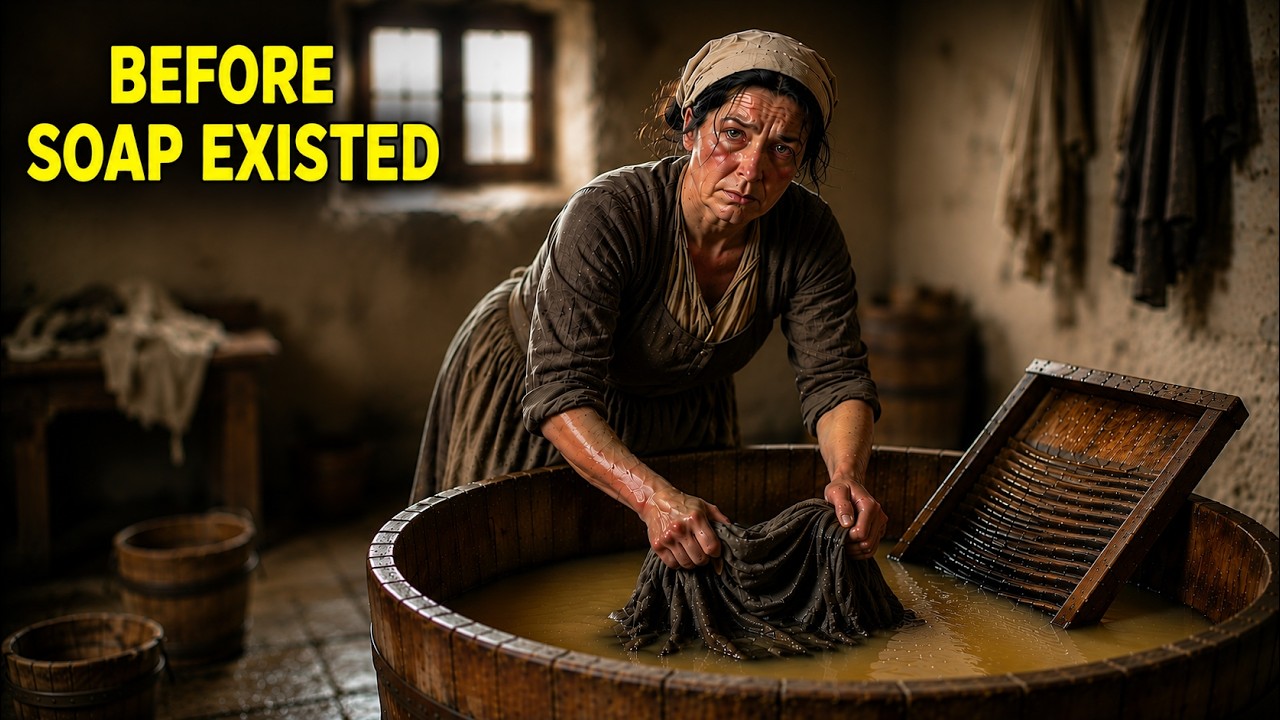
The story begins with a problem that still frustrates every household: stubborn grease and grime that will not come out of fabric no matter how many times it is washed. Modern solutions include soap, detergent, and washing machines. Two thousand years ago, none of those existed. Yet people faced the same challenge.
Their garments were often made from sheep’s wool coated with a natural grease called lanolin, which was so sticky that water alone could never remove it. People needed something that could break down the grease without damaging the delicate wool fibers. That search led to a solution that sounds strange today but worked remarkably well. When urine was left to sit in open vessels for several days, bacteria gradually transformed it.
Fresh acidic urine changed over time into an alkaline cleaning solution, and that alkaline quality broke down the grease and oil on clothing, making them soluble in water. What made it especially valuable was the fact that this mixture was milder than lye, the harsh substance made from wood ash. Lye could clean away grime, but it also damaged wool fibers. Fermented urine proved far gentler on wool.
For centuries, people relied on it as a dependable cleaning method. It was not a laboratory formula but a discovery born of daily necessity and experience, and it remained part of everyday life for thousands of years. This was never just a household trick. In Roman cities, it grew into a full industry.
Every major city had workshops called fullonicae, where clothes were washed and given their final finishing touches. These establishments were much like modern dry-cleaning shops, with one major difference: instead of soap, their tanks were filled with fermented urine. Each workshop had small masonry stalls where workers placed their feet on the garments and stamped them vigorously in a solution of urine and clay. The Roman writer Seneca described this choreography in his own writing, giving it the name saltus fullonicus, meaning the fuller’s dance.
After this stamping, the clothes were placed in basins of running clean water to wash away the excess urine and clay. Then they were rubbed with a special clay known as fuller’s earth, which absorbed any remaining grease and left the fabric white and clean. White garments were hung over sulfur smoke to brighten their whiteness even further. Finally, the clothes were brushed with the prickly heads of teasel plants to raise the wool’s nap to a silky finish and then pressed under heavy wooden boards to remove every wrinkle.
The system was so organized that it developed its own supply chain. People collected urine in household vessels and sold it. Public toilets provided urine on a large scale, and the laborers who cleaned those facilities also sold the collected urine for profit. It became such a valuable resource that an entire economy formed around it.
When that industry grew large enough, the Roman government took notice. Rome at that time was struggling through a serious crisis. After the civil war known as the Year of the Four Emperors, the treasury was nearly empty. When the new emperor Vespasian took the throne, he urgently needed money.
He sought revenue through every possible means, and taxing the urine trade was one of them. His son Titus objected, declaring it a degrading practice. Vespasian responded by silently picking up a silver coin that had come from this very tax and holding it close to his son’s nose. He asked whether the coin smelled.
Titus said it did not. Vespasian then delivered a phrase that has echoed through the centuries: money does not stink. The Latin version, pecunia non olet, remains famous to this day. The laborers behind this industry lived anything but comfortable lives.
Most of the workers in the fullonicae were slaves or freed slaves who stood for ten to twelve hours a day in the alkaline solution. The constant moisture and harsh chemical environment cracked their skin and caused painful sores. Many suffered from foot infections, and those who worked near the sulfur smoke sustained severe damage to their lungs. Yet despite the harshness of their work, the fullers carved out a distinct place in Roman society.
They had their own association, the collegia fullonum, and election slogans painted on the walls of Pompeii show that they played an active role in the social and political life of their cities, not just in its workshops. This method was not confined to Rome. The strongest evidence comes from Rome itself, but traces have also been found in ancient cities across France, Greece, Hungary, and North Africa. Evidence from old Icelandic homes shows that the practice continued in northern Europe for centuries after the fall of the Roman Empire.
One of the most common popular beliefs about the practice was that Roman fullers placed pots on the streets so that passing men could urinate into them. Modern research by historian M. Flohr demonstrated that the small pots placed along roadsides could never have met the needs of such a large industry. The urine was in fact purchased commercially in large quantities from public toilets and private households.
Another popular myth holds that clothes washed in urine would permanently stink. In reality, ammonia evaporates quickly into the air. Once the garments were rinsed in clean water and dried in the sun, the smell disappeared completely. This was not only recorded in old texts but also confirmed by a modern experiment.
In 2026, a research team deliberately stained pieces of white wool with oil, dirt, and wine and left them for three days. Some samples were washed in a mixture of stale urine and water, others with Castile soap, and a third set in plain water alone. The urine mixture proved as effective as soap at removing grease and oil, and in several ways even better. When the samples were washed and dried, no odor remained.
The experiment confirmed what ancient writers had recorded centuries earlier. This method was not suitable for every fabric. Urine was used only for sturdy wool garments such as the toga and the sagum. Linen and silk, because of their delicate nature, required gentler washing methods.
The job carried real responsibility. Under Roman law, if a fuller ruined someone’s garment, he was required to compensate the owner for its full value. Laundry work was not merely a chore but a profession with legal obligations. So why did such an effective method come to an end?
Two major developments brought it down. The first was a change in chemistry. In 1790, French chemist Nicolas Leblanc discovered a process that could produce cheap soda ash from ordinary salt. Soda ash was a crucial ingredient in soap making, and once it became affordable and widely available, manufacturing soap became far easier and cheaper.
In the nineteenth century, Ernest Solvay improved the process even further, making soda ash cheaper still. People no longer needed to store urine for months to clean their clothes. They could simply buy soap from the market and do the same work without any of the smell or inconvenience. But having soap was not enough.
Laundry itself still demanded hours of bending over, scrubbing by hand, and soaking hands in harsh alkaline water. That remained as painful in the eighteenth century as it had been centuries earlier. This is where a new figure enters the story: Jacob Christian Schäffer, a German man who watched washerwomen bent over their tubs for hours at a time, their hands burned by chemicals and their joints aching from constant strain. In 1777, he designed the first practical washing machine.
It was a closed wooden tub fitted with wooden paddles inside and a handle on the outside. Turning the handle drove the paddles through the water, forcing the water through the clothes and cleaning them far more easily than hours of hand-scrubbing. Nearly a century later in Indiana, a man named William Blackstone watched his wife struggle daily with the heavy labor of laundry. She hauled heavy water, scrubbed clothes against a wooden washboard, and wrung them out by hand.
In 1874, Blackstone built her a small wooden tub with a shaft inside fitted with wooden rods. Turning a flywheel by hand moved the rods back and forth, washing the clothes in soapy water without effort. The machine proved so successful that Blackstone founded a company based on the design, one of the first washing machine manufacturers in the world. After 1900, the way people washed clothes changed permanently.
Machines began to replace human labor and old methods. The earliest machines used wooden tubs, hand-operated mechanisms, and simple motors, but the technology steadily improved. Over the twentieth century, electric motors, automatic controls, and new washing systems made the machines faster, easier, and more efficient. By the 1950s and 1960s, automatic washing machines had become part of ordinary households.
Today’s modern machines, with sensors, smart controls, and energy-efficient technology, have completely transformed the way clothing is cleaned. For thousands of years, human beings used methods that now seem inconceivable, all born from necessity and experience. And in the end, the journey from urine-filled tanks in Roman workshops to the automatic washing machine is a story not just of invention, but of how every major innovation solves an old problem differently.
The difference is simply that over time, the solutions themselves changed.