By the 1930s, the Doxford engine works at Pallion on the River Wear had become the largest marine engine manufacturer on Earth. A quarter of the world’s ships turned on its design. The machine itself was unlike anything else ever sent to sea: a three-story tower of moving metal with no cylinder head at all. Two opposed pistons sat facing each other inside a single enormous cylinder, and when fuel ignited between them, the blast drove one piston up and one down at the same instant.
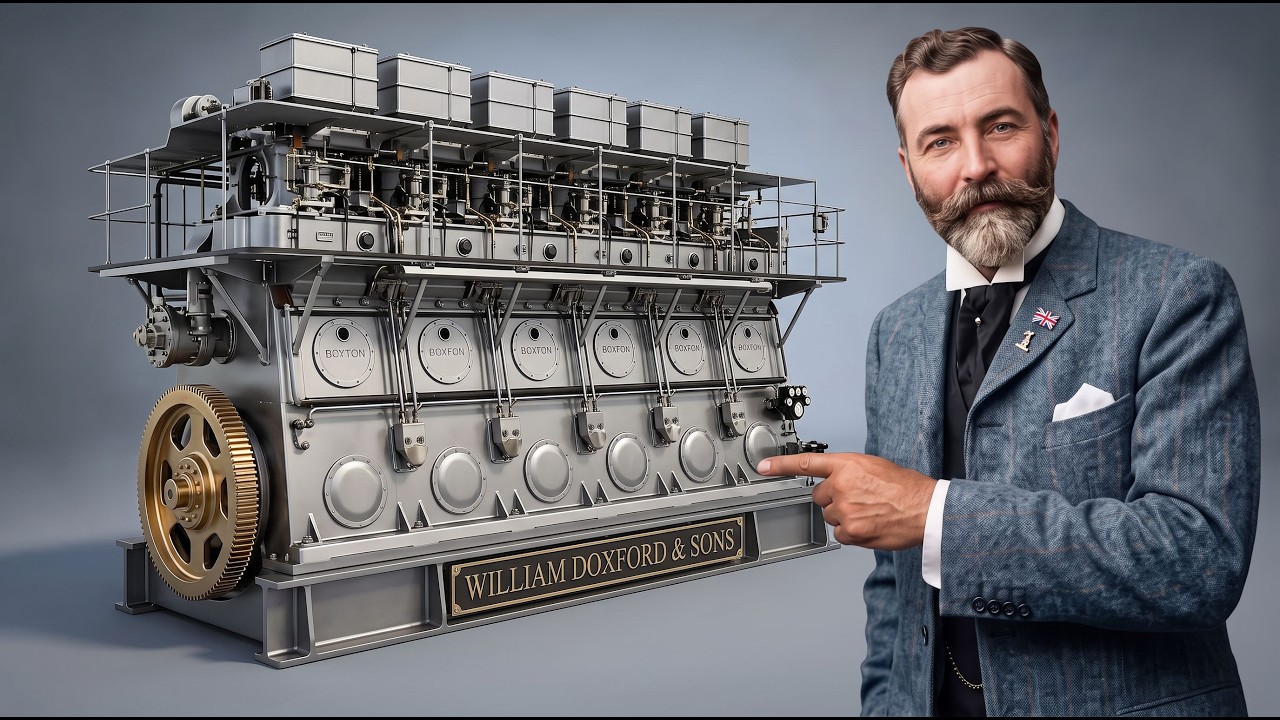
The lower piston drove the crankshaft directly; the upper one was connected to that same single shaft by external side rods that plunged up and down in the open air, in full view, slowly enough that a man could stand at the engine’s foot and follow every stroke with his eye. It ran so slowly that it needed no gearbox, bolting straight onto the propeller shaft. Men called it the cathedral engine, and the name fit. You looked up at it.
The story of that engine began on the same river in 1840, when a young merchant shipwright named William Doxford set up on his own at Cox Green, on the quieter upper reaches of the Wear, building wooden sailing ships. The 1840s gutted the wooden shipbuilding trade, and yards across the country went under. Doxford survived by being careful and stubborn, and in 1857 he made the decision that shaped everything that followed: he moved his yard downriver to Pallion, a far larger site with deep water closer to the sea. In 1864 the yard turned from wood to iron and the business surged.
When William Doxford died in 1882, the yard passed to his sons. The son who took the wheel, Sir William Theodore Doxford, was more than a shipbuilder. He was an employer, a magistrate, and eventually a member of parliament for Sunderland from 1895 to 1906, a man who sat on conciliation boards and gave evidence to the Royal Commission on Labor. His real gift was for the strange idea.
In the 1890s the yard produced the turret ship, an odd-looking vessel with a rounded, humped deck rising out of the hull like the back of a whale. The shape exploited the tonnage rules of the day, making the vessel cheaper to run than an ordinary ship of the same capacity, and orders came. The yard was thinking sideways about power too, building its own engine and boiler works from 1878 and experimenting with oil fuel as early as 1887. The engine that would make the Doxford name immortal was the work of a Swiss engineer named Carl Otto Keller, born in 1877, who joined the firm in 1905 and rose to become chief designer.
Serious research into the diesel engine began in 1906, and in 1911 the firm built a single-cylinder test engine of conventional design, ran it, and found it full of weaknesses. Keller did something bolder than trying to fix it. He abandoned the conventional layout altogether and turned to a principle that seemed almost perverse: the opposed piston. That same year, by converting a single-cylinder engine from air injection to airless injection, the team lifted its mechanical efficiency from around 75 percent to 82 percent, a step ahead of Rudolf Diesel’s own cycle.
The engine Keller designed had no cylinder head. Instead, two massive pistons faced each other inside one cylinder, with fuel injected into the space between them. The fire blew the pistons apart, driving one up and one down at once from a single combustion. The single-crankshaft solution set Doxford apart; rival opposed-piston engines needed two crankshafts, one at each end.
Keller made his work with one. The engine burned cheap, heavy fuel oil, ran slowly, and stood three stories tall. In 1913 the first single-cylinder opposed-piston engine was built and tested, and between July and December 1914, under Lloyd’s Register supervision, it ran a full-power endurance trial lasting 35 continuous days. It passed.
The First World War delayed full-scale production, but when the world settled, the ships came. In 1921 the yard completed the Ingrun, the first motor ship Doxford ever built. In February 1922 came the Pacific Commerce, the first British ship to carry the engine; she ran until 1958, 36 years. Doxford believed in the machine enough to license it widely: an initial fee and a royalty of one pound for every brake horsepower built.
Eventually around 25 licensees across Britain, France, and the United States were building Doxford engines under agreement. By 1919 the company had poured about £100,000 into development. The world started buying, and the works at Pallion began to sing. Through the 1930s, Doxford became the largest marine engine manufacturer in the world, not in Sunderland, not in Britain, in the world.
Between a quarter and a third of the globe’s motor tonnage turned on engines built at Pallion or under Doxford license. The men who ran the works were craftsmen who knew every mood of the machine, who knew by ear which cooling hose was tired and about to split before it sprayed scalding water across the engine room. In the Second World War the yard answered again, building something like 107 engines over five and a half years, testing a completed engine almost every fortnight at its peak. The three-cylinder economy model sipped just six tons of oil a day, a frugal giant hauling the convoys that kept Britain fed and armed.
But even at the summit, the first shadow was falling across the drawing boards. Ship owners were beginning to ask for something the beautiful machine could not easily give them. They wanted it bigger. The trouble began with the very thing that had made it magnificent.
The single crankshaft, the elegant trick that set Doxford apart, was also the machine’s weakest point. There is a limit to what a single length of forged steel will bear, however cleverly you shape it. In the early 1950s, when the works was still near the height of its powers, the big six-cylinder engine of 750 mm bore began breaking its crankshafts. A broken crankshaft is the spine of the engine snapping, a ship stopped dead in open water thousands of miles from home.
For a firm whose entire reputation rested on reliability, there could hardly have been a worse thing to go wrong. The engineers redesigned the shaft, gave it a stiffer form and a circular center coupling, and the corrected engines ran for decades afterward. The technical battle was won. But trust is not a thing you can forge stiffer, and the words “Doxford” and “broken crankshaft” spoken in the same breath were remembered for 20 years.
Worse than any single failure came the ceiling. The P engine of 1961 could not be built beyond six cylinders because torsional vibration in its comparatively flexible crankshaft made anything larger impossible. Six cylinders was a wall built into the engine’s own bones. The J engine of the mid-1960s pushed the wall back with a much stiffer shaft, reaching nine cylinders and better than 16 megawatts, but it arrived carrying the ghost of the 1950s on its back.
Who would specify the very biggest Doxford on the list, knowing what every ship owner knew about big Doxfords and their shafts? Meanwhile the world’s ships kept swelling. Through the 1970s, supertankers, bulk carriers, and container ships demanded more power in bigger single units, and they wanted it cheap. The rivals, Sulzer of Switzerland and Burmeister & Wain of Copenhagen, shared a plain virtue: they were conventional, simpler to build, cheaper to buy, more powerful for their size, and shaped to drop neatly into the ships the world was actually ordering.
A retired chief engineer named Alons Vahhiden, who had spent a working lifetime with Doxford engines, set down the postmortem in three points. The crankshaft and main bearing spacing were not suitable for high powers; the machine would not scale. The engine had too many moving parts, all those side rods, yolks, guides, and links, and in a modern shipping world of fast turnaround there was no time for proper maintenance. And it was too tall; the opposed pistons disturbed the deck structure, forcing skylights to be cut into the deck to clear the top of the engine.
A technical paper delivered in 1988 added the single number that settled every argument: the J-type Doxford burned about 7 percent more fuel than its competition, chiefly because of its low compression pressure. In an industry that lived and died on the price of bunker oil, 7 percent was a death sentence. The ownership of the firm had already changed hands in a way almost too strange to believe. In 1972, William Doxford and Sons, a firm traceable in an unbroken line back to 1840, was bought by Court Line, a company whose real money came from selling package holidays in the Mediterranean.
Court Line had oil tankers, an airline, and a clutch of holiday firms, and buying a shipyard did not look like folly; it looked like diversification. But at the very moment Doxford most needed a parent willing to pour money into closing the fuel gap, it found itself owned by a company whose attention and cash were pointed elsewhere. The research and development that might have kept the engine in the race was starved precisely when it mattered most. Then the oil shock of 1973 sent fuel prices through the roof, and the three-day week imposed as Britain’s power stations ran short of coal gutted the disposable income that package holidays floated upon.
Bookings collapsed by about 30 percent. On 15 August 1974, Court Line collapsed, stranding around 100,000 holidaymakers abroad with worthless return tickets. The collapse pulled the ground out from under Doxford. The shipyards were nationalized.
The fate of William Doxford’s creation was now decided not on the Wear but in Westminster. In 1977, British Shipbuilders was formed, a state corporation holding what remained of a trade that had once ruled the oceans. When the Doxford question reached the desk of its chief executive, the sums were pitiless: a 7 percent fuel penalty, a maintenance appetite modern shipping had no patience left to feed, an order book thinning by the month. The decision took shape slowly, and then British Shipbuilders would stop building the Doxford engine.
There had been one last attempt to save it, a joint venture with the old licensee Hawthorne Leslie called the Seahorse, keeping the opposed-piston layout but running far faster, around 300 revolutions a minute, reimagined for the modern age. A prototype was built and it ran. No Seahorse ever reached a commercial ship, defeated by piston ring problems never fully solved and by competition that had grown too strong. Design work on the very last variant, the 58JS, began in the autumn of 1976; only ten were ever built.
In 1980, the last Doxford engine of all left the works, a 76JC4R bound for a Canadian bulk carrier called the Canadian Pioneer. After 67 years of unbroken development, it was over. It was not merely the last Doxford. It was the last low-speed marine engine ever built in Britain.
In the tool room, the staff handbuilt a working scale model of a nine-cylinder Doxford, made lovingly and correctly, a memorial in metal made by the very men it commemorated before the thing it honored was even quite dead. The yard itself fought for four more years. In 1984 it kept itself alive on North Sea oil work and ferries for Danish owners. In 1986 it merged with its old neighbor Austin and Pickersgill to form Northeast Shipbuilders Limited, one last consolidation.
The town fought with a campaign called Save Our Shipyards, backed by local councils and unions, and in the House of Commons, Don Dixon, the member for Jarrow and a former shipyard worker, warned against retraining shipyard men to produce plastic knobs. On the 7th of December 1988, Kenneth Clarke rose in the Commons and told members that British Shipbuilders’ own advice was clear and final: no proposal could make merchant shipbuilding at Sunderland viable. The yards would progressively close. Around 5,000 to 6,000 jobs would go.
On the 12th of December 1988, the last newly built ship floated out of Pallion, and days later another left the old yard at Southwick. Six centuries of shipbuilding on the River Wear stopped, not paused, stopped. In 1989, the yards were leveled. The river that had launched ships since the Middle Ages, the greatest shipbuilding river in the world mile for mile, launched nothing at all.
The engine works today is occupied by a printer. The old shipyard ground belongs to an engineering firm. The skills scattered into a region where unemployment ran at about one in five, and the knowledge that had passed for generations from father to son simply stopped being passed on. But the machine itself was not quite allowed to vanish.
In January 2003, a group of people formed the Doxford Engine Friends Association, and because of them, engines survived. The original single-cylinder prototype, the largest single-cylinder internal combustion engine preserved anywhere in the United Kingdom, was rescued days before it was due to be scrapped and moved to the Anson Engine Museum at Northwich in Cheshire, where it was restored to running order, the only running survivor of its type left anywhere in the world. Out at sea, the last Doxford-engine ships were reaching the breakers’ beaches by the 2010s. One by one, the ships that had carried the strange, beautiful idea across every ocean on Earth were cut into scrap.
And somewhere in Cheshire, in a quiet museum shed, the last one of its kind, the only survivor still able to move, is kept alive. You can still, if you go and ask, watch it turn.