The average one-week vacation for an American family of four now runs nearly eight thousand dollars, and nearly two out of three working Americans say they feel vacation-deprived. In 1971, a father could pack the family into a station wagon, drive cross country, and come home with change in his pocket. A book of seven ride tickets at Walt Disney World cost $4. 75 then, roughly thirty dollars in today’s money.
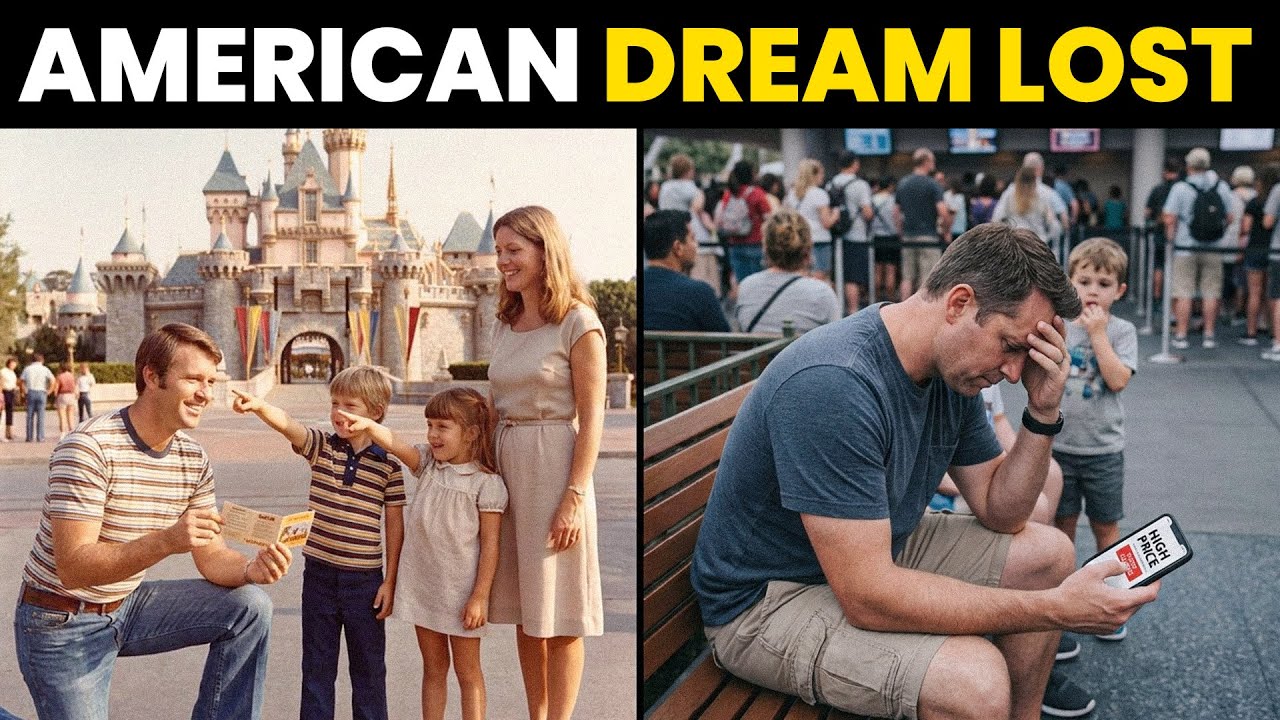
A single-day peak ticket now runs $189, more than six times the inflation-adjusted price. The road did not close. It just got expensive. The story of how the American middle-class family vacation disappeared begins in 1952, when a Memphis businessman named Kemmons Wilson took his five children on a road trip and came home furious.
Every motel he encountered was filthy. Each one charged extra for the kids. The beds sagged, the bathrooms smelled. Wilson drove home with a plan: a chain of motels on every highway in America, where children stayed free, the sheets were clean, and a pool sat outside.
He built a neon sign fifty feet tall, visible from two miles away, complete with a winking star. He called it Holiday Inn. For the next twenty years, that sign meant a tired family could pull over and finally exhale. This was the arrangement America made with the middle class after the war.
Work forty hours, get two weeks off. Point the Buick west, and the country opened up. By 1978, the average American worker took 20. 3 days of vacation every year.
At Disney, you bought a book of stamped coupons, used the rides you wanted, and saved the A tickets for the little ones. You showed up, you paid, you rode. No app, no reservation, no strategy meeting. Then came October 1973.
The OPEC embargo quadrupled the price of oil, from three dollars a barrel to twelve, in a matter of months. Congress dropped the national speed limit to fifty-five. Families bought smaller cars, planned shorter routes, and chose cheaper motels. Americans did not stop driving.
They stopped enjoying it. The thrill of the open highway, the reason a father would drive eleven hours to see a giant ball of twine in Kansas, died that October. Trips got shorter, and then they stopped happening. The oil crisis did not kill the family vacation.
It softened it up. The real damage came from American boardrooms. In 1982, at a Holiday Inn board meeting in Memphis, an accountant stood up and declared the great sign garish and too expensive to maintain. The board voted to tear down all of them.
Over a thousand glowing icons, coast to coast, were replaced with flat plastic squares that looked like every other motel in America. That sign had been a lighthouse for tired families, the reason a little sister pressed her nose against the back window at nine o’clock at night and yelled that she saw one. The identity went first. Then the places themselves went extinct.
In its prime, Howard Johnson’s was the biggest restaurant chain in America, with over a thousand locations, the orange roof, twenty-eight flavors of ice cream, and fried clams. The last Howard Johnson’s restaurant in America, one orange roof holding out in Lake George, New York, closed in 2022. You could walk from Maine to San Diego today and not find a single working one. Not one.
Then came the price. Disney eliminated the ticket books and introduced date-based pricing. Families now book months ahead and pay up to $189 for one day. Family travel costs have climbed double-digit percentages year after year.
That is not inflation. That is a filter, and the middle class does not make it through. If you were wealthy, none of this mattered. If you were poor, it was already out of reach.
If you were middle class, this was yours, and then it was not. The number of vacation days American workers earned did not collapse. The workers simply stopped taking them. Every year, American workers forfeit 768 million days of paid time off, days the boss already paid for.
Two hundred thirty-six million of those days are completely forfeited, with no rollover and no payout. That amounts to $65. 5 billion in benefits handed back to employers every year, free of charge. The reason is not laziness.
Americans are earning more vacation days than ever. Forty-three percent say they are afraid of the mountain of work waiting when they return. Twenty-eight percent worry they will look replaceable. Researchers call it work martyrdom.
The idea is that if you do not take a vacation, your boss will notice, will know you are the loyal one, and maybe you will not be the first one on the layoff list. So people go on vacation, but they are not on vacation. They check their phones in hotel bathrooms so the kids do not see. Forty-three percent of millennials say they use their vacation days just to sleep, not to travel, because they are that exhausted.
The United States remains the only advanced economy on Earth that does not legally guarantee a single paid day off. Germany gets twenty by law, France twenty-five, Japan ten. The United States gets zero. The middle-class family vacation did not die because families could not afford it.
It died because they got priced out of the places and scared out of the time, both sides of the squeeze at once. They did not get poorer. They got scared. Has the American family vacation come back?
Kind of. There are 2,500 relaunched Holiday Inns now. They are clean and efficient, with apps, key cards, and free Wi-Fi. The beds are fine.
The pool is fine. The lobby coffee is fine. Everything is fine. But fine is not what it used to be.
The orange roofs are gone. The great signs are gone. The $4. 75 ticket book is gone.
The wood-paneled Country Squire with all three kids in the wayback is gone. The 20. 3 days of vacation Americans used to take dropped to sixteen by the mid-2000s, and most people do not even take those. Somewhere in a garage, maybe yours, there is still a cooler like the one from those trips.
It still has the sticker. It still smells faintly of Coppertone and melted ice. Open it up, and you are not looking at a cooler. You are looking at a receipt for a quality of life that was traded away.
The great sign was swapped for a push notification. Two weeks on the road became forty-eight hours at an airport hotel. The feeling of being completely off became a Slack message on a Sunday night. Nobody took the family vacation away all at once.
It was given up, one small trade at a time, and everyone was too busy working to notice. The vanishing family vacation is not the only thing the middle class gave up between 1975 and today. There is one more thing, sitting in the driveway right next to that old station wagon.