In late August 1862, two generals studied the same map of northern Virginia and reached opposite conclusions. John Pope saw an army of fifty thousand men, a river protecting his front, and a railroad feeding everything he needed. He was confident, loudly and publicly so. He had issued proclamations to his troops telling them he came from an army that had seen only the backs of its enemies.
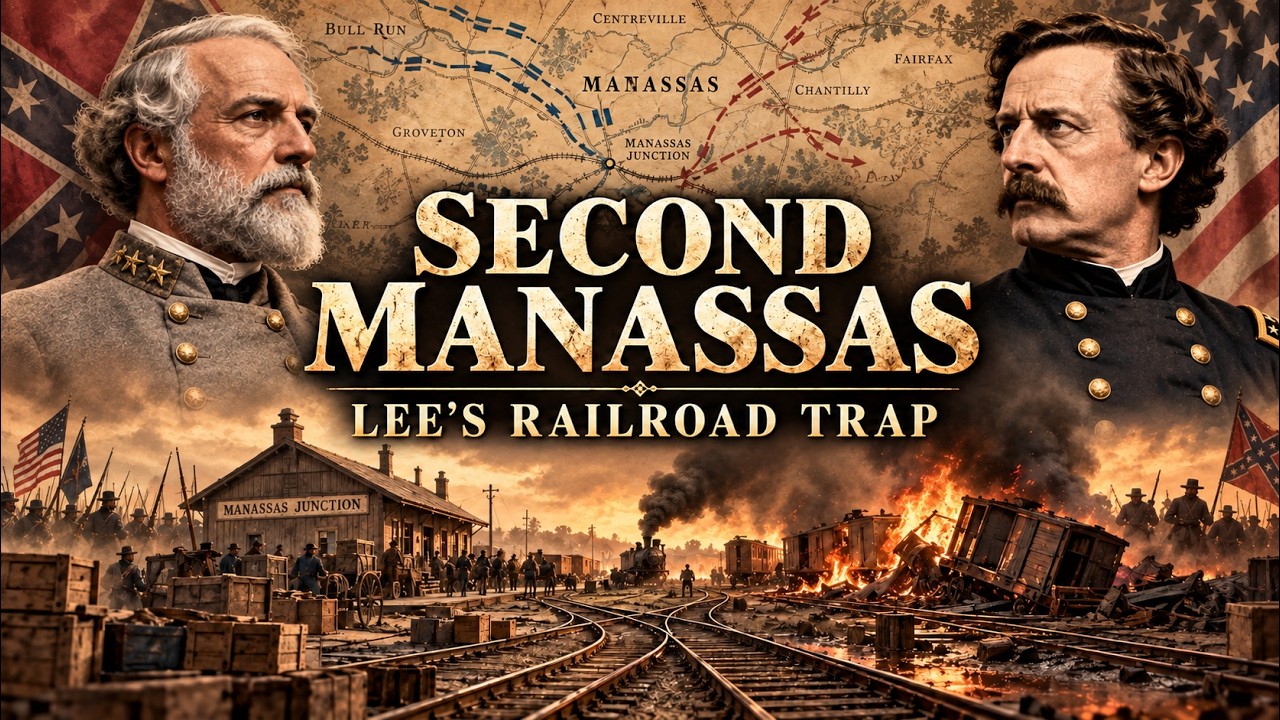
Robert E. Lee looked at the same map and saw something different. He did not look at Pope’s army. He looked at what held it in place: a single railroad line, a single depot, a single point through which flowed everything Pope required—food, ammunition, shoes, medicine, replacement rifles.
Pope saw a strong position. Lee saw a weakness. What followed, one of the Confederacy’s most brilliant operational victories of the war, began not on a battlefield but in that difference in how two men read the same map. To understand how Lee reached that point, you have to understand what he had just survived.
Six weeks before Second Manassas, Lee took command of what would become the Army of Northern Virginia, and the situation he inherited was as bad as it could be. George McClellan’s Army of the Potomac had spent the spring crawling up the Virginia Peninsula. McClellan, an engineer by training and cautious by nature, built roads, bridges, and supply depots as he advanced, until by late June his army stood within twenty miles of Richmond. The Confederate capital was a real and immediate target.
Lee spent the rest of June fighting McClellan through the outskirts of Richmond. These were the Seven Days Battles: Mechanicsville, Gaines’ Mill, Savage’s Station, Glendale, and Malvern Hill. The fighting was brutal. Coordination was often clumsy.
Stonewall Jackson, supposed to be the hammer driving McClellan toward the main Confederate force, was uncharacteristically slow throughout, a subject historians still debate. Confederate losses were heavy. There were moments when the campaign nearly failed. But when the smoke cleared, McClellan had retreated to the James River under the protection of Union gunboats, and the immediate threat to Richmond was gone.
Richmond was saved, and Lee gained something he had not possessed since taking command: the initiative. He could now choose where to strike instead of waiting for the next blow. The choice he made with that freedom would shape the next month of the war. While McClellan withdrew toward the James, Washington was already planning its next move.
John Pope came east from the Western Theater, where he had earned a modest reputation at Island Number Ten on the Mississippi, and took command of what Washington called the Army of Virginia. His mission was clear: operate in northern Virginia, pressure Confederate communications around Gordonsville, and eventually join with McClellan’s forces to form a unified army Lee could not withstand. Pope was confident. He issued public pronouncements.
He told his men he came from armies that had seen only the backs of fleeing enemies, and that a policy of taking strong positions and holding them did not appeal to him. He said he came from the West, where he was used to facing enemies face to face. This did not sit well with soldiers who had fought fiercely for a year and had their own opinions about what courage meant. But whatever Pope thought of himself, his strategic position was real.
The Rappahannock River covered his front, a genuine defensive barrier. Washington lay behind him, connected by the Orange and Alexandria Railroad. Trains ran south from Alexandria daily, through Manassas Junction, on toward Pope’s lines, carrying everything that kept a mid-nineteenth-century army in the field. This point matters because it is the key to everything Lee did next.
The railroad did not merely supply Pope’s army; it was the reason his army could remain in place. Fifty thousand men need food. They burn ammunition at a rate difficult to imagine unless you do the arithmetic. They wear out shoes.
They need medicine, replacement horses, repair tools. Every day they consume quantities of material that must come from somewhere. In northern Virginia in 1862, that somewhere was the railroad. Cut the railroad, and Pope’s fortified position behind the Rappahannock would cease to be fortified.
It would become a trap: fifty thousand men stuck in hostile country, running out of food and ammunition, their army’s ability to sustain itself collapsing sharply. Pope’s dispatches from this period show a commander focused outward, on Confederate positions, on when McClellan’s troops would arrive, on his own offensive intentions. The railroad was working, the trains were moving, the depot at Manassas Junction was full. There was no obvious reason to think about it.
Lee thought about it. A direct assault was never an option. Even with Jackson’s corps returned from the Shenandoah Valley, where they had spent the spring conducting one of the most famous campaigns in American military history, Lee’s army was smaller than Pope’s, and the situation would only worsen. Reports indicated McClellan’s army was being withdrawn from Harrison’s Landing on the James River.
Once those veterans began moving north to reinforce Pope, the military arithmetic would become impossible. A frontal attack was a way to lose the campaign in a single afternoon. Lee needed to pull Pope out of his position, and the one thing that might force Pope to abandon a river defensive line was a threat to the railroad behind him—not a threat he could ignore or repel, but a direct strike at the depot itself. So Lee decided to do something most commanders would consider reckless.
He decided to divide his army in the face of a larger enemy force. He would leave a covering force behind defensive works to hold Pope’s attention along the Rappahannock. He would send Stonewall Jackson with roughly twenty-three thousand men, nearly half the Confederate army, on a wide march around Pope’s right flank—not to attack Pope’s flank, but to bypass it entirely, reach Manassas Junction, Pope’s main supply depot, and destroy it. The battle Lee wanted to fight was not on the Rappahannock.
It was at the depot. On the morning of August 25, 1862, Jackson’s corps crossed the Rappahannock at Henson’s Mill Ford and turned north. What followed was one of the greatest feats of physical endurance of the Civil War. In forty-eight hours, after marching fifty-six miles in the blazing August heat, Jackson reached the rear of Pope’s army at Manassas Junction.
Fifty-six miles on foot in a Virginia August, with temperatures in the mid-nineties Fahrenheit and matching humidity, on roads that turned to red dust under the feet of tens of thousands of men carrying rifles and equipment on near-empty stomachs, because the wagons had been left behind and the men ordered to travel light. A Virginia soldier who made the march left a description of how it began. The orders came so quickly on the morning of the twenty-fifth that many men had no time to cook their rations. The biscuits were left behind half-baked, raw dough abandoned.
The column formed up as best it could. They passed the village of Orleans. They went through Salem after dark, having covered twenty-six miles, and stacked arms in the road. Many simply lay down where they stopped and slept before their bodies touched the ground.
They woke before dawn. The second day took them over the Bull Run Mountains, through Haymarket and Gainesville, advancing steadily through the August heat. By ten or eleven that night they halted near Bristoe Station: another twenty-six miles. The same soldier wrote that many men lay down in the very spot where they stopped.
Too exhausted by the march and the heat, they lacked the energy to move to the side of the road. Think of those men in the column on the evening of August 26. Two days, fifty-six miles, many of them with shoes completely worn through. Lee had written before the Maryland Campaign that thousands of his soldiers had no shoes at all.
The roads were hard, the heat merciless. Men fell out along the way, collapsing from heat exhaustion, and no one had the strength to help them. These were the men about to attack one of the largest Federal supply depots in northern Virginia. On the evening of August 26, Jackson’s advance cavalry reached Bristoe Station on the Orange and Alexandria Railroad.
Two trains were derailed, and a quarter mile of track was destroyed. Pope’s supply line, the artery that had been pumping life into his army for weeks, was cut. But Bristoe Station was not the objective. It was the announcement.
The objective lay four miles north. Jackson sent two regiments under Brigadier General Isaac Trimble to advance against the depot, reported to be lightly guarded. They captured it quickly, along with three hundred prisoners. What those two regiments found was one of the most remarkable scenes of the entire war.
The Confederate Army of Northern Virginia in the summer of 1862 was an army that possessed almost nothing. Men went days without adequate rations. Coffee was a memory for most. Sugar, preserves, the staples a mid-nineteenth-century soldier expected, had been scarce for months.
The army moved fast partly because it traveled light, and it traveled light partly because the Confederate supply system had been failing steadily since the start of the war. Manassas Junction was the antithesis of everything they had been living through. Pope had been using the depot as his main supply center. Trains had been arriving for weeks.
When Jackson’s men arrived, they found warehouses and open storage areas stacked with more than Confederate soldiers had experienced in recent memory. According to accounts from the period, there were knapsacks, bags of food, canteens filled with everything imaginable, enormous quantities of commissary supplies and provisions, and countless luxuries from sutlers’ stores, including expensive liquors and imported wines. One soldier described the strange sight of a starving man eating lobster salad and drinking Rhine wine, barefoot and in ragged clothes. A barefoot Confederate soldier, who two days earlier had been eating half-cooked biscuits on a road under the Virginia sun, was now eating lobster salad and drinking imported wine in a Federal depot.
A Virginia infantryman left a more detailed account. He described arriving at the depot and receiving orders to rest near the commissary stores. Then word spread. Rations were issued, not by weight or measure, but passed out package by package among the companies.
His company received in turn a barrel of cakes, a sack of bacon, and a barrel of sugar and coffee. The Yankees had prepared it all in advance, ready to cook. Then, when it became clear Federal forces were gathering and Jackson would have to leave, orders came to open everything and let the men take what they needed. He wrote of vast warehouses filled with every kind of delicacy: canned ham, lobster, tongue, candy, cakes, nuts, oranges, lemons, pickles, ketchup, and mustard.
He confessed that the old soldier’s mouth watered even now thinking of the good things they got there. Then the men had to choose, because orders stipulated taking four days’ rations—four days of carrying. So soldiers stood before warehouses full of food and made their decisions. Some filled their knapsacks with cakes, some with candy, some with oranges, some apparently with canned lobster and Rhine wine consumed on the spot.
And one man, the soldier telling this story, took only French mustard. He filled his haversack, and for good measure put another bottle in his pocket. That was his entire four-day ration. He later wrote that it turned out to be the best thing he took.
He traded it for meat and bread all the way to Frederick. An entire army standing before the greatest prize of its military life, and one man walked out with a haversack full of French mustard and profited from it for two weeks. Meanwhile, Jackson’s first order regarding the whiskey was unmistakable: smash in the heads of the hundreds of barrels of whiskey, wine, and brandy. He needed men able to march again before dawn.
By the night of August 27, fires were burning at Manassas Junction. Everything that could not be eaten or carried away was put to the torch: warehouses full of army supplies, ammunition, equipment, the entire reserve supply stock of Pope’s army. The column of smoke rising from Manassas Junction was visible for miles, even from Washington. Now consider what John Pope saw that night.
Three days earlier he had written confidently to his commanders about the enemy retreating. His cavalry had seen Confederate forces moving north through the passes of the Bull Run Mountains and reported it. But Pope initially concluded Jackson was simply moving toward the Shenandoah Valley, away from his front. Then the reports began to arrive: Bristoe Station, the railroad cut, the capture of Manassas Junction, the depot burning.
His supply line was gone. The depot was ash. There were twenty-three thousand Confederates somewhere behind his lines, and he did not know exactly where. Pope’s dispatches of August 27 and 28 grew increasingly agitated.
He issued orders contradicting earlier orders. He directed troops toward Jackson’s last known positions, positions Jackson had already left. A telegram of August 28, written with the confidence of a man who believed he had trapped his prey, went to corps commander Irvin McDowell: if you move quickly and immediately, we will bag the whole crowd. Pope had fifty thousand men advancing in a seven-mile arc to prevent Jackson’s escape.
But Jackson had left the previous night, by three different roads, specifically to mislead any pursuit. John Pope turned his entire army around. He abandoned his position on the Rappahannock, that strong, defensible river line that had made him nearly immune to direct assault, and marched northeast toward Manassas to find and destroy the Confederate force in his rear. This was, in one sense, the only rational response possible.
He could not ignore twenty-three thousand Confederates behind his lines. He had to deal with them. But in doing so, he did exactly what Lee wanted him to do. Pope was no longer behind the river.
He was no longer in a defensive position with a railroad feeding him reinforcements. He was moving, responding to the Confederate initiative, marching toward ground Lee had chosen, in the direction Lee wanted him to go. And Longstreet was coming through the mountains with thirty thousand more men. The operation had put Pope in a position where turning to face Jackson was a reasonable, perhaps inevitable, response.
Jackson, after burning Manassas Junction, had to disappear again. He pulled his corps a few miles northwest and placed them along a feature that would become one of the defining pieces of terrain in the battle: an unfinished railroad line that had been surveyed, graded, and partially built in the area, then abandoned when the money ran out. The workers were gone. The rails were never laid.
But the earthworks remained: a long, high embankment of packed earth, with cuts through the hills where the track was to pass. Confederate officers immediately recognized what this position offered. Men standing behind the embankment could fire down on attackers crossing open ground. The cuts channeled attack routes into predictable paths.
An army could hold this line against a much larger force as long as ammunition lasted. Jackson’s plan was simple in description and brutal in execution: hold this position, endure whatever Pope throws at you, do not retreat, do not withdraw, wait for Longstreet to arrive from the west. If the embankment held, the trap could close. If it broke, the entire campaign would collapse.
While Jackson waited behind his earthworks, Longstreet’s thirty thousand men were moving through the Bull Run Mountains. And there was a moment when everything almost fell apart. To reach Pope’s army from the Piedmont west of the mountains, Longstreet’s corps had to pass through a gap in the Bull Run range. He chose Thoroughfare Gap, a narrow defile where the hills dip enough to allow a road and a stream to pass side by side, with the walls of the gap rising sharply on both sides.
This was the hinge of the entire operation. If Union forces closed that gap, Longstreet’s corps would be stuck on the wrong side of the mountains, cut off from Jackson, cut off from Lee, unable to close the trap. Twenty-three thousand Confederates would be waiting behind a railroad embankment with no main force coming to join them. The entire plan lived or died at that gap.
Pope had cavalry intelligence reports of Confederate movements in the mountains. By August 28, he realized something important was happening to his north and west. He sent Brigadier General James Ricketts with a Union division to hold the gap. Ricketts arrived and took position to cover the pass.
What followed was a real fight. Longstreet hit the Union line from the front while sending other units through Hopewell Gap, a second, less obvious opening in the hills a few miles north. Ricketts found himself pressed from two directions at once with the force he had, unable to cover both passes. By the evening of August 28, the Union division was withdrawing.
Longstreet had passed through. The door remained open. The trap could still close. On the evening of August 28, Union troops from John Gibbon’s brigade were marching east along the Warrenton Turnpike, passing directly in front of Jackson’s hidden position on the embankment.
Jackson could have let them pass. Patience was the safe option. One more day and Longstreet would be in position. Instead, he opened fire.
The fight at Brawner’s Farm was a formal exchange of fire in the Victorian style: two forces standing in the open at close range, trading volleys in the fading evening light. Gibbon’s men fought fiercely. These were the soldiers who would earn the nickname the Iron Brigade, and they earned part of it here. Casualties were heavy on both sides.
The battle ended in something like a draw. Why did Jackson do it? Historians debate his exact reasoning, and honesty requires saying that. But the most persuasive explanation is this: he needed Pope to stop searching and start attacking.
He needed Pope to find him here, at the embankment, and commit to destroying him there while Longstreet was still coming. Brawner’s Farm was a signal fire. I am here. Come and get me.
Pope came. August 29 and 30, 1862. Pope convinced himself he had found Jackson: isolated, surrounded, and a strong enough blow would destroy him before Confederate reinforcements arrived. He was partially right about where Jackson was.
He was completely wrong about what it meant. The attacks of August 29 were piecemeal. Pope had the men to crush the embankment, but they went in division by division, sometimes brigade by brigade, at different times, never combining their weight into a single coordinated blow. Each attack was repulsed individually.
Between attacks, Jackson’s men resupplied themselves with any cartridges they could find on the ground and waited for the next wave. By midday, some Confederate units were so short of ammunition that men were throwing rocks at advancing Union infantry. Union soldiers coming across the open field toward the embankment knew what they were heading into. A soldier of the 24th New York described it later: we turned from a group of good-natured boys into the most bloodthirsty devils.
The embankment held against every assault of August 29. That evening, Longstreet’s thirty thousand men arrived from the west, taking position on Jackson’s right and extending the Confederate line southward. Pope, focused on the embankment in front of him, did not yet fully realize Longstreet was there. One of Pope’s staff officers later recalled seeing him that morning of August 30 standing under a tree, waiting for Jackson to retreat.
What his troops found when they advanced was Jackson’s corps still on the embankment, waiting, not retreating. The afternoon attacks of August 30 were heavier and more organized than anything Pope had sent the day before. At moments they nearly broke the Confederate line. At some points the fighting reached hand-to-hand.
Confederate units gathered ammunition from the bodies of dead Union soldiers to keep their rifles firing. The embankment held. But Pope’s army had now fully advanced, committed its entire strength, leaning into the fight against Jackson. The left flank, always the weak point, lightly fortified, was extended and exposed.
Before Longstreet’s attack, there was a moment worth pausing on, because it almost did not happen when Lee wanted it to. On August 29, Lee pressed Longstreet to attack. Jackson was holding the embankment. Pope was focused to the north and east.
The Union left flank was exposed. This was the decisive moment. Longstreet refused. The ground had not been fully reconnoitered.
The timing was not right. A premature attack might fail. He argued for waiting. Whether this was the right decision is a debate that has run since the 1860s, with Lee’s admirers and Longstreet’s defenders on opposite sides.
There is no definitive answer, and anyone who tells you otherwise has not read the historical scholarship. What we know is that Longstreet spent decades defending his decision in writing, and Lee’s supporters spent decades arguing that the one-day delay cost them the chance to destroy Pope’s army entirely. What we also know is that when Longstreet finally moved, it worked. Late in the afternoon of August 30, 1862, Longstreet moved.
Five divisions, twenty-eight thousand men, advancing simultaneously across a wide front, in one of the largest coordinated attacks of the war. A soldier named Andrew Coates of the 5th New York Infantry was on the Union left, the flank lightly fortified all day. He watched Longstreet’s corps coming. He wrote later: there was silence for a moment.
Then bang, bang, bang, bang. It did not just wound and kill men; it tore them apart. For the first hundreds of yards, Longstreet’s attack moved like a tide. It swept the Union flank not just with firepower but with the sight of it, the sheer mass of men moving across a front a mile wide.
Coates and his regiment were at Chinn Ridge, determined to hold the position. The first Confederate volley told them they were in for a hard fight. The second told them the battle was going badly. Hold the flag, for God’s sake, don’t let it fall into their hands.
That plea, from Francis Spellman of the same regiment, is recorded in official reports. The 5th New York held as long as it could, then the line broke. It broke the way a dam breaks, not gradually but all at once. Union regiments that had been fighting fiercely against Jackson’s positions suddenly found Confederate forces appearing on their left flank, then behind them.
The Army of Virginia began to collapse. There were moments of desperate courage during the retreat: officers rallying broken units, regiments making stands at Henry House Hill, the same ground where Union soldiers had made their last stand at First Bull Run a year earlier. Those stands slowed the pursuit enough to prevent outright catastrophe. Pope’s army survived destruction, but it survived as a shattered force streaming back toward Washington, no longer capable of independent operations.
Pope was relieved of command within days and reassigned to fight the Sioux uprising in Minnesota, an assignment that effectively ended his command of a large army. Only three months had passed since a massive Union army had threatened Richmond. The Richmond Examiner declared Second Manassas the most decisive victory the Confederacy had won on the Eastern front so far. Here is what Lee’s different question produced: the fifty-six-mile march, two regiments capturing Manassas Junction, a barefoot soldier eating lobster salad and drinking Rhine wine, a man with a haversack full of French mustard, fires visible from Washington, John Pope abandoning a defensible river line and marching his army onto ground chosen by his enemy, two days of fighting at an unfinished railroad embankment, then twenty-eight thousand men sweeping the Union left flank into collapse.
None of that resulted from Lee’s army being stronger than Pope’s. It was not. None of it required fighting Pope where he was strongest. Lee never did that.
It all traces back to a single decision made over a map: not asking where Pope’s strength was, but what gave him that strength. The answer pointed to a railroad, and Lee followed that answer wherever it led, including a plan that looked reckless from the outside and succeeded from the inside. The cost of that victory was real. Confederate losses for the entire campaign were about 9,474 killed and wounded.
Union losses were about 14,462. But Confederate losses must be understood proportionally. Lee’s army was smaller, and the Confederacy had fewer men to replace those losses. Every major victory cost the Army of Northern Virginia strength that could not easily be recovered.
By late August 1862, that army was smaller and more worn down than it had been in June. It would continue to diminish. There was no path by which that equation could be reversed. Pope’s army was broken, but it was not destroyed.
The Union rebuilt it. The war went on. Second Manassas was a brilliant operational victory. But it was not a solution to the war.
Within days, Lee was crossing the Potomac into Maryland—another gamble, another campaign seeking a way to achieve something decisive before the arithmetic caught up with him. That campaign would end at a creek called Antietam. But that is another story. There is one more person in this story.
A Virginia soldier survived the march, stood in the warehouses at Manassas Junction, made his choices, and carried those choices north through the campaign. Years after the war, he sat down to write what he remembered. Not strategy, not operational logic. What he remembered was the food: the cakes, the canned ham, the lobster, the Rhine wine drunk by barefoot men in ragged clothes, and the man who carried the mustard.
His name was John Worsham, a soldier in the 21st Virginia Infantry, who kept a record of the march and what he found at its end. Of everything available at Manassas Junction, he chose French mustard. He filled his haversack and added another bottle for good measure, then walked into the Virginia night. We know that during the next two weeks, as the campaign moved north toward the killing ground at Antietam, he traded the French mustard for meat and bread, bottle by bottle, and ate better than most of his comrades.
He understood something about value and scarcity and opportunity that most people grasp too late in life, if they grasp it at all. He also understood that a haversack full of mustard is worth nothing at all unless you are in a place where people want mustard. Robert E. Lee understood the same thing about a railroad.
That is where this battle began, and that is why it ended the way it did.