On the morning of June 3, 1864, roughly seven thousand Union soldiers fell in less than an hour at Cold Harbor, Virginia. When the shooting stopped, veterans who had survived Gettysburg, Antietam, and Fredericksburg quietly began sewing their names onto the backs of their coats so their bodies could be identified. They expected to be ordered forward again. By May 1864, the early war’s chivalry had given way to grinding industrial warfare, and at the center of it stood Ulysses S.
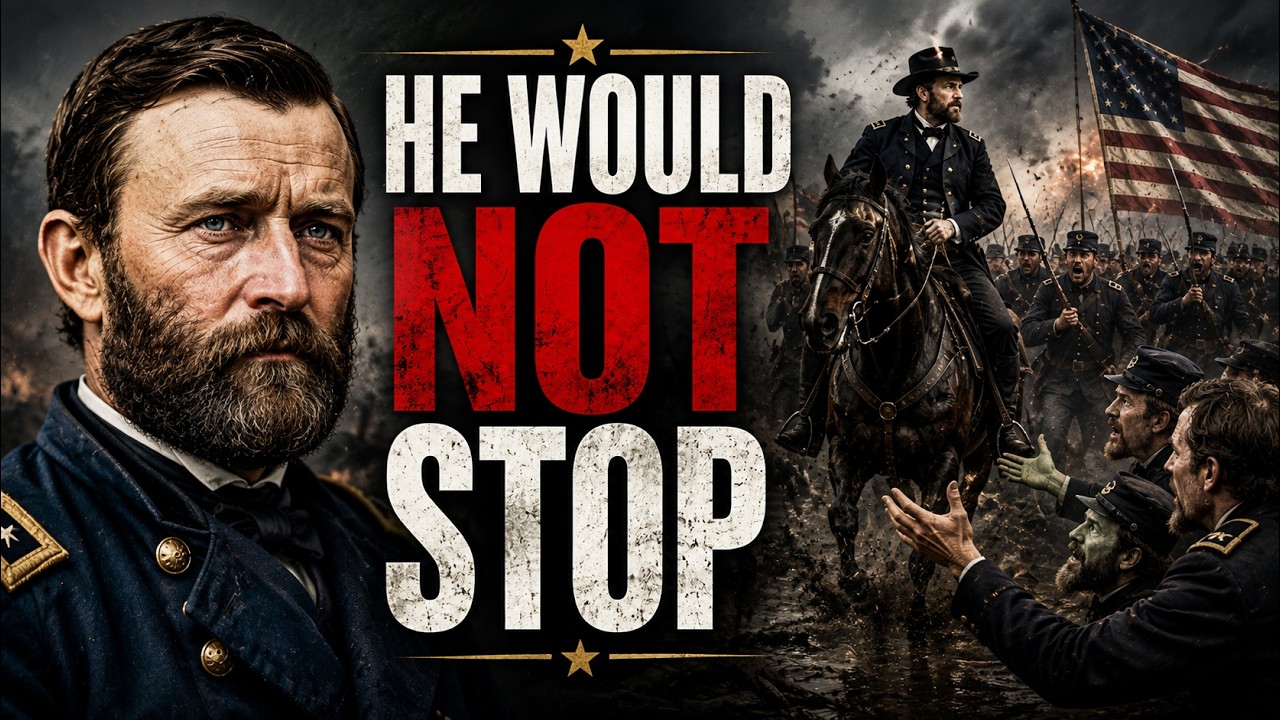
Grant. Grant was attempting something no Union general had done before. After the Battle of the Wilderness, where twenty thousand men had fallen in two days in a burning forest, every man in his command braced for retreat. McClellan would have retreated.
Burnside had. Hooker had. It was simply what Union commanders did. Grant turned south instead.
As the bodies piled up at Spotsylvania, North Anna, and Cold Harbor, the pressure came not only from the Confederates across the field but from inside his own camp. His core commanders were exhausted. His staff was terrified. Hardened, experienced soldiers begged him to halt, to rest, to breathe.
Grant offered no speech and no compromise. He turned south again. To understand why Grant would not stop, one has to understand the pattern he broke. For three years before his arrival in Virginia, the Eastern Theater had followed a rhythm everyone had come to expect.
A Union general would take command, mobilize the Army of the Potomac, march toward Richmond or toward Robert E. Lee’s army, fight several battles, and then, as casualties mounted, withdraw. McClellan did it. Burnside did it.
Hooker did it. Even George Meade, still commanding the Army of the Potomac under Grant’s overall authority, had learned the pattern. By 1864, Lee counted on it as reliably as the seasons. Grant gave orders for the Overland Campaign, a sustained offensive aimed at destroying Lee’s army.
The Wilderness took eighteen thousand Union casualties. Men burned alive in undergrowth fires. But when May 7 came and the smoke cleared, the familiar order to retreat north across the Rapidan never came. Instead, Grant ordered the army south.
One veteran remembered that when the men realized they were marching south instead of back across the river, a cheer went up along the lines. They were not retreating. Lee rushed his army south to meet them. The two forces collided at Spotsylvania Courthouse, a small crossroads that became one of the bloodiest places in American military history.
Lee had fortified a massive salient, a bulge in his lines protected by artillery and entrenchments. Grant sent Winfield Scott Hancock’s Second Corps, twenty thousand men, crashing into that salient on May 12. The assault broke through, but Lee rushed in reinforcements, and the two armies fought in close-quarters combat for eighteen hours. Union losses that day reached roughly nine thousand, Confederate losses around eight thousand.
Grant’s officers were devastated. Meade, technically the commander of the Army of the Potomac, bristled at Grant’s presence and resented his diminished role. Historians note real tension between their staffs. Some officers sensed Meade’s unease with the relentless pace.
He continued to carry out Grant’s orders, but the strain filtered through headquarters. Grant did not stop. After Spotsylvania, the armies fought at the North Anna River. More casualties.
Then Bethesda Church. More casualties. Finally, they came to Cold Harbor, a crossroads near a tavern that had once offered travelers cold shelter without heat. Lee’s army had fortified the position with multiple lines of earthworks and rifle pits, with artillery on commanding ground.
They had time to dig in. Grant arrived with the Army of the Potomac battered and worn, thirty days into continuous combat. In the days before the assault, men wrote letters they were not sure they would survive to send. One soldier wrote home, “We have done marching enough for the present, I think.
I hope we shan’t have to make any more charges. ” He would not get his wish. At 4:30 a. m.
on June 3, Grant ordered the assault. Roughly fifty thousand men in three Union corps were assigned to the attack, though not all advanced at once. Wave after wave went forward into the Confederate entrenchments, and wave after wave was cut down. In less than an hour, the assault collapsed.
Union soldiers had gained almost nothing. Estimates put Union casualties at roughly seven thousand in the first phase of the attack alone, with total federal losses at Cold Harbor around twelve thousand. Confederate losses were on the order of four thousand five hundred. By any reasonable measure, it was one of the worst tactical defeats of the war.
Grant admitted it. He later wrote, “I have always regretted that the very last assault at Cold Harbor was ever made. No advantage whatever was gained to compensate for the heavy loss we sustained. ” He had ordered it anyway.
Grant had worked out a cold logic his officers could not yet accept. The Union had begun the campaign with about one hundred twenty thousand men. The Confederacy had about sixty thousand. The North, with a population of twenty-two million, could replace its losses.
The South, with a population of nine million, nearly half of them enslaved people who could not serve as ordinary soldiers, could not. In thirty days, the Union had lost roughly fifty-five thousand men, but it could produce new soldiers. The Confederacy had lost roughly thirty-three thousand, and it could not. Lee was running out of men.
Grant also saw something beyond population arithmetic. The North had factories working around the clock, twenty thousand miles of railroad to move recruits and supplies to the front in days, and an industrial base the South could not match. Lee’s army was an island. Every casualty was permanent.
Every supply consumed could not be replaced. The Confederate States were being strangled by the Union blockade. Their economy was collapsing. So Grant’s calculation was brutal but simple.
Keep Lee fighting. Keep him bleeding. Eventually his army would cease to exist, not dramatically, but through slow, grinding dissolution. Regiments would dwindle, supplies would run out, desertion would increase.
And if Grant stopped, if he retreated to rest and resupply, Lee would get breathing room. He could reorganize, consolidate, reinforce other theaters. Stopping was worse than fighting because stopping gave Lee a lifeline. Grant could not stop.
Not after the Wilderness. Not after Spotsylvania. Not after Cold Harbor. Every day he stopped was a day Lee got stronger.
His own generals did not understand it. After Cold Harbor, the mood in the Army of the Potomac was grim. Senior officers who had seen the worst the war had to offer questioned Grant’s judgment in private. Some sounded close to open defiance.
In Washington, the pressure was worse. Secretary of the Navy Gideon Welles wrote in his diary that the country was becoming accustomed to the constant sacrifice. Newspapers that had praised Grant’s aggressiveness began calling him a butcher. Congress started asking questions.
Mary Todd Lincoln was reported to have called Grant “that butcher” and urged her husband to remove him. Whether or not she used those exact words, the stories captured how horrified civilians were by the bloodshed. Before the campaign began, Lincoln had written privately to Grant that he was entirely satisfied with his plans and would not interfere. That trust mattered now, when everyone else was calling for Grant’s head.
Yet Grant did not stop. His plan, conceived even before the assault at Cold Harbor, was to move southeast, swing around Lee’s right flank, and march toward Petersburg, a major Confederate supply hub south of Richmond. If Grant could seize or even threaten Petersburg, Lee would be forced to abandon his fortified positions and fall back. The key was that the army had to move immediately, while Lee was still reeling.
The exhausted, demoralized Army of the Potomac was ordered to march again, and the men obeyed. They had learned something no amount of reasoning could have taught them. Grant would not turn back. One soldier wrote, “Grant seems determined to outflank Lee’s right and force him to abandon his entrenchments.
Though we are worn out and the list of dead and wounded grows hourly, there is a feeling in this army that we are finally making progress. ” These were men who had fought for three years with nothing to show for it. Now they felt the war was actually moving somewhere. In mid-June 1864, Grant’s army crossed the James River on a pontoon bridge nearly twenty-one hundred feet long, constructed in under eight hours.
Lee did not know where Grant had gone. For a brief moment, the Army of the Potomac had slipped away entirely. But the Union commanders at Petersburg moved too slowly. By the time the first assaults went in, Lee had rushed troops south to defend the city.
The window closed, and the siege of Petersburg began. Nine and a half months of trench warfare looked on the surface like Grant had failed again. But it was not a failure. It was the trap closing.
Every week Petersburg held, Confederate supplies dwindled. Every week Lee’s men deserted in growing numbers. Lee wrote to Jefferson Davis in increasingly desperate terms about the state of his army. The Army of Northern Virginia was dissolving, not through battle, but through slow starvation and exhaustion.
On September 2, 1864, a telegram arrived in Washington that changed everything. “Atlanta is ours and fairly won. ” William T. Sherman.
The fall of Atlanta, coordinated with Grant’s strategy of simultaneous pressure across all theaters, meant the Confederacy could no longer shift troops from one front to another. Abraham Lincoln, who had faced a genuine possibility of losing the 1864 presidential election to a peace candidate, won re-election in November by a landslide. The North had chosen to continue the war. The North had chosen Grant.
Through the fall and winter, the siege tightened. Grant extended his lines west, forcing Lee to extend his own thinner and thinner lines to match. Lee’s army, which had entered the Overland Campaign with roughly sixty thousand men, was now a shadow of itself. Boys and old men filled the ranks.
On April 2, 1865, Union forces finally broke through the Confederate lines at Petersburg. Lee evacuated the city and Richmond. The Confederate government fled south in the night. Grant gave the order every general before him had failed to give.
Pursue. He sent Sheridan’s cavalry racing ahead to cut off the Confederate retreat, closing every road and blocking every escape route. On April 9, 1865, at Appomattox Courthouse, Robert E. Lee asked to discuss terms of surrender.
Grant arrived in his mud-spattered field uniform, no sword, no ceremony. Lee came in full dress uniform with his sword. Grant offered terms so generous that Lee was visibly moved. Confederate officers could keep their sidearms.
Soldiers who owned horses could keep them. No one would be prosecuted. No one would be imprisoned. The men would simply go home.
One year from the Rapidan Crossing to Appomattox. What previous commanders had failed to accomplish in three years of war, Grant had done in twelve months. When Union soldiers began firing artillery in celebration, Grant ordered them to stop. “The war is over,” he said.
“The rebels are our countrymen again. ”
Grant knew exactly what he was doing. He was not detached, not numb, not the cold machine his critics described. During the Overland Campaign, documented by his staff, Grant sat alone after receiving the casualty reports from the Wilderness, put his face in his hands, and wept.
Not in front of his generals, not in front of his staff, alone in his tent in the dark. He felt the weight and carried it anyway. He later wrote his memoirs not for glory but because his family was broke and he wanted to leave them something. He finished the manuscript four days before he died of throat cancer on July 23, 1885.
In those memoirs, he explained the logic, defended the strategy, and insisted with quiet conviction that there was no other way. He never quite answered whether it was worth it. He never stopped asking, even after history had told him it was. The men who had sewn their names into their coats on the morning of June 3, 1864, lived to take them out.
Grant did not stop, not because he did not feel the weight, but because he felt it completely and carried it anyway. He understood that the cost of stopping was higher than the cost of continuing, that mercy shown to his own army in the short term meant cruelty to the nation in the long term, and that the fastest path through the suffering was straight through it. He never, not for a single day, pretended the cost was anything less than what it was.