The U. S. Army entered the American West with superior numbers, modern weapons, and the confidence of a professional military. That did not mean it understood how to fight on the frontier.
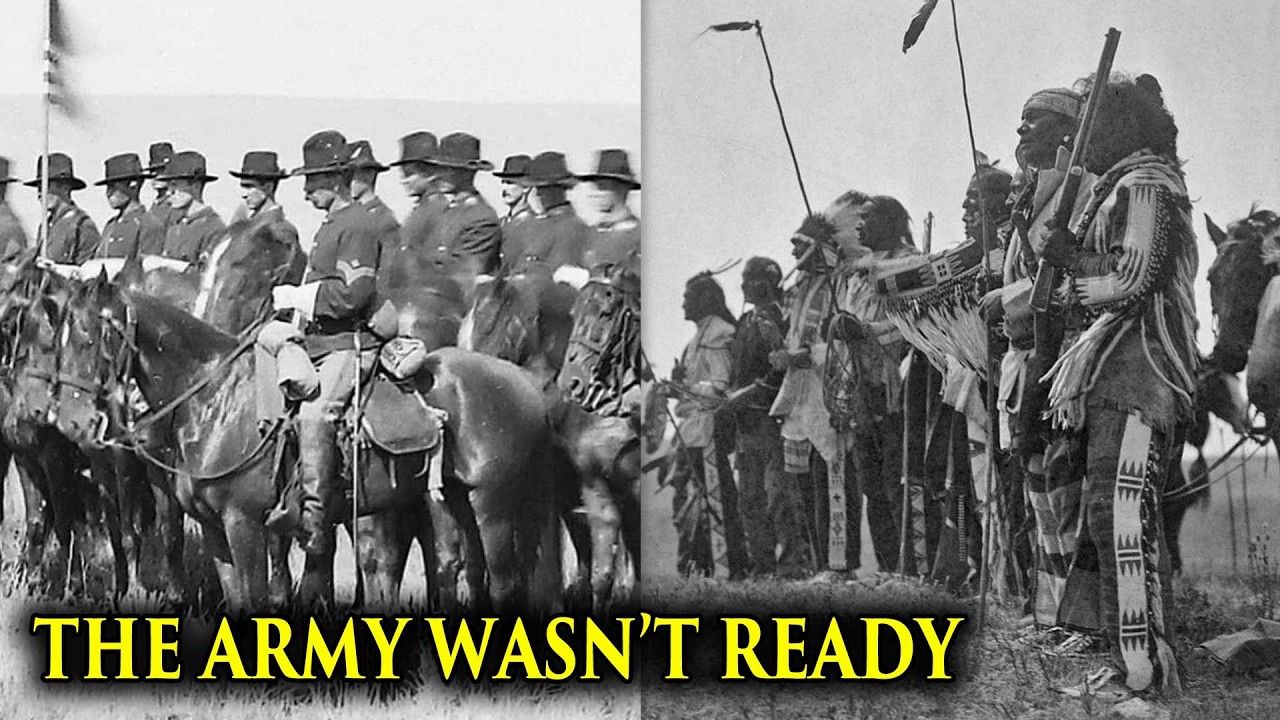
Native warriors knew the terrain, moved with astonishing speed, and used deception, surprise, and carefully timed attacks to exploit weaknesses in conventional army tactics. From sudden ambushes to feigned retreats and hit-and-run strikes, these methods repeatedly forced American soldiers to fight in unfamiliar conditions. The most effective of these tactics, and the concern they caused among experienced military commanders, would shape some of the most important conflicts of the American West. The popular image of the frontier comes from old films: a column of blue-coated cavalry, outnumbered but determined, armed with advanced repeating rifles, while on the opposite ridge warriors carrying obsolete muskets or simple bows prepare to attack.
The historical record tells a very different story. During most of the Indian Wars, individual Native warriors were often better equipped for the fast-moving, close-range combat of the frontier than the average U. S. Army soldier.
The assumption of automatic Western technological superiority simply does not hold, and this misjudgment had serious consequences. In 1873, seeking to standardize equipment and reduce expenses for a peacetime army, officials adopted the Springfield Model 1873, popularly known as the Trapdoor Springfield. On paper it was a strong design, using the powerful . 45-70 cartridge, accurate at long ranges, and built to withstand harsh conditions.
Its main weakness was that it could fire only one shot before needing a manual reload. Army leadership, still influenced by older tactical thinking, feared that faster repeating rifles would cause troops to consume ammunition too quickly. They preferred a slower, more controlled rate of fire. The result was a weapon suited to a style of warfare that was already becoming outdated.
Worse still was the ammunition. To cut costs, the government produced cartridges with soft copper casings instead of more durable brass. In the harsh conditions of the western plains, the soft metal became a serious liability. Rapid firing heated the chamber quickly, causing the copper casings to expand and stick to the barrel.
When soldiers tried to extract an empty round, the mechanism tore the soft rim instead of pulling it out, disabling the weapon. The only field solution was to pry the stuck casing out with a knife, a slow and difficult task in the middle of a fast-paced engagement. Meanwhile, Native tribes were not bound by the same ordnance restrictions. Through trade networks and frontier merchants, groups such as the Lakota, Cheyenne, and Comanche obtained some of the most advanced firearms of the time.
Many warriors carried lever-action rifles like the Henry and the Winchester Model 1866, which used tubular magazines that allowed rapid, sustained fire of up to fifteen rounds in under thirty seconds without reloading. This disparity is now evident from modern archaeological research at the Little Bighorn battlefield. Popular history long assumed that Custer’s troops were defeated mainly because of superior enemy numbers, but precise mapping of cartridge cases and bullets using modern forensic techniques revealed a more complex picture. The evidence indicates that Lakota and Cheyenne forces possessed at least 375 modern firearms, including Winchesters and Henrys.
As the 7th Cavalry formation collapsed, the volume of counter-fire from Native forces was not merely equal to that of the soldiers but greatly exceeded it. In the final chaotic half hour of the engagement, some estimates put the rate-of-fire advantage at roughly five to one in favor of the Native forces, while U. S. soldiers struggled with the slow load-and-fire cycle and clearing jams.
New recruits arriving at frontier posts often carried an unjustified confidence in their equipment. Veterans, especially those who had served in the Civil War, understood the reality on the ground. They recognized that their single-shot rifles put them at a disadvantage if trapped in open terrain against opponents with superior weapons, riding skills, and mobility. For the mid-nineteenth-century European or American military mind, cavalry was a precise, disciplined tool.
Soldiers trained to ride in tight formations, advance across open ground, and use sabers or coordinated pistol fire. Many were technically dragoons, soldiers who used horses primarily for fast movement and often dismounted to form traditional skirmish lines once the engagement began. For them, the horse was essentially a means of transport controlled by a rider whose feet remained firmly in iron stirrups. When the army moved onto the Great Plains, they encountered peoples such as the Comanche and Lakota, for whom horsemanship meant something entirely different.
Children learned to ride as soon as they could walk. This level of mobility not only challenged American officers but alarmed them, making much of their West Point training far less effective on the open plains. The Comanche in particular built a vast sphere of influence known as Comancheria, stretching across parts of Texas, New Mexico, and Kansas, founded largely on their exceptional equestrian skill. Plains warriors often rode without heavy saddles or iron stirrups, using a simple leather strap instead.
They guided their horses through slight shifts in weight, knee pressure, and quiet vocal signals, leaving both hands free for other tasks. One technique, known to frontier observers as the rider shield, involved the rider swinging his body to the far side of a galloping horse, which could reach about thirty miles per hour, while clinging with a braided strap around the horse’s neck and a heel hooked over its back. This position made it extremely difficult for opposing marksmen to target the rider directly. From the perspective of a soldier on the ground, the horse itself became a moving barrier with very little of the rider exposed.
Yet from under the horse’s neck, a skilled warrior could still aim and fire an arrow or weapon accurately at full speed. While American soldiers using muzzleloaders or single-shot Springfields typically needed fifteen to twenty seconds to reload, a Comanche warrior could use this method to loose up to twenty arrows per minute. Given the momentum of the galloping horse, these arrows carried enough force to pierce a large animal such as a buffalo. The painter and explorer George Catlin, who spent time among the southern plains tribes in the 1830s and 1840s, recorded his astonishment at these riding techniques, describing the ability to swing down under the horse and back into the saddle at full gallop as nearly physically impossible and ranking these warriors among the finest horsemen he had ever seen.
One of the most effective tactics born from a deep understanding of the American military mindset was the feigned retreat, which turned the army’s own momentum into a weakness. On the morning of December 21, 1866, a small decoy group of about ten warriors, including Crazy Horse himself, approached Fort Phil Kearny in the Powder River region of Wyoming and engaged a wood-cutting party. Captain William J. Fetterman, known for his confidence in his troops’ ability against Native fighters, was sent out with eighty-one men.
Crazy Horse and the decoy group began a deliberate retreat, appearing disorganized and exposed, luring the pursuing soldiers toward Lodge Trail Ridge, out of sight of the fort. Fetterman had received explicit orders not to pursue any opponent beyond the ridge, but the sight of a withdrawing enemy force led him to continue the chase. Once the column crossed the ridge, a much larger force, estimated between one thousand and two thousand Lakota, Cheyenne, and Arapaho warriors, appeared from hidden positions along the valley. The retreating decoy group turned back, and Fetterman’s unit was surrounded from multiple directions.
The engagement was short and decisive. The terrain offered little cover, and the sudden appearance of a vastly larger force threw the soldiers into confusion. In the close-quarters fighting, the single-shot army rifles proved ill-suited to the fast-paced engagement. According to official military records, all eighty-one men under Fetterman’s command were killed in approximately thirty minutes.
No one survived. In the rugged terrain of Arizona, New Mexico, and northern Mexico, the army faced the Chiricahua Apache, an opponent that forced them to abandon conventional methods entirely. While American soldiers depended on a continuous supply chain of wagons loaded with food and equipment, Apache groups traveled with minimal provisions. They could sustain themselves from an environment most soldiers considered nearly uninhabitable, extracting moisture from desert plants, finding hidden water sources, and surviving for long periods on very little food.
A small group could cover up to seventy miles in a single day across mountainous terrain under intense desert heat, conditions that often exhausted cavalry horses and heavily laden infantry. This dynamic became especially clear during the final phase of the Geronimo campaigns in the 1880s. A small band of Chiricahua Apache, numbering fewer than forty active fighters along with about sixty community members including women, children, and elders, evaded a combined force of roughly five thousand American soldiers and three thousand Mexican soldiers for nearly two years, draining a significant portion of the military resources available in the region. Apache fighters did not merely use their surroundings for cover; they blended into them almost completely, using natural materials and stillness to become nearly invisible.
A patrol could pass within a short distance of a concealed individual without noticing anything unusual. General George Crook, who spent years studying Apache tactics, wrote candidly of their exceptional skill and warned that pursuing them by standard military methods was often ineffective. The decentralized command structure of Native forces proved another decisive advantage. In a traditional military unit, the loss of officers often led to confusion, as soldiers were trained to rely heavily on direct orders.
Native war parties did not operate under a rigid chain of command. Before an engagement, a council might agree on an overall approach, but once fighting began, centralized coordination gave way largely to individual decision-making, with each warrior acting on his own judgment and reading of the situation. This difference became especially clear during the collapse of the 7th Cavalry at the Battle of the Little Bighorn on June 25, 1876. When Lieutenant Colonel George Armstrong Custer divided his forces and advanced toward a large camp along the river, he expected a relatively conventional response.
Instead, his troops faced a highly adaptive, multi-directional response from Lakota and Cheyenne forces. In a separate detachment under Major Marcus Reno, officers lost cohesion, and soldiers struggled to adapt without clear direction. On the ridges where Custer’s direct command found itself surrounded, company commanders became separated from their men, and the formations they had organized quickly lost coherence. Archaeological evidence indicates that rather than maintaining organized defensive positions, a number of soldiers broke off and moved individually across the terrain, seemingly waiting for instructions that never came.
Meanwhile, Lakota and Cheyenne warriors continued to operate with a high degree of coordination through individual initiative, with leaders like Gall rallying nearby warriors by personal example rather than formal command. By the late 1870s, army leadership was forced to confront a difficult reality. In direct tactical engagements on the open plains, conventional forces often struggled to outmaneuver Native war parties in mobility, coordination, and combat skill. Generals William Tecumseh Sherman and Philip Sheridan shifted their focus from direct engagement with warriors to targeting the broader systems of food and settlement that plains communities depended on for survival.
A central element of this strategy was the large-scale reduction of the American bison herds, actively encouraged by military and commercial interests. The bison population, estimated at around thirty million in the early nineteenth century, had shrunk dramatically by the 1880s due to commercial hunting that military and government policies permitted and in some cases encouraged. Sheridan spoke publicly in favor of continued unrestricted hunting, describing it as an effective means of resolving ongoing conflicts by removing a vital resource. The second key component involved launching military campaigns during the winter months, a period both sides had traditionally avoided due to harsh conditions.
Recognizing that winter reduced the ability of tribal communities to move, military leadership began winter campaigns targeting settlements during this vulnerable period, often focusing on disrupting horse herds, food stores, and shelter rather than engaging in direct combat. By the end of the Indian Wars, the army had largely achieved its objectives, not primarily through tactical victories in battle but through a sustained strategy aimed at undermining the resources and living conditions that plains peoples relied on for survival. These conflicts represented a fundamental clash of military styles and cultural values. Native warriors were highly skilled strategists who forced the most powerful army of the era to rewrite its plans entirely.
The tactical legacy of Comanche horsemen, Apache fighters in difficult terrain, and leaders like Crazy Horse left a lasting impact on how the American military approached irregular warfare. The U. S. Army eventually named some of its most advanced equipment, including the Apache, Kiowa, Black Hawk, and Chinook helicopters, after the very peoples it once fought.
Military institutions now study the Indian Wars as an important historical case study in asymmetric conflict and unconventional warfare, finding meaningful parallels between historical Apache tactics and modern irregular warfare. The lesson that an organized, technologically advanced army can still face significant challenges from an adaptable opponent skilled in using terrain and exploiting rigid command structures remains relevant to military strategists today.