In September 1506, Philip the Fair, Duke of Burgundy and consort of Queen Joanna of Castile, died suddenly of typhoid fever. His wife, who had spent years trapped in a marriage marked by his public infidelities, refused to leave his body. According to several accounts, Joanna kept the coffin close by and ordered it opened repeatedly to gaze upon her husband’s decaying corpse. Whether or not the story was entirely true, it circulated quickly among the courts of Europe.
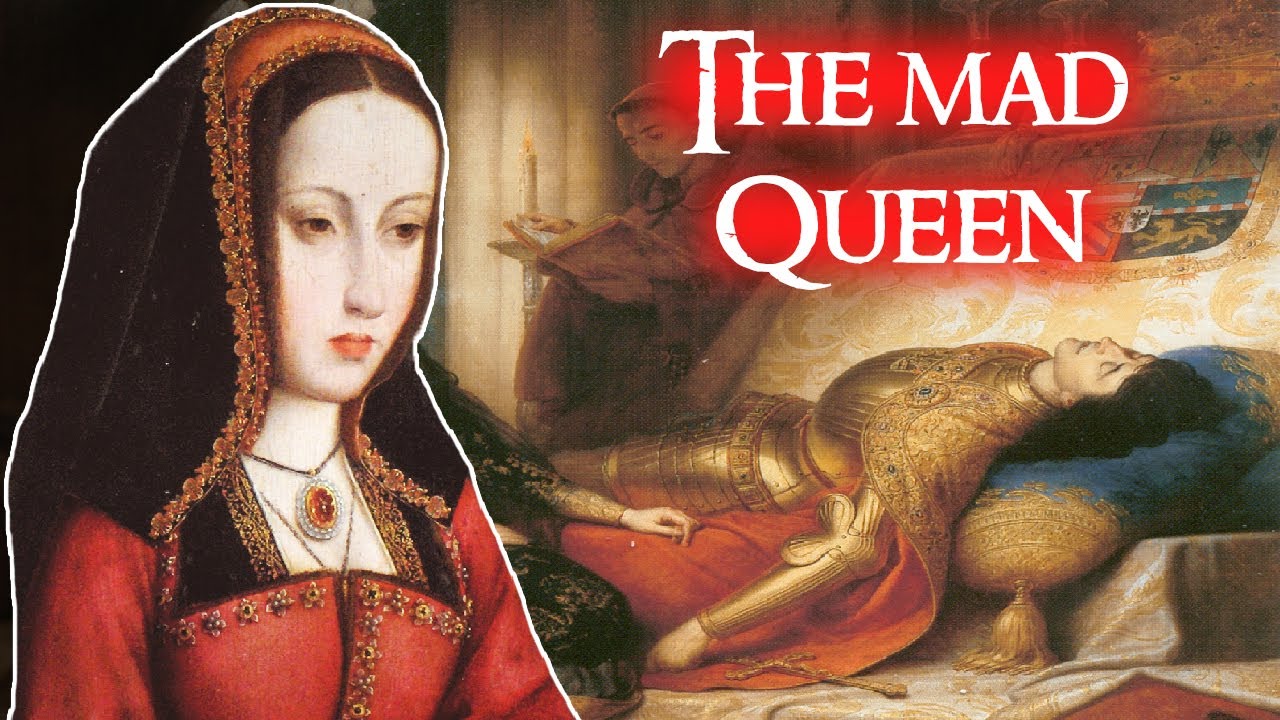
And for Joanna’s father, King Ferdinand of Aragon, it was a gift. Joanna, known to history as Joanna the Mad, was born on 6 November 1479, the third child and second daughter of Isabella I of Castile and Ferdinand II of Aragon. Her parents’ marriage in 1469 had created a dynastic union between the two most powerful kingdoms of the Iberian Peninsula. Castile dominated the center of the country, stretching south toward Toledo and north along the coast of the Bay of Biscay.
Aragon, whose traditional capital was Zaragoza, had expanded east and southeast to absorb Barcelona and Valencia. By the time Isabella and Ferdinand completed the conquest of Granada in 1492, the last Muslim stronghold in Iberia had fallen, and the two monarchs ruled over nearly the entire peninsula, with only Portugal remaining independent. Their kingdoms, however, remained separate. Isabella ruled Castile, Ferdinand ruled Aragon, and the marriage contract stipulated that they would continue to do so throughout their lifetimes.
Whichever child succeeded them would one day inherit both crowns and rule over a vast territory. But at the time of Joanna’s birth, that prospect seemed distant. She had an elder sister, Isabella, and a slightly older brother, John. The succession belonged to them, not to her.
Joanna received the education typical of a Renaissance princess. She studied the writings of the Church Fathers alongside the works of Greek and Roman authors, learned to play the clavichord, the guitar, and the monochord, and mastered several languages spoken across her parents’ realms, including Castilian, Leonese, Catalan, and Portuguese. Her relationship with her mother, however, was strained. Isabella and Ferdinand’s religious zeal was legendary throughout Europe, earning them the title of the Most Catholic Monarchs.
Isabella had established the Spanish Inquisition to prosecute heretics. Joanna, by contrast, was reported to be a lukewarm Catholic, and rumors circulated that her mother had her effectively tortured in an effort to strengthen her piety. Because Joanna was not expected to inherit, her parents decided to marry her into one of Europe’s other great families. Their foremost enemy was France, with whom they had been at war for control of the Italian Peninsula.
France had another bitter rival in the Austrian House of Habsburg, which ruled the Low Countries, a broad region encompassing much of the modern Netherlands, Belgium, and Luxembourg. Maximilian I, the head of the House of Habsburg and the Holy Roman Emperor, agreed to marry his eldest son and heir, Philip the Fair, to Joanna. He would also marry his daughter Margaret to Joanna’s brother John, cementing a strong marital alliance between the Spanish monarchs and the Habsburgs. Joanna was married to Philip in 1496, when she was just sixteen.
Her marriage entourage, consisting of over one hundred ships, arrived in the Low Countries in August, and the couple were married on 19 October. Over the next decade, they had six children, four daughters and two sons, each of whom would go on to rule as emperors, kings, and queens. Despite this outward dynastic success, the marriage was troubled. Philip was a serial philanderer, and his unfaithfulness was common knowledge.
Even more worrying, Joanna began to show signs of emotional instability during their years living in Brussels. She would oscillate between periods of depression and rage, though it remains unclear whether she suffered from genuine illness or was reacting to an unhappy and humiliating marriage. Her position changed dramatically when her older siblings died. John died of an unspecified illness in 1497.
His wife Margaret was pregnant at the time, but the child was stillborn, ending John’s line. The following year, Isabella died while in labor. The infant survived but was sickly from the beginning and died in 1500. Joanna, once a minor figure in dynastic politics, was now her parents’ heir.
Philip was well aware that he was married to the future successor of Castile and Aragon, and he increased his efforts to control his wife. Joanna, in turn, appears to have engaged in a form of passive protest, remaining in her rooms and refusing to eat. Again, it is unclear whether this was the behavior of a genuinely unwell woman or the deliberate resistance of a wife who could not otherwise escape her husband’s domination. On 26 November 1504, Isabella of Castile died.
Because the marriage contract required Castile and Aragon to remain separate, Joanna now succeeded as Queen of Castile while her father continued to rule Aragon. This created a dangerous rivalry between Ferdinand and Philip, both of whom sought to control the kingdom. Ferdinand began pressing the argument that Joanna was mentally unstable and therefore unfit to rule. He proposed that he should govern Castile as regent until Joanna’s eldest son, Charles, came of age.
This would bypass Joanna entirely and, just as conveniently, block Philip from interfering in Castile. From 1505 onward, Ferdinand campaigned to convince the nobles of Castile to elect him regent in his daughter’s stead. Joanna did nothing to help her case in the months that followed. Then, in September 1506, her husband died of typhoid fever.
The stories of her refusing to leave his body and opening his coffin only reinforced the image of a woman unhinged by grief. Ferdinand seized on the reports. In the summer of 1507, Joanna was forced to hand over the regency of Castile to her father. She was effectively relegated to a position of zero power, while Ferdinand added Castile to his kingdom of Aragon.
Historians have long debated whether Joanna was truly mad or whether her alleged madness was exaggerated or even invented by the men who benefited from it. Ferdinand certainly benefited. So did her son, Charles. Joanna was originally detained at the palace of Tordesillas in the province of Valladolid, the same place where the 1494 treaty dividing the Americas between Spain and Portugal had been signed.
She lived there with her daughter Catherine, effectively under arrest by her father’s regime. Ferdinand visited her only twice during this period. When Ferdinand died in 1516, a peculiar situation emerged. Joanna, the supposedly mad queen who had been under house arrest for years, finally succeeded to the Kingdom of Aragon.
The crowns of Castile and Aragon were at last united under her rule. The new territory, which historians later named Hispania after the Roman term for the region, became the Kingdom of Spain, and Joanna was its first queen. But despite her title, Joanna remained a prisoner. Her jailer was now her son, Charles, who, in order to secure his own succession to the united kingdom, continued to keep his mother confined as an alleged madwoman.
There was one fleeting attempt to restore Joanna to her rightful place. In 1520, a revolt gripped Spain, led by a group of nobles alarmed by Habsburg influence. Charles, who based himself in the Low Countries and rarely visited his Spanish dominions, had stoked their resentments. The rebels freed Joanna, but when the revolt was suppressed, so too was her liberty.
It was the last time she was used for political purposes. Joanna spent the next thirty-five years under house arrest at Tordesillas. Little is known about her life there. She died in 1555 in her mid-seventies.
Meanwhile, her son Charles had become the most powerful ruler Europe had seen since the fall of the Roman Empire. In addition to the Spanish territories acquired by displacing his mother, he inherited his father’s Habsburg lands in the Low Countries, the Habsburg territories in Austria and Hungary, and held the paramount position of Holy Roman Emperor in Germany. Whether Joanna was actually mad remains unknown. Some scholars have speculated that she suffered from schizophrenia, others from bipolar disorder.
But it is also true that her alleged madness served her father and her son enormously from a political perspective. It is entirely possible that Joanna the Mad Queen was perfectly sane, and that her reputation was the deliberate construction of a brutal family power grab.