In the winter of 1778, teams of workers in Orange County, New York, hauled massive iron rings through the snow on ox-drawn sleds. Each ring measured two feet in length and weighed over a hundred pounds. They moved them ten at a time through the frozen forests to the banks of the Hudson River. The entire operation was secret, because if the British discovered what these men were building, the war might be lost before the chain ever touched the water.
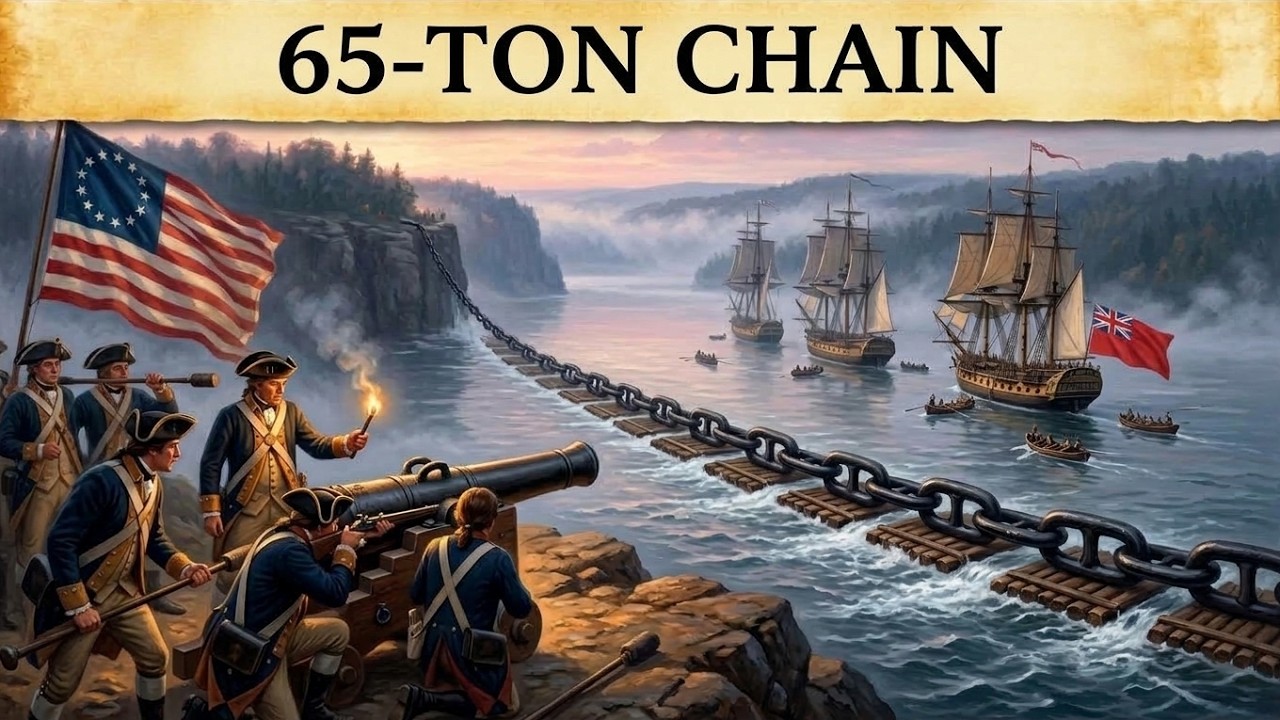
The plan of the Continental Army to stop the most powerful navy in the world was to stretch a chain across the river. Not a wall. Not a fleet. A chain.
The chain held for five years, survived the betrayal of one of America’s most honored generals, and was never tested by the enemy it was built to stop. The British looked at it, studied it, and paid a traitor to hand over its plans, yet they never sailed against it. To understand why anyone would attempt something so audacious, one must understand what the Hudson River meant in 1776. John Adams described it as the key to the entire continent, and he was not exaggerating.
The river stretched more than three hundred miles from New York City to beyond Albany. Connected to Lake Champlain and Lake George, it formed a water route reaching into British Canada. Both sides understood the stakes. If the British controlled the Hudson, they could split the American colonies in half.
New England, where the Revolution began and from which most of Washington’s soldiers came, would be completely cut off from the rest of the country. Supplies could not cross. Troops could not advance. Orders from the Continental Congress in Philadelphia would never reach the armies in Massachusetts or Connecticut.
The war would end, not because the Americans lost a battle, but because they lost the ability to function as a unified fighting force. By late 1776, the British were terrifyingly close to achieving this. They had captured New York City that autumn, driving Washington’s exhausted army out of Manhattan and across New Jersey. They controlled Canada to the north.
Royal Navy ships already dominated the lower Hudson, sailing freely past American positions that were supposed to stop them. All the British needed was to push those warships further up the river and meet forces coming down from Canada, and the Revolution would be strangled in its cradle. Washington knew it. Every general in the Continental Army knew it.
The question was how to stop the world’s most powerful navy while barely having an army and certainly having no fleet. The forts scattered along the river were not doing the job. The Americans had built fortifications throughout the Hudson Highlands, but they were constantly overrun. The British had professional soldiers, trained officers, and ships that could bombard coastal positions from the water.
Washington needed something different. He needed an obstacle that could halt ships outright, even when the defenders were outnumbered and outgunned. The answer came from a man born in England who had originally fought for the enemy. Thomas Machin was born in Staffordshire, England, in 1744, and trained as an assistant to James Brindley, one of England’s most famous canal builders.
Machin understood water, understood engineering, and knew how rivers moved. He crossed the Atlantic, ended up in the American colonies, joined the British Army, and was sent to Boston. He fought at Bunker Hill in 1775, watching wave after wave of British soldiers climb toward colonial gunfire. He watched the colonists hold their ground against professional troops, and something changed in him.
He defected. Leaving the British Army, he joined the Continental forces, switching allegiance in the middle of the war. Washington noticed him almost immediately. There were almost no trained engineers in the entire Continental Army, and here was a man who genuinely knew what he was doing.
Washington sent Machin to the Hudson Highlands with a description that revealed how desperate the situation was. He called Machin a faithful and skillful hand, possessing great experience as an engineer. Machin arrived at the Hudson and studied the problem. The river was deep.
You could not sink obstacles as ancient armies had done with logs and scuttled ships. The current was too fast and the channel too wide. But Machin had an idea. What if they did not try to block the river from the bottom?
What if they blocked it from the surface? Build an iron chain heavy enough that no ship could break through. Float it on logs so the river itself carried it. Anchor it on both shores.
The idea was not entirely new. As early as 1775, generals had discussed using chains and booms as potential obstructions in rivers. But no one had actually built one of this size across a river this powerful in the middle of an ongoing war. The first attempt went up at Fort Montgomery in 1776.
Machin supervised the installation of a chain stretching from the fort on the west bank to Anthony’s Nose on the eastern side. It was thirty-five tons of iron, sixteen hundred and fifty yards long, and it worked for a time. Ships could not pass. But the problem was never the chain itself.
The problem was the men guarding it. In October 1777, British General Henry Clinton sailed up the river to support General John Burgoyne’s campaign near Saratoga. Clinton’s forces reached Fort Montgomery and saw the chain blocking the river. He did something clever.
He did not try to break the chain with his ships. He recognized that the chain was too strong for any vessel to smash through by ramming. But the troops guarding it on the shore were another story. Clinton landed his forces, split them into two columns, and attacked Forts Montgomery and Clinton from the land.
The garrisons were outnumbered and defeated. After heavy fighting, both forts fell. The Americans who survived scattered into the hills. Once the British controlled the shore, they simply detached the chain from its anchor points, moved it aside, and sailed their warships through the gap.
Clinton continued up the river and burned Kingston, the first capital of New York, sending a column of smoke over the valley visible for miles. The chain itself had done its job. No ship had broken it. No hull had smashed through.
The iron had held, but the fortifications protecting it were too weak, the garrisons too small, and the entire defensive system collapsed because a vital part had failed. Machin was wounded in the fighting and needed months to recover. The Americans lost control of the river, and for a few terrifying months it seemed the entire chain strategy was finished. The British had proven they could get around a chain.
Some officers in the Continental Army wondered if the whole idea was a waste of iron. Then something unexpected happened. Burgoyne lost at Saratoga. The British fell back to New York City.
And Washington, instead of abandoning the chain idea, embraced it more strongly. He ordered a new chain built. A bigger chain. A chain that would make the first look like a rehearsal.
The contract went to Peter Townsend, owner of the Stirling Iron Works in Orange County. Townsend signed the agreement in February 1778. The terms were specific. The chain was to be made of Stirling iron, known for being stronger than iron from other mines in the region.
Each link was to be about two feet long, square in shape measuring two and a quarter inches, with a swivel joint every hundred feet and a clevis every thousand feet. The Continental Congress would pay four hundred pounds for the finished product. It was a considerable sum, but this was no ordinary chain. About sixty workers descended on the Stirling Iron Works and began the job.
The iron ore came from the Stirling and Long mines, magnetic deposits that produced exceptionally strong iron. The workers extracted it, smelted it in the furnace, and hammered the raw bars into links in the forge. Seven blacksmith fires and ten welding fires burned around the clock. They worked in rotating shifts, hammering the glowing iron into shape, welding the links closed, and stacking them for transport.
Six straight weeks of work in the depths of winter, with sparks flying into the frozen air and the ringing of hammers echoing through the woods. The operation was protected by militia under Colonel John Hathorn, who posted guards in the surrounding forests to keep out Loyalists and British spies. Under the Iron Act of 1750, the British had effectively prohibited the American colonies from manufacturing iron products. The forge was not just secret.
It was illegal. Had the British found it, they would not only have destroyed the chain, they would have had grounds to punish everyone involved. As the links were completed, teams loaded them onto ox-drawn sleds, ten at a time, and pulled them through the snow to a forge in New Windsor, closer to the river. There, under Machin’s supervision, the links were assembled into groups of nine, connected with clevises, and mounted on massive wooden rafts.
The rafts themselves were fifty feet long and twelve feet wide, with pointed ends to cut through the river current, sealed against water with tar and hemp. The entire assembly was floated down the river to West Point. The location was crucial. This time the Americans had chosen a far better spot than Fort Montgomery.
West Point sits at a sharp S-shaped bend in the Hudson. Sailing ships coming upriver had to make a sharp turn to the west at this point, losing speed and having to maneuver against the wind. While they were slow and exposed, cannons could hit them from both shores. Directly across that bend, at the narrowest point, the chain waited.
Fifteen hundred feet of iron stretching from the shore at West Point to Constitution Island on the opposite bank. The chain was not stretched tight like a clothesline. That would have been a fatal mistake. The Hudson’s current would have snapped a taut chain or torn its anchors from the shore.
Instead, Machin let the chain sag and curve with the current like a necklace laid across the water. Heavy anchors were spaced along its length to hold the structure in place while allowing it to flex with the tide. The chain could even be detached at the middle to let friendly boats pass and then reconnected once they had crossed. Every detail of the design reflected someone who truly understood rivers, understood the forces at play, and had thought through every way the system could fail.
On April 30, 1778, Thomas Machin watched the final section of the great chain lock into place across the Hudson. The work of hundreds of ironworkers, woodcutters, wagon drivers, river men, and soldiers was complete. The entire structure had been smelted, assembled, transported, and installed in about eight weeks. It was one of the most impressive engineering achievements of the entire war, and almost no one outside the Continental Army knew about it.
But the chain alone was not enough. The lesson of Fort Montgomery was still fresh. You could build the strongest chain in the world, and it meant nothing if someone could land troops and remove it from the shore. Here, the Polish-born military engineer Tadeusz Kościuszko came into play.
He was tasked with designing the fortifications at West Point, and he approached the job with a single guiding principle. The forts were not there to fire at ships. The forts were there to defend the chain against land attack. Every battery, every redoubt, every defensive position was oriented toward one mission: making sure no one could reach the chain’s anchor points.
Kościuszko built fortifications on the heights with interlocking fields of fire covering every possible approach. He designed a winch system to tighten and slacken the chain. He added Land Thorne Battery at Gee’s Point and Knox Battery to cover the southern approach. In front of the chain itself, the Americans placed a second floating barrier: a massive boom of heavy logs bound together with chains and positioned south of the iron chain.
Any ship trying to ram the chain at full speed would hit the boom first. The logs would slow the vessel, entangle its rigging, and leave it stranded in the water directly under the guns of West Point. The chain would not even need to stop the ship. The cannons would finish the job.
The British knew all of this. Their intelligence reports described the chain and fortifications in detail. British naval officers could do the math. A warship trying to sail past West Point would first have to navigate the S-curve, losing speed and maneuverability.
Then it would hit the log boom, which would slow it further and likely foul its sails. While the ship was stuck and drifting, the chain would catch its hull, and all the while cannons on both shores would fire at close range. Even if a ship somehow broke through the chain, it would be damaged and alone behind enemy lines, with no way to receive supplies or reinforcements across the same chain on its return. The risk was not merely losing a ship.
The risk was that you would definitely lose a ship and gain nothing from it. So the British stayed away. For two years, no warship attempted to sail past West Point. The chain turned the upper Hudson into American territory, protecting supply lines, troop movements, and communications between New England and the rest of the colonies.
It prevented the British from conducting the kind of raids Henry Clinton had carried out along the Connecticut coast. Historians at West Point have said that the importance of this protection is difficult to overstate. In 1780, however, the chain came closer to falling than it ever had when threatened by a ship. The threat did not come from the river.
It came from within the American army itself. Benedict Arnold was, by nearly any measure, one of America’s best fighting generals. At Saratoga in 1777, his battlefield leadership had been decisive. He was wounded twice, and the second time a bullet in his leg left him permanently disabled.
He had led the invasion of Canada and fought in nearly every major battle. But Arnold also believed he had been continuously slighted. Congress passed him over for promotions. Other officers received credit for victories Arnold felt were his own.
His finances were in chaos. He was bitter and angry, looking for a way to get what he felt he deserved. In the spring of 1779, Arnold and his young wife Peggy Shippen began communicating secretly with the British. Through a Philadelphia merchant named John Stansbury, they contacted Major John André, the chief intelligence officer for British General Henry Clinton.
Arnold was offering to sell military secrets, and what he was selling was the most strategic location in the American war effort. Arnold maneuvered to get himself appointed commander of West Point. He worked his connections with Congress. He convinced Washington that his war wounds made him unfit for field command but ideal for managing a garrison.
Washington agreed, and in the summer of 1780, Benedict Arnold took command of the fort protecting the great chain. The price for his betrayal kept rising. Arnold initially asked for ten thousand pounds. When he realized the value of what he was offering, he doubled it.
Twenty thousand pounds and a general’s rank in the British Army. Clinton agreed. Arnold began deliberately weakening West Point’s defenses, sending troops on unnecessary missions and letting supplies run low, to ensure the fort would fall easily when the British attacked. On September 21, 1780, Arnold met André near Haverstraw, New York.
He handed over detailed maps of the West Point fortifications, including the chain, the batteries, the troop positions, everything the British needed to seize the entire complex. Arnold even told the British that a heavily loaded ship could break the chain, trying to convince them a direct assault would succeed. The conspiracy unraveled in a way no one expected. André had traveled to the meeting aboard the British warship Vulture, anchored in the Hudson.
But American forces fired on the Vulture and forced it to retreat downriver, leaving André stranded behind enemy lines. He had no choice but to try to return to New York City by land, wearing civilian clothes and carrying a pass Arnold had given him. On September 23, near Tarrytown, New York, three American militiamen stopped him on the road. André presented his pass, but something about his manner aroused suspicion.
They searched him and found the plans for the West Point fortifications hidden inside his boot. Every detail of the chain, the batteries, the troop positions, all written in Arnold’s own hand. André was captured. When word reached Arnold that his intermediary had been arrested, he did not hesitate.
He fled immediately, taking a boat and rowing out to the Vulture, which was still lurking in the river. He escaped and never set foot on American soil as a free man again. Washington was reportedly stunned when he learned the truth. He had trusted Arnold.
He had given him command of West Point as a favor, believing the wounded warrior deserved a comfortable post after all he had sacrificed. Now it turned out Arnold had been working to hand over the chain, the forts, the cannons, and the soldiers stationed there to the enemy. André was tried, convicted, and hanged as a spy within days. Arnold received his money and his British army rank, though many British officers despised him for his treachery.
Clinton was so determined to capture West Point that he paid Arnold the full twenty thousand pounds even though the plan had failed. It was a huge sum, and the fact that Clinton spent it on a failed operation tells you exactly how important the chain and its fortress were to British strategy. After the conspiracy collapsed, the great chain remained exactly where it was. Every spring, soldiers hauled it back into the river using the winch system Kościuszko had designed, threading the massive links through the water and attaching them to the anchor points on both banks.
Every autumn, before the ice set in, they pulled it out and stored it on the shore. The river froze hard enough in winter that ice floes moving with the tide could smash the chain, so it came out every November and went back in every April with remarkable regularity. The rhythm became so predictable that soldiers in the Continental Army began using it as a personal gauge of the war. They called it General Washington’s watch chain.
If spring came and Washington ordered the chain back into place, it meant the war was still going on. If he left it on the bank, perhaps the rumors of a peace settlement were real. A soldier named Joseph Plumb Martin later wrote that they watched the chain eagerly every spring, afraid to hope too much, waiting to see whether the links would return to the water or stay coiled on the riverbank. The chain went back into the water every year until 1782.
Four years. No British ship ever attempted to cross it. No attack ever shook it loose. The defensive system Machin designed, Kościuszko fortified, and Arnold tried to sell worked exactly as intended.
It was deterrence in its purest form. The chain never needed to stop a ship. It only needed to convince the British that the attempt was not worth the cost. And it did.
After the Treaty of Paris ended the war in 1783, the great chain was finally dismantled. Workers pulled the links from the river, and most of the iron was taken to the West Point Foundry at Cold Spring, where it was melted down and reused. Some of the chain and the wooden rafts that carried it sank to the bottom of the Hudson, where pieces likely remain to this day. But thirteen original links, along with a swivel and a clevis, were preserved.
They can be seen now at Trophy Point, within the grounds of the United States Military Academy at West Point. Visitors can walk up and touch iron hand-hammered in a secret workshop in 1778, hauled through the snow on ox-drawn sleds, floated down the river on logs, carrying the fate of a revolution for five years. Thomas Machin continued to serve in the Sullivan Expedition against the Iroquois and fought at the Siege of Yorktown, where the war finally ended. He settled in Montgomery County, New York, and died in 1816 at the age of seventy-two.
Historians have noted that Machin’s accomplishments are not sufficiently known or appreciated, and the reason is almost ironic. The chain’s greatest success was that nothing happened at all. The British never tried to break it. There was no dramatic battle, no last stand, no violent collision between iron and warships.
The chain stayed in place, year after year, quietly performing the single task it existed for. Because nothing happened, no one wrote the epic story that would have made Machin famous. But that is exactly what makes the great chain remarkable. In a war marked by desperate battles and impossible conditions, the most effective defense the Americans built was the one that never had to fight.
A sixty-five-ton chain floating on logs, protected by the forts of a Polish engineer, nearly sold by a bitter traitor, and never breached. The British had the ships, the cannons, the sailors, and the plans. They had everything they needed to try. But they looked at that chain stretched across the cold waters at West Point, considered what would happen to their ships when they slowed at that narrow bend under the muzzles of American guns, and decided it was not worth the risk.
Sometimes the best weapon is the one your enemy refuses to test.