In 1849 Virginia, the safest place to hide a weapon was not under a floorboard or inside a barn. Those places got searched. The safest place was beneath a grave bearing the name of someone who had never lived. Enslaved man Asa Crowder understood something his enslavers did not.
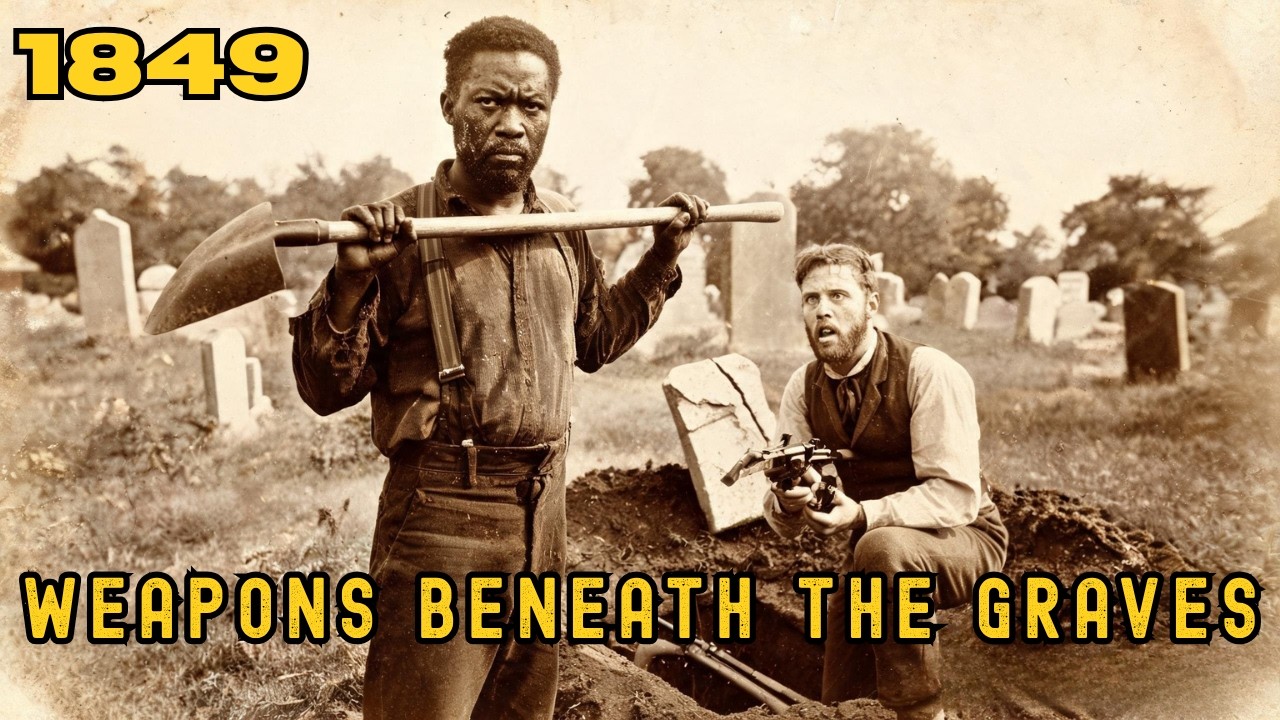
They controlled nearly every inch of the land inhabited by the living, but fear kept them away from the dead. So he turned their cemetery into an arsenal and waited for the night when the graves would begin giving back their weapons. The sound came just after midnight. Metal striking stone.
Once. Then again. It came from behind the wooden fence surrounding the farm’s burial ground. A field hand assigned to late duties reported it to Everett Slade, the overseer.
Slade carried a lantern to the cemetery gate. He stopped there. The cemetery lay less than a quarter mile from the main house, but after dark it might as well have been another country. Slade believed in restless spirits.
More importantly, he believed the enslaved dead carried their grievances with them. That fear was not compassion; it was guilt dressed as superstition. The farm worked Black men and women until sickness, injury, or exhaustion removed them from the fields. Death did not end the violence of that system.
It merely removed the worker from production. But men like Slade preferred not to examine that result too closely. He stood outside the gate and called for Asa Crowder. Asa arrived carrying a shovel.
He was forty-six years old, broad-shouldered, and quiet-natured. He was so useful that most white men on the place stopped noticing him unless someone needed burying. He dug graves. He made rough coffins when necessary.
He repaired headstones. He cleared weeds. Because the farm considered death unpleasant work suited to enslaved hands, they granted Asa something extremely rare: an area under very little supervision. Slade raised his lantern toward the cemetery.
Go and look. Asa went in alone. He moved between the uneven rows of markers. Slade stayed safely behind the fence.
There was nothing supernatural inside. No spirit had struck the stone. The sound had been made by Asa himself earlier that evening. The edge of his shovel had slipped and struck a buried rock.
He had been covering a wooden box. Inside it lay disassembled firearm parts, wrapped for protection against moisture. The cache sat less than twenty steps from where Slade now stood. Asa walked directly past it.
He checked the far end of the cemetery. Then he came back. Nothing, he told Slade. The overseer accepted the answer at once.
He wanted the cemetery empty. That made the deception easier. By morning the cemetery looked as it always had. But it was no longer merely a place for the dead.
It had become the first safe site Asa Crowder had ever controlled. In an enslaved labor camp, privacy was treated as a threat. Cabins could be entered without warning. Sleeping quarters were searched.
Barns were inspected. Tools were counted informally. Roads were patrolled. Gatherings were restricted.
Movement beyond assigned work was questioned. The system depended on keeping enslaved people from controlling place, information, and time. The cemetery broke that pattern. White workers avoided it whenever possible.
Slade avoided it almost entirely after sunset. Even Harlan Westcott, the farm’s owner, rarely visited except when a burial connected to his household required his presence. The graves of the enslaved received far less attention. Asa had noticed this for years.
He noticed who entered and who stayed out, the paths the guards used, where lantern light stopped, which areas were visible from the main road, and above all, he noticed what no one searched. The idea did not begin as a weapons arsenal. It began with a false grave, not a real burial site. Asa had one rule he never broke: he would not open the grave of someone actually buried.
The people under those markers had been exploited enough. Any resistance he built would occupy unused ground. So he chose a narrow strip between old graves. He dug shallow at first, watching the farm road between every movement.
When the hole was deep enough, he placed a small wooden box inside. What lay within it was a damaged part of a pistol given to him by Gideon Vance, an enslaved blacksmith who repaired farm equipment under strict supervision. It was barely useful. That did not matter.
Asa retrieved the box. Then came the harder part. He needed a grave above it. Not just disturbed soil.
A grave required a name. Asa invented one. He cut a rough marker from scrap wood and slowly carved the letters. The name belonged to no one.
No birth. No date. No one. That absence was the protection.
People might remember a real name. Real kinship might raise questions. A fabricated dead person could not contradict him. But Asa understood that new construction was dangerous.
A new marker among old ones would attract attention. He dragged the wood through the dirt. He struck one edge with stones. He rubbed clay into the carved letters.
Then he planted it in the ground at a slant. He did not make it look abandoned for decades; that would have been too obvious. He made it look unimportant. That distinction mattered.
The best concealment on the farm rarely depended on hiding. It depended on insignificance. Asa stepped back and examined the result. Nothing about the false grave drew attention.
That was its strength. Days passed. No one asked about it. Then a week.
Then longer. Slade crossed the cemetery road repeatedly without entering. Workers moved in the adjacent fields. Westcott rode past on horseback.
No one stopped. The grave endured because no one cared enough to prove it did not exist. Then Asa understood the scale of what he had found. The farm’s authority was built on intervention.
Its owners claimed the right to inspect bodies, homes, workers’ movements, and relationships. Yet their own fears created an exception. The cemetery was still technically Westcott’s property. But ownership meant little if the owner refused to look closely at what happened there.
Asa began studying the ground differently. He stopped seeing graves only. He saw distances, sight lines, tree cover, water drainage, the routes between markers, and the places where soil could be moved without looking unnatural. He studied how rain settled on loose earth, how quickly grass grew back, how long a fresh-carved marker kept its pale surface.
This was not superstition. It was engineering conducted under threat. Every mistake could expose more than Asa alone. That was why he told almost no one.
Gideon knew only that Asa had found a safer place for metal than the forge; he did not yet know the full location. Ruth Morrow, who washed burial shrouds and sometimes helped prepare bodies, noticed changes in the cemetery but asked no direct questions. Asa trusted silence more than enthusiasm. That principle would define everything that followed.
The farm believed dangerous resistance announced itself through anger. Asa understood that the most dangerous kind of preparation could resemble obedience. He still dug real graves. He still repaired fences.
He still lowered his eyes when Slade expected it. He still carried his shovel across the same ground. Nothing changed in his outward routine. Beneath it, something had changed.
Another firearm part arrived, then another. Each piece was kept separately. Nothing was complete enough to reveal the entire design. Asa buried each under unused ground and built another false grave.
Not too many. Not yet. Too much change would become visible. The cemetery had to grow slowly enough that memory would not detect it.
That required patience. Patience in an enslaved labor camp was costly. Every additional day meant another day under forced labor, another punishment somewhere on the property, another family threatened with separation, another reminder that waiting was not neutral. Gideon would later confront Asa about that cost.
For now, Asa continued building. One evening he stood near the first false marker while the farm sank into darkness behind him. Light came from the main house. Almost none came from the workers’ quarters.
Between them lay the cemetery. That division was no accident. The farm’s slavery depended on deciding who possessed safety and who lived under constant exposure. Asa had found one place where that arrangement could be reversed.
The marker bore the name of a dead man who had never belonged to any living person. Beneath it lay the beginning of something Slade would have destroyed immediately had he known: a weapon. But more importantly, a precedent. If one false grave could hold, another could.
If metal could be hidden there, information could be hidden too. If information could be hidden, roots could be built. And if roots could be built, the cemetery might eventually become more than a hiding place. It might become a structure for departure.
That possibility was still distant. For now, Asa needed only one thing from his enemies. He needed them to remain exactly as they were: controlling, arrogant, and afraid. Later that night, Slade passed the cemetery road again.
He did not enter. Asa watched from a distance. Beneath the false marker, the hidden metal remained untouched. The first test had succeeded.
The graves had begun to lie. The second grave was not meant to hide more metal. It was built to test whether Asa could control meaning. He waited until rain softened the cemetery ground.
Then he moved a marker a few feet from its original position. There was no grave beneath it. No weapon either. It was simply a piece in a pattern only he understood.
For three days, no one noticed. That gave Asa something more valuable than another hiding place. It gave him proof that the cemetery could be altered without attracting attention. From that moment, he stopped thinking of graves as individuals.
He began designing a system. Gideon Vance supplied the next pieces. The blacksmith worked in an open-sided shop where every hammer strike echoed across the yard. Slade considered the shop too exposed for conspiracy.
That assumption was useful. Gideon received broken farm tools, damaged locks, bent hinges, cart pieces, and sometimes firearms brought for simple repairs. He never dismantled a complete weapon; that would have been noticed immediately. Instead, he seized opportunities measured in seconds.
A screw, a spring, a damaged plate that could be replaced, a bayonet separated from an old rifle. Individual pieces disappeared within the ordinary waste of farm maintenance. The theft was small enough to look like loss of property. Over time, loss became supply.
Gideon understood metal better than Asa. Asa understood concealment better than Gideon. Together, without meeting long, they began turning those parts into potential weapons. The process was slow by necessity.
Nothing moved directly from the forge to the cemetery. A direct route created a pattern, and patterns were dangerous. Pieces passed through ordinary daily work. A metal piece wrapped in cloth inside a tool basket.
A firearm component hidden among broken iron awaiting disposal. A blade traveling with wood scraps. The system did not depend on perfect secrecy. It depended on the farm’s conviction that enslaved workers could not coordinate beyond what their masters saw.
That conviction was wrong. It was also one of the institution’s most persistent weaknesses. Ruth Morrow became involved because she saw what Asa tried to hide. She was carrying a burial shroud toward the cemetery when she stopped beside a recently placed headstone.
She looked at it, then at Asa. The marker was supposed to look old. Ruth saw the problem at once. The clay was convincing.
The damaged edge was convincing. But the carved letters were too clean. She did not ask whose grave it was. She touched one letter with her thumb.
Fresh wood showed beneath. Asa watched her. Neither spoke for several seconds. Then Ruth took dirt from under the marker and pressed it into the carved letters.
She set the marker back. That was the moment Asa brought her into the operation: not because she discovered the secret, but because she protected it before being asked. Ruth was thirty-nine and had spent years washing clothes, burial cloths, and bedding stained by the farm’s labor. She understood how much could be hidden inside routine.
White oversight focused on actions that looked unusual. Ruth specialized in making unusual things look ordinary. She began moving small components toward the cemetery between folded cloth and burial supplies. Never making a bundle heavy.
Never repeating the same method twice in a row. Never choosing a predictable day. Asa imposed those rules immediately. Gideon disliked some of them.
He considered the caution excessive. Asa considered it the reason they were still alive. The false graves multiplied slowly, but they were not to remain identical. Asa needed to know what lay beneath each one without digging.
Written labels were impossible. Anything written could be seized. One paper could become evidence against everyone connected to it. So the markers themselves became the record.
A stone leaning east meant firearm parts. A broken upper corner meant powder insulated against moisture. Two shallow cuts across the underside meant blades or tools for cutting restraints. The marks were simple because complexity created errors.
They were also designed to look casual. A tilted headstone raised no concern. A damaged stone was expected. Two shallow scratches looked like weather or careless tools.
Asa used neglect as a method of encryption. The farm had no reason to carefully maintain the graves of the enslaved. That contempt now protected the code. Ruth learned the marks first.
Gideon learned only what he needed for supply. Asa refused to give anyone the full picture. This was not distrust in the usual sense. It was organizational structure.
Under slavery, capture could turn knowledge into a weapon against others. A network where everyone knew everything was not brave; it was fragile. Asa planned to build something that could survive even if one person disappeared. Then he added the second layer.
One evening Ruth found him moving markers that covered no caches. She watched him measure distances in steps. He shifted one a few inches, then another. What are you changing?
Asa did not answer at once. He stood near the center of the cemetery and looked toward the tree line. Then he asked her to stand beside him. From that position, the irregular graves looked meaningless.
Asa pointed to a stone leaning east, then to another farther away, then toward the lowest part of the cemetery fence. Ruth traced the line with her eyes. It ran toward a narrow gap in the trees where the farm’s view weakened. Asa pointed again.
A cluster of markers formed another line, angling toward a stream crossing hidden from the main road. Ruth understood. The graves were not just labels. Their positions matched the ground beyond the cemetery.
The leaning marker indicated more than what lay beneath it; its placement indicated a path. The distance between two stones represented the distance between known landmarks. A group near the northern edge matched a wooded hill. The gap between markers indicated where a boundary could be crossed without following the road.
The cemetery had become a map no one could seize. It did not look like a map. No paper. No written route.
No names. No single object could reveal the entire design. A person trained to read it could stand among the graves and memorize the sequence. He could leave without carrying on his body anything patrols might find.
That changed the project’s purpose. Weapons could make resistance possible. Routes could make survival possible afterward. Asa understood this distinction more clearly than Gideon.
Gideon still thought of confrontation first. Asa thought of what would come after the first shot. The disagreement surfaced in the forge several nights later. They spoke while Gideon repaired a wagon brace.
The hammer kept striking between sentences, so those nearby heard only the sound of work. Gideon had gathered enough usable metal to think about moving. He believed waiting had begun serving the enemy. Every week brought new punishment, another forced separation, new proof that patience did not protect enslaved people from violence.
We have enough to start, he said. Asa kept his eyes on the road. Enough to start is not enough for the end. Gideon struck the metal harder.
For him, preparation without a date had become another form of captivity. For Asa, a date chosen by anger could become an execution. Neither man was entirely wrong. That was what made the argument dangerous.
The farm imposed urgency every day, but urgency was exactly what men like Slade could exploit. An act born of rage could be isolated. A coordinated system was harder to destroy. Asa refused to make the cemetery a monument to despair.
If weapons came out of the ground, they needed a destination. If people fled, they needed routes that did not end at the first patrol road. If one person was captured, the rest needed to continue. The argument ended without agreement.
Gideon returned to his hammer. Asa walked back toward the cemetery. By then the cemetery held several false graves, but the weapons beneath them were no longer the most important secret. The real secret was visible from above.
It lay in distances, angles, and empty ground: a map disguised as neglect. The farm owners believed the cemetery represented the final boundary of enslaved life. Asa quietly held a view beyond theirs. The problem was no longer where to hide weapons.
It was how to move them without leaving a trace. Asa learned that the cemetery itself could carry information, but an arsenal that could not be distributed was only a buried burden. If Slade ever searched the right section, everything gathered there could vanish in a single morning. The solution came from a funeral.
A woman from the quarters died after a long illness. She was to be buried near sunset after field work ended. Asa prepared the grave. Ruth handled the burial shroud.
A crude coffin was assembled from farm wood. Nothing about the process was unusual. That was exactly why Asa watched closely. Wood moved from the workshop to the burial ground.
Cloth moved from the wash area. Shovels and rope moved with the burial crew. A farm cart crossed carrying things no one wanted to inspect closely. Slade watched the procession from a distance.
He did not open the coffin. He did not examine the folded cloth. He did not search the tool basket. Death allowed things to move without scrutiny.
Asa understood at once what that meant. The cemetery no longer had to be where smuggled goods ended. It could become where smuggled goods changed direction. The first transfer was small and deliberate.
Ruth hid a metal firing mechanism beneath layers of clean burial shroud. It had entered the cemetery days earlier by another route and remained under a false grave. During funeral preparations, Asa retrieved it, wrapped it, and handed it to Ruth. She left the cemetery hiding it in the same bundle she had brought.
Slade saw her leave. He said nothing. The mechanism entered the cemetery as hidden property and exited as part of a funeral routine. That single movement changed Asa’s entire strategy.
He began reducing the amount of usable material stored underground at any time. Items arrived separately. They remained briefly. Then they moved again.
A barrel part might enter with damaged tools and leave days later under folded cloth. A blade might be hidden among grave tools, then carried on a cart hauling wood scraps. Gunpowder stayed underground only long enough to be repackaged against moisture and redirected elsewhere. The false graves became temporary stations.
That distinction mattered. A permanent arsenal depended on its location never being discovered. A distribution network could survive discovery because its value lay in constant motion. Ruth understood this advantage faster than Gideon.
She had spent years working within routines white overseers considered unworthy of attention: washing, folding, preparing, carrying, cleaning. The farm’s authority obsessed over dramatic threats. It watched roads. It watched gatherings.
It watched unusual movements. But it was far less effective against resistance hiding inside tasks authority had already classified as harmless. Ruth began exploiting that weakness deliberately. She varied what she carried.
Nothing heavy enough to change her posture. Nothing with an obvious shape under cloth. Nothing moved along the same route too often. When a burial was scheduled, Asa did not automatically use it.
Predictability could destroy the system. Sometimes a full funeral passed with nothing smuggled at all. That restraint frustrated Gideon. He had begun repairing enough firearm parts to make the buried material useful.
He could see progress in the metal. But he could not see progress in the waiting. For him, every successful transfer raised the same question: when would they use what they had built? The question became harder to ignore as farm pressures increased.
Westcott began demanding greater production from the tobacco fields before the season changed. Workdays lengthened. Slade answered delays with punishment and threats. Movement between work areas was watched more closely.
The farm was not unstable because Asa had acted. It was unstable because coercion required constant reinforcement. Violence was not an occasional feature of slavery; it was the mechanism that made forced labor possible. Gideon lived under that pressure every day.
He wanted an answer that metal could provide. One evening, while repairing a broken wheel rim, he confronted Asa again. The blacksmith kept working as they talked. We have moved enough now.
Asa understood what he meant. Enough weapons, enough tools, enough knowledge of the ground, enough reason. But that was not the same as being fully ready. Move where?
Asa asked. Gideon glanced toward him. Out. And what comes after the road?
Gideon did not answer. Asa continued. After the first patrol? After they bring men from neighboring properties?
After they cut off the bridge? Gideon struck the iron. You can keep asking questions until we die waiting. There was no easy answer to that charge.
Waiting under slavery was not safety. Every additional week carried consequences. Someone could be sold away. Someone could disappear after resisting.
Someone could lose the strength needed to escape. Asa knew planning itself could become a trap. If the plan became more sacred than the people it was meant to protect, the plan had failed. But Gideon had another weakness.
He saw the first confrontation as a decisive moment. Asa saw it as the beginning of a pursuit. That difference separated them. Successful resistance had to last beyond its first night.
Asa cared nothing for a single night of defiance. He would not accept immediate destruction. He wanted to break the farm’s control long enough for people to get beyond it. That required more than weapons.
It required timing, routes, separation of information, places to redirect supplies, and a system that would not collapse if one person was captured. The cemetery was becoming that system. Funerals allowed them to test whether supplies could move while under observation. The most dangerous test came several weeks later.
A burial was scheduled while Slade already suspected iron was missing from the forge. He had questioned Gideon that morning. It was not enough for an accusation. But it was enough for Asa to become cautious.
Ruth arrived carrying the burial shroud and a small bundle of tools. The bundle contained nothing forbidden. That was deliberate. Asa wanted to know whether Slade would search it.
He did. Not thoroughly. But more thoroughly than before. He opened part of the cloth.
He examined the basket. He turned over a wooden-handled tool. Then he waved her through. Ruth continued toward the cemetery without looking back.
Asa had just learned that route was no longer safe. He changed it at once. On the next transfer, nothing forbidden entered with Ruth. Instead, Gideon hid a disassembled firearm part inside the hollow underside of a wooden brace being delivered for coffin construction.
Asa removed it while working alone. The brace itself was used normally. Nothing suspicious remained. The system adapted.
Adaptability mattered more than secrecy itself. Absolute secrecy was impossible. Eventually Slade would notice something. The goal was to ensure that what he noticed was already obsolete.
Asa began organizing movements so no route, cache, or person became indispensable. He distributed goods across more people. The cemetery remained central, but it was no longer the final destination. Some items left toward the wooded end of the property.
Others moved to hidden sites near the stream. A few went to people who knew only one part of the larger plan. No one carried a complete picture. The network became hard to destroy because it no longer existed in one place.
Then came the funeral that proved Asa’s method. The procession moved slowly from the quarters toward the burial ground. Slade stood beside the road. Westcott was absent.
Ruth walked carrying folded cloth on her arm. Asa followed near the cart. Gideon remained in the forge, visible from a distance. Everything looked ordinary.
The coffin entered the cemetery carrying only the dead. But hidden among the things moving with the procession were components that had been under false graves that morning. By the time the burial ended, those components were no longer in the cemetery. They had passed through it.
The weapons began to spread without ever being moved as weapons. Slade watched the procession return. He saw tired adults leaving another funeral. He saw tools.
He saw cloth. He saw an empty cart. What he did not see was that the cemetery behind them had just become less important than it was an hour earlier. Asa had solved the storage problem by refusing to rely on any single cache.
The graves could now be discovered. Not without consequences, but discovery no longer meant total destruction. For the first time, the operation could survive the loss of part of itself. And that was when the danger changed.
Because a hidden cache might be uncovered by accident. A moving network required someone to realize it existed. Soon someone would. It was not Everett Slade who first realized the cemetery might be more than a graveyard.
It was Harlan Westcott. Slade reacted to what frightened him. Westcott reacted to patterns. That made him more dangerous.
The farm owner had spent years treating disorder as something curable by pressure. Lost tools were blamed on carelessness. Delayed work was blamed on defiance. Broken equipment was blamed on the enslaved users.
But by late summer, the irregularities no longer seemed isolated. A rifle returned from repair with a replacement part that did not match the original design. A wagon hinge had been repaired using metal that should have been allocated to other work. Two blades from an old storage rack were missing.
Nothing proved theft. Nothing proved conspiracy. But Westcott did not need proof to become suspicious. He needed only enough inconsistency to believe someone was using farm property for a purpose he had not authorized.
He started with the forge. Gideon was ordered to display his tools. Westcott watched him work. He examined iron scraps, picked up discarded fittings, asked where the damaged pieces had gone.
Gideon answered without hesitation. Broken, reused, worn, discarded. All reasonable explanations. That was the problem.
Westcott found no weapon. He found too many explanations. The next day he searched the forge yard. Then the storage shed.
Then the carriage house. Slade followed behind him, unsettled. Nothing significant appeared. That unsettled feeling worked against them.
Slade wanted a culprit. Westcott wanted structure. By the third day he was looking at places Slade had already dismissed. His attention reached the cemetery before Asa was ready.
It happened in daylight. Asa was cutting weeds near the southern end when he saw Westcott coming down the road on foot. Slade walked a few steps behind. That alone was unusual.
Slade usually stayed outside the cemetery fence unless ordered closer. Westcott stopped at the entrance. He did not hesitate. Then he went inside.
Asa kept working. Stopping quickly would have been a reaction, and a reaction could become evidence. So he kept cutting while Westcott moved among the graves. For years the cemetery had been protected by neglect.
Now a man was finally looking. Not mourning. Not supervising a funeral. Inspecting.
Westcott studied the markers. He touched one with his boot. He moved to another. Then another.
He was not looking for ghosts. He was looking for human intention. Asa recognized the difference immediately. Slade remained near the entrance.
Westcott turned to him. How many funerals since spring? Slade could not answer confidently. He had never cared enough to know.
Westcott’s expression changed. The weakness had become visible. The cemetery had expanded under the authority of men who had never bothered to watch it. Westcott turned toward Asa.
You. Asa approached. Westcott pointed to a marker near the middle. A false one.
Who is buried here? The question was simple. The danger was not. Asa had prepared for discovery of a cache.
He had prepared for a damaged marker. He had prepared for Slade entering at night. But a direct question about a fabricated dead person required something different: memory under pressure. He looked at the marker.
The name carved on it had never belonged to anyone. Asa gave the shortest possible answer. Field hand. Fever.
Westcott waited. From where? Lower tobacco road. No family history.
No dates. No unnecessary details. A lie weakened the more it was decorated. Westcott looked at Asa, then at the marker.
He moved on. The next question came at another false grave. This one covered nothing. Wash house.
Again brief. Again ordinary. Westcott did not look convinced. But suspicion was not discovery.
Not yet. Then he stopped. The ground beneath one marker had settled differently from the surrounding soil. Rain had revealed a slight depression.
Asa saw it at the same moment. That grave held something. But not what Westcott expected. Westcott pressed his boot into the soil.
Soft. He looked at Asa. Open it. Slade moved closer to the fence but did not fully enter the burial ground.
Asa brought his shovel. He began digging. This was no longer concealment. It was controlled exposure.
That distinction had been planned months earlier. Asa had known from the beginning that no cache stayed invisible forever. If the cemetery was ever searched, the search had to end somewhere. So he created graves that could be discovered, not empty ones.
Empty graves would deepen suspicion. They needed to contain enough to confirm what the investigator already feared. Asa removed the top layer of soil. Westcott watched every movement.
The shovel struck wood. Slade stepped forward. Westcott ordered Asa to uncover the lid. He did.
A small wooden box appeared. Westcott bent and opened it himself. Inside were rusted metal, a damaged firing plate, two corroded pieces, a piece of wooden stock swollen from moisture, and powder wrapped so poorly that water had reached it. Slade swore under his breath.
Westcott said nothing. He lifted one piece, examined it, then looked at Asa. The evidence seemed conclusive. Someone had hidden weapon parts beneath a false grave.
The cemetery had been compromised. For Slade, that meant the mystery was solved. He finally entered, his anger temporarily overriding his fear. He demanded names.
Asa gave him none. Westcott continued examining the contents. Then Asa knew the deception had worked. The cache looked real enough to be believed and useless enough to be abandoned.
It had been built as a sacrifice layer, a pre-planned discovery. The rust was deliberate. The damaged wood was deliberate. The spoiled powder was deliberate.
Even the soft soil had been allowed to remain slightly visible. Asa had hidden this grave on purpose. He had hidden it to be found. Westcott believed he had reached the heart of the operation.
In fact, he had reached the boundary Asa had placed around it. That did not mean they were safe. It meant the opposite. A decoy could misdirect a search, but it could not prevent one.
Westcott stood. This ground will be watched from now on. Slade nodded quickly and began talking about night patrols, inspections, restrictions. Westcott ignored most of it.
His attention remained on Asa. Not with certainty, but with calculation. He knew the damaged cache explained the missing metal, but it did not explain everything. The weapons were unusable.
The effort required to hide them made no sense if neglect alone had destroyed them. Either someone had failed catastrophically or they had wanted them buried for another reason. Westcott did not know which. That uncertainty was dangerous.
After they left, he left too. Ruth reached the cemetery from the wash area. She did not approach the open grave at once. Asa was already covering it.
She looked toward the road, then at him. They found one. Asa nodded. Which one?
The one meant to be found. That answer did not reassure her. The real fact was not that the decoy had worked. The real fact was that Westcott had entered the cemetery at all.
Their strongest protection was gone. Asa finished returning the soil. Then he gave Ruth new instructions. Nothing essential would remain under the false graves longer than necessary.
Transfers would accelerate. Routes would change. The markers linked to active caches would be reassigned. The cemetery had survived its first serious inspection, but the meaning of survival had changed.
Before that day, secrecy meant keeping Westcott out. Now secrecy meant letting him in and ensuring he found the wrong truth. The balance had shifted. Slade believed a hidden arsenal had been discovered.
Westcott believed some conspiracy had made a mistake. Asa knew neither man understood what they had actually uncovered. The grave they opened was not evidence of failure. It was part of the plan.
For the first time, Asa had forced the farm owner to see exactly what he wanted him to see. The ruse bought Asa time. It did not buy safety. Within two days, Slade changed the farm’s routine.
Workers moving between the forge, wash house, workshops, and cemetery were stopped more often. Tool bundles were opened. Carts were searched before leaving one work area for another. Burial materials no longer passed unobserved.
The cemetery had lost its protection. Now the pressure moved outward. Westcott realized the damaged cache could not explain everything. Whoever had hidden the damaged weapon parts knew enough to hide them under a false grave.
That required planning. Planning required more than one person. So Westcott stopped looking for objects. He began looking for relationships.
Who talked to Asa? Who worked near Gideon? Who carried materials to the cemetery? Who changed direction when Slade appeared?
He did not need written evidence. Farm control had always transformed ordinary behavior into usable evidence. A conversation could become conspiracy. Hesitation could become proof of guilt.
Friendship could become a threat. Ruth recognized this shift immediately. She stopped carrying anything connected to the network. For days she carried only laundry and burial materials that could withstand inspection.
Asa ordered the remaining active caches emptied through routes established in advance. They moved beyond the cemetery. Gideon resisted. The forge was under tighter supervision now.
His chances to move metal were shrinking. He believed delay was more dangerous than action. Asa believed the opposite. They had no time for another argument.
The operation had entered the phase Asa feared most: not discovery, but constriction. Every route narrowed. Every person became more visible. Every mistake became harder to correct.
Gideon made his mistake near the carriage shed. It was not dramatic. That was what made it believable. He was carrying a wooden repair brace under his arm.
Slade stopped him. The brace itself was ordinary. The metal component hidden along its underside was not. Slade turned the wood over.
The piece fell into the dirt. A firearm mechanism. Small. Usable.
Enough. Gideon did not run. Running would have confirmed more than that object already had. Slade picked up the metal and stared at it.
Then he looked toward the forge. The link Westcott had been trying to prove had finally appeared. Gideon was taken away from the work area before Asa heard what had happened. By the time news reached the cemetery, Slade had already begun his interrogation.
Asa did not know how much Gideon would endure. He did not know the methods Slade would use. He knew only what Gideon knew. That was the calculation that mattered.
Gideon knew the cemetery held false graves. He knew some markers carried encoded meanings. He knew weapons had passed through the ground. He did not know all the external routes.
He did not know everyone connected to later transfers. Asa had built the network that way deliberately. But Gideon still knew enough to destroy its center. Ruth found Asa near the southern fence before sunset.
They took him. Asa kept working. Stopping would draw the attention of a man stationed along the road. Ruth lowered her voice.
If he tells them, he tells them what he knows. She looked at him. That seemed cruel. It was not.
That was why Asa had never allowed anyone to carry the entire structure. Slavery made trust dangerous in ways unrelated to loyalty. A person could be loyal and still break under coercion. A resilient network had to survive that possibility.
It could not blame the person trapped inside it. That principle was about to be tested. The first information came the next morning. Slade entered the cemetery with two armed white men.
Gideon was not with them. Slade pointed to a marker near the western edge. Dig there. Asa looked at the grave.
He recognized it at once. Two shallow cuts, a slight tilt, a location Gideon knew. It looked immediately like betrayal. Asa took the shovel.
He opened the earth. A wrapped bundle lay beneath the soil. Inside were two blades and several firearm parts. Usable.
Real. Slade’s expression changed. This was not a damaged decoy. He had found exactly what he was looking for.
He ordered another site opened. Again, material appeared. Then another. By midday Slade believed Gideon had surrendered the cemetery.
From the outside, it looked that way. The blacksmith had given them a code. He had given them markers. He had given them caches.
The operation seemed finished. But Asa understood something Slade did not. Gideon had not revealed the network. He had revealed the version of the network designed to be sacrificed.
Months earlier, when the false graves multiplied, Asa had forced Gideon to prepare for a possibility he hated to discuss: capture. They had built an outer layer real enough to withstand interrogation. Real weapons, real marker signals, real locations. A lie constructed entirely of facts.
The difference lay in what was missing. The uncovered graves contained materials Asa had already considered expendable. Their locations no longer matched active escape routes. The code Gideon knew was accurate.
But it was incomplete. If forced to speak, he would give Slade something convincing. That was the goal. A false confession collapsed under examination.
A partial truth was hard to question. Gideon had remembered. He was not betraying Asa. He was following the contingency plan.
That realization brought no comfort. It meant Gideon was still resisting. It also meant he was buying time with his body. Slade returned to Westcott convinced he had broken the conspiracy.
Westcott was less certain. But the discoveries were substantial enough to satisfy him temporarily. Several graves were marked for further inspection. The farm’s attention focused on the exposed layer.
Elsewhere, Ruth used the diversion exactly as Asa intended. Slade’s men concentrated on the false graves. She redirected the remaining materials away from the burial ground. The network shrank, then moved.
Gideon had bought that movement. He never returned to the forge. There was no announcement, no explanation. The farm did not consider enslaved people worthy of explanations about what was done to them.
Two days later, Slade came to the cemetery. He told Asa to prepare a grave. The order was ordinary. But the name was not.
Gideon Vance. Asa said nothing. He took the shovel. For years he had dug in unused ground to hide metal.
Now he was digging in unused ground for its actual purpose. That difference changed every movement. The false graves had been engineering. This was loss.
Asa chose a place far from the caches. Gideon’s burial would conceal nothing. That rule remained. The dead were not for storage, not symbols, not tools.
The slavery system had treated people as tools for too long. Asa would not reproduce that logic in resistance. Slade stayed nearby while he worked. The overseer expected grief to reveal something: anger, hesitation, a mistake.
Asa gave him none of that. He dug to the required depth, prepared the ground, and waited. When Gideon’s body arrived, there was no large gathering. Westcott had no interest in allowing that.
The burial was kept controlled and brief. Ruth stood at a distance. Asa lowered his friend into the earth. No speech.
No dramatic farewell. Just work. That restraint was not an absence of grief. It was what survival required.
Gideon had wanted to move sooner. He had accused Asa of waiting until resistance became impossible. Now he would never see whether the plan worked. That was the cruelty of careful preparation.
Those who built the road were not guaranteed to walk it. When the others left, Asa stayed long enough to settle the soil properly. He placed a real marker at the head of the grave. No invented name.
No secret cuts. No encrypted sign. Gideon Vance had existed. His grave would not lie.
Around it stood the false markers. Those still pointed toward roots beyond the farm. The exposed caches had served their purpose. They had absorbed the sharp edge of investigation.
The deeper network remained active. But the price was now visible in the middle of the cemetery. Gideon believed weapons existed to be used. In the end, his most important act was not firing one.
It was giving the enemy enough truth to distract them from finding the rest. Gideon’s grave remained untouched. But everything around it did not. Before Slade left the cemetery that evening, he delivered Westcott’s next order.
At dawn, the cemetery would be searched from end to end. Any markers suspected of being false would be removed. Loose earth would be opened. Any cache beneath it would be carried to the main yard.
The cemetery was no longer under surveillance. It had been scheduled for dismantling. Asa had expected this decision eventually. He had not expected it so soon.
By sunrise, every active cache underground would become a liability. There would be no second chance to empty them. Ruth understood the meaning as soon as Asa reached her near the wash area. What remains?
A lot. It was the first time he had answered her with such directness. The outer layer Gideon had sacrificed protected the escape routes, but functional components remained hidden beneath markers not yet discovered. The powder had already been moved further out.
Some blades had left days earlier. But the remaining firearm parts mattered. If Westcott recovered them, he would gain evidence and the network would lose materials that could not be easily replaced. Asa had until morning.
The cemetery was watched. The forge was exposed. Ruth could no longer carry suspicious bundles across open work areas. The usual routes were closing simultaneously.
Under those conditions, the obvious decision was to abandon what remained. Asa refused. Not because the weapons were more valuable than lives, but because Gideon had already died protecting the system that moved them. Leaving everything underground now would make his sacrifice a pointless delay.
Asa looked toward the materials still gathered from the burial: cart, boards, rope, shroud, tools, vessels used to carry away soil and broken wood. The funeral had ended, but its movement had not stopped. That distinction gave him one last route. The grave itself would remain untouched.
Asa would hide nothing with Gideon. Instead, he would use the cleanup operations surrounding the burial to empty the neighboring false graves. Ruth went first. She returned to the cemetery carrying only the things expected after a funeral: folded cloth, a cleaning bucket, a small tool basket.
Slade’s men watched her enter. They did not stop her. The funeral was over, and their attention had shifted toward the next morning’s search plan. That assumption cost them dearly.
Asa began removing excess boards from the burial area. He took one broken board toward the southern edge. He knelt beside a false headstone as if clearing soil from its base. Beneath the surface lay a wrapped firearm lock.
He lifted it with the dirt. The metal piece disappeared into the hollow underside of the board. The board went onto the cart. No one searched it.
Ruth worked in another section. She did not dig; digging would be visible. Instead, she removed items from caches Asa had placed carefully: shallow enough for emergency access. A wrapped spring group went into a bucket beneath a muddied cloth.
A blade disappeared inside a pile of discarded rope. A small metal plate slipped under the false bottom of a tool basket. Nothing was moved in a way that suggested future use. Gideon had always done it that way.
When dismantled, a weapon stopped being a weapon. Now that principle was saving the network. They worked in short shifts, never two markers in a row, never an unnecessary trip. Whenever one of Slade’s men looked toward the cemetery, Asa returned to visible work.
He smoothed Gideon’s grave, adjusted the real marker, gathered wood scraps. The burial process provided their cover. Every action had its ordinary explanation. That was the fundamental contradiction Asa had exploited from the start.
The enslavers believed control meant seeing everything, but seeing an action was useless if they misunderstood its purpose. Near dusk, Slade entered. He no longer stopped at the fence. Gideon’s arrest and the discovery of the caches had weakened his superstitions.
Suspicion had replaced fear. He walked among the markers and watched Asa load the cart. What are you taking, scrap wood? Slade yanked a board out.
Nothing was attached beneath it. Asa had expected the inspection. The loaded materials on the outside were clean. The hidden components were deeper in the pile.
Slade threw the board back. Then he kicked one of the buckets with his foot. The mud shifted. Nothing metallic appeared.
He looked toward Gideon’s grave. For a moment, Asa thought Slade might order it opened. He did not. Even now, the overseer understood the difference between a recent burial he had witnessed personally and the false graves surrounding it.
That certainty protected Gideon from desecration. Ironically, it also protected what Asa was moving beside him. Slade left. The transfers continued.
By full darkness, the cart contained no complete firearm. It carried something more dangerous: the final usable pieces needed to complete weapons already distributed beyond the cemetery. Ruth took the first material toward a secondary site near the forest edge. Asa did not accompany her.
One person carrying knowledge of both departure and destination would create an unnecessary exposure. She returned later with an empty basket. No explanation was exchanged. None was needed.
The operation had succeeded. By midnight, the cemetery’s active caches were nearly empty. One cache remained. It lay beneath a marker near the center of the burial ground.
Removing it would require more visible disturbance than the rest. Asa considered leaving it. The cache held several firearm components Gideon had repaired shortly before his capture. Westcott would find them in the morning.
That would reinforce his belief that the cemetery still held the heart of the operation. There was value in that. A search continuing underground was a search directed away from where the weapons had actually gone. Asa made his decision.
He left the cache in place. Not because he failed to reach it. Because Westcott needed to find something. By morning, the cemetery would look guilty.
But it would not be useful. At sunrise, Westcott arrived with Slade and several men carrying shovels. This time there was no hesitation. Markers were pulled.
Earth was opened. The search was systematic and destructive. Westcott no longer cared whether the cemetery was organized. He wanted to expose the mechanism beneath it.
The first false grave contained nothing. The second held an empty wooden cavity. The third contained packing material and one broken piece. Slade grew agitated.
Another grave was opened. Empty. Then another. The pattern was wrong.
Westcott expected an accumulation of material. Instead he found evidence of removal. That was more troubling. He ordered them to continue.
Near the center, they reached the cache Asa had deliberately left. The container was extracted. Westcott opened it. Inside were genuine firearm components.
Functional. Recently protected. For several seconds no one spoke. Slade took the discovery as proof that more existed.
But Westcott understood the opposite. He looked across the opened ground. Too many empty spaces. Too many containers that had held something.
Too few usable weapons. The cemetery had never been an arsenal waiting to be discovered. It had been a place through which an arsenal had passed. That realization changed the investigation.
Westcott turned toward Asa. When were these moved? Asa gave no answer. Westcott pointed to the empty cavities.
These were full. Still silence. The farm owner finally understood the scale of his error. He had spent days focusing his surveillance on the burial ground because he believed concealment depended on location.
Asa’s system depended on movement. Westcott ordered his men to search the cemetery. By then, the search itself had become useful to the people he was trying to stop. His attention was fixed on ground that had already become irrelevant.
The weapons had not disappeared. They had been distributed. Westcott could dig up every false grave and still recover only parts. The important materials were now somewhere beyond his search.
For the first time, his anger was not directed at theft. It was directed at planning. Someone had anticipated the inspection. Someone had built caches designed to be sacrificed.
Someone had allowed real materials to be discovered. Someone had used his own investigation to protect a deeper system. This was no longer isolated resistance. It was engineering.
Westcott ordered every false marker removed. Not inspected. Removed. He wanted to strip the cemetery of the structure that had allowed this deception to exist.
Slade asked whether they should keep opening the ground. Westcott looked at the broken rows. Everything. Asa heard the order without showing reaction.
Ruth was surprised when she later learned what had happened. The markers were the code. The distances were the map. Destroying them should have destroyed the system.
But Asa did not try to save them. He no longer needed to. The roots had already been preserved. The important alignments existed in memory.
The weapons were already moving beyond the cemetery. What remained in the ground was evidence of a machine after its essential parts had been removed. Westcott believed he was dismantling the operation. In fact, he was dismantling something that had already completed most of its work.
And with every marker torn from the earth, he came closer to discovering the final purpose Asa had hidden from him. The graves did not only point downward. The final purpose of the cemetery became clear only after Westcott began destroying it. The headstones had always carried more information than the caches beneath them.
Some indicated contents. Some marked temporary storage. But the distances between stones, the empty spaces, the angles, and the lines they formed across the burial ground served another purpose. They pointed outward.
That was the part Westcott never understood. He had spent days looking down. Asa designed the system to be read across the ground. By the time the false markers were torn from the earth, Ruth already knew the route.
Others knew it too without ever seeing the markers again. A stone leaning near the eastern edge indicated the stream crossing. A wide gap between two false graves represented the open ground to avoid. Three markers placed in an uneven line pointed toward the wooded hills behind the tobacco fields.
Another pair aligned with a low section of the boundary where patrol visibility weakened after dark. Nothing looked intentional unless one learned to read the pattern. Now instruction had replaced structure. The cemetery could be destroyed.
The route could not. That was Asa’s final advantage. He had been erasing its original form only. The first movement began that evening.
Not an attack on the main house. Not an open confrontation. The goal had never been spectacle. The goal was breaking the farm’s ability to control movement long enough for people to leave.
The weapons that once lay beneath false graves appeared at points Westcott had stopped watching. A firearm part repaired by Gideon was reassembled near the forest boundary. Blades were placed where restraints and barriers could be cut. Powder moved with those assigned to cause disruption at points far from the escape route.
The arsenal no longer existed as a single cache. It existed as separate tools assigned to separate purposes. That decentralization was exactly what made Westcott’s search futile. He could seize one object without stopping the rest.
The first disturbance came near the wagon passage away from the cemetery. A barrier was damaged enough to slow movement without drawing immediate attention. Another road usually used by mounted patrols was blocked. A gate that should have closed tightly no longer held.
None of these acts defeated the farm. But they did something more practical. They bought time. And time was the only resource Asa had been working for from the beginning.
Ruth moved toward the first reference point after dark. She carried nothing that revealed her role. No map. No written directions.
She did not need them. She remembered the graves. From the center of the cemetery, the sequence was simple. East, low fence, stream, edge, then away from the main road.
The map now existed in her head. Others knew only sections of it. That separation remained deliberate until the final night. If one group was stopped, the full path would not be exposed.
The movement began quietly. Westcott realized something was wrong only when Slade reported disruption outside the burial ground. Even then, the two men remained focused on the cemetery. That was the final misdirection.
Asa allowed them to keep believing the graves mattered. The people and weapons connected to them had already moved elsewhere. Westcott ordered Slade to take his men toward the damaged boundary. Then another report drew attention in a different direction.
Movement near the fields. A broken gate. Signs someone had crossed near the stream. The farm’s response split.
That was exactly what Asa needed. A repressive system often looked strongest when everyone obeyed its structure. Its weaknesses appeared when it had to respond to multiple failures at once. The farm depended on predictable routes, predictable labor, predictable fear.
Asa’s network attacked that predictability. He never needed to defeat Westcott’s entire property. He only needed to make Westcott unsure where resistance was happening. For a brief period, that ambiguity worked.
Ruth reached the wooded edge. Others followed at separate intervals. No large group crossed open ground together. There was no procession to chase.
The movement’s trail scattered exactly as the weapons had scattered. Asa remained in the cemetery. That decision had been made before Gideon’s death. Someone had to remove the final reference points.
The false markers Westcott had already torn down helped, but many real landmarks within the burial ground could still allow a careful observer to reconstruct the geometry. Asa began changing them. He moved the loose markers that belonged to no real sites. He broke the exposed remains of the false markers.
He filled the shallow depressions. He disrupted the lines that had once pointed toward the stream. He could not erase everything. He only had to make reconstruction unreliable.
That was enough. Slade returned after midnight. For the first time, he entered the cemetery in darkness. In Virginia in 1849, the safest place to hide a weapon was not under a floorboard or inside a barn.
Those places were searched. The safest place was beneath a grave bearing the name of someone who had never lived. Asa Crowder understood something his enslavers did not. They controlled nearly every inch of the land inhabited by the living, but fear kept them away from the dead.
So he turned their cemetery into an arsenal and waited for the night when the graves would begin giving back their weapons. The sound came just after midnight. Metal striking stone. Once.
Then again. It came from behind the wooden fence surrounding the farm’s burial ground. A field hand assigned to late duties reported it to Everett Slade. Slade carried a lantern to the cemetery gate.
He stopped there. The cemetery lay less than a quarter mile from the main house, but after dark it might as well have been another country. Slade believed in restless spirits. More importantly, he believed the enslaved dead carried their grievances with them.
That fear was not compassion. It was guilt dressed as superstition. The farm worked Black men and women until sickness, injury, or exhaustion removed them from the fields. Death did not end the violence of that system.
It merely removed the worker from production. But men like Slade preferred not to examine that result too closely. He stood outside the gate and called for Asa Crowder. Asa arrived carrying a shovel.
He was forty-six years old, broad-shouldered, and quiet-natured. He was so useful that most white men on the place stopped noticing him except when someone needed burying. He dug graves. He made rough coffins when necessary.
He repaired headstones. He cleared weeds. Because the farm considered death unpleasant work suited to enslaved hands, they granted Asa something extremely rare: an area under very little supervision. Slade raised his lantern toward the cemetery.
Go and look. Asa went in alone. He moved between the uneven rows of markers. Slade stayed safely behind the fence.
There was nothing supernatural inside. No spirit had struck the stone. The sound had been made by Asa himself earlier that evening. The edge of his shovel slipped and struck a buried rock.
He had been covering a wooden box. Inside it lay disassembled firearm parts, wrapped against moisture. The cache sat less than twenty steps from where Slade stood. Asa walked directly past it.
He checked the far end of the cemetery. Then he returned. Nothing, he told Slade. The overseer accepted the answer at once.
He wanted the cemetery empty. That made the deception easier. By morning the cemetery looked unchanged.
But it had become the first safe site Asa Crowder had ever controlled.