Robert E. Lee, the most revered general the Confederacy ever produced, did not lose at Gettysburg because he was outnumbered, because his cavalry vanished, or because luck abandoned him. He lost because, over three days in July 1863, he repeatedly chose to interpret mounting danger as an obstacle that another coordinated blow could overcome. This is the story of how a brilliant commander made a series of escalating decisions that cost thousands of lives, and then privately admitted he had been wrong.
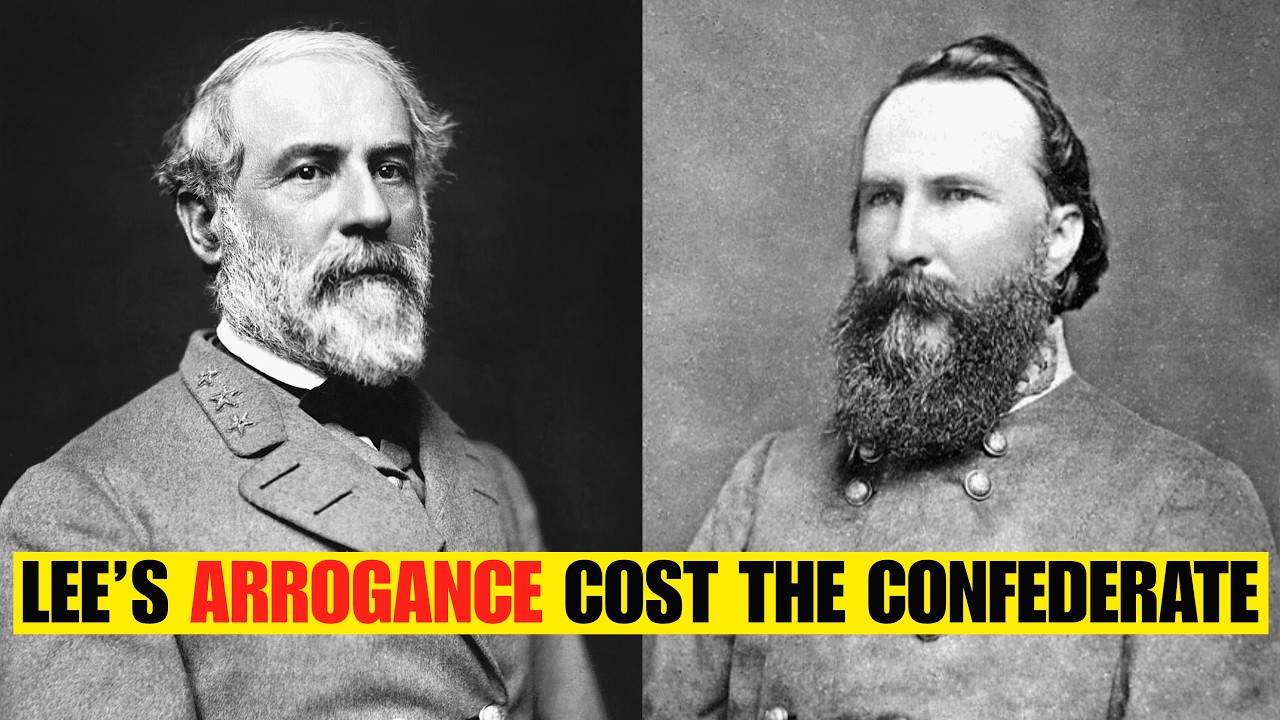
Gettysburg was not a single catastrophic error. It was the climax of a pattern. By the morning of July 3, Lee was not holding a map that told him he could win. He was holding a string of partial victories and a belief that they meant something.
To understand how that belief was built, and how it survived every warning a general could ask for, it is necessary to go back to how he arrived in Pennsylvania at all. In late spring 1863, the farmlands of Virginia were exhausted. The Army of Northern Virginia, the Confederacy’s largest field force, could barely feed itself. Supply lines faltered.
Horses starved. Soldiers marched on short rations. Lee made a strategic decision: invade the North, draw the Union army away from Virginia, live off enemy resources, and disrupt Union plans for the summer. By 1863, the Confederacy was losing.
The Union had more men, more factories, and a greater capacity to replace losses. The South’s only advantage was time. If the war dragged on long enough, Northern war weariness might crack, and the Confederacy might negotiate its survival as a separate nation. To buy that time, Lee’s army had to keep winning.
In early May, at Chancellorsville, Lee achieved his masterpiece. He had divided his army twice and driven a larger Union force into retreat. But Stonewall Jackson, shot by his own men, died of pneumonia on May 10. Jackson was not merely a subordinate.
He was Lee’s entire command system. Give Jackson a vague order, and he would execute it through sheer will and aggression. Two weeks after Jackson’s death, Lee reorganized his army into three corps under new commanders. But he kept using the same leadership style: vague orders, minimal supervision, and trust in subordinate initiative.
He was applying a system built for an irreplaceable man to two men who needed clarity. On June 28, Lee lost his cavalry intelligence. He was now operating partially blind, and he knew it. That same day, a scout named Henry Harrison reached Longstreet’s column with urgent news: the Union Army of the Potomac had crossed the Potomac and was moving north.
The intelligence was correct. Lee received the report and responded by ordering his army to concentrate east of the mountains. He was acting on the information he had. What he could not know was where the collision would occur.
On June 30, a Confederate brigade under Pettigrew entered Gettysburg to reconnoiter. He saw Union cavalry in the town and withdrew without engaging. That same morning, Union cavalry commander John Buford was moving toward Gettysburg and realized what the map indicated. This ground was worth defending.
He positioned his troopers along Seminary Ridge, thin and fragile lines, but placed with purpose. He decided to hold. The next morning, July 1, A. P.
Hill’s corps decided to test the strength of the Union cavalry presence. What was intended as reconnaissance became a skirmish, and the skirmish became a battle. By mid-afternoon, Confederate forces had routed Union troops north of town, and Lee arrived on the field to find an unexpected victory. Here occurred the first escalation.
Lee had a choice. He could consolidate, reorganize, and wait for his supply trains and cavalry to arrive, following the very principle he had just issued: do not fight a general battle until the army is fully concentrated. Or he could interpret this accidental first-day victory as proof that enemy lines could be broken. In his official report, Lee was frank about his decision.
A general engagement had not been planned at Gettysburg unless the enemy attacked. But after July 1, he saw that withdrawal was dangerous given the weak supply train and the exposed road south. The battle became, in his words, “in some measure unavoidable. ” That phrasing matters.
Lee did not say it was forced. He said it was unavoidable in some measure, meaning the decision to stay and fight was his, though constrained by circumstances. The accidental victory made retreat risky. So Lee stayed, and he decided to attack the next day.
What Lee could not say aloud, but knew, was that withdrawal would make his army look human, fallible, and defeatable. In the mythology of the South, which Lee had spent years building, his army was invincible because it represented something greater than military strength. It represented a divinely sanctioned civilization. Slavery was not merely an economic system; it was a moral one, and Lee’s army was its sword.
Retreat would mean admitting that sword could break. Lee’s reputation was tied to the Confederate claim that their cause was just. The moment he stopped attacking was the moment the South had to face the possibility that it was not. So Lee did not withdraw.
The political situation required him to keep attacking. The myth demanded it. By the evening of July 1, something had hardened in Lee’s mind. A day earlier, he had not wanted this battle.
Now that he had won it by accident, he could not imagine not winning it decisively. Victory was no longer a possibility. It was a necessity. That necessity rested on the choice of one man.
Richard Ewell had succeeded Jackson in command of the Second Corps. On the evening of July 1, Lee ordered him to take Cemetery Hill, the high ground anchoring the Union position, “if practicable. ” Those two words were crucial, and for Ewell they were a trap. His troops had been marching and fighting for twelve hours.
They were exhausted. To attack Cemetery Hill, he would need artillery support he could not provide from within the town, coordination with units he was unsure of, and an enemy strength that was unknown. Darkness was falling. Ewell wanted to obey.
He understood the moment might be decisive. But everything his eyes told him said the cost would be catastrophic. He decided the risk outweighed the potential gain, and he pulled back. Ewell made the right decision.
Every logical calculation told him so. But that was not the problem. The problem was that Lee’s order had been a question, “if practicable,” while Ewell needed a direct command. Jackson would have understood the question as an imperative.
Ewell understood it as permission to say no. Lee had built a system for one man. Ewell was a different man, and that difference became structural. On the morning of July 2, that command structure faced a far more serious test.
James Longstreet, Lee’s old war horse, commander of the First Corps and the senior officer in the army after Lee himself, heard Lee’s plan to attack the Union left and break their lines. Longstreet disagreed. His argument was logical. The Union controlled Cemetery Ridge and the high ground around it, a natural defensive position shaped like a fishhook.
The Union had interior lines, allowing them to shift troops from one part of the position far faster than Lee could maneuver around the outside. By then, with reinforcements arriving overnight, the two armies were nearly equal in strength. With Union troops entrenched on stronger ground, Longstreet’s alternative was direct: do not stay at Gettysburg. Maneuver around Meade’s left flank.
Force him to attack Confederates on ground Lee chose, or force him to worry about Washington and abandon his position. It was an offensive strategy, not a cautious one. But it required something Lee had stopped doing: waiting. Longstreet pressed the argument.
Lee listened, then said no. Lee’s own report gives the answer. After the first day’s victory, he wrote, it had “created a belief” that another attack on the Union position might succeed. A belief, not proof, not certainty.
The partial success of July 1 had convinced Lee that his army possessed an offensive power that could overcome even a strong defensive position. At Chancellorsville, he had seen his army do what should have been impossible. Now he was drawing the seductive lesson from that victory: we have men who can do impossible things. Longstreet obeyed.
His corps attacked late in the afternoon of July 2. One of his division commanders, John Bell Hood, a famously aggressive fighter, filed the only formal protest of his military career, requesting to maneuver around the Union left rather than attack head-on as ordered. Lee refused. The attack gained ground.
Confederates reached the Devil’s Den, the Wheatfield, and the base of Little Round Top. But the stone wall at the base of Little Round Top held. Confederate soldiers kept advancing and kept falling. By evening, the men who had begun with confidence were digging in, exhausted, having traded their blood for worthless ground.
The Union line had absorbed the blow. The second day proved that a direct assault on a fortified position, no matter how fierce, would not break Cemetery Ridge. Longstreet knew it. He had watched the attack fail moment by moment.
That night, when Lee announced he would attack again, with greater force this time, Longstreet wrote in his own memoir: “I never felt such depression in my life. ” He was not angry at the decision. He was depressed because the failure of yesterday’s strategy was obvious, and yet it was going to be repeated. By the evening of July 2, Lee had complete information about what a direct assault could achieve.
It could gain tactical ground. It could not gain more. But Lee had spent a decade building his reputation on doing the impossible. By that evening, that identity had become a burden he could not shed.
Longstreet was arguing for maneuver, patience, and letting the enemy attack on ground of their choosing. To Lee, that sounded like doubt, like fear, like abandoning what made Lee who he was. He could not bear to abandon that, because if he did, he would not be a military genius. He would be just a man leading an army in a losing cause, fighting to preserve slavery.
So he chose again, not on incomplete information, but on complete information that contradicted his identity. That is worse in some ways. Not a mistake made in the dark, but a choice made in broad daylight. The morning of July 3 began with an artillery bombardment.
Lee ordered nearly 150 guns to soften the Union line. For almost two hours, Confederate artillery rained fire on Cemetery Hill. But smoke obscured the targets. Fuses malfunctioned.
Confederate guns fired high, and because of ammunition shortages, the reserve batteries that should have been positioned to resupply were not there. The bombardment did less damage than Lee’s officers believed. Around 1:00 p. m.
, ammunition began to run out. Edward Porter Alexander, Lee’s artillery chief, faced grim calculations. If Lee delayed, fell back, resupplied, or attacked the next day, the Union would use those same hours to strengthen Cemetery Hill further. The window was closing not because of ammunition alone, but because waiting meant fighting a stronger position tomorrow than today.
Alexander sent actual field messages, preserved in the Library of Congress. At 1:25 p. m. : “If you are coming at all, come at once or I cannot give you proper support.
” Fifteen minutes later: “For God’s sake come quick, or we cannot support you. Ammunition is nearly out. ”
Longstreet, who had been watching the bombardment that morning, made his own calculations. If the bombardment failed, if the Confederate guns had not damaged Cemetery Hill enough, the assault would be a slaughter.
He did not share his calculations with Lee. He had already tried to make that argument twice. He simply stood, watched the smoke rise, and waited to see whether his fears would be realized. On Cemetery Hill the night before, Union artillery chief Henry Hunt had spent the night examining Confederate positions.
He calculated precisely where the bombardment would come from. He positioned his guns accordingly. He ordered his crews not to fire during the Confederate bombardment, to conserve ammunition and prepare for the moment Confederate infantry appeared. Hunt was doing exactly what Alexander was doing, real-time artillery calculations.
But Hunt had something Alexander did not. He was on the defensive. He did not have to weaken the objective with his guns. He had to stop the advance.
When Pickett’s men began their march across the open ground, Union artillery was waiting. They were not surprised. They were not caught off guard. They were waiting.
The assault was not launched out of absolute confidence in the men. It was launched because the window for artillery support was closing. It went forward while Confederate artillery ammunition was running out, not after a successful preparation, but in the face of a failed one. Longstreet gave the order.
Nearly 13,000 to 15,000 Confederate soldiers under Pickett, Pettigrew, and Trimble began the three-quarter-mile march across open farmland toward Union positions. No cover. No obstacles. Straight toward entrenched infantry behind a low stone wall, with artillery that had been waiting for this exact moment.
A small group of men under Brigadier General Lewis Armistead reached the Union lines and briefly broke through. It was the moment history remembers as the climax of Confederate glory. Armistead was mortally wounded within minutes. The breach was closed within minutes.
Of the men who began that advance, nearly half did not return. Some estimates put Confederate losses at over 50 percent, killed, wounded, or captured. In less than an hour, on a strip of open farmland barely a mile wide, the interpretation finally met reality. The Army of Northern Virginia suffered roughly 28,000 casualties over three days, nearly 40 percent of its total fighting strength.
In contrast, the Union suffered about 25 percent casualties, brutal but sustainable. Lee had drained his army at twice the rate his enemy could drain theirs. Nineteen of 46 division and brigade commanders were killed or wounded. Nearly half the officer corps was lost.
These were losses that could not be replaced quickly. In the minutes after the failed assault, Lee rode out to meet the returning divisions of Pickett, Pettigrew, and Trimble. Not from his headquarters, but directly into the wreckage of the battle, not to observe from a distance, but to face the men who had paid the price. What he said to Pickett in those moments was the truest thing he ever said about Gettysburg.
He accepted responsibility in real time, on broken ground. Then came the retreat. It rained for days. Wagon trains of wounded stretched for seventeen miles.
No springs, wounds without care. Soldiers who survived described the screaming coming from those wagons as the worst sound of the entire war. The Potomac had flooded past the crossing point. When the men finally reached it, the water was up to their armpits.
Ammunition had to be left behind. Exhausted soldiers collapsed by the roadside in the dark and could not be found again. One soldier, James Sudath, wrote home clearly. Lee, he wrote, thought there was no place he could not take, but the hills of Gettysburg were more than he could bear.
In his official report, submitted on July 31, a month after the battle, Lee wrote that the troops had perhaps been required to do more than they were able to accomplish. Six months later, in January 1864, Lee wrote to Longstreet: “If I had taken your advice at Gettysburg instead of going the course I did, everything would have been entirely different. ” Lee knew. He said it clearly in his own hand.
But after the war, something changed. Lee’s reputation had to survive. His army was dissolving. The South was under occupation.
The entire social order that had supported the war, the slavery his army had fought to preserve, was collapsing. The culture needed Lee to be flawless, incapable of misjudgment. So two of Lee’s former officers built a myth to protect him. They claimed Longstreet had sabotaged the battle, that Lee had been right, that the South lost only because of bad luck and betrayal.
The myth took root because it was easier than the truth: that a brilliant man defending an evil cause had made a series of choices that bled his army dry. Understanding why Lee made those choices does not excuse them. It makes them worse, because it shows they were not inevitable. They were choices.
Each one was justifiable at the time. Together they were catastrophic. Lee was a genius, but he was wrong. When he was wrong, nearly 30,000 men paid the price.
Many were conscripted. Many were enslaved. They all died so that a system of human ownership could last a few more years. Longstreet saw it coming and had no way to stop it.
The men who marched in Pickett’s Charge saw it coming and had no choice but to march. The country saw it coming and could not halt it. The war continued for four more years, and slavery would only end by fire. Lee also saw it coming, and he kept attacking anyway.
That is what an ethical catastrophe looks like when it wears the mask of competence. Lee knew. He said it plainly to Longstreet, and then he lived with it.