By late May 1942, the most dangerous man in the Nazi empire was lying in a Prague hospital bed, and the doctors believed he would live. Reinhard Heydrich, the man Hitler had placed over the terror machinery of the Third Reich, the chief architect of the Holocaust, had been ambushed on an open road by two Czechoslovak agents. The explosion had torn into his body, but the surgeons had operated for hours, removed his shattered spleen, and closed the wounds. The reports were cautiously optimistic.
Heydrich was even well enough to receive a visitor: his superior, Heinrich Himmler, who traveled from Berlin to sit with him. The visit took place on 2 June 1942, and the conversation reportedly lasted for hours. Nothing suggested the crisis to come. The next day, 3 June, Heydrich suddenly collapsed.
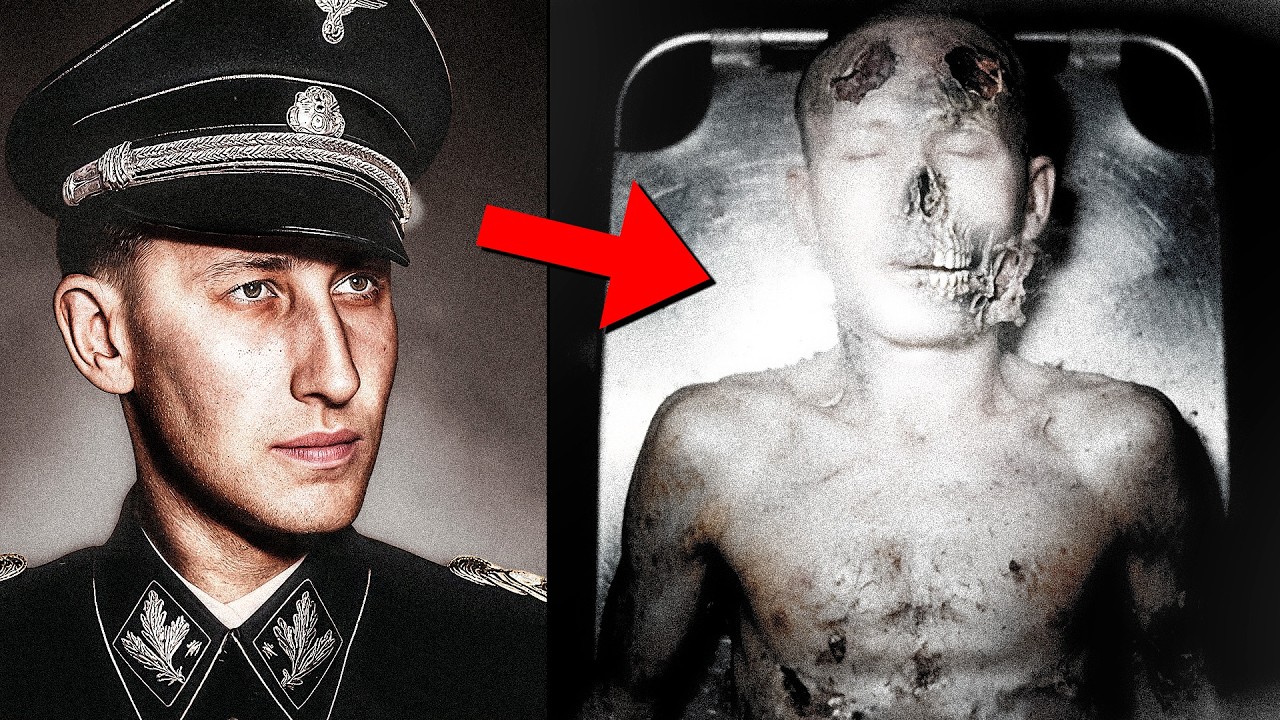
His fever spiked, infection raged through his body, and within hours he slipped into a coma. At 4:30 on the morning of 4 June, he was declared dead. He was thirty-eight years old. The man who had organized the systematic murder of millions had perished not on a battlefield but in a sterile hospital room, and the speed of his deterioration stunned even the physicians who had been treating him.
The autopsy that followed produced an official conclusion: Heydrich had died of a severe bacterial infection caused by the shrapnel wounds from the grenade. Pus was found in his chest cavity, his abdomen, and around his left lung. His liver, kidneys, and heart had all been compromised. The document was clear, clinical, and strangely defensive, insisting in unusually direct language that there was no basis whatsoever for the suspicion of chemical poisoning from the explosive charge.
It read like a document written by men who already knew that rumors would spread. For decades, those rumors refused to die. Heydrich had not always seemed destined for such a violent end. Born in 1904 in Halle, Germany, he was the son of a respected musician and teacher, raised in a middle-class home filled with discipline and classical music.
He was remarkably gifted, a violinist of near-professional skill, an elite fencer, and fluent in several languages. He also carried a coldness that unsettled everyone who met him. His fellow sailors in the German Navy gave him the nickname the Blond Devil, a name that would come to define his entire career. He joined the SS in 1931, and Heinrich Himmler interviewed him personally.
According to contemporary accounts, Himmler challenged Heydrich to devise an intelligence plan for the party on the spot. In roughly twenty minutes, Heydrich produced a detailed and efficient proposal that impressed Himmler immediately. It was, as many would later say, the moment Himmler found his perfect weapon: brilliant, cold, methodical, and dangerously effective. Within a decade, Heydrich commanded the RSHA, the Reich Main Security Office, which gave him control over the Gestapo, the SS intelligence service, and the Einsatzgruppen, the mobile death squads that followed the German army into Eastern Europe.
More than a million people, men, women, and children, were shot by those units, and Heydrich oversaw it all. In January 1942, he chaired the Wannsee Conference outside Berlin, where senior Nazi officials coordinated the Final Solution: the systematic extermination of European Jews. He did so with the calm of a corporate executive reviewing quarterly targets. He did not shout.
He did not rant. He organized horror as if it were ordinary office work. In September 1941, Hitler appointed him Acting Reich Protector of Bohemia and Moravia, the territory that is now the Czech Republic. His mission was to crush any sign of resistance, and he did so with calculated brutality.
Resistance leaders were arrested and executed. Bodies were hanged publicly as warnings. But Heydrich also understood that terror alone was not enough, so he increased food rations, launched social programs, and improved conditions in the factories. It was a cold and effective strategy: fear on one side, the illusion of stability on the other.
And it was working. In London, the Czechoslovak government-in-exile watched in despair as its underground networks collapsed. The conclusion was grim: if no one stopped Heydrich, he would win. He had to die.
The mission was called Operation Anthropoid. Two agents, Josef Gabčík and Jan Kubiš, were trained by the British in sabotage and infiltration. They parachuted into occupied Czechoslovakia in late 1941 and spent months hiding, moving between safe houses, and depending on local resistance, all while the Gestapo hunted for them. Their single objective was to kill Reinhard Heydrich.
On the morning of 27 May 1942, at approximately 10:30, Heydrich left his residence in an open green Mercedes, with no armored escort and no convoy. He was certain no one would dare attack him. Gabčík and Kubiš waited at a sharp bend in the road in Prague, a point where the car would have to slow down. As the Mercedes approached, Gabčík stepped forward and raised his Sten submachine gun.
It jammed. For a moment, the mission hung in the balance. Heydrich looked directly at Gabčík, and then, instead of ordering the driver to accelerate, he did the unexpected: he ordered the car to stop. He wanted to confront his attackers.
Kubiš immediately threw a modified grenade at the vehicle. The explosion ripped through the side of the Mercedes, and shrapnel, metal fragments, and pieces of the seat tore into Heydrich. But the blast did not kill him instantly. Wounded, he climbed out of the car, pistol raised, and staggered after his would-be assassins through the streets of Prague.
Witnesses remembered the surreal scene: the most feared man in the Nazi regime, covered in blood, still trying to give chase. The damage, however, was severe. His left lung was penetrated, his spleen was destroyed, his diaphragm was ruptured, and a rib was fractured. Shrapnel was lodged deep in his body.
He was rushed to Bulovka Hospital, where surgery lasted for hours. The doctors removed his spleen, controlled the internal injuries, and initially believed he would survive. For several days, his recovery seemed to be progressing well. Then came Himmler’s visit, and then, within twenty-four hours, Heydrich’s condition collapsed cataclysmically.
That sequence of events sparked one of the most enduring mysteries of the Second World War. Decades later, researchers began reexamining the documents connected to Operation Anthropoid, and a troubling hypothesis emerged. The grenade used by Kubiš was not a standard ordnance. It was a British adaptation based on an anti-tank grenade, the No.
73. Some researchers claimed that documents connected to the SOE, the British Special Operations Executive, mentioned rumors about modifications made to certain explosives for clandestine missions. According to this theory, some grenades may have been prepared with toxic agents of botulinum origin. The logic was simple: if the explosion did not kill the target outright, the infection would finish the job.
It would explain, at least in theory, the astonishingly rapid deterioration of a man whose surgery had initially been considered successful. The symptoms, the intense fever, the sudden collapse, the swift progression of infection, all seemed suspicious to some later investigators. Yet, to this day, there is no definitive proof that the grenade contained toxins. Most historians still maintain that Heydrich likely died of a bacterial infection caused by the wounds and the contaminated fragments from the explosion.
But the hypothesis has never fully disappeared, because the more people examined the case, the more questions arose. An even more disturbing theory pointed not at the British, but directly inside the Nazi regime. By 1942, Heydrich was seen by many as one of the most dangerously competent men in the Third Reich, brilliant, young, brutal, and with direct access to Hitler. Within the SS, some believed he would one day surpass Himmler himself.
Himmler knew this. He had built Heydrich’s career, but he also knew his subordinate’s ambition. And so the coincidences began to attract attention. After Himmler’s hospital visit, Heydrich worsened dramatically within a day.
His attending physician was Dr. Carl Gebhardt, an SS doctor and a close ally of Himmler. Gebhardt made a decision that would be debated for decades: he chose not to administer sulfonamides, one of the few antibacterial treatments available at the time, saying that Heydrich appeared to be recovering well and the drug was unnecessary. Later historians have argued that the treatment might have increased his chances of survival, though it is impossible to say with certainty.
Years afterward, Albert Speer, the Reich’s armaments minister, stated that he believed Gebhardt had also treated him suspiciously when he fell seriously ill in 1944. None of this proves that Heydrich was murdered on Himmler’s orders, but the coincidences, the medical decisions, and the internal power struggles within the SS kept the theory alive. The Nazi response to the assassination was savage. Hitler was furious.
He gave a speech portraying Heydrich as a martyr, an innocent hero cut down by cowardly enemies acting on behalf of Jews and Bolsheviks. A grand state funeral was held, with flags, uniforms, speeches, and high-ranking officials in attendance. Himmler stood before the coffin, visibly shaken. Some accounts say he wept.
Yet the autopsy report told a different story from the official narrative of a hero killed in combat. It described a man who had survived the attack, undergone an initially successful surgery, and then deteriorated quickly and unexpectedly days later. To many later researchers, the report suggested that Heydrich might have been saved, and that for some reason, he was not. Meanwhile, Nazi vengeance fell upon the Czechoslovak population with devastating force.
Mass arrests began, public executions multiplied, and the Gestapo launched a desperate manhunt for the assassins. Then came Lidice. The small Czech village was effectively erased from the map. All adult men were shot.
Women and children were deported to concentration camps; many of the children never returned. The houses were destroyed and the streets demolished. Even the village’s name was meant to disappear. It was a clear message: any challenge to Nazi power would be punished with absolute terror.
In the following weeks, more than 1,300 people were executed. Gabčík and Kubiš managed to remain hidden for a time, aided by the local resistance. But eventually, after betrayals and Gestapo interrogations, the Nazis discovered their hiding place: the crypt of the Church of Saints Cyril and Methodius in Prague, where they were sheltering with other resistance members. The SS surrounded the building.
The battle lasted for hours. The agents fired back against vastly superior forces, and at one point the Nazis flooded parts of the crypt to force them out. With no escape, the defenders chose to die where they stood. None surrendered.
Reinhard Heydrich had been inside the Nazi elite for less than a decade, and in that time he had helped build a machine of repression and murder without precedent in modern Europe. His name became inseparable from the Gestapo, the SS, the mass executions in the East, and the administrative machinery of the Holocaust. Millions of lives were destroyed through the system he organized. And perhaps the most disturbing thing about him was the way he did it: without rage, without hysteria, without theater.
Cold, precise, and methodical, like a man tallying numbers in a ledger. Decades later, his autopsy report remains one of the most debated documents of the Second World War. On the surface, it is a routine medical file, cold and bureaucratic. But behind the clinical language lies a question that has never fully been answered: Was Heydrich killed only by the Czech resistance fighters, or was he also eliminated by the men of his own regime, who had come to see him as a threat too dangerous to remain alive?
There may never be an absolute answer. Perhaps his death was simply the result of wounds and infection. But the very existence of the doubt says something about the world those men lived in, a regime built on paranoia, ambition, fear, and the constant struggle for power.
Even the monsters of Nazism did not trust one another.