Baby Face Nelson had the least room to maneuver of any outlaw in America that morning. A month earlier, outside the Little Bohemia lodge in Wisconsin, he had shot three lawmen at close range, killing one, a federal agent named W. Carter Baum. Killing a federal agent made surrender all but impossible.
His last known location that week was northern Illinois. He and his wife had disappeared somewhere in the Chicago area. When the FBI later tried to trace his movements, even Melvin Purvis’s Chicago office admitted in its report that his whereabouts during late May and early June were unclear. That demanded real discipline.
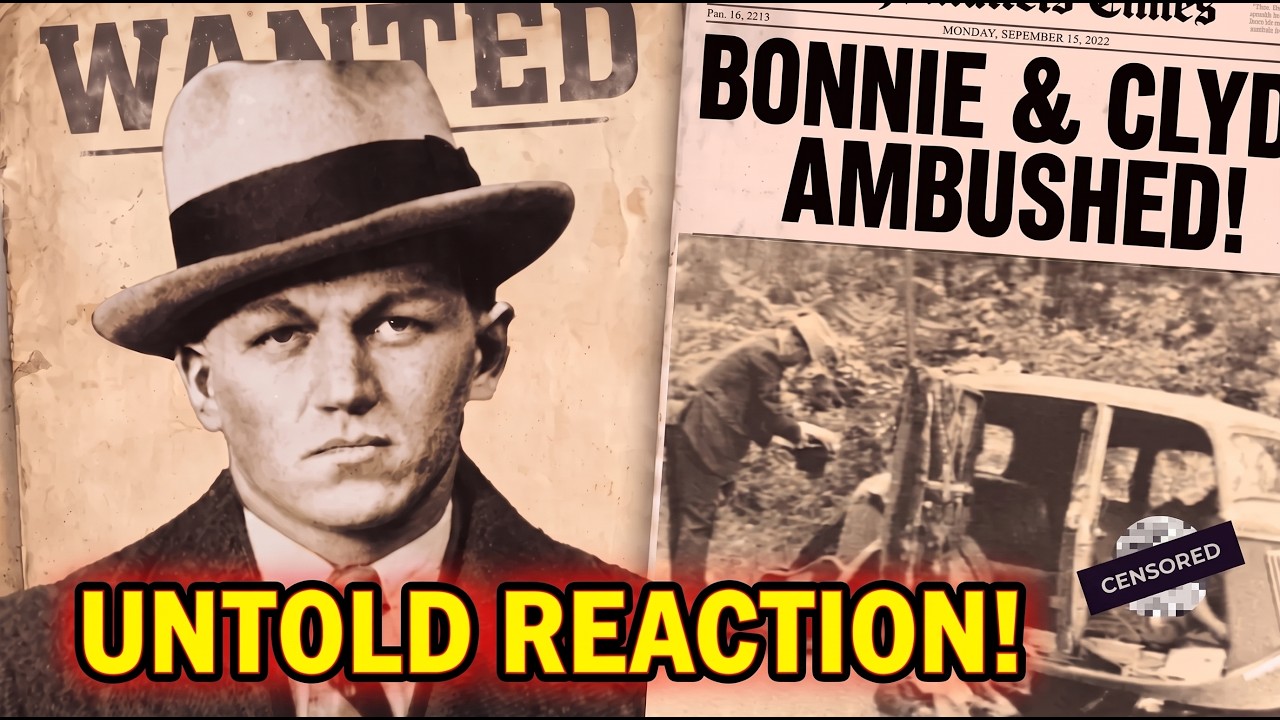
A twenty-five-year-old man whose picture ran in every newspaper in the country was hiding in the suburbs of America’s third-largest city, and the police could not find him. He stayed invisible by suppressing every visible trace of his life during a period when the government was demonstrating the consequences of chasing outlaws. Then came the Louisiana ambush. On May 23, 1934, lawmen killed Bonnie Parker and Clyde Barrow on a rural road.
Bonnie died in the passenger seat beside Clyde, struck by twenty-six bullets. Before that morning, a woman riding with a wanted man could at least hope the authorities would hold their fire. That hope died on that Louisiana road. Every woman tied to a wanted man in America understood the government would shoot her too.
Helen Gillis had been released from federal custody four weeks earlier when the news broke. She had been arrested at Little Bohemia when the men fled, then held, tried, and bailed out. By May she was free and legal, out of trouble. She could have left.
The smartest move was to stay away and let the government forget her. Instead, she went back to Little Bohemia. About a month after the lodge shootout, almost exactly coinciding with the ambush, Helen rejoined her husband in hiding. They lived quietly near Lake Geneva, Wisconsin, for several days before moving on.
The newspapers were still running photographs of the Louisiana shooting and the two bodies. The twenty-one-year-old mother chose that week to get back in the car with the most wanted man in the country. Neilson’s household changed nothing after May 23. The last outlaw couple in America had watched what happened to the other one, and they stayed a couple.
Nelson’s professional answer came five weeks later and left no room for doubt. On June 23, 1934, the attorney general issued a federal warrant for his arrest. Seven days later, on June 30, thirty-eight days after the Gibson ambush, Nelson walked into the Merchants National Bank in South Bend, Indiana, with John Dillinger and Homer Van Meter. They robbed the bank in broad daylight.
A police officer was shot and killed during the operation. Nelson was reportedly hit in the chest but survived because he was wearing a bulletproof vest. The gang escaped to Chicago. When two police officers later approached their meeting place on Wolf Road outside the city, Nelson shot them too.
The government had applied its ambush policy in Louisiana, posted rewards for information leading to Nelson’s capture, and Nelson responded by robbing a bank with two of the most wanted men in America and shooting at every officer who came near. The ambush did not make him cautious in his work. It made him cautious in everything except the work itself. That contradiction was the core of his character.
In hiding, he was so disciplined that federal files admitted they lost track of him for a week at a time. In action, he behaved as if May 23 had never happened. Other men on the wanted list read about that ambush and quietly stopped robbing banks without announcing their retirement. Nelson did not slow down.
The logic was harsh but sound. A man facing prison might be deterred by the threat of harsher punishment. Nelson had already faced the worst possible consequence, and you cannot threaten a man with what he has already been promised. His entire summer proved he understood that calculation with perfect precision.
Nelson, Helen, and his partner John Paul Chase left Chicago for California and spent the rest of the summer moving back and forth between Chicago and the West Coast. They stayed in auto camps and took back roads. Once a small-town policeman pulled them over for speeding. Nelson went to the police station, paid a five-dollar fine, and drove off.
No one searched the car that held a machine gun, a rifle, and ammunition. The most wanted family in America passed a routine traffic checkpoint like any other family on a road trip, because Nelson stayed calm and composed everywhere except inside a bank. They wandered through Sacramento and San Francisco, then headed to Reno and Las Vegas. They spent October in auto camps and hot springs in Nevada, and in early November they turned back toward cold Chicago.
On November 27, 1934, on a highway outside Barrington, Illinois, six months and four days after Bonnie and Clyde were killed, federal agents Samuel Cowley and Herman Hollis spotted Nelson’s stolen car. He was driving. The encounter became a gun battle. Both agents were killed.
Nelson was hit multiple times and died that night. No other fugitive of the 1930s killed more FBI agents in a single fight than he did. He was twenty-five years old. His body was found the next morning in a ditch near a cemetery in Niles Center, after an anonymous phone call told the government where to look.
That was Baby Face Nelson’s response to the deaths of Bonnie and Clyde.