In the winter of 1999, teenage vandals broke into the vacant lodge that crowned the highest point in Oakland County, Michigan. What happened that night reduced a seventy-six-year-old monument to American industrial royalty to rubble and ash. When morning came, the walls that had sheltered the Ford family were gone. Only the stone chimney remained, standing like a grave marker above foundations that traced rooms once filled with laughter.
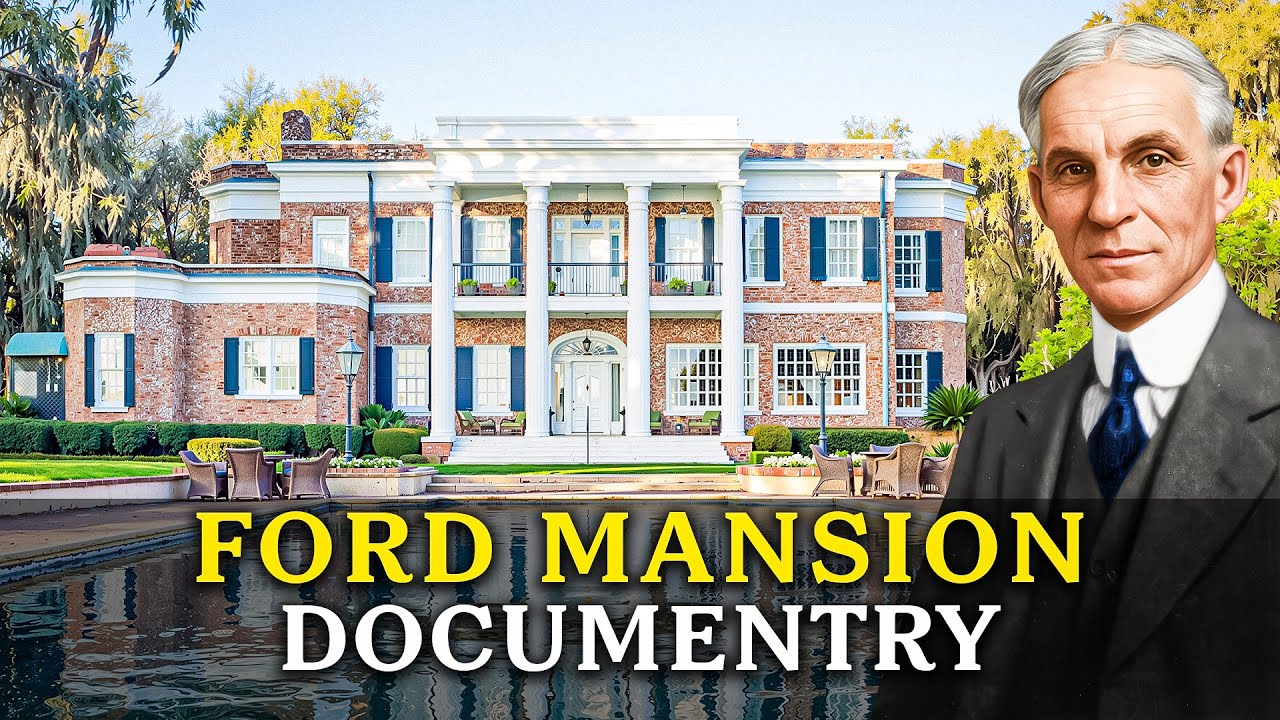
That lodge had been Haven Hill, the private sanctuary of Edsel Ford, the only son of Henry Ford. Built in the 1920s, it was meant to be an escape from the crushing weight of being heir to the greatest fortune in American industry. Instead, it became a monument to a dream that could not last. The Ford family wealth in the early 1920s was almost incomprehensible.
Henry Ford’s net worth reached 1. 2 billion dollars, equivalent to roughly 22 billion today. By 1923, ten million Model T automobiles had rolled off his assembly lines. The Fords were not merely rich.
They were American royalty, their lives and decisions shaping the destiny of Detroit and the entire automobile industry. Edsel Ford was born on November 6, 1893, the only child of Henry and Clara Ford. He became president of Ford Motor Company in 1919 at just twenty-six years old. On paper, he had everything.
He was married to Eleanora Clay, niece of department store magnate J. L. Hudson, and together they were raising four children. In reality, Edsel lived under pressures that would eventually consume him.
By the early 1920s, the privacy of the Ford family’s Detroit home was eroding. The city was growing and changing. Labor tensions at the Ford factories were escalating into something dangerous. The wealthy were increasingly viewed not as leaders but as targets.
Then came the Lindbergh kidnapping, which sent shock waves through every affluent family in America. If it could happen to Charles Lindbergh’s son, it could happen to anyone’s children. Edsel began purchasing parcels of land in western Oakland County, assembling a 2,422-acre estate. The land included one of the highest elevations in the county, a dramatic hill rising beside a wooded lake.
Locals had called it Heaven Hill for generations. Edsel renamed it Haven Hill, a sanctuary, a nerve retreat, a place where he could escape the judgment of his father. Construction on the main lodge began in 1924 and continued through 1931, though the family moved in by 1926. Architect Robert O.
Derrick, who would later design the Henry Ford Museum, created a structure that married rustic charm with modern comfort. The lodge sprawled across 6,900 square feet, built from cedar logs harvested from Michigan’s Upper Peninsula. Landscape architect Jens Jensen, famous for his prairie style using native plants, designed gardens, walking trails, boardwalks, and gazebos at scenic overlooks. Pine needles were trucked in regularly and scattered across the grounds to fill the air with a fresh, northern scent.
Haven Hill was not just a house. It was a self-sufficient world. A working farm included an 11,000-square-foot barn housing 1,500 sheep, cows, chickens, and horses. Two vegetable gardens provided fresh produce.
A gate house served as a secure entrance where guards checked anyone seeking entry. A carriage house, originally built for the chauffeur and the family cars, became a playhouse for the Ford children, complete with real electricity and plumbing. There were horse riding stables with a full riding arena, a swimming pool with a cabana, a tennis court, and a 3,000-foot toboggan run with a motorized tow lift that pulled riders back to the top. A lagoon, created by damming a small creek, became the focal point of the estate’s social life.
Haven Hill also became a stage for the most famous people of the era. Charles Lindbergh visited just months after his historic solo flight across the Atlantic in 1927. Thomas Edison, Henry Ford’s close friend, walked the grounds in his later years. Admiral Richard Byrd, the polar explorer whose expeditions Edsel personally financed, was a frequent guest.
In gratitude, Byrd named a range of mountains in Antarctica after his benefactor. Edgar Rice Burroughs, creator of Tarzan, visited. So did the Duke of Windsor, formerly King Edward VIII of England. But beneath the surface, something was deeply wrong.
Edsel had the title of president, but he did not have the power. Henry Ford never truly let go. While Edsel served as president, Henry controlled every major decision. Worse, Henry seemed to take perverse pleasure in contradicting, undermining, and publicly humiliating his only son.
In meetings, he would interrupt Edsel, overrule him, even shout at him to shut up before storming out of the room. Edsel’s gifts lay in different areas than his father’s. He had an artistic sensibility, a keen eye for design. He wanted to modernize the aging Model T.
Henry’s response was brutal: rub it out. Destroy it. Edsel backed down. To fight his father openly would tear the family apart.
To disengage meant abandoning his responsibilities. He was trapped between duty and dignity, and the stress was taking its toll. Making matters worse was Harry Bennett, Henry’s security chief, a brutal man who served as the founder’s enforcer. He seemed to take particular pleasure in making Edsel’s life difficult, and Henry allowed it, perhaps even encouraged it, as if the abuse would toughen his son up.
It did not toughen him. It was killing him. By the early 1940s, Edsel’s health was failing. He developed stomach problems, chronic pain that would not go away.
Doctors diagnosed stomach cancer, already metastasized by the time they found it. Surgery was attempted but unsuccessful. Henry Ford refused to accept what was happening, blaming Edsel’s lifestyle and insisting that better eating, different doctors, and quitting smoking would make everything fine. He could not see that his son was dying.
On May 26, 1943, Edsel Ford passed away at his home in Grosse Pointe Shores. He was forty-nine years old. The official cause was stomach cancer and undulant fever. But many people, including Edsel’s own son Henry Ford II, believed the real cause went deeper.
Henry II would later say of his grandfather: that old man killed my father. After Edsel’s death, Henry Ford briefly reassumed the presidency of the company. But the eighty-year-old founder was mentally inconsistent and no longer fit for the position. The company began to lose over ten million dollars a month.
It was Edsel’s widow, Eleanora, who finally broke the deadlock. Controlling over 40 percent of the company shares she had inherited, she delivered an ultimatum to Henry Ford: step down and let Henry Ford II take over, or she would sell her shares and take the company public. Clara Ford supported her daughter-in-law. Cornered by his wife and daughter-in-law, Henry finally relented.
On September 21, 1945, Henry Ford II became president. One of his first acts was to fire Harry Bennett. Henry Ford died on April 7, 1947, at age eighty-three. He had outlived his only son by less than four years.
After Edsel’s death, Eleanora no longer wanted to keep the vast estate. In 1946, just three years after her husband’s passing, she sold Haven Hill to the Michigan State Park System. It became part of the Highland State Recreation Area. The state used the lodge as a conference and environmental learning center, and for a time it seemed Haven Hill might have a second life as a public resource.
But in 1980, state budget cuts forced the closure of the structures. The lodge, the carriage house, the barn, all of it was locked up and left empty. For nineteen years, Haven Hill sat abandoned. Vines crept up walls.
The swimming pool cracked. The tennis courts disappeared beneath weeds. Weather got inside the lodge. Then, in late January 1999, teenage vandals broke in.
A fire started, whether accidental or deliberately set. The flames consumed the cedar logs harvested from the Upper Peninsula seventy-six years earlier. By morning, Haven Hill Lodge was gone. In the years that followed, other parts of the estate were lost.
The horse riding stables burned down in another fire. In 2008, a severe storm caused the massive barn to collapse. One by one, the structures disappeared, leaving only fragments and memories. Today, Haven Hill is part of the 5,900-acre Highland State Recreation Area.
Visitors can follow trails to the ruins. The stone chimney still stands, though it is slowly deteriorating and has been cordoned off. Low stone walls mark where rooms once stood. The gate house has been partially restored by volunteers from the Friends of Highland Recreation Area.
The carriage house still stands, boarded up. The pool remains, cracked and dry. Eleanora Ford lived until October 19, 1976, outliving her husband by thirty-three years. She became one of Detroit’s most important philanthropists, supporting the NAACP, the Henry Ford Hospital, and the Detroit Symphony.
She ensured the Grosse Pointe Shores mansion was preserved for the public. It stands today as a national historic landmark, its original art collection intact. Haven Hill never received the same preservation. When the lodge burned, there was no outcry, no campaign to rebuild.
The estate meant to be a permanent sanctuary lasted barely fifty years in its intended form. From vision to ashes took seventy-six years. The sanctuary that Edsel Ford built to escape his father’s shadow could not protect him. After he died, it could not protect itself.
Now it belongs to hikers and mountain bikers, to deer and birds, to the slow processes of decay and regrowth. All that remains is a chimney, some foundations, rusted fixtures in the soil, and the stories told about what once stood there.