In May 1943, a young German soldier in a Texas prisoner-of-war camp was so certain Germany would win the war within six months that he shaved his head, expecting thick hair to grow under the Texas sun before his triumphant return home. For two years, men like him refused to believe Germany could be defeated. They dismissed radio news as propaganda. When Hitler’s death was announced, many doubted that too.
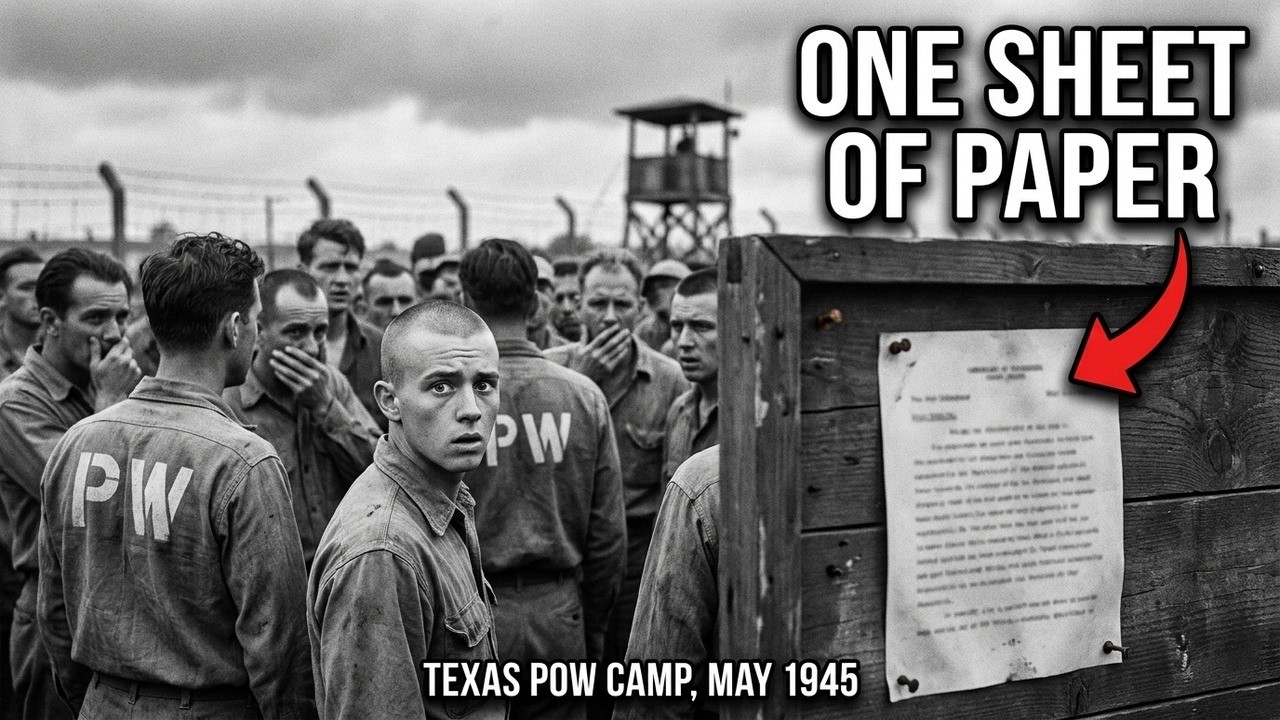
Then, on a May morning in 1945, during breakfast, the Americans pinned a single sheet of paper to the camp bulletin board. Washington had braced for riots that day, even suicides. But what these men actually did was something no one had planned for. The men who read that paper had arrived in Texas by train in 1943.
Most had been captured in Tunisia when the Afrika Korps surrendered that spring. In their own minds, they had not been defeated. They had been winning in the desert for two years. They had simply run out of fuel, ammunition, and ships.
They stepped off the train in Hearne, Texas, with their pride intact. An American guard named Bobby Sullivan remembered what they expected. He said they thought that when Hitler came to liberate them, he would laugh at their clothes marked “Prisoner of War. ” A young prisoner named Willie Nielson put it more simply years later.
He said, “We were proud, and we didn’t really feel that we had been beaten. ” Nielson was the one who remembered the bet about the shaved head. In 1943, he said, “The soldiers believed that a German victory was imminent, and there were many bets in the barracks. ” Remember that name.
Willie Nielson will return at the end of this story in a way he could never have imagined in that barracks. Texas offered them nothing to change their minds. Hearne was far from the war. The food was good, the barracks were clean, and the army strictly followed the Geneva Convention.
Nearly four thousand German prisoners lived there. They built fountains in their compounds, a theater with tiered seating, and space for a band. They printed their own camp newspaper. But they were not isolated from the truth.
In many camps, news reached the barracks directly. At Camp Algona in Iowa, every barracks had a radio. Daily broadcasts tracked the Allies’ advance through France, Belgium, and Holland, up through Italy, and across the vast fronts in Russia. So how did men who heard all of that continue to bet on a German victory?
Because in camps like these, the hardliners decided what the truth was. A history based on the papers of the Algona commandant makes it clear. Fanatical Nazis claimed that Allied victory stories were just exaggerated propaganda. A prisoner who dared to say Germany was losing the war risked being branded a traitor by the men sleeping beside him.
So the radios played, the front lines moved, and in many barracks no one said what everyone could hear. Not every man at Camp Hearne hoped for a German victory. One of them prayed secretly for the opposite and recorded what he saw in his diary. Fritz Hauss was a sergeant in the German Air Force, running a radar system in an anti-aircraft battery in North Africa.
He was captured in Tunisia in May 1943, and by October he was in Compound Three at Camp Hearne. Hauss was a devout Christian. Back in Germany, his family had secretly hidden a Jewish woman in their home. At Hearne, he and a few men who wanted to become chaplains met secretly and prayed for Germany’s defeat in the war.
By the spring of 1945, even the hardliners had little room to argue. American armies had crossed the Rhine. The Soviets were at the gates of Berlin. In late April came news that Mussolini had been killed.
Then came news that Hitler was dead too. In the Minnesota camps, according to their historian, prisoners initially doubted the report of Hitler’s death. On April 28, ten days before the end, Fritz Hauss opened his diary and wrote, “It is terrible now. Indescribable misery is falling upon Germany.
Everything has collapsed, and we are here behind barbed wire, overwhelmed by sorrow, worry, and apathy. Life has faded away. ”
In Washington, the War Department was preparing for the moment when the rest of the camps would catch up to his view. There were more than 370,000 German prisoners in the United States.
Officials feared a final outburst of Nazi violence upon the announcement of surrender or Hitler’s death, even so-called suicide clubs. No one knew how men who had refused to believe for two years would react when they finally had to. At Camp Hearne, the morning of May 8, 1945, began like any other. Prisoners were eating breakfast in the mess halls when the Americans posted the news of Germany’s surrender on the bulletin board.
No loudspeakers, no speeches, just a single sheet of paper. A prisoner named Arno E. Nickau remembered what happened next. “The first man who read it returned to the barracks.
Someone asked him, ‘What happened? ’” He answered, “Why don’t you look for yourself? ” And so, one by one, each man got up and went to the board. When each of them came back, Nickau said, he threw himself onto his bunk.
No one spoke. The men who had bet everything on a German victory lay on their beds staring at the ceiling. Then a prisoner, lying on his bunk, began to sing. The words he sang are the strangest part of this entire story.
As Nickau remembered them, the words were roughly as follows: “Be patient, for we are the ones who bear the blame. ” Soon the entire barracks joined in the singing. The men who two years earlier would not admit to losing a battle were now singing that they were the ones to blame. Hold on to those words.
By the end of this story, you will hear almost the same words from a man who had seen this defeat coming. Years later, Willie Nielson was asked how the prisoners received the news that morning. His answer was three words. “Sad.
Very sad. ”
In the camps where records survived, the War Department’s nightmare never materialized. No riots, no suicide clubs. But one camp saw a moment no one could have scripted.
At Fort Oglethorpe, near Chattanooga, some German prisoners broke down and wept when they heard that it was over. There was no other display of emotion or any disturbance within the compound. That is how the army magazine Yank reported it a few weeks later. That evening, the post commander, Colonel Howard Clark, gave a brief speech at a special retreat ceremony for the victory.
The flags on the post were still at half-mast in mourning for President Roosevelt, who had died less than a month earlier. Thirty minutes after that ceremony, Colonel Clark learned that his son, Lieutenant William A. Clark, had been killed in battle at Luzon in the Philippines three weeks before. The man who stood to celebrate Germany’s defeat did so while his son had already died in a war that was not yet over.
He simply had not been told. In Iowa, at Camp Algona, the news crushed the men who had believed the most. According to the camp commandant’s papers, seven dedicated Nazis suffered complete nervous breakdowns when the surrender was announced. The German chaplain and the prisoner doctors themselves managed to help four of them recover.
In the same camp, some prisoners asked for something no one in Washington had imagined. At least fifty German prisoners asked to join the American army so they could go fight the Japanese. The army had no rules for that, and nothing came of it. In the small branch camps in Minnesota, American officers reported no demonstrations on V-E Day, only tension.
The sergeant in charge of the camp at Howard Lake summarized the change in one sentence: “Almost all of them are anti-Nazi now. ” The Nazi salute was banned. At Hearne, the camp spokesman wrote in the prisoners’ newspaper that the “black sheep” of the camp, who until then had only moved in secret, had finally revealed themselves. The surrender changed the nature of the camps for the Americans as well.
By the spring of 1945, American newspapers were publishing letters from readers complaining that German prisoners were being treated with kid gloves. Photographs of the liberated concentration camps were in every paper. Within days of V-E Day, rations were reduced. At the branch camp in Vermont, Minnesota, there was no more beer and no more factory-made cigarettes.
One prisoner at a California camp remembered that before the surrender, the atmosphere had been almost friendly. Afterward, the Americans became more reserved. Prisoners still received food, were paid for their work, and remained protected. But the easy years were over.
So what happened to the men who refused to believe? The soldier who shaved his head under the Texas sun never got the homecoming he had bet on. His six months turned into years. Willie Nielson, the young man who had not felt defeated, lived to see a book written about Camp Hearne.
The book was published in 2004 by Texas A&M University Press. Its foreword was written by Willie Nielson, former prisoner of war at Camp Hearne, from 1943 to 1945. As for Fritz Hauss, the Air Force sergeant who had prayed for Germany’s loss, he returned home and became a Baptist pastor. Years later, he remembered the American chaplain at Hearne, who had hoped that the prisoners would reject Hitler’s tyranny and help build a new democratic Germany.
Hauss wrote, “This hope has been fulfilled. Remember that song in the barracks, we are patient because we are the guilty ones. ” Fritz Hauss put it in almost the same words. He said, “It is God’s judgment, and as a nation, we deserve it.
”
The camp no longer exists, but north of Hearne, near Highway 485, you can still walk among the foundations of the barracks, the fountains the prisoners built, and the seats of their theater. The site is now a museum. Somewhere on that ground stood the board where a single sheet of paper ended an argument that two years of radio news could not settle. Within weeks of that morning, German prisoners across America were ordered to sit and watch one film.
What that film showed them, and what thousands of them did afterward, is the subject of this story.