On August 15, 1945, Japan’s emperor announced surrender, and radios across Tokyo crackled with the news. But in the bamboo-hutted stations deep in the Philippines, in the shadows of Burma’s jungles, and in the cells of Nanjing, the war did not feel over. In one such station, a group of young women—some barely out of girlhood—sat in silence, clutching one another like driftwood in a storm. They did not know what the date meant.
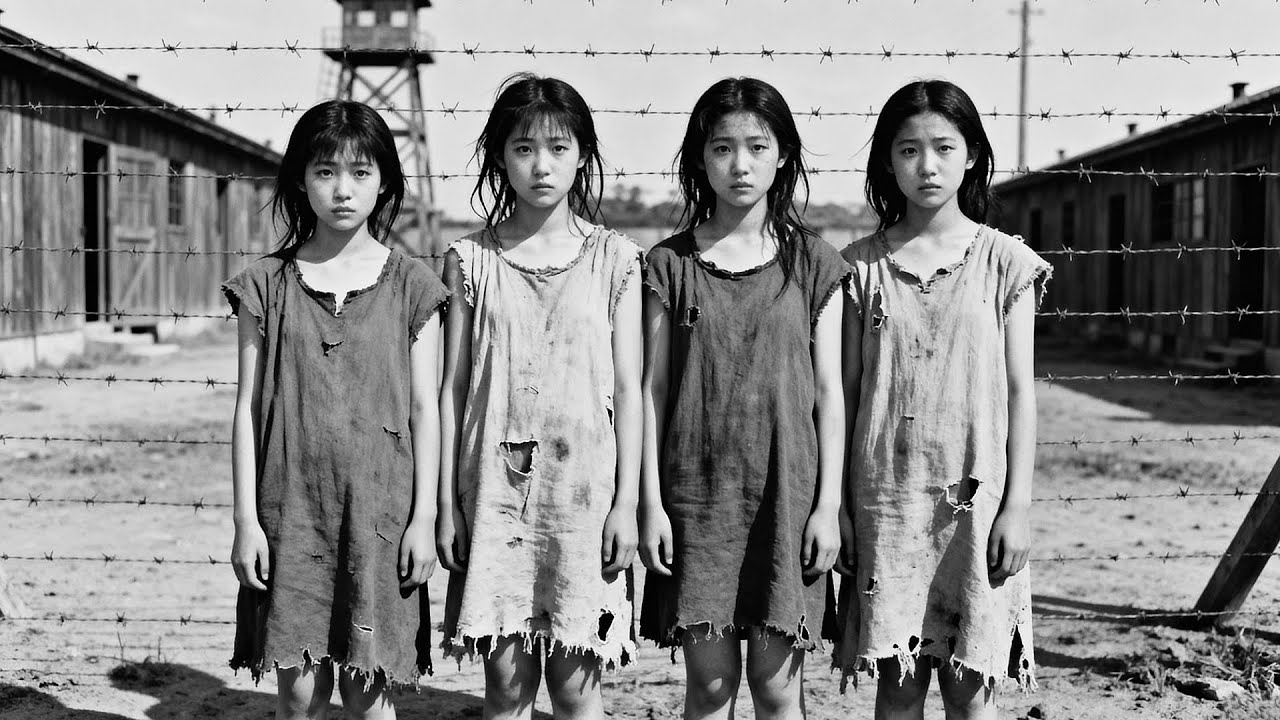
They knew only the sound of boots, the bark of Japanese sergeants, the gnawing ache in their stomachs, and the way time had shrunk to a single expectation: more soldiers, more nights, more survival. The place had been called a comfort station, a phrase that sounded almost merciful in its vagueness. In truth, it was a prison without bars. The Japanese Imperial Army had built such sites wherever its flags spread—Shanghai, Manila, Rangoon, Seoul.
Estimates later given to historians varied wildly. Some said 50,000 women had been taken; others argued it was closer to 200,000. Numbers that could fill stadiums were reduced here to shadows behind reed mats, waiting for the next order. One of the women, seventeen years old, bit her lip so hard it bled.
She had been taken from her Korean village two years earlier, told she would work in a factory for the empire. Instead, she had been placed on a transport ship, then herded into this station. Her name, like so many others, had been stripped away and replaced with a number on a ledger. She would later say that her greatest fear was not dying, but forgetting the sound of her mother’s voice.
Nearby sat a Filipino woman, older—perhaps twenty-three, though malnutrition carved years into her skin. She had been captured after the Japanese swept through her village in 1942. She remembered hiding in tall grass with her younger brother until bayonet tips flashed above them. He had been killed on the spot.
She had been taken. Now her body was a ledger entry, her memories the only thing left unrecorded. The women had been conditioned into silence. Rules were shouted in Japanese: obedience, cleanliness, availability.
Doctors came once a week for inspections that left them sore and humiliated. Soldiers filed in by the dozen. On long nights, each woman endured twenty or more visits. Disease spread quickly, but refusal was unthinkable.
Outside, the war was indeed shifting. American bombers had rained fire on Tokyo. Atomic clouds had risen over Hiroshima and Nagasaki. Hirohito’s surrender speech signaled the collapse of an empire.
But in these hidden rooms, there were no radios, no celebrations, no knowledge of history turning. Only the creak of doors, the hiss of lamps, and the dread of another set of boots scraping against the threshold. The Japanese guards had fled days earlier, abandoning their posts when defeat became inevitable. Yet the women did not feel liberated.
Abandonment did not equal freedom; it meant exposure. Rumors drifted through like smoke. Americans were near. For women who had endured years of being used by one army, the thought of another filled them with terror.
Soldiers were soldiers. Uniforms, no matter their color, meant power over the powerless. At dusk, the hut grew still. Shadows stretched long over cracked floorboards.
The women huddled together, the younger clutching the older, the older clutching no one. Outside, the rumble of engines approached. Boots—heavier, unfamiliar in rhythm—began to echo. The cicadas faltered, as if the jungle itself were holding its breath.
Inside, the Korean girl pressed her nails into her palms until crescents of blood bloomed. She thought of her mother, of a market stall by the river, of roasted chestnuts and the smell of soap. She braced for the routine that had erased her humanity. The door slid open.
Silhouettes filled the frame, broad shoulders outlined against fading light. The women recoiled, pulling shawls tight around bony arms. The figures stepped inside, carrying something bulky, something square. The women did not yet understand that they were not boxes of ammunition, but crates of food.
The men were not barking orders in clipped Japanese, but murmuring in English. But in that first instant, none of the women could hear the difference in tone. They saw only uniforms. Uniforms meant ownership.
Uniforms meant terror. The Americans paused, uncertain at the sight of hollow-eyed women cowering on the floor. They set down their crates with deliberate slowness, like men trying not to spook wild deer. One GI pulled a tin from his pocket, shaking it gently.
It rattled with the sound of canned peaches. Another held out a bar of soap as if it were a peace offering. The women did not move. Food, soap, offers—these were tricks soldiers used before cruelty.
And yet the Americans kept their distance, speaking words whose cadence carried no menace. One man, tall and red-haired, attempted to mime eating. He tapped the tin with his knife, made a spooning motion toward his mouth, and grinned with the nervous smile of someone who knows he looks foolish. For the first time in months, perhaps years, something flickered across a woman’s face.
Not fear, but confusion. She almost laughed. Almost. But the habit of silence clenched her throat shut.
The youngest of the women, perhaps fifteen, reached forward with trembling hands, expecting the blow to come. Instead, the soldier placed the tin gently into her palms. She drew back instantly, clutching it to her chest as if it were contraband. He did not move closer.
He simply nodded once, then stepped back. The moment rippled through the group. The older Filipina woman stretched out her thin, shaking arm toward the soap. The soldier placed it in her hand without a word.
She pressed it to her face, inhaling the clean scent, and tears slid down her cheeks. Soap—a thing so ordinary it rarely merited notice—had become more precious than gold. The Americans set down more supplies: bandages, quinine tablets, powdered milk. None of it fit the script the women had been forced to memorize.
Soldiers did not give. Soldiers only took. Yet here were men who offered, then stepped back, as though aware of invisible boundaries carved by trauma. Then something almost absurd happened.
The red-haired GI pulled from his pack not more food, but a small harmonica. He pressed it to his lips and began to play. A clumsy tune, notes bending, not quite in rhythm. The sound startled everyone, even his comrades.
But in that strange moment, the hut filled with something neither side expected: music. It was cracked and imperfect, but it was not shouted commands. It was not boots pounding or fists slamming. It was astonishingly gentle.
One woman covered her mouth as if afraid laughter might escape. Another tilted her head, tears mixing with a small, incredulous smile. The fear did not dissolve overnight. When the GIs tried to coax the women outside, some refused, convinced danger waited beyond.
When medics arrived with stretchers to take the sick, women clutched one another, begging not to be separated. A doctor later recorded that the women showed signs of psychic shock—a phrase inadequate to describe years of systematic violation. Yet slowly, day by day, gestures built trust. A soldier kneeling to lace a torn sandal instead of demanding her body.
Another sitting nearby, carving a piece of wood into the shape of a bird, then leaving it at her feet without asking for anything in return. One survivor later recalled the surreal moment she tasted her first bite of canned peaches. The syrup clung to her lips, the sweetness overwhelming after years of hunger. She wept, not just for the taste, but for the strangeness of realizing someone wanted her to eat—not be eaten.
For her, that spoonful was proof the world had not ended with cruelty. The statistics of the system the Japanese called ianfu were staggering. By 1991, decades after liberation, a Korean woman named Kim Hak-sun broke her silence, standing before cameras and telling the world she had been taken at age seventeen. Her account was one of the first to pierce the silence that had stretched like a shroud over survivors.
“We were treated as less than animals,” she said. For every Kim Hak-sun, there were thousands who never spoke, some out of shame, others because their voices had been buried by time. American military documents lent colder, clinical confirmation. The US Army’s psychological warfare unit recorded notes about comfort stations in Burma, the Philippines, and China.
Reports listed venereal disease rates, pregnancies terminated under force, and the staggering daily demands on each woman: fifteen to thirty soldiers per day, sometimes more. A 1944 Allied report estimated that 80 to 90 percent of comfort women were Korean; others were Chinese, Taiwanese, Filipino, Dutch, Indonesian. Survivors recalled being as young as thirteen when first taken. Against this backdrop, the behavior of American soldiers upon liberation appeared even more startling.
Bound by the articles of war, US troops faced strict prohibitions against rape. Not all abided by those laws, for no army is spotless. But in the comfort stations, they encountered something that froze even hardened veterans. A system so organized, so brutal that it defied the imagination of men who had stormed beaches under fire.
Many were disgusted, even ashamed that humans could engineer such cruelty. “We thought we had seen hell,” one medic later recalled, “but then we walked into those rooms. ”
The war ended, but liberation did not mean peace. When the Americans withdrew, the women faced a silence as suffocating as captivity.
Some returned to their villages only to find doors closed. Families crushed by poverty and fear did not welcome daughters who carried the stain of the Japanese Empire. A Korean woman recalled walking home after liberation, still weak, her hair unevenly hacked short by soldiers years before. She expected an embrace, but her mother turned away, whispering that neighbors would talk.
“I was alive,” she said years later, “but in their eyes, I was already ruined. ”
The Tokyo War Crimes trials mentioned the comfort women system only in passing, focusing instead on aggressive war and atrocities like the Nanjing massacre. Few Japanese officers were ever punished specifically for running the stations. The women waited for acknowledgement that rarely came.
The Americans’ refusal to touch them in 1945 was a mercy; the world’s refusal to remember them afterward was another cruelty. And yet memory endured in private. A Filipina survivor said the smell of canned peaches followed her for the rest of her life. Every time she opened a tin in later years, she would weep—not for the fruit itself, but for the absurd miracle of a soldier offering her sweetness after years of degradation.
Another woman remembered the sound of a harmonica, clumsy notes played by a red-haired GI who had no idea his fumbling melody would remain lodged in her memory like a beacon. Decades later, monuments rose in Seoul, Manila, and Taipei to honor the comfort women. Bronze statues of young girls sitting solemnly faced embassies, their gazes unflinching. Survivors continued to demand recognition, apologies, reparations.
Governments traded words, denied, defended. But the women’s voices, fragile with age, still recalled that singular shock: the astonishment of finding mercy where they expected only harm. Survivors who spoke publicly emphasized not only what the Japanese had done, but what the Americans had not done. That absence of violation became almost as defining as the abuse that preceded it.
In a war filled with noise—bombs, speeches, radio broadcasts—the quiet decision not to touch carried its own weight. It was a silence that echoed louder than words.