On the eighteenth of September, in the year 96, a stonemason’s chisel was given an order unlike any it had received before. For years, such tools had been used to carve imperial names into arches, milestones, and public walls across the Roman world. Now the command was to erase. One name was to be gouged out of bronze and stone wherever it stood, struck out name by name, until only a rectangular scar remained.
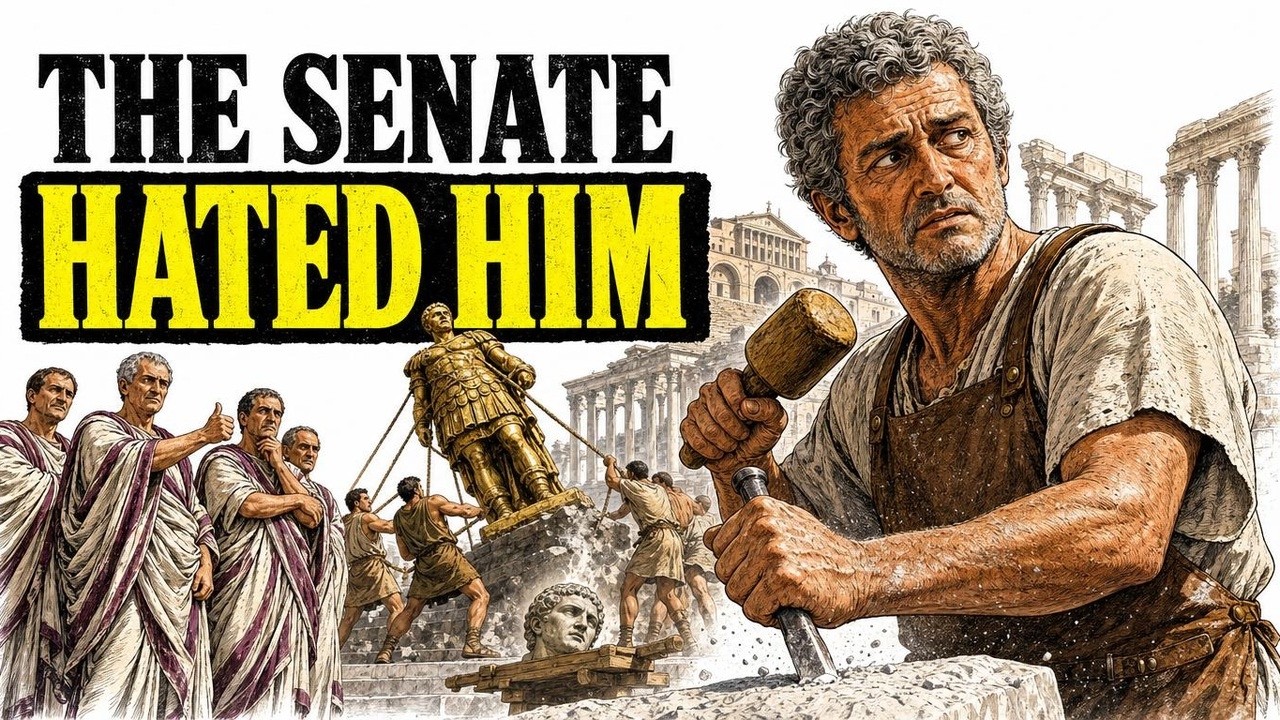
The man whose memory was to be removed was the emperor Domitian. The official story, written by the men who survived him and celebrated his death, described a monster: a paranoid tyrant who demanded to be worshiped as a living god, drained the treasury, and terrorized the Senate. The historian Suetonius, a young man in Rome at the time, recorded the Senate’s reaction to the emperor’s murder. Senators called for ladders to be carried into the Senate House, climbed up to tear down shields bearing his portrait, and shattered them on the marble floor.
Voices shouted for his memory to be scoured from the earth. But the objects that survived the destruction tell a different story. Coins recovered from the soil after two thousand years show remarkable economic stability. Silver purity held steady through his entire reign.
Frontier forts reveal a border defended with professionalism. The stones of Rome itself, from the Colosseum to the Palatine Hill, show a capital rebuilt on a scale that shaped the city for three centuries. The written record screams tyrant. The physical evidence describes one of the most capable administrators the empire ever produced.
The investigation begins with a military diploma, a small bronze tablet now under museum glass. Such tablets were ordinary paperwork. A soldier who completed twenty-five years of service received one as proof that he was now a Roman citizen, his marriage recognized, his children legitimate. Thousands were issued.
This particular tablet bears a rectangular wound where the emperor’s name once stood. Someone took a chisel to it, scraping the letters down to a smooth trough. Weather does not cut like that. This was deliberate.
The same wound appears everywhere. On the architraves of temples in Ephesus, where the limestone blocks still carry an empty patch at eye level. On the stone gates of forts along the Rhine. On the plinths of statues in the North African cities of Leptis Magna and Bulla Regia.
On milestones sunk into roads that lead nowhere. Always the same name. Always the same rectangular hole. Soldiers in Britain, masons in Syria, clerks in Egypt all reached for the same blank space in the same year.
That was not coincidence. It was an order. The Romans called this practice damnatio memoriae, the damnation of memory. It was among the harshest sentences the state could pass.
His acts were annulled. His name was struck from the calendar. Only a handful of emperors ever received this sentence in full. Domitian’s was the most thorough the empire had yet attempted.
Suetonius, an outsider to power, about twenty-seven years old when the emperor died, was living in the city and watching the ruling class come apart. He did not describe a tidy handover of power. He described a frenzy. Senators were wild with joy.
They wanted to see the man’s memory undone in front of their own eyes. Suetonius recorded their words, the insults hurled at a corpse that was not even in the room. This was fifteen years of held breath let out at once. The later senator Cassius Dio added that the Senate had feared this man so completely while he lived that not one of them had dared move against him openly.
Pliny the Younger, who had held office under Domitian, later wrote of the day with strange delight, describing people taking pleasure in dashing the emperor’s statues to the ground. The erasure was not left to a mob. It became a formal act of the state. Messengers carried sealed scrolls out of Rome, changing horses at imperial post stations, riding through the night.
When a commander on the Rhine read the order, a centurion picked men and marched them to the fortress gate. One soldier was handed a chisel. He spent the afternoon chipping his emperor’s name off the stone he had walked beneath every morning of his service. There was a bitter edge to that scene.
Many of these men owed everything to Domitian. He had raised legionary pay for the first time in over a hundred years. The army loved him for it. Suetonius admitted as much, writing that soldiers grieved for him and would have avenged him if they had found leaders.
The case against him was built by the senatorial class he had spent fifteen years frightening. They said he demanded to be addressed as master and god, that he shut himself inside an enormous new palace on the Palatine, that he turned the Senate into a chamber of fear. Tacitus described a reign of terror after the fall of senators Helvidius Priscus, Herennius Senecio, and Arulenus Rusticus, when writing a book of praise for a dead Republican could become a capital charge. Professional informers were everywhere.
A joke made too loudly at dinner could be fatal. A man named Mettius Pompusianus was executed in part because he kept a map of the world painted on his bedroom wall. But the erasure was rushed. Art historians studying the marble portraits of Nerva, the elderly senator who took the throne, have found a ghost inside them.
The sculptors did not carve a new emperor from fresh stone. They took statues of Domitian and recut the faces. Nerva’s portrait sometimes sits on a head that is too long, a face stretched over another man’s bone. The dead emperor stares out from inside the man who replaced him.
The coins tell the most damaging story against the prosecution. Domitian’s predecessors had debased the currency for years. Nero had cut the weight and purity of the denarius. Vespasian and Titus had let the standard slip.
In his first full year of rule, Domitian raised the silver content back to the standard of Augustus a full century before. He recalled the weak coins and re-struck them. No emperor would match his best figure again for well over a hundred years. This was not the hand of a spendthrift.
This was the signature of a man who thought in decades. Domitian also launched one of the most costly building campaigns the city had ever seen. He rebuilt the temple of Jupiter Optimus Maximus and roofed it in gilded bronze tiles. Plutarch wrote that the gilding alone had swallowed more than twelve thousand talents.
He finished the Colosseum. He built a covered concert hall. He built a new stadium for foot races on the Campus Martius, whose long curved outline still fixes the shape of the Piazza Navona. The project that carried his name most heavily rose on the Palatine Hill, where he cleared away the old aristocratic mansions and built the Domus Flavia, an instrument of government carved in stone.
For three centuries after, every Roman emperor would rule from these rooms. The land under that palace had once held the homes of the old senatorial families. Their descendants now had to climb the Palatine as petitioners and cross his marble floors as supplicants on ground their own grandfathers had owned outright. The building told them, without a single word, that the age of the great families sharing power was finished.
On the frontiers, the same emperor was seen differently. A centurion on the Danube knew only that Domitian had raised the pay of the entire army by a full third. He led wars personally, against the Chatti across the Rhine and later the Dacians on the Danube. It cost Rome dearly.
A whole legion was destroyed in an ambush. There was a revolt in 89, when the governor of Germania Superior declared himself emperor with two legions behind him. It collapsed within weeks when a thaw broke the ice on the river and stopped his German allies from crossing. The fear of a repeat sharpened every suspicion the emperor carried afterward.
The frontier he left behind held. The line did not break for years after his death. Suetonius, after pages spent cataloging cruelty, drops in one sentence that undoes much of his own portrait. He writes that under Domitian the provincial governors were held on so tight a reign that they never showed more honesty or restraint than in these years.
The provinces were governed better then than before or since. His inspectors could not be bought. A governor caught stealing received exile or the axe. The men who wrote his history were not hiding in cellars.
Tacitus held a praetorship in 88 and served abroad through the worst years of the terror. Pliny held financial and legal posts under Domitian and prosecuted cases in his own courts. Quintilian was handed the tutorship of the emperor’s grandnephews, the boys marked out as heirs, along with a fortune. These men wore the emperor’s favor like a good wool cloak.
Only after he was safely dead did they rediscover a lifelong buried loathing of the man who had promoted them. Their testimony was not a chronicle. It was a defense statement, the sound of clever men explaining why their years of comfortable service under a tyrant should not be counted against them. Domitian tore up the script of the Senate’s fiction.
Augustus had built his system on the careful lie that he was first among equals. Domitian looked at the Senate and saw a dining club of rich men grieving for a republic that would never return. In 85, he took the title censor for life, a permanent grip on the role of the Senate that no man before had claimed forever. He decided who counted as a senator at all.
The turning point came inside his own family. Flavius Clemens, a consul married to the emperor’s own niece and father to the two boys Domitian had adopted as his heirs, was arrested and executed on a charge of atheism. If the emperor would kill the father of his own chosen heirs, no rank, no service, no kinship could save a man. The plot against Domitian was conceived in the shadow of that execution.
The killing was quiet, domestic, and close. The men who arranged it ran his household. They knew the hour he rose and the room he slept in and the blade he kept beneath his pillow. On the morning of the eighteenth of September, 96, a freedman named Stephanus, who had worn a bandage on his arm for days to hide a dagger, asked for a private word with the emperor, saying he had uncovered a conspiracy.
As Domitian bent his head to read the document, Stephanus struck him low in the groin. The emperor, forty-four and still strong, seized his attacker and they went down together, grappling. Domitian shouted for the boy who tended his shrine to fetch the dagger from beneath his pillow. The boy found only an empty hilt.
The conspirators had drawn out the steel days before. No guards came. The others burst through the door, and it ended after seven wounds in a bedroom beneath the shrine of Minerva. The aftermath told the truth of the reign more plainly than any single act within it.
The Senate voted the damnatio memoriae on the spot. The Praetorian Guard felt something wholly different. They demanded the killers by name. When the new emperor Nerva tried to shield them, the guard mutinied, dragged the conspirators out, and killed them.
The armies on the frontiers were furious and looking for a leader to avenge him. The ordinary people of Rome felt almost nothing at all. The Senate denied him a state funeral. According to Suetonius, his body was carried out of the palace on a common bier, the kind used for the city’s poor.
But his old nurse, a woman named Phyllis who had held him as an infant, brought the body to her own villa and had it burned there in secret, at real risk to her own life. Later she gathered his ashes and carried them into the temple of the Flavian family, mixing them with the ashes of his niece Julia. One woman’s private loyalty set against the public rage of the most powerful assembly on earth. To the men who wrote him down, he was a flat monster with nothing inside.
To the woman who had known him from the cradle, he was worth the danger of treason. The attempt to erase his name failed, and its scars became his monument. The attempt to erase his works failed more completely still, because the foundations of the city stand on them, and no chisel ever cut that deep.