In the summer of 1952, a woman who had lost her husband that winter was driven along the top of Scotland, past the last farms before the open sea, when a broken castle came into view above the cliffs. Its roof had failed in places. Its windows were gone. By the accounts that survive, the few still inside kept to a single room around one peat fire because the rest could not be lived in.
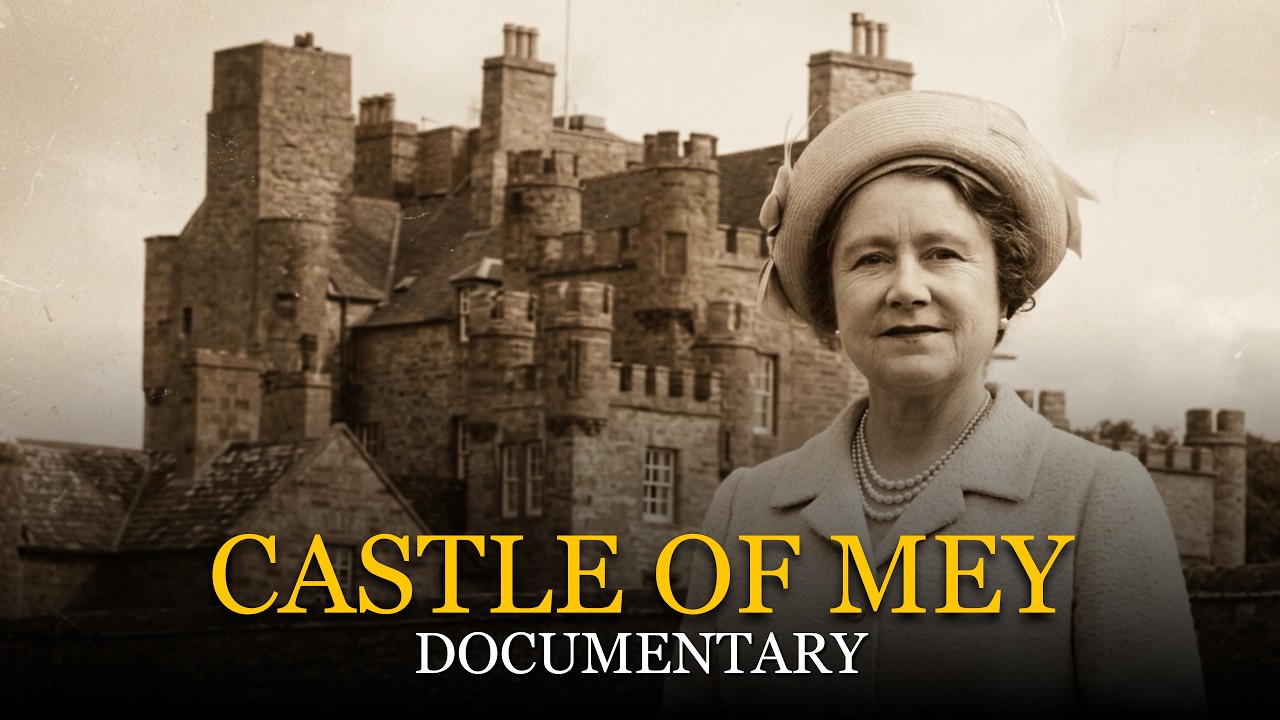
Months before, she had been the queen at a king’s side. Now she was a widow of fifty-one, no longer a wife and no longer a queen, with no house that was truly hers. She looked at the ruin a long moment, then asked her hostess a single quiet question: whether a castle abandoned at the edge of the country might be the one thing left that could give a grieving woman a reason to begin again. The widow had come to Caithness, the flat, treeless county at the very top of the British mainland, to be where no one was looking.
She was the guest of Commander Clare Viner and his wife, Lady Doris Viner, old friends who kept a house on Dunnet Head called the House of the Northern Gate. It was about as far as a grieving woman could get from the world that had just changed under her: a long way by road and rail from London, a place where a famous face could pass almost unremarked among people with their own hard work to do. The castle she found there fitted the mood of the place exactly. It was called Barrogill, a tall gray block of a proper old Scottish tower with turrets at its corners, set in a scrap of parkland with the wind coming off the Pentland Firth and nothing to break it.
It was not a grand sight. By the reported account of that day, she turned to her hostess and asked whether the woman thought it might suit her. To understand what an odd question that was, you have to know who was asking it. She had palaces at her back, staff to run them, and centuries of ceremony to fill her days.
But those houses belonged to the crown and the nation, held in trust, lent to whoever held the office. She had lived her whole adult life inside that arrangement. Here, on a cold road at the end of Scotland, she was looking at a broken castle that nobody wanted and asking whether it might be hers. Not the crown’s.
Hers. The castle had been standing in one form or another for close to four hundred years. It had been built between 1566 and 1572 by George Sinclair, the fourth Earl of Caithness, a man who ruled the far north with a hard and bloody hand. He was locked up more than once by his own crown, was granted a formal pardon in 1556 for what the record calls the oppression of the people under him, fought a pitched battle against the Earl of Sutherland, and after a victory at Dornoch had several beaten men beheaded.
Worst of all, when his heir made peace with an enemy the Earl would not forgive, the father had his own son shut away, and the young man died a prisoner in the family stronghold of Girnigoe in 1576. The Earl built the castle not for himself but for a younger son, William Sinclair, from whom came a branch of the family known ever after as the Sinclairs of Mey. For a long stretch it was their house. Then a descendant who inherited the earldom in 1789 changed the castle’s name to Barrogill, and for about a hundred years it served as a seat of the earls themselves.
In the eighteenth century a wing was added to the west, and in 1819 the twelfth Earl brought in William Burn, one of the most sought-after country house architects Scotland ever produced, who dressed the old fortress in the softer Gothic manner of his day. And then the money and the meaning began to drain away. In 1889, the fifteenth Earl of Caithness died without a direct heir, and the castle passed out of the Sinclair family altogether. Over the next sixty-three years it went through more than one owner, and with each passing the estate shrank and the building slid a little further down.
Death duties, first brought in during the 1890s and raised again and again, fell like a hammer on families whose wealth was all in land and stone. Farming went through long years of depression. Two world wars took the young men and the servants and the certainty. Across the country, such houses were being pulled down at a startling rate, quietly, one after another, because a roof over empty rooms costs money and empty rooms bring none in.
By 1952, the castle had almost finished dying. The parkland around it had come down to about thirty acres. The roof was failing, its slates gone in places, and windows had fallen out and not been replaced. There was no electricity in the building, no running water, no bathrooms.
The people still living there had retreated into the one room they could keep warm around a single fire of peat cut from the local ground. During the Second World War, the old castle had been given over to housing troops, and that rough use, piled on top of long neglect, pushed it the rest of the way down. So when the talk in the room turned, as such talk did, to the fact that this castle too was probably finished, that the sensible thing was to let it be abandoned and very likely pulled down, the widow standing among them listened. And then, by the account that has come down to us, she said something that stopped the conversation cold.
“Never,” she is said to have replied. “It’s part of Scotland’s heritage. I’ll save it. ”
And then she bought it.
The figure that comes down again and again is £100, thought to be worth little more than the value of the lead still lying on the roof. In other words, she paid more or less the scrap price of the metal, and the four-hundred-year-old castle came along with it for nothing. Some tellings hedge the number and say the sum was anywhere between a single pound and a hundred. What every version agrees on is that the headline price was almost nothing, a token, a formality.
The £100 went to the owner, Captain Imbert Terry, as a nominal price. She also spent about £300 to buy more land, which brought in perhaps £30 a year in grazing, and something like £124 on furnishings to make the rooms fit to live in. There was a deeper reason under the public one. She wanted somewhere, she said, to escape there occasionally when life became hideous.
The clock on all of this says everything about the state she was in. Her husband had died in the February. On the 6th of February 1952 at Sandringham, George VI died of a coronary thrombosis at the age of fifty-six, and a marriage of nearly twenty-nine years ended between one day and the next. She was born Elizabeth Bowes-Lyon on the 4th of August 1900, a daughter of the Earl of Strathmore and Kinghorne, raised in part at Glamis, the old castle in Angus.
She had married him in 1923 when he was still only the Duke of York. And in 1936, when his elder brother gave up the throne, everything the younger brother had been spared fell on him in a single stroke. He became king, and she stood beside him through every year of it, the wife who held him steady. The moment her husband died, she stopped being queen.
Her elder daughter, a young woman of twenty-five, was now Queen Elizabeth II, and there could not be two queens at once. So a new name had to be found for the woman left behind, and she became Queen Elizabeth, the Queen Mother. It was a kind solution and a clever one, and also, when you sit with it, a demotion dressed as a courtesy. The thing that had shaped every hour of her life since the abdication was gone with the man she had just buried.
By the middle of June she was in Caithness and had seen the castle. On the 16th of June, by the date one careful account gives, by August, within about three months of first laying eyes on it, it was hers. There was no long deliberation. And there is one more thing about the purchase that matters more than the price.
This castle, unlike every other roof she had ever slept under, would belong to her personally, as a private woman. In all her long life, it would be the only house she ever personally owned. Keeping the promise would take three hard years. The work began in earnest in 1953 and ran through 1955 for the main body of the house, with the west wing not brought fully back until 1960.
She turned to a local man, Hugh Macdonald of the Thurso firm of Sinclair Macdonald and Son. The roof had to be made whole again, the lost slates replaced, the timbers made sound. The missing windows had to be filled, the walls replastered, the whole shell made weathertight. And then came the things the castle had never had in four hundred years of standing.
Electricity was brought into the building for the first time in its history. Running water was laid on for the first time. With the roof holding at last, she turned to the next thing, the thing that everyone in Caithness would have told her was impossible on that coast. She was going to make a garden.
Her answer to the wind was a wall that runs east and west of the castle, rising in places as high as fifteen feet. Locally it earned a name that says exactly what it is and what it is for: the Great Wall of Mey. Behind that wall she laid out a walled garden of about two acres, divided further into garden rooms shut off from one another by tall hedges. She grew raspberries, strawberries, and globe artichokes.
Her favorite corner had a name of its own, the Shell Garden, tucked into the shelter of the north wall, and it was full of roses. A rose garden at the top of Scotland in the teeth of the North Sea wind, made by a widow’s hands and a fifteen-foot wall. A few years into her life at Mey, she became a farmer in earnest. In 1958 she bought a farm called Longo, about a hundred hectares on the Caithness cliffs above the Pentland Firth, with a further stretch of rough grazing rented on top.
In 1960 she founded a flock of North Country Cheviot sheep. In 1964 she established a herd of Aberdeen Angus cattle. One of her Aberdeen Angus, recorded as Castle of Mey Evening Star the 44th, sold for 5,000 guineas at the great Perth sales in 1990. A castle-bred bull, Castle of Mey Elscott, made 8,000 guineas in 1996.
Her Longo sheep took the breed championship at the Royal Highland Show nine times. When the local farmers came to look over her cattle and her sheep, she had them into the castle and gave them tea and chocolate cake and drams of whiskey. Her year settled into a shape, and the shape had Mey at two of its corners. She spent about three weeks there each August and about ten days each October.
She walked her garden and inspected her cattle and looked in on the farm. Above all, she fished. For fifty years she stood in the rivers of the north with a rod. Her gillie was Charlie Wright, and his verdict on her has the ring of a professional who does not flatter.
She was a good fisher, he said, excellent at playing a fish. She is supposed to have said that she slept better in Caithness than anywhere else in the world. Not everyone in her family understood the pull of the place. Her younger daughter, Princess Margaret, was a creature of warmth and comfort and bright company, and the far north offered her very little of any of it.
She is reported to have called it “Mummy’s drafty castle. ” There was one member of the family, though, who loved the place as she did: her grandson, the young Prince Charles, who is reported to have fled to Mey from the hard years of his boarding school at Gordonstoun, where he was bullied, and the comfort he found in his grandmother’s castle seems to have marked him for good. She knew what usually happened next to a house like hers: the owner who loved it died, and the house passed to people who did not love it in the same way, and slowly or quickly it slid back toward the very fate she had snatched it from. So in 1996, the year she turned ninety-six, she did the thing that would make the castle safe.
She gave it away. She transferred the castle, its gardens, and the nearby farm into the hands of a trust set up for the purpose, called the Queen Elizabeth Castle of Mey Trust, established to hold and keep the place after she was gone. At the head of the trust as its president she placed the Prince of Wales, her grandson, the one member of the family who shared her deep love of the place. In October 2001, she walked her garden at the top of Scotland for the final time.
She was 101 years old. She went home to the south afterward, and on the 30th of March 2002, she died at the Royal Lodge in Windsor, only about seven weeks after her younger daughter, the same Princess Margaret who had never warmed to the drafty castle, had died before her. Half a century, almost exactly, had passed between the first sight of the ruin and the last walk in the garden. In that half century she had taken a roofless tower that everyone had given up on and made it live in stone and slate and wire and pipe, in wall and hedge and rows, in cattle and sheep that won at Perth and at the Highland Show.
She had told the truth about the place years before in a single unguarded phrase. She had wanted, she once said, somewhere to escape to when life became hideous. That was the castle in the end. The hideous thing had been the loss of her husband and her place in the world in a single winter, and the escape had been a broken tower at the top of Scotland that she gave fifty years to making whole.
A great house that the century had condemned was kept alive by one person’s refusal, and in the keeping of it she had quietly kept herself. Since her death, the castle has opened its doors to the public through the summer, from the 1st of May to the end of September, closing for a short spell in the height of summer so that the family can use it privately, as her grandson, now the king, still does each year, keeping the August habit she began. Something close to 30,000 people come to see it in a good year. The roses she planted in the shelter of the north wall still come each summer.
The vegetables still grow in the middle of the walled garden. The black cattle and the white-faced sheep still take the wind on the cliffs above the Firth.