The West was not won in a single shot. It was won, lost, won again, and lost again, in a long grinding spiral of violence where men fought over grass, over wire, over water, and over the exact placement of a fence line drawn by one man and declared wrong by another who was willing to kill to redraw it. Legend gave us the duel: two men, one street, high noon, a clean settling of a conflict compressed into thirty seconds, a winner, a loser, and a saloon resuming business. Reality gave us something else entirely: feuds lasting decades, wars consuming whole counties, violence passed patiently through families, communities, and generations, driven by a momentum that had long since stopped being about the original grievance and had become simply the condition of remaining alive in a particular place at a particular time.
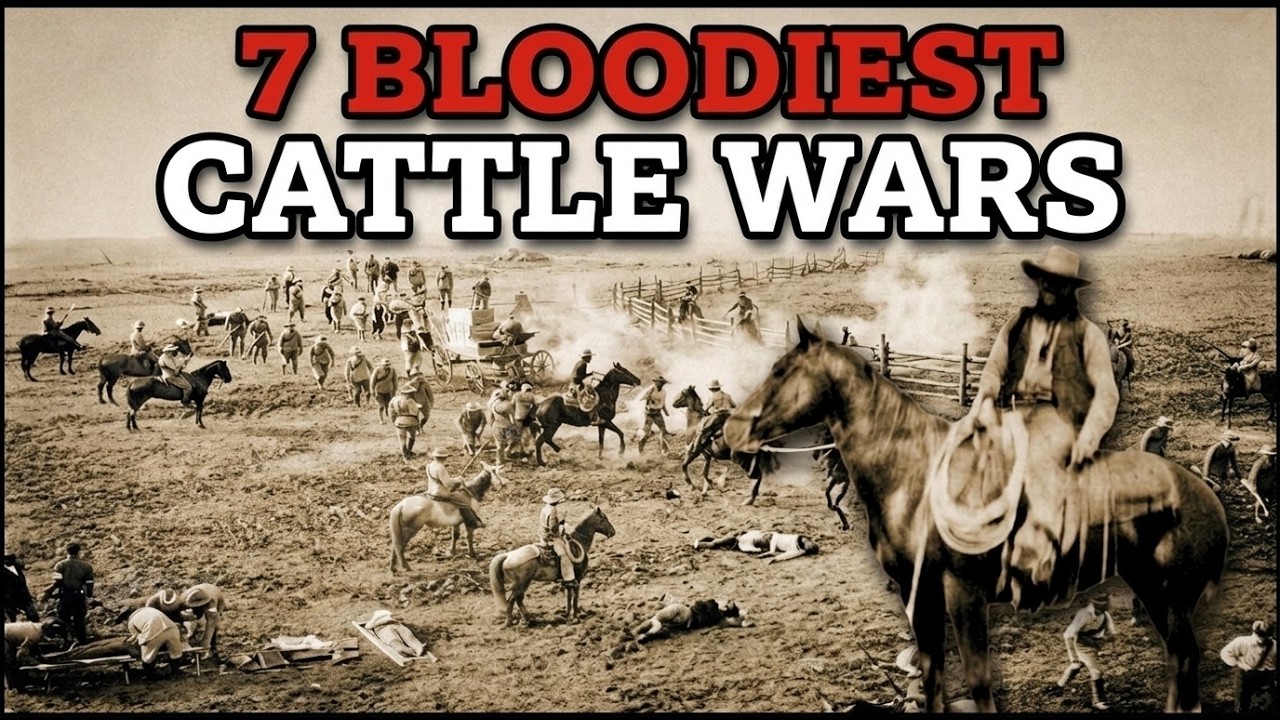
The range wars of the American West were not romantic, and they were not settled in thirty seconds. They were settled, when they were settled at all, by exhaustion, by emigration, and by so many deaths on all sides that the original question of who owned a piece of land was answered not by a court or a treaty but by the brutal arithmetic of whoever was left alive to claim it. In April 1892, the Johnson County War brought a private army of fifty hired killers from Texas into Wyoming. They were paid for by the Wyoming Stock Growers Association, transported north in a private train car with a list of names and a mandate from an organization that had concluded the legal system had failed them.
They crossed into Johnson County to solve the problem of cattle rustling. The rustlers, in the association’s view, were the small ranchers and settlers who had moved into the county’s grazing lands over the previous decade. The association, an organization of cattle barons whose fortunes had been built on open range and were now threatened by the simple arithmetic of land filling with people who had not asked permission to come, had decided these men were thieves. The evidence ranged from documented to fabricated, and the men making the accusation were not much interested in the difference.
Their list contained seventy names, men to be killed on sight. The operation was planned carefully. The territorial governor was informed, and the state’s U. S.
senators, whose political careers depended on the goodwill of the cattlemen who funded their campaigns, quietly supported it. The invasion began at the KC Ranch on the morning of April 9. Inside was Nate Champion, a small rancher who had been targeted before. The previous winter, a group of men had come to kill him in his sleep, but he had woken, fought them off, and survived.
He knew what was coming when he heard movement outside his cabin that morning. He fortified himself inside, loaded his rifle, and held the KC Ranch against a fifty-man army for most of the day. What he did during those hours, a single man’s desperate defense of a wooden cabin against professional killers, he recorded in a diary he kept writing between gunshots. He wrote about the voices outside, about the men he could hear moving, about the fact that he was alone and that they were not going to leave.
His final entry noted that the gunfire had grown heavier and that he did not know how much longer he could hold out. He held until the invaders set the cabin on fire. He ran through the smoke and was hit multiple times. He kept running, was hit again, and fell about a hundred yards from the cabin door.
The invasion that had brought fifty men to solve a cattle-rustling problem killed only Nate Champion and one other man. It did not solve the rustling problem. What it did was alert Johnson County, which responded by arming about two hundred men and surrounding the invaders at the TA Ranch. The siege lasted two days.
The invaders were trapped and outgunned and would have been killed to the last man had the U. S. cavalry not arrived. The governor had telegraphed President Harrison, whose political ties to Wyoming’s senators made the cavalry’s arrival far from coincidental.
The cavalry saved the invaders, who were taken into custody. The legal proceedings that followed were thoroughly corrupted by the association’s political influence. Witnesses disappeared. Evidence was tampered with.
The prosecution was starved of resources. Not a single participant in the invasion was ever convicted of anything. Nate Champion had held out for a full day, written about it, run through smoke, and died a hundred yards from his own door. His killers walked free.
The war in Johnson County ended, and the score it had been meant to settle was settled by nothing. The Pleasant Valley War, from 1887 to 1892 in Arizona’s Tonto Basin, claimed about thirty lives over five years, a number that seems modest until the valley’s small population is considered, making its per-capita death rate among the highest of any frontier conflict. It began with sheep. The Graham family raised cattle.
The Tewksburys raised sheep. In the ranching economy and culture of 1880s Arizona, this was not a business difference but a declaration of identity and loyalty, a provocation that range culture considered an answerable insult. Sheep cropped grass differently than cattle, down to the roots. Range grazed by sheep was, in the cattleman’s view and practical reality, ruined for cattle.
The cattlemen of the Tonto Basin made clear their position on sheep. The Tewksburys brought them anyway. The first killing came in 1887. Whatever specific chain of accusations, stolen horses, and disputed range had produced it, the murders that followed ran less on the original cause than on the institutional momentum of a feud that had taken its own course.
The Grahams and their allies killed. The Tewksburys and their allies killed. Men were ambushed on trails they had ridden safely for years, shot from hiding, killed at breakfast and at water crossings, in the ordinary routines that conflict turns into vulnerabilities. The sheriff of Apache County came to the valley and was ambushed.
A reporter sent to cover the war was killed. Tom Graham, the last surviving member of the Graham family, was shot in 1892 in Tempe, Arizona, while hauling a load of grain. His wife witnessed it and identified the shooter, who was acquitted. The Graham line was reduced to zero, and the war ended with it.
Ed Tewksbury lived until 1904, the last man left standing in a conflict that consumed everyone who entered it. The fence-cutting wars ran from 1883 to 1884 in Texas. Barbed wire reached the Texas plains in the late 1870s, arriving with the force of a technology that solved a problem for wealthy ranchers while creating one for everyone else whose livelihood depended on open range. Large landowners fenced their land, their pastures, their water sources, and the trails that small ranchers and cattle drivers had used for decades as public passages across unsurveyed ground of often unclear ownership.
Small ranchers and cattle drivers cut the wire. By 1883, the cutting was systematic and organized, with armed men riding out at night with wire cutters, targeting a structure they understood as an economic mechanism destroying their ability to live in the country they had worked for decades. They cut wire across dozens of Texas counties, destroying miles of fencing in a few nights and leaving signs on cut posts warning against rebuilding. When ranchers sent men to guard the fences, the cutters shot at them.
When the guards returned fire, the cutters organized into larger groups. The violence escalated through 1883 and 1884 with the momentum of a conflict both sides treated as existential. The Texas legislature eventually passed laws making fence-cutting a felony and prohibiting the enclosure of public land, designed to address both sides of the conflict at once. The legislation reduced cutting but did not end it.
The range kept closing. Barbed wire kept marking the landscape with the permanent authority of something that, once established, could not be fully reversed. The open range died under the weight of ten thousand fence lines drawn across land that had been open, was now closed, and would never reopen. The wire won.
The Mason County War, from 1875 to 1876 in Texas, known locally as the Hoodoo War, pitted German settlers against Anglo-Texas cattlemen over rustling, legal authority, and the cultural friction of two communities sharing one county with contradictory relationships to the law. The Germans had settled in the 1840s and 1850s and built a community with the precision of people who had crossed an ocean to found something permanent. The Anglo cattlemen carried the assumptions of men who had worked Texas for a generation and viewed the Germans’ inclination to use courts, report crimes, and cooperate with the legal system as a cultural assault on the frontier law that settled disputes by other means. Rustling was real on both sides, with each accusing the other.
A group of Anglo vigilantes calling themselves the Minute Men began arresting and then killing men they accused of theft. The accused were Germans. Killings escalated. A mob lynched five men without trial in 1875.
Texas Rangers arrived. The Rangers were Anglo, and the German community, which was supplying the victims, regarded their neutrality with suspicion. Scott Cooley, a former Ranger whose adopted father had been killed in the conflict, led a personal vendetta that included beheading at least one enemy and presenting his scalp at a dance, where men who approved of his work received it as a trophy. The violence continued through 1876 before dying down the way frontier feuds usually do, not through peaceful resolution but through enough deaths on both sides that too few participants remained to continue.
Mason County settled into a fragile coexistence. The cultural division lingered for decades in communities that occupied the same geography, ran their affairs separately, and remembered what the other side had done with the permanent memory bred of atrocity. The Sutton-Taylor feud, running from 1867 to 1876 in Texas, was not about cattle. It was about the Civil War, specifically the resentments that war left in Texas border communities between men who had fought for the Confederacy and men who had cooperated, or were believed to have cooperated, with the Reconstruction government that came to administer the defeated South.
The Taylors were Confederates. The Suttons aligned with Reconstruction authorities and the state police organized by Texas’s Republican government. The first outright violence came in 1867 with the killing of members of the Taylor family by Sutton allies under circumstances the record describes as involving a cattle dispute that ended in death. The Taylors responded in kind, the Suttons responded in turn, and the feud found its rhythm.
John Wesley Hardin, at twenty already the most prolific killer on the frontier, entered the conflict on the Taylor side in 1873, adding a man of unlimited willingness to use violence and a gun skill that regularly translated into results. He killed a deputy sheriff named Charles Webb in 1874 in a gunfight whose details varied but whose outcome did not. Bill Sutton was killed the same year, shot by Jim and Bill Taylor on a steamboat in Indianola, a killing the Taylors considered the settling of a specific debt. The feud declined after Sutton’s death without fully ending.
Hardin eventually fled Texas. The survivors simply outlasted the men who had been most committed to killing each other. The Tascosa disputes of the 1880s in the Texas Panhandle grew out of labor. Tascosa was a supply point for the massive ranches of the region, operations whose combined acreage made them agricultural empires requiring the organizational infrastructure of small corporations.
The cowboys who worked those ranches and gathered in Tascosa for periodic breaks from the range discovered in the early 1880s that the cattle barons who employed them had made a decision about the value of their labor, without consulting the cowboys it would affect. The cowboys struck in 1883, one of the first cowboy strikes in American history, demanding higher wages and refusing to work until their demands were met. The ranches brought in replacement workers. The strike collapsed.
The cowboys who organized it were blacklisted across every operation in the region, their names circulating on lists exchanged among the cattle barons, effectively eliminating their ability to find work in the area where they had spent their careers. The resulting resentment was documented in the violence that followed in the mid-1880s: gunfights in Tascosa saloons, LS Ranch cowboys killed by former strikers, former strikers killed by LS cowboys. The night of March 21, 1886, the worst on record, saw four deaths in a gunfight behind a saloon. The Boot Hill cemetery outside Tascosa received the dead with the regularity of an institution built for exactly that purpose.
Tascosa declined in the late 1880s as the railroad bypassed it for Amarillo. The town built by the cattle economy was abandoned by it. What remained was Boot Hill, a witness to what labor conflicts in the region had produced when legitimate means of resolution were removed from the available options. In 1900, the range war in Browns Park, in the country where Colorado, Wyoming, and Utah meet along the Green River, brought in Tom Horn.
The isolated high basin had long been home to small ranchers and men the cattle barons called rustlers, coexisting in a delicate, uneasy balance produced by the open range. Ora Haley, owner of the Two Bar ranch, hired Horn that year to solve his Browns Park problem. Horn’s method was the same everywhere he was employed: an ambush, a concealed position, a single shot from a distance that made identifying the shooter difficult and prosecution impossible. Matt Rash died in July 1900, shot in his cabin.
Isom Dart died in October 1900, shot at his doorway. The Browns Park community understood what was happening even if the courts could not prove it to legal certainty. The small ranchers knew Horn had been hired, and they knew what his presence meant for the men on Haley’s list. Some left.
Those who stayed armed themselves, watched the ridgelines, avoided windows, and lived in the permanent vigilance of people waiting for something they knew was coming and could not prevent. Horn was convicted in Wyoming in 1902, not for the Browns Park murders but for the killing of fourteen-year-old Willie Nickell, which the investigation showed to be another of Horn’s paid executions. He was hanged in Cheyenne on November 20, 1903. The Browns Park range war had not ended with any legal settlement of who owned which pasture.
It had ended the way Horn’s methods always ended such things: the people occupying the disputed land were removed by death or flight, until the land was no longer disputed because the disputants no longer existed. Ora Haley expanded his range. The Green River kept flowing through Browns Park as it always had. These were the real range wars, not the legend.
Not the clean thirty-second conflicts the Western genre built from raw material that was never thirty seconds and never clean. Eight conflicts, decades of total duration, hundreds of dead, counties emptied, industries transformed, violence passed from generation to generation, grinding and definitive, between people fighting over grass, water, and wire, and over the question of who held the right to draw a line across the land and call it theirs. The legends gave us heroes and villains and moral clarity in a gunfight that ends with one man down. The range wars gave us the Johnson County invaders returning home under government cavalry escort after killing Nate Champion on his own doorstep, gave us Tom Horn shooting from under a tree and slipping past every court that tried to hold him accountable, gave us the German settlers of Mason County burying their dead while the Anglo vigilantes who killed them served no punishment history recorded.
The land held all of it. The grass grew back. The barbed wire rusted. The names on the Boot Hill markers faded through the decades that followed.
And the frontier that produced those names moved on to its next chapter, with the indifference of a place that never much cared to answer for what it had consumed.