A witness stood in a courtroom, raised his right hand, and swore to tell the truth. Then he pointed across the room at an innocent man and helped send him to death row. He did it because the system handed him the perfect opportunity, and he seized it. That is not the twisted ending of this story.
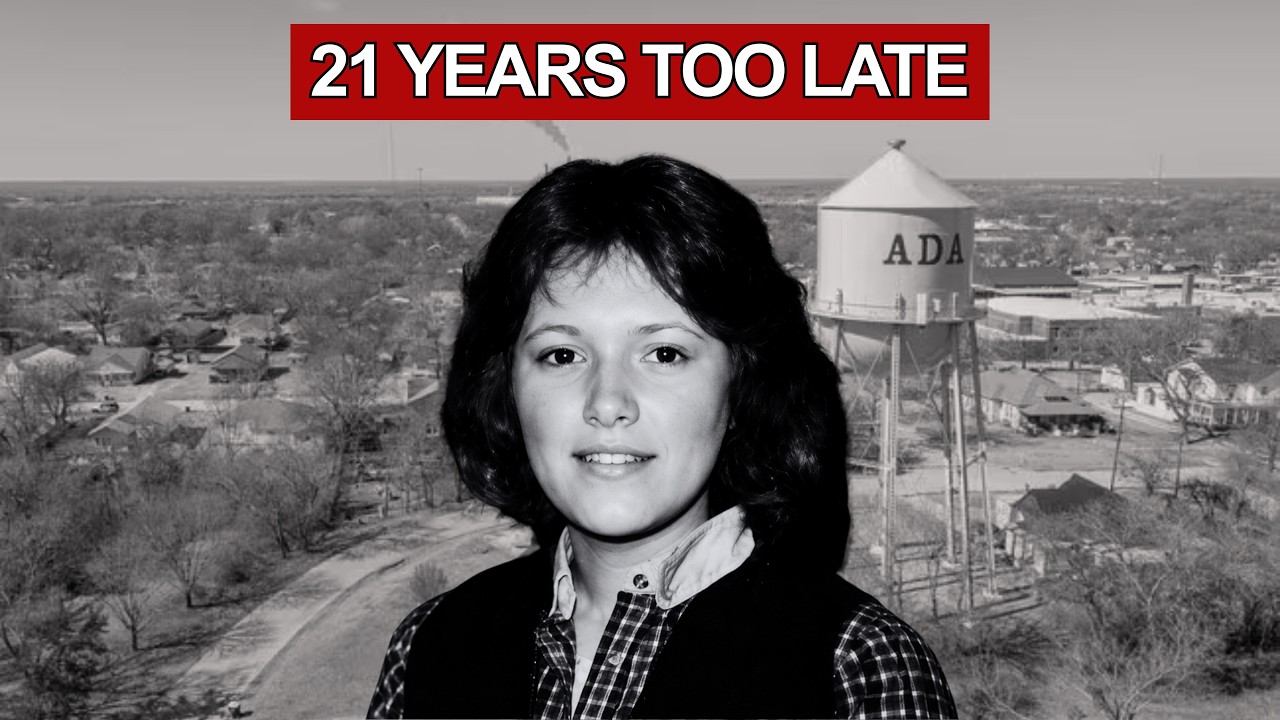
It is where the story begins. In December 1982, Debra Sue Carter, a 21-year-old waitress in Ada, Oklahoma, was murdered in her apartment. The case would come to define two men who did not kill her but lost eleven years of their lives anyway, and the one man who did kill her and remained free for over two decades. Ada in 1982 was a small town of roughly 16,000 people.
Unemployment had reached about eleven percent, the worst since the Great Depression, and rural Oklahoma felt the pressure deeply. Factories were laying workers off, farms were struggling, and small communities grew more suspicious of outsiders. Debt and fear changed how people treated one another. Debbie, as friends called her, had just moved into her own garage apartment.
She worked three jobs to make rent: waiting tables and tending bar at the Coachlight Club, babysitting, and taking whatever extra work she could find. Regulars knew her by name. She wore a western-style belt engraved with the name “Debbie,” and people remembered her by it. On the night of December 7, 1982, a quiet Tuesday, business at the Coachlight Club was light.
Among the regulars that night was a 22-year-old named Glen Gore. He had known Debbie for years. When the bar closed, Gore walked out to the parking lot and approached her at her car. Exactly what was said is disputed.
What is certain is that he was the last known person to speak with her before she drove away alone. Hours later, around two-thirty in the morning, Debbie called a friend, Jenna Vietta, saying someone was in her apartment. She did not sound terrified, just uneasy. When the friend asked who it was, Debbie said only, “Hold on.
” Then silence. The friend heard movement in the background and said she would come immediately. The phone rang again. It was Debbie, telling her not to bother.
She had decided to stay home. She changed the subject and asked her friend to call in the morning so she would not be late for work. No one heard from Debbie after that. The next morning, a close friend found Debbie’s body on the bedroom floor.
Her father climbed the apartment stairs and found his daughter’s corpse: a bloodstained towel stuffed in her mouth, broken glass scattered across the hallway. The scene was so disturbing that one paramedic became sick. The bedroom looked ransacked, clothes and bedding thrown everywhere. On Debbie’s back, someone had written a name using ketchup.
Investigators read it as something like “Duke Graham. ” On her chest, nail polish spelled the word “my death. ” On a nearby table, also in ketchup, was a misspelled warning: “Don’t look for us or else. ” It was deliberately written in plural, as if more than one person had committed the crime.
The medical examiner documented extensive bruises on her face and neck, defensive wounds on her arms, and ligature marks. The cause of death was asphyxiation from the combination of the towel and a strangling ligature. Seventeen hairs were collected from the scene, along with body fluid evidence and a bloodied fingerprint on the bedroom wall. In 1982, none of that evidence could be analyzed to modern standards.
It sat in storage for years. Investigators initially believed the broken window indicated a break-in. But when crime scene analysts examined it closely, they found glass fragments on both sides of the window. Some had clearly fallen outside, some inside.
That is not how a real break-in happens. That is how a staged break-in looks, a scene arranged from inside to make police believe an intruder came from outside. The crime scene reconstruction confirmed it: this was not a chaotic home invasion by multiple people. It was one person deliberately building a false story using nail polish, ketchup, and broken glass.
One name kept circulating in town gossip about the murder. Ron Williamson had once been the closest thing Ada had to a celebrity. As a teenager, he was a gifted baseball player, talented enough that in 1971, at eighteen, he was drafted nationally and played minor league ball for the New York Yankees. Then a shoulder injury ended everything.
By twenty-four, his career was over, and he returned to Ada with nothing of the dream that had defined him. What followed was a sharp decline. He was diagnosed at various times with bipolar disorder, severe depression, and schizophrenia. He drank heavily.
He lived with his mother. He became what small towns call “the local eccentric,” singing loudly in the street at night and behaving in ways that worried his neighbors. He frequented the Coachlight Club, the same bar where Debbie worked. Dennis Fritz looked nothing like Williamson on paper.
He was a high school science teacher with a stable job, no criminal record, and nothing in his past suggesting violence. His connection to the case was awkwardly thin: he had become friends with Williamson in 1981, and the two sometimes went to the Coachlight together. That friendship, according to the records, is the only reason his life was about to be destroyed. In March 1983, three months after the murder, Glen Gore went to police and told them he had seen Williamson at the bar that night bothering Debbie.
Williamson was brought in for questioning. He denied any involvement and voluntarily gave hair and saliva samples without resistance. His mother told police he was home before ten that night, before the bar even closed. There was no physical evidence linking him to the apartment.
Gore, the man who had just placed himself at the center of the story and the last confirmed person to speak to Debbie alive, walked out of that police interview without giving a fingerprint, saliva, or a single hair sample. No one asked. That gap is the opportunity around which the entire case turns. In 1983, a fingerprint expert from the Oklahoma State Bureau of Investigation named Jerry Peters examined the bloodied fingerprint on Debbie’s bedroom wall.
His conclusion at the time: it matched neither Carter, nor Williamson, nor Fritz. That finding was never shared with the defense. The same year, Williamson took a polygraph test, and according to court records, a videotaped statement was made that favored his innocence. The district attorney never disclosed the existence of that tape to Williamson’s lawyers.
Around the same time, a man named Ricky Jo Simmons reportedly went to police and confessed to killing Debbie. That confession, too, was never disclosed. These three pieces of evidence, the excluded fingerprint, the videotape, and Simmons’s confession, became central findings in Williamson’s later federal appeal. The failure to disclose them was a matter of legal record.
What remains disputed is how deliberate or negligent the concealment was at the time. For almost five years, nothing happened. The case went cold. In the spring of 1987, Debbie’s body was exhumed, officially to obtain a new set of fingerprints for comparison.
The same expert, Jerry Peters, who had said in 1983 that the bloodied print matched no one involved, now reached the opposite conclusion: the print matched Carter herself. The same fingerprint. The same expert. According to court findings reviewed later, it was the only time in his 24-year career that he changed his conclusion about physical evidence.
On May 8, 1987, police arrested both Ron Williamson and Dennis Fritz. Dennis Fritz stood trial first, in April 1988. The prosecution’s case rested on microscopic hair comparison evidence and the testimony of a prison informant who claimed Fritz had confessed. That informant came forward just one day before the state would legally have had to release Fritz for lack of evidence.
The jury convicted him of first-degree murder. He was sentenced to life in prison without parole. Ron Williamson’s trial began two weeks later. His lawyer operated with very limited resources.
No one requested a competency evaluation, despite Williamson being, by all later accounts, in an active psychotic state throughout the proceedings. He screamed at witnesses. He overturned furniture. The jury did not see illness.
They saw a dangerous man. No one in that courtroom explained the difference. The prosecution’s key witness was Glen Gore. By then, Gore was already in prison on another charge, so his preliminary hearing testimony was read into the record instead of presenting him in person.
According to that testimony, Debbie had asked him to dance that night specifically because Williamson was bothering her. Of the roughly two dozen other people in the bar that night, no one corroborated his account. Four separate pieces of evidence formed traps. The first was hair analysis.
A forensic scientist testified that hairs found at the crime scene microscopically matched Fritz and Williamson. Nearly thirty years later, the FBI formally acknowledged that microscopic hair comparison had been overstated in testimony across thousands of cases nationwide. In 1988, none of that had come to light. The second trap was the prison informants, people incarcerated with Fritz and Williamson who came forward with stories of confessions.
Such testimony remains one of the most documented sources of wrongful convictions in the American legal system. The third trap involved a dream. While separately imprisoned in 1984 on unrelated bad-check charges, Williamson reportedly described a dream to an investigator, one in which he played the role of a detective investigating the case, not a guilty man confessing. At trial, that account was presented to the jury without that context.
The fourth trap was what never reached the jury at all: the excluded fingerprint, the videotape, and Simmons’s confession. Under Brady v. Maryland, prosecutors are legally required to turn over evidence favorable to the defense. It did not happen here.
On April 27, 1988, the jury convicted Ron Williamson of first-degree murder. His sentence was death. He was sent first to an Oklahoma state prison, then transferred to a windowless underground facility for death row inmates, designed for total isolation. His cell was about two meters by four and a half meters.
Reports from that period describe him going months without bathing, barely eating, pacing and screaming his innocence. No one intervened. By 1994, his execution date was set for September 27. Five days before that date, his lawyers filed a federal habeas corpus petition.
A stay was granted. Five days separated Ron Williamson from an execution that Oklahoma could never have reversed. The federal court that eventually granted him a new trial detailed the failures that had brought him there: the undisclosed videotape, the hidden confession, and ineffective defense counsel that never raised the question of his mental competency. Meanwhile, Dennis Fritz, still imprisoned and still appealing, contacted the newly formed Innocence Project.
He understood that the physical evidence from 1982 still existed and that DNA testing, a technology barely available at the time of his trial, could exonerate him. He filed a specific request to preserve that evidence before it could be lost or destroyed. In 1999, the DNA testing was finally done. The hairs once said to microscopically match Fritz and Williamson matched neither man.
The semen evidence collected during the original autopsy matched neither man either. Every piece of physical evidence from that apartment pointed somewhere else entirely. It pointed to Glen Gore. On April 15, 1999, a Pontotoc County judge dropped all charges against both men.
Williamson walked out of the same courthouse where he had been sentenced to death eleven years earlier. By 1999, Gore was already serving a sentence in the Oklahoma prison system on unrelated convictions for kidnapping and weapons possession. When the DNA results were announced, reportedly a day before Williamson and Fritz walked free, Gore fled from a work detail near Purcell, Oklahoma. He did not get far.
Within about a week, he surrendered through a lawyer. In 2001, prosecutors formally charged Gore with the rape and murder of Debra Carter. On June 24, 2003, 21 years after that final phone call, a jury convicted him and sentenced him to death. His conviction was overturned on appeal in 2005 on an evidentiary issue.
At his second trial in 2006, a jury convicted him again, but the panel could not agree on a sentence, which under Oklahoma law meant an automatic sentence of life in prison without parole. The man who first pointed the finger, who testified under oath against an innocent former baseball player, who avoided giving a biological sample for seventeen continuous years, had been the killer all along. Freedom did not erase what happened to either man. Williamson returned to Ada changed in ways that proved permanent.
He remained convinced, even after release, that police would come back to arrest him. He carried a knife in his pocket out of fear, not aggression. His family tried to keep him on psychiatric medication, but his alcohol addiction made it nearly impossible. In periods of stability, he publicly demanded compassion for others still on death row.
A man who had come within five days of execution stood outside prisons demanding better treatment for those inside. On December 4, 2004, Ron Williamson died in an Oklahoma nursing home, diagnosed with cirrhosis of the liver, surrounded by his sisters. He was 51. He had lived only five years after his release.
Dennis Fritz rebuilt a quieter life in Missouri. He spoke about how the hardest part was not the years inside but everything those years had taken from him outside: watching his daughter grow up through prison visits instead of at home. He became an advocate for the wrongfully convicted and served on the board of the Midwest Innocence Project. In 2008, he published his memoir of the ordeal.
Both men eventually received $500,000 each in settlements from the city of Ada, plus a separate, undisclosed settlement from the state. Dennis Fritz died in March 2024 at age 74. One detail after the exoneration deserves attention. Peggy, Debra Carter’s mother, eventually built a kind of relationship with Dennis Fritz, the man once convicted of killing her daughter.
At an Innocence Project event years later, they reportedly danced together. Not because they had forgotten what happened, but because sometimes after the system fails everyone involved that completely, standing together is the only thing left to do. This was not one mistake. It was layer upon layer of small failures stacking until they produced a death sentence for an innocent man.
The last person seen with the victim was never tested. A fingerprint expert reversed a conclusion he had held his entire career at the moment prosecutors needed him to. Evidence that could have exonerated sat in a drawer instead of reaching defense counsel. False science was presented to the jury as certainty.
A man was tried for his life while in an active psychotic state with no one checking whether he was competent to stand trial. At the heart of every legal reform that came out of this case is a 21-year-old woman who never got to see her real killer brought to justice. Debbie Carter worked three jobs to build an independent life. She made one phone call at two-thirty in the morning, scared enough to ask a friend to come get her, then told her not to bother.
She deserved better.