The photograph from the Ambassador Hotel kitchen on June 5, 1968, froze Ethel Kennedy in history as the perfect widow, kneeling beside her dying husband. America read that image as the whole story of their marriage. It was not. Robert Kennedy had first courted her older sister, Patricia.
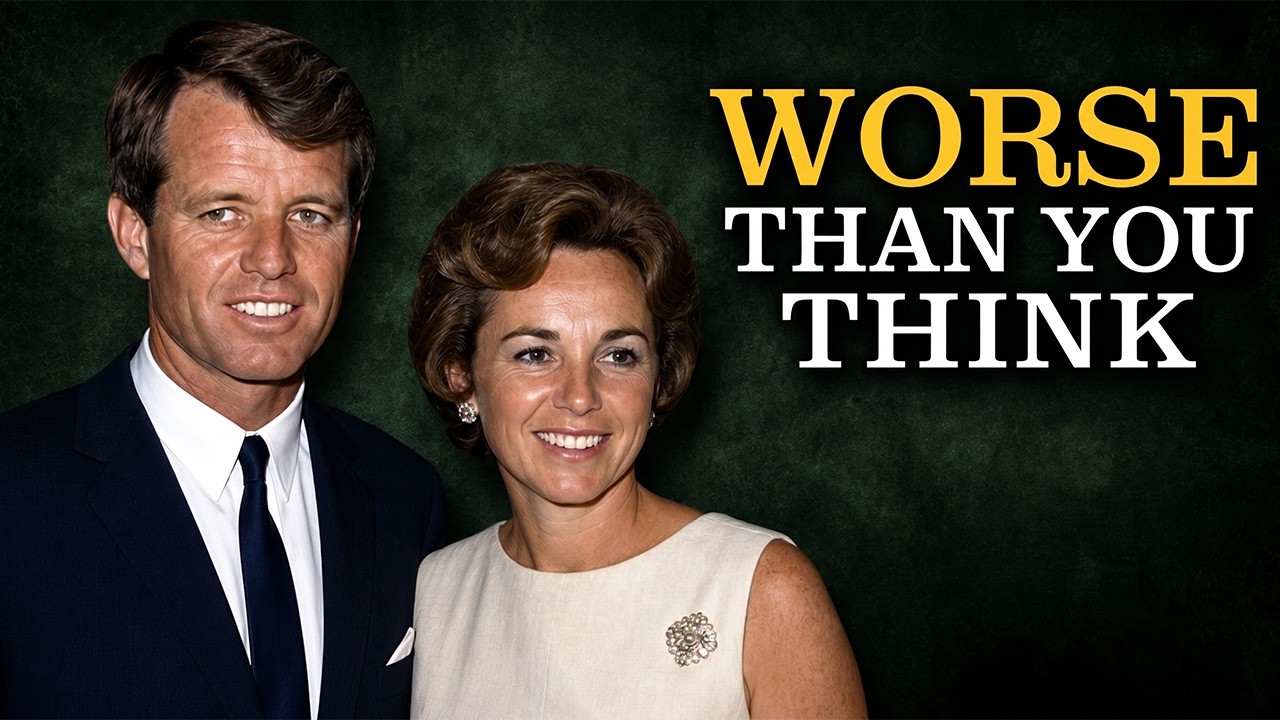
Ethel had spent eighteen years proving she belonged to the Kennedy family, and she would spend fifty-six more years controlling what historians could ever learn about it. The story began on a ski slope in December 1945 at Mont Tremblant, Quebec, when Jean Kennedy brought her Manhattanville College roommate, a loud, fearless seventeen-year-old named Ethel Skakel, on a family trip. Bobby came too, but he barely noticed Ethel. He was dating her older sister, the calmer, prettier Patricia.
For about two years, Bobby courted Pat while Ethel watched from the edges of her own family, cracking jokes, organizing games, making herself impossible to ignore. When Bobby and Pat drifted apart, he turned to the sister who had been auditioning the entire time. To understand why Ethel spent two decades trying to out-Kennedy the Kennedys, you have to understand what she was trying to leave behind. The Skakels were richer than the Kennedys and far less controlled.
George Skakel started as an eight-dollar-a-week railroad clerk and built Great Lakes Carbon into one of the largest privately held companies in America. In 1936, he installed his seven children in a thirty-one-room manor in Greenwich, Connecticut, and by most accounts, let them run wild. Neighbors later described a household of guns, wrecked cars, heavy drinking, and boys who treated the town as a private amusement park. Her mother, Ann, a fiercely devout Catholic, drilled religion into her daughters.
Ethel absorbed two lessons early: God was not negotiable, and family embarrassments were not discussed. Both would run her entire life. Her courtship of Bobby was less a romance than a campaign. In 1946, while he was still half attached to her sister, Ethel volunteered in Jack Kennedy’s first congressional race.
At Manhattanville, she wrote her senior thesis on Jack’s book, Why England Slept. Before Bobby ever proposed, Ethel had studied the Kennedys the way other students studied for exams, and she had decided which world she wanted. Bobby, for his part, got something too. He was the seventh child, overshadowed by Joe Jr.
‘s ghost and Jack’s charm. Ethel believed in him with a ferocity nobody else offered. Friends remembered her as his loudest cheerleader before he had done anything worth cheering. They became engaged in February 1950 and married on June 17, 1950, at St.
Mary’s Church in Greenwich. The Boston Globe said the quiet part in print: “The marriage unites two large fortunes. ” The wedding itself previewed the next forty years. On the Kennedy side, discipline and political usefulness, with Jack serving as best man and treating the reception like a campaign stop.
On the Skakel side, according to multiple biographer accounts, Ethel’s brothers turned the celebration into a demolition derby of drunken pranks that mortified the bride. She was marrying out of one chaotic dynasty into a colder, more organized one. From the early 1950s on, Ethel oriented her entire existence toward Hyannis Port and away from Greenwich. The system had rules.
Rule one: produce. Rose Kennedy had nine children. Ethel would eventually have eleven, a child roughly every eighteen months from 1951 to 1968. Rule two: serve the machine.
In 1952, the young couple moved into a Boston rooming house so Bobby could run Jack’s Senate campaign, and Ethel, pregnant, organized the famous tea parties that put the candidate before thousands of women voters. Rule three: your husband belongs to the family first. Inside the family circle, people joked she was more Kennedy than the Kennedys. It was a compliment with a knife in it.
Jackie could retreat into books and Paris. Joan could retreat into music. Ethel had no identity that wasn’t issued by the family. Then, in one afternoon, the family she had been quietly leaving was gutted.
On October 3, 1955, months after Ethel delivered her fourth child, her parents’ private plane went down near Union City, Oklahoma, killing both. There was no long public mourning. Friends later described her grief as intense and almost entirely private, sealed off the way her mother had taught. Within a year, she and Bobby bought Hickory Hill, the thirteen-bedroom estate in McLean, Virginia, from Jack and Jackie.
Ethel turned it into the loudest address in Washington. Newspapers showed America a glorious circus: eleven kids, a menagerie of horses and dogs, touch football on the lawn, parties where fully dressed guests ended up in the swimming pool. Ethel was cast as the anti-Jackie, unpretentious, fun, fertile, devout. Behind the legend, the man of the house was almost never in the house.
Through the McClellan Committee years and then as Attorney General, Bobby worked hours that made him a visitor in his own home. Ethel ran an estate of a dozen children and rotating staff essentially alone while pregnant most of the time. Between 1951 and 1968, she was pregnant eleven times, buried both parents and a brother, and served as hostess for the most socially demanding household in Washington. The famous Marilyn Monroe rumor is weaker than its fame.
Serious biographers who went looking, including Evan Thomas and Larry Tye, found no solid evidence that Bobby had an affair with Monroe. But even Ethel’s sympathetic chroniclers concede the essential asymmetry: she worshipped him with a totality he did not visibly return. In that family, a wife’s job description did not include asking questions. The record cannot settle what happened in private, and an honest telling should say so.
What the record does show is rivalry inside the sisterhood of Kennedy wives. Ethel and Jackie circled each other for years, the earth mother and the aesthete. People around them later recalled Ethel mocking Jackie’s breathy voice and grand manners while privately smarting that Jackie got the White House and the mystique. The family had one queen’s crown, and Ethel, who had sacrificed the most to belong, was never going to wear it.
Then Dallas. November 1963 didn’t just kill the president. It nearly dissolved the man Ethel had built her life around. Bobby fell into a depression his biographers describe in unsparing terms, gaunt, withdrawn, wearing his dead brother’s old coat.
Contemporary accounts describe Bobby and the widow Jackie bound together in mourning, while Ethel, whose faith made grief almost a theological error, kept the household loud and the sorrow off-limits. In September 1966, her brother George Jr. died in a plane crash, eerily echoing their parents. Almost exactly a year later, his widow choked to death during a meal at home.
Four Skakel deaths in two decades, and virtually none of it entered Ethel’s public story. She had learned in a thirty-one-room house full of secrets that you do not explain your family. You outrun it. Which brings us to the most uncomfortable documented fact in this story: the 1968 campaign was substantially her doing.
When Bobby agonized for months over challenging a sitting president, his advisors split, his brother Ted urged caution, and Ethel pushed. Biographer Evan Thomas called her Bobby’s most consistent advocate of a race for the White House. She teased him for hesitating. She invoked his dead brother.
She wanted the crown that had gone to Jackie’s husband, and she believed, genuinely, that Bobby was America’s best hope. Both things were true at once. In March 1968, he declared, and Ethel, pregnant with their eleventh child, went out on the trail beside him. For a few months, the marriage was what the myth always claimed: two people fused into one purpose, visibly happy, visibly effective.
On April 4, 1968, the night Martin Luther King was assassinated, Bobby climbed onto a flatbed truck in a black neighborhood of Indianapolis and delivered, unscripted, one of the great speeches in American history. Ethel was with him, visibly pregnant, and the crowds treated the couple as a single organism. Her wedding ring was reportedly torn off more than once in the crush. After seventeen years of waiting rooms and delivery rooms, she was finally standing where the history was happening.
It lasted eleven weeks. On June 4, 1968, Bobby won the California primary. Earlier that day at Malibu, he had pulled their twelve-year-old son David out of a dangerous undertow. Just after midnight, walking through the kitchen of the Ambassador Hotel, he was shot.
Ethel, three months pregnant, was steps behind him. The photograph of her kneeling, one hand raised to hold back the crowd, became one of the most famous images in American history. Upstairs, David watched his father’s shooting live on television, alone, hours after his father had saved his life. Bobby died the next day.
Six months later, on December 12, Ethel gave birth to a daughter, Rory, whose father had been dead half a year. Two million people lined the tracks as the train carried Bobby’s body from New York to Washington, and Ethel, weeks into a pregnancy and days into widowhood, walked the length of the cars thanking supporters one by one. Within months, she helped establish the Robert F. Kennedy Memorial, the seed of what became Robert F.
Kennedy Human Rights. Publicly, she was magnificent. Privately, by the accounts of people inside Hickory Hill, she refused, essentially forever, to speak about the assassination, not to reporters, and far more consequentially, not to her children. Her sons later told interviewers that their father’s death was simply not discussable at home.
The older boys spiraled into drugs, expulsions, and a shuffle of boarding schools. David, the boy from the Malibu surf and the hotel television, died of a drug overdose in a Palm Beach hotel in April 1984 at twenty-eight. Michael died in a reckless skiing accident in 1997. Ethel buried two sons the way she had buried her parents, her brother, and her husband: publicly composed, privately sealed.
She never remarried across fifty-six years of widowhood. In 1991, she gave People magazine the line that defined her second act: “Remarrying would be adultery. How could I with Bobby looking down from heaven? ”
Here is what almost nobody noticed while they were pitying her.
After the assassination, the National Archives let Ethel Kennedy take control of her husband’s papers. Not the government. The widow. For more than four decades, dozens of boxes from Bobby’s years at the center of American power, including material touching the Cuban Missile Crisis, sat at the John F.
Kennedy Presidential Library under family control. Historians who wanted them had to ask the Kennedys. Many asked. Most waited.
Writers the family trusted got in. Writers that didn’t waited or worked around the edges. Substantial releases only began around 2012, the missile crisis’s fiftieth anniversary. The definitive film about her life, the 2012 documentary Ethel, was made by her own daughter Rory, with Ethel’s cooperation and on Ethel’s terms.
In it, when the conversation approaches June 1968, the eighty-three-year-old matriarch waves the subject away on camera. The silence was the portrait. When she died in Boston on October 10, 2024, at ninety-six, three presidents eulogized her, and the obituaries ran the kitchen photograph one more time. For fifty-six years, America read that gesture as helplessness: a wife losing everything on a hotel floor.
But follow what that hand did next. It took the papers. It built the foundation. It decided which questions her children could ask, which boxes historians could open, which version of an eighteen-year marriage would survive as the official love story.
The girl from Greenwich learned one skill before she learned anything else: how to bury a family’s truth and smile through the funeral. She married into a dynasty, and in the end she outperformed it at its own specialty. Bobby Kennedy got the martyrdom.
Ethel got the archive, and the archive, not the marriage, is the thing she never let anyone touch.