In October 1936, Nazi Germany and Fascist Italy announced a closer partnership between their regimes. Benito Mussolini was quick to describe the alliance as an axis around which the rest of Europe would revolve. The two dictators shared enemies, ambitions, and a belief that war could reshape the continent. But their relationship was never truly equal.
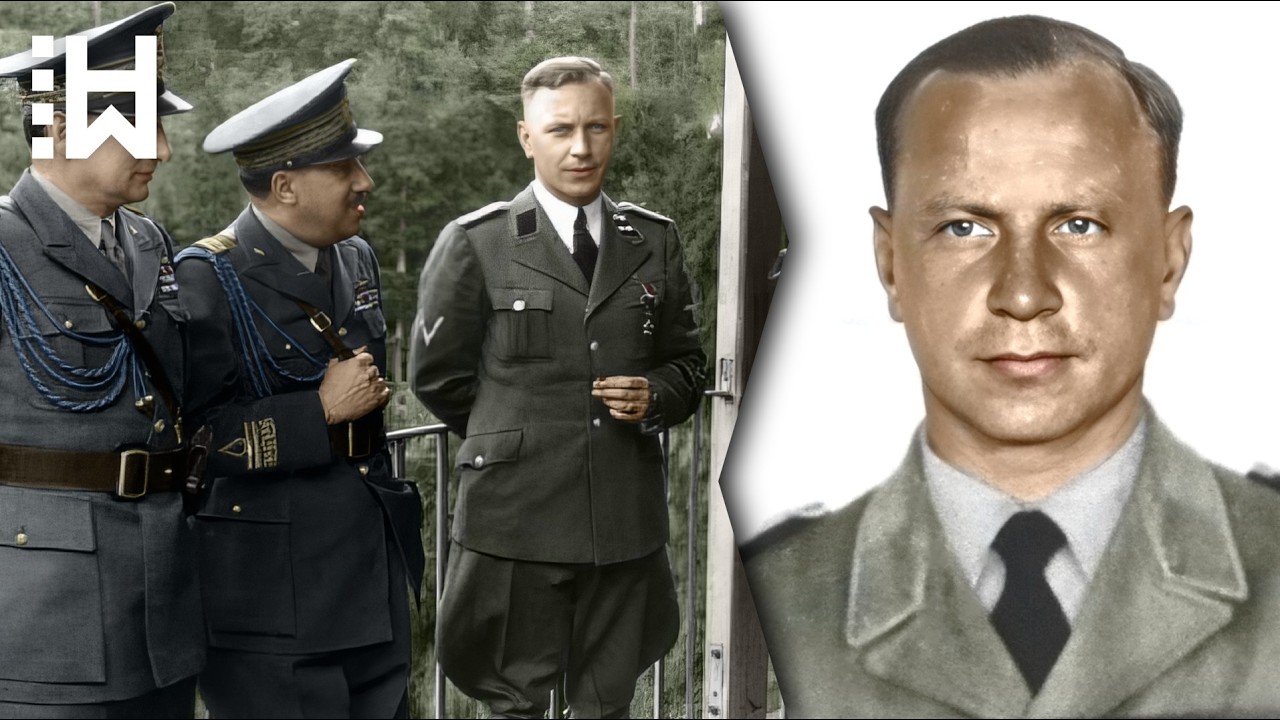
Over the following years, Italy grew increasingly dependent on German military power, and when Mussolini was removed from office in July 1943, with Italy signing an armistice with the Allies two months later, German forces occupied Rome and much of the country. Among those who took control of the former Allied capital was an SS officer who had arrived there years earlier as a police liaison and built close ties with Italian authorities. Under occupation, he became one of the most powerful German officials in the city, managing the persecution of Jews and resistance members, as well as selecting the prisoners killed in the Ardeatine Caves in March 1944. His name was Herbert Kappler.
Kappler was born on September 23, 1907, in Stuttgart, then part of the German Empire. He grew up in a middle-class Protestant family, studied mathematics at the University of Stuttgart, and after earning his degree worked as an electrical engineer for various companies. He joined the Nazi Party on August 1, 1931, and in 1933, the year Adolf Hitler became chancellor of Germany, Kappler joined the SS, the Nazi paramilitary organization. The following year, he married Leonore Jantsch, a typist at the Nazi Party office in Stuttgart.
The marriage remained cold and distant, and after the couple could not have children, they adopted a boy from the Lebensborn home, part of a Nazi program created to raise children considered racially desirable. In January 1936, Kappler was transferred to the Gestapo headquarters in Stuttgart, and in 1937 he qualified as a criminal commissioner at the police academy in Berlin. In 1938, during the Anschluss, the Nazi annexation of Austria, he helped run a campaign to strip Austrian Jews of their property and drive them from the country. In the spring of 1939, Kappler, who was fluent in Italian, was sent to Rome as a police liaison officer, where he also managed the work of the SS intelligence service, the SD.
The Second World War began on September 1, 1939, when Nazi Germany invaded Poland. Italy stayed out of the fighting for the first nine months, joining the war on Germany’s side only in June 1940. During the early war years, Kappler worked closely with the Italian police, building networks of informants and hunting enemies of the regime in the capital of an allied state. That arrangement ended in the summer of 1943.
In July, the Grand Council of Fascism, the highest body of Mussolini’s own movement, voted against him, and King Victor Emmanuel III dismissed Mussolini and ordered his arrest. In September, the new government under Marshal Pietro Badoglio signed an armistice with the Allies, a ceasefire that took Italy out of the war. In response, Nazi Germany decided to invade Italy and disarmed Italian army units. On September 12, German commandos freed Mussolini from captivity and installed him at the head of the Italian Social Republic, a fascist puppet state in the north.
When Nazi Germany occupied part of Italy, Kappler was appointed commander of the Security Police and SD in Rome and the surrounding region. He was, in effect, the master of German police terror in Rome. His first major action was directed against the Jews of Rome, one of the oldest Jewish communities in Europe. On September 26, 1943, he summoned their leaders and demanded fifty kilograms of gold within thirty-six hours, threatening to deport two hundred heads of Jewish families if it was not paid.
The gold was collected and delivered, but it did no good. A few weeks later, on the morning of October 16, the roundup of Rome’s Jewish residents began. It was not organized by Kappler but by SS officer Theodor Dannecker, a deportation specialist sent from Berlin with his own unit. Kappler assisted in the operation.
Dannecker’s men and Kappler’s men surrounded the old Jewish quarter in Rome and searched the rest of the city, arresting 1,259 people. Those who could prove they were not Jewish were released. The remaining 1,023 were held for two days, then loaded onto a train bound for Auschwitz, the largest Nazi death camp in occupied Poland. Only sixteen people survived the war, fifteen men and one woman.
Kappler even sent a letter to the Auschwitz commandant, Rudolf Höss, informing him that he would receive a shipment of more than a thousand Italian Jews around October 22 or 23, and asked him to be ready to grant them special treatment, which in Nazi language meant extermination in the gas chambers. In the following months, another eight hundred Jews of Rome were tracked down and deported, many betrayed by Italian informants and arrested by Kappler’s men. Not everyone in Rome was within Kappler’s reach. Across the city, a network of clergy led by Monsignor Hugh O’Flaherty, an Irish priest resident in the Vatican, hid thousands of Jews and escaped Allied prisoners of war in monasteries and private homes, protected by the neutrality of the Holy See.
Vatican City had been a sovereign state in the heart of Rome since 1929, and German police could not enter it. Unable to touch the priest on Vatican territory, Kappler devised a plan to assassinate him. But O’Flaherty continued to move through the occupied city in disguise and was never captured. Kappler’s worst crime came in the spring of 1944.
By that time, the front had drawn close to Rome, with an Allied beachhead near the coastal town of Anzio, only fifty kilometers to the south, and armed resistance was growing bolder. At midday on March 23, 1944, partisans of the Groups of Patriotic Action, urban resistance units dominated by communists, detonated a bomb hidden in a garbage cart on the narrow Via Rasella in central Rome. The target was the Bozen Police Regiment, a German police unit largely recruited from the German-speaking population of South Tyrol. Thirty-two of its men were killed immediately, and one died of his wounds within a day.
The German response was immediate, and Adolf Hitler himself suggested destroying Rome. On the evening of March 23, 1944, Herbert Kappler and Lieutenant General Kurt Mälzer, the German military commander in Rome, recommended a reprisal in which ten Italian civilians would be shot for every policeman killed in the attack. They proposed that the victims be selected from individuals already under sentence of death and awaiting execution. General Eberhard von Mackensen, commander of the German Fourteenth Army, under whose jurisdiction Rome fell, approved the proposal.
The intended number was 330, ten men for each of the 33 dead, but Kappler did not have nearly that many prisoners under death sentence. He made up the number with men already in German and fascist custody, including prisoners awaiting trial, resistance suspects, ordinary criminals, and seventy-five Jews, as well as civilians taken off the streets. On March 24, 1944, the prisoners were taken by truck to the Ardeatine Caves on the southern edge of the city. Only there did the Germans discover that a miscalculation had brought five more men than the quota, making the total 335.
Rather than release them, Kappler ordered them executed with the others, because they had already seen everything. The victims were taken into the tunnels of the abandoned quarries in groups of five, forced to climb over the bodies of those already killed, and then shot. The executions were carried out by Kappler’s own men, including Erich Priebke, who checked off names as the condemned were brought in. When it was over, German engineers blew up the entrances to hide the bodies.
Rome was liberated by the Allies on June 4, 1944, and Kappler retreated north with the withdrawing German forces. He remained in northern Italy until Germany surrendered on May 8, 1945. The next day, Herbert Kappler surrendered himself to the British military police in Bolzano, a city in northern Italy. He was handed over to the Italian authorities in 1947, and in 1948 an Italian military court in Rome sentenced him to life imprisonment for his crimes, the first four years of which he spent in solitary confinement.
He was held in the military fortress in Gaeta, a coastal town between Rome and Naples. In prison, Kappler’s life took an interesting turn. His first wife divorced him during his sentence, and his most devoted visitor became, ironically, Monsignor Hugh O’Flaherty, the priest he had once hunted through the streets of Rome. Kappler was the one who wrote first, and O’Flaherty visited him regularly for much of that period, the only visitor Kappler received.
The two men talked about literature and religion. Under his influence, Kappler, raised Protestant, entered the Catholic Church, and O’Flaherty baptized him. It is impossible to say whether his conversion reflected genuine remorse, as he never publicly admitted guilt for the massacre or expressed regret for the dead. In 1972, Kappler married a nurse named Anneliese after a long correspondence.
The wedding ceremony took place inside the prison. In 1975, Kappler was diagnosed with terminal cancer, and the following year he was moved to a military hospital in Rome. His wife and the West German government requested his release on humanitarian grounds, but their requests were refused. For Italy, the Ardeatine Caves massacre remained an open wound.
The disease weakened Kappler, and the nursing training his wife had received gave her almost unrestricted access to his room. In August 1977, according to the account that became famous but was never fully verified, Anneliese Kappler smuggled her husband out of the hospital inside a large suitcase. By that time, he weighed less than fifty kilograms, about 110 pounds. However, the story soon changed.
The Italian defense minister, Vito Lattanzio, publicly stated that the suitcase story had no basis at all, partly because of the physical dimensions of the hospital exits and elevator. Anneliese Kappler later claimed her husband had been lowered from a third-floor window using a rope, then hidden in a car and driven toward West Germany. Investigators reportedly found a tie point near the window and traces of a rope. The West German government refused to extradite him and refused to retry him, citing his poor health.
Kappler’s escape and West Germany’s refusal to hand him over caused widespread outrage in Italy. Although Herbert Kappler spent his final months as a free man, history remembers him for his actions in occupied Rome. He extorted the Jewish community of Rome before deporting its members to Auschwitz, directed the German police terror in the Italian capital, and selected the prisoners killed in the Ardeatine Caves. He later presented himself as a soldier who had merely carried out orders.
Yet it was Kappler who prepared the lists, added victims when the numbers did not match, and personally supervised the massacre. Herbert Kappler was seventy years old when he died in Soltau, West Germany, on February 9, 1978.