In September 1964, Janet Auchincloss sat down with a tape recorder to tell history what she remembered. For hours, over two long sessions, the mother of Jackie Kennedy spoke of the wind on her daughter’s wedding day, of the president calling her “Mummy,” and of the morning her granddaughter Caroline pointed to a newspaper and asked, “A man shot him, didn’t he? ” But one name never crossed her lips: Jack Bouvier, the father who should have walked Jackie down the aisle. He was absent from the recording entirely, just one of many stories Janet had spent a lifetime carefully editing.
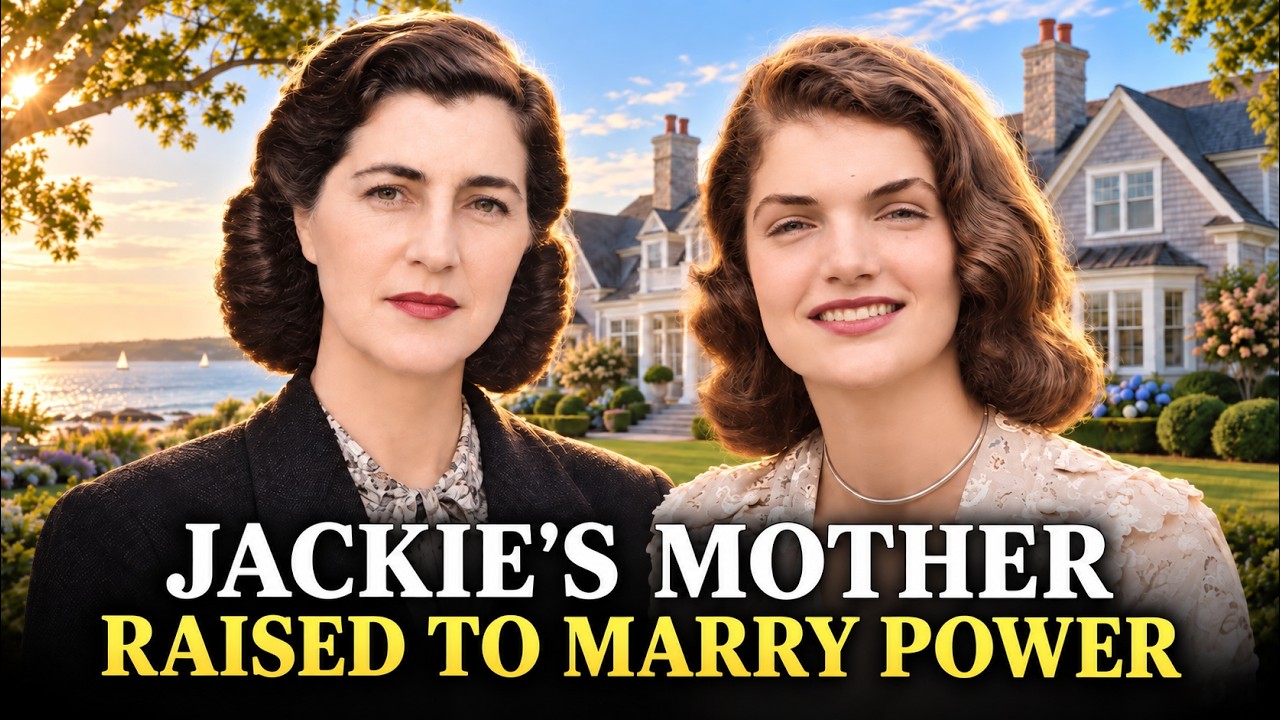
Janet Norton Lee was born in Manhattan on December 3, 1907, the middle of three daughters. Her father, James Thomas Lee, was a lawyer, banker, and real estate developer who built 998 Fifth Avenue, described as the first truly luxurious residential building on the avenue, and later 740 Park Avenue, where his granddaughter Jackie would spend part of her childhood. The family never worried about money. What they lacked was the right kind of past.
The Lees were Irish Catholic, with roots in Cork, Tipperary, and County Clare. In New York society of the 1910s and 1920s, that mattered. The families who controlled the social register, the private clubs, and the elite invitation lists were predominantly Protestant, proud of lineages reaching back to colonial America. New money could buy an address on Fifth Avenue, but it could not easily buy the feeling of belonging.
Janet devised her own answer. According to one account, while a student in Virginia, she began describing herself as one of the Virginia Lees, and later the Lees of Maryland, as if connected to General Robert E. Lee. Biographer Jan Potker was blunt about it: Janet used her surname to claim a kinship that did not exist.
Another writer, Alice Kaplan, described her as claiming descent from the Maryland Lees when her ancestors were Irish immigrants in New York. She seems to have gotten away with it, partly because few in her circles bothered to check. Her education at Miss Spence’s School, Sweet Briar College, and Barnard College helped, though she left Barnard without a degree. She had another stage as well, one where no one asked for a diploma: the horse show circuit.
Janet became an accomplished rider, winning the hunt championship at the National Horse Show in Madison Square Garden three times on a mare named Dan Sou. In a world where owning a horse and riding well told people who you were, equestrian skill granted her a status her name alone could not. On July 7, 1928, in East Hampton’s Church of St. Philomena, Janet Lee married John Vernou Bouvier III before about five hundred guests.
The groom was a Wall Street stockbroker, noticeably older, handsome, and so dark-complected, the stories went, that he had earned nicknames: “Black Jack,” “The Sheik,” “The Black Orchid. ” He already had a reputation as a womanizer. The Bouviers presented themselves as French nobility; the groom’s father had privately printed a genealogy tracing the family to an ancient house near Grenoble. The truth was more modest.
The first Bouvier in America had been a cabinetmaker who arrived in Philadelphia in 1815. Janet’s own father saw little in the match, reportedly considering Jack Bouvier a drunkard and a spendthrift. On July 28, 1929, Janet gave birth to her first daughter, Jacqueline Lee Bouvier. Months later, the stock market crashed, a blow to Black Jack’s finances and pride.
His younger brother died that same year from alcoholism. The marriage deteriorated. Black Jack drank and did not hide his interest in other women. A second daughter, Caroline Lee Bouvier, known all her life as Lee, was born on March 3, 1933.
The following year, the New York Daily News published a photograph from a horse event showing Janet sitting on a fence, looking toward the ring, while her husband, behind her back, held the hand of another woman. Janet cared deeply about appearances. Now her humiliation was in a newspaper anyone in New York could buy. By 1936 the couple separated, tried again briefly in 1937, and gave up.
In January 1940 the Daily Mirror ran the headline “Divorce Suit Against Socialite Broker. ” That summer Janet obtained a divorce in Reno, Nevada. For a Catholic woman of her class in 1940, divorce carried a heavy social price. She paid it anyway.
Her daughters paid a price of their own. By many accounts, the girls adored their father. For all his failings, Black Jack was remembered as warm and affectionate with them, the parent who spoiled rather than disciplined. Their mother had custody and made the rules, with far less money than before, estimated at around a thousand dollars a month in alimony.
It was a substantial sum for most Americans, but not for a woman trying to keep her daughters in private schools and riding lessons. Within two years she remarried, this time choosing a man who could afford the life she wanted for her girls. The contrast with Black Jack Bouvier could not have been sharper. Hugh Dudley Auchincloss Jr.
, called Hughdie, was quiet where Jack was flashy, cautious where Jack was reckless, and wealthy in a way that did not depend on the daily moods of the stock market. His mother came from a family that had owned Standard Oil stock from the beginning. Hughdie had studied at Groton, Yale, and Columbia Law, worked in government, and founded his own brokerage firm in 1931. He had also been divorced twice.
His second wife, Nina Gore, was the mother of Gore Vidal, who became Hughdie’s stepson and who later described Janet as a socially ambitious woman. Hughdie already had three children when he met Janet. He owned two estates where the Bouvier girls would spend much of their adolescence: Merrywood, a large home above the Potomac River in McLean, Virginia, and Hammersmith Farm in Newport, a rambling twenty-eight-room house from 1887 overlooking Narragansett Bay. On June 21, 1942, Janet married Hughdie at Merrywood.
He was a lieutenant in the United States Navy, and the country was at war. The marriage gave Janet what her first marriage had not: a stable husband, secure wealth, and two grand homes in which to raise her daughters. Two more children followed: Janet Jennings Auchincloss in 1945 and James Lee Auchincloss, called Jamie, in 1947. Three for him, two for her, two for both, seven children from four different marriages scattered between Merrywood and Hammersmith Farm.
Jackie and Lee now had a stepfather, and one day he would be the man walking Jackie toward the altar. The most dramatic portrait of Janet as a mother comes from J. Randy Taraborrelli’s 2018 book, Jackie, Janet & Lee. According to him, Janet once asked her daughters if they knew the secret of “eternal happiness” and answered her own question: “Money and power.
” He writes that she pushed them to marry above their station and wanted financial settlements arranged before either daughter wed, with allowances reaching tens of thousands of dollars. He describes a mother who openly favored her older daughter, praising Jackie and criticizing Lee. In one story, when Janet learned that one of Jackie’s early suitors did not have real money, she slapped her daughter across the face. There are other, gentler memories.
In her 1964 Kennedy Library interview, Janet described trying to teach the six-year-old Lee why honesty mattered. She told the story of George Washington and the cherry tree and asked, at the moment of confession, what George had said. Lee, perched on the edge of her seat, answered, “He said he didn’t do it, of course. ” Janet laughed telling the story, adding that the president nearly fell off his chair.
Lee had a ready explanation: “Well, Mummy, I think he should have waited until the next morning when his father wasn’t so angry. ”
The most common example of Janet’s control over her daughters’ romantic lives concerns a young stockbroker named John Husted. Jackie became engaged to him in the winter of 1951–1952. The New York Times announced the engagement in January 1952.
A few months later, it was over. Husted himself, and later biographers, said Janet objected to the match for largely financial reasons; he was earning around $17,000 a year as a stockbroker. Whether Janet’s motives were ambition or fear, the historical record does not settle. A woman who had seen her first marriage collapse in public, endured lean years after divorce, and rebuilt her life through a second, carefully considered marriage might genuinely have believed she was protecting her daughters from her own mistakes.
Or she might have been betting on the next step in the family’s ascent. The upbringing produced two accomplished young women. Jackie attended Miss Porter’s School and Vassar, spent a year in Paris, and finished her degree at George Washington University. Lee followed her sister to Miss Porter’s, and in 1951 the two toured Europe together, a trip they later turned into a book.
Janet met John F. Kennedy before her daughter did. In her 1964 interview, she remembered leaving a dinner party in Washington with her husband and seeing a tall young man walking alone in the street at night. She said, “That’s Jack Kennedy,” and she and Hughdie offered the young congressman a ride.
What struck her was that he had not asked anyone for a ride or called a cab. He was walking off alone into the dark. She said, “He had a sort of Lindbergh quality to me at that moment. I certainly had no idea that I would ever see him again.
” Jackie met Kennedy in May 1951 at a Georgetown dinner. By spring 1953, Kennedy was a senator, and Jackie was working as an inquiring photographer for the Washington Times-Herald. Janet later told the next part with visible pride. A friend’s daughter was going to London for the coronation of Queen Elizabeth II, and Janet thought Jackie should go too.
Jackie refused, and Janet quickly understood why. She gave her daughter advice that revealed her view of romance: “If you’re so much in love with Jack Kennedy that you don’t want to leave him, I think he would be much more apt to know his own feelings if you were meeting exciting people and doing interesting things rather than sitting here waiting for the telephone to ring. ” Jackie went. Her sketches of the coronation appeared on the Times-Herald’s front page three or four times.
The day she returned, Kennedy called Janet himself to ask which flight his daughter was on. He met the plane, boarding it without warning. That was the first moment Janet felt the relationship was truly serious. In late June, the engagement of Jacqueline Bouvier and Senator John F.
Kennedy was announced, with the wedding set for September 12 in Newport. The reception was to be held at Hammersmith Farm, and Janet oversaw it. The wedding dress and bridesmaids’ dresses were made by Ann Lowe, a talented Black designer who had dressed Janet and other elite women for years. About ten days before the wedding, a flood in Lowe’s New York studio damaged ten of the fifteen dresses, including the bride’s.
Lowe and her team remade them in time, absorbing the extra cost and losing around $2,000 on the order. The dress became one of the most photographed of the century, yet for years almost no one knew the name of the woman who made it. When Lowe arrived at Hammersmith Farm to deliver the dresses, a staff member directed her to the back service entrance. She refused, saying she would return the dresses to New York before using the back door, and entered through the front.
The most painful words came later from the bride herself. Asked who made her wedding dress, Jackie reportedly did not mention Lowe’s name, saying only that it was made by a colored woman. The morning of September 12, 1953, was clear, bright, and very windy in Newport. Archbishop Richard Cushing officiated at St.
Mary’s Church, and the reception at Hammersmith Farm drew about 1,200 guests by the Kennedy Library’s count. Black Jack Bouvier came to Newport for his daughter’s wedding. Earlier that year, in April, he had walked his younger daughter Lee down the aisle when she married Michael Canfield. But Jackie’s wedding went differently.
Most accounts agree he was not invited to the rehearsal dinner the night before, spent the evening drinking at his hotel, and was in no condition to escort the bride on the wedding day. Accounts differ on how much Janet was responsible. Some biographers say she kept him entirely from the ceremony and reception. Others say the drinking settled it.
The result is clear: Hughdie Auchincloss walked Jackie down the aisle of St. Mary’s, and by most accounts, her father was not in the church at all. In 1964, Janet mentioned none of this. She recalled vaguely a toast.
“I have a feeling that at some point somebody asked us, and Jack raised a toast to me and to Hughdie,” she said, admitting she no longer remembered the words. Black Jack Bouvier died of liver cancer in August 1957. Jackie had loved her father despite all the disappointments. For Janet, the wedding was the summit of a long climb.
The Irish Catholic girl from Manhattan who had boasted of the name Robert E. Lee was now the mother of a daughter married to an American senator with presidential ambitions. By 1961 that daughter would live in the White House. As mother of the first lady, Janet began receiving letters from strangers, much of it critical, telling her Jackie should change her hairstyle.
She sometimes passed along a small suggestion, but when it came to how much the first lady should change to please the public, she was unusually firm. In 1964 she said, “I think it’s ridiculous to try to act the way you think people expect you to, because then you become just a colorless creature. ” She added, “I really think you should retain your own identity. ” Then she said something difficult to hear without thinking of how much of her own life she had spent adjusting her image: “It seems to me what is right in your own private life should be right in your public life.
”
In August 1963, when Jackie gave birth prematurely to a boy named Patrick, Janet went with the president to the hospital in Boston. She remembered him standing with Patrick at the incubator, saying something like, “Oh, nothing must happen to Patrick, because I couldn’t bear to think of the effect it might have on Jackie. ” Patrick died two days after birth. “I could see the effect it might have on him too,” Janet said.
Weeks later, the Kennedys spent their tenth wedding anniversary at Hammersmith Farm, where they had been married. Janet did not pretend the marriage was easy. “All their strains and tensions, which any sensitive people have in their marriage, had been erased to the point where they had become very close to each other,” she said. “He appreciated her talents, and she adored him.
” Two months later, the president was dead. On the morning of November 22, 1963, Janet was at home in Washington, tired and behind on her correspondence. A friend called to suggest golf. They played a few holes, and the friend drove Janet home.
She went upstairs, and the telephone rang. It was Nancy Tuckerman from the White House. “She told me what had happened in Dallas,” Janet said in 1964, without adding any adjective. Janet and Hughdie went to Bethesda Naval Hospital to wait for the plane from Dallas.
She remembered the silent crowd outside and the long elevator ride to the rooms where Jackie arrived at last, still wearing the clothes she had worn in the motorcade. Before they left, Janet asked her daughter what she could do. “She asked me to spend the night at the White House,” Janet said. “I was very touched by that.
I knew she did not want to be alone. ” There was confusion that night about the children. A message, apparently from the presidential plane, asked that Caroline and John be taken to Janet’s house in Georgetown. Janet brought down a crib from the attic.
When she mentioned this, Jackie was astonished. “But I never sent such a message,” she said. Caroline, who was five, had to be told, and there are two versions of how it happened. In Janet’s 1964 account, Jackie said the nanny, Maud Shaw, should use her own discretion.
Shaw told Caroline that evening, reasoning that the child should face the shock before sleep rather than wake up to it. The Washington Post, retelling those days in 2013, told a harsher story, saying Janet insisted the nanny do it and that Shaw pleaded, “Please, no. ” When Shaw finally spoke to Caroline, she said, “Your daddy has gone to look after Patrick. ” Janet’s memory resumes the next morning.
She and Hughdie were resting in the president’s bedroom when Caroline came in pushing a big toy giraffe. She pointed to a picture of her father on the front page of the newspaper. “He’s dead, isn’t he? ” she asked her grandmother.
“A man shot him, didn’t he? ”
The following summer, the summer of the interview, Caroline and John returned to Hammersmith Farm for their first summer without their father. Janet said it made her happy because she believed every visit Kennedy had made there had been happy. The president’s flag, given to him by Hughdie in 1961 with a small plaque beneath it, was still among the family’s proud possessions.
“I feel his spirit here,” she said. When Caroline arrived that summer, she opened the guest register and, proud of her handwriting, filled five or six pages with the same phrase: “Caroline loves it here. ”
The years after Dallas brought tensions of a different kind, much of it centering on Janet’s second daughter. Lee’s first marriage ended in divorce, and in March 1959 she married Prince Stanislas Radziwill, a Polish nobleman living in London.
Many biographers say she became involved with Greek shipping magnate Aristotle Onassis in 1962 or 1963 while still married, and that she was ready to leave her husband for him but was persuaded that a scandal might damage President Kennedy’s reelection chances. She stepped back. In October 1963, while Jackie was still grieving Patrick, she sailed herself on Onassis’s yacht Christina with Lee. In October 1968, it was Jackie who married Onassis, not Lee.
In Taraborrelli’s account, Lee continued to hope, even after Kennedy’s death, but Jackie settled it. He writes that Janet was furious, that she slapped Jackie for it, once on each cheek, saying this was her way of disciplining her daughters when they were young. Janet’s own life was changing as well. Hughdie Auchincloss died on November 20, 1976.
On October 25, 1979, Janet remarried at Hammersmith Farm, with Jackie beside her as witness. The groom was Bingham Willing Morris, her old friend from youth, a retired investment banker and widower. The marriage was brief in practice; they separated in 1981 but never divorced, and he remained her husband until her death. Janet’s health began to decline in the years that followed.
She was eventually diagnosed with Alzheimer’s disease. The 1964 interview had been full of precise, small memories, the name of the snowplow driver who got them out before the inauguration, the giraffe Caroline pushed in front of her, and over time she lost the ability to hold onto those memories. In 1985 she lost a daughter as well. Janet Jennings Auchincloss, the little girl who had adjusted her brother’s lace collar on that windy wedding day in 1953, died of lung cancer at thirty-nine.
Toward the end, according to Taraborrelli, Janet tried to settle an old account. He writes that Lee had been absent for much of her mother’s illness, and that during one of her rare visits, Janet gave her a large sum of money with a note. The amount is reported variously as $650,000 or $750,000. The message read: “For any time I failed you, I’m very sorry.
Perhaps this small gift will make your life a little easier. Love, Lee. ” Taraborrelli concedes that only Janet and Lee were in the room and that Lee never spoke of it. He also says Jackie felt her sister did not deserve it.
Janet Lee Bouvier Auchincloss Morris died on July 22, 1989, at Hammersmith Farm after a long illness, at eighty-one. News reports at the time said her two elder daughters, Jackie and Lee, were with her when she died. However much distance had grown between the sisters, and whatever each felt about their mother, they were together at the end. She was buried in Newport, in the city where she had built her second life.
The documented facts about Janet Lee tell a powerful story without the unverified tales that surrounded her. She was a granddaughter of Irish immigrants who claimed a southern ancestry she did not have. She was a champion rider and a divorcée in an era that punished divorce. She built a second marriage that gave her daughters the homes, schools, and social circles that shaped them.
And, by the most direct evidence, her own words, she was a playful, proud, perceptive mother who was simply present on the worst night of her daughter’s life. Letitia Baldrige, Jackie’s White House social secretary, once said of what was written about Janet: “The stories were really inaccurate. Some of them were. ” Other things, including the favoritism and the pain it caused Lee, are hard to confirm or deny.
Then there is that little girl perched on the edge of her seat, hearing about George Washington. Her mother told her, “Nobody ever becomes anything unless they tell the truth. ” That same mother claimed kinship with Robert E. Lee that never existed.
And over two long sessions in 1964, she never once spoke the name of her daughter’s father. Perhaps it was discretion, in an interview about the president with Hughdie beside her. Perhaps her memory failed her. She told her interviewer early on that she had tried to arrange her years with Kennedy, “and I’ve absolutely erased it from my mind.
” Or perhaps it was a choice. In September 1964, at Hammersmith Farm, Janet Auchincloss spoke for hours into a tape recorder about a wedding, a presidency, and a murder. She remembered the wind, the snowplow, the giraffe, the ducks. In 1953, by most accounts, a man sat in a hotel in Newport while his daughter was married without him.
On the tape, he does not exist.