At three in the morning on September 5, 1920, a young woman stumbled into the darkened bathroom of her suite at the Hotel Ritz in Paris. She had spent the night drinking and dancing in the Montparnasse nightclubs. Her husband was already in bed. She reached for a bottle on the shelf and swallowed what she believed to be a sleeping powder.
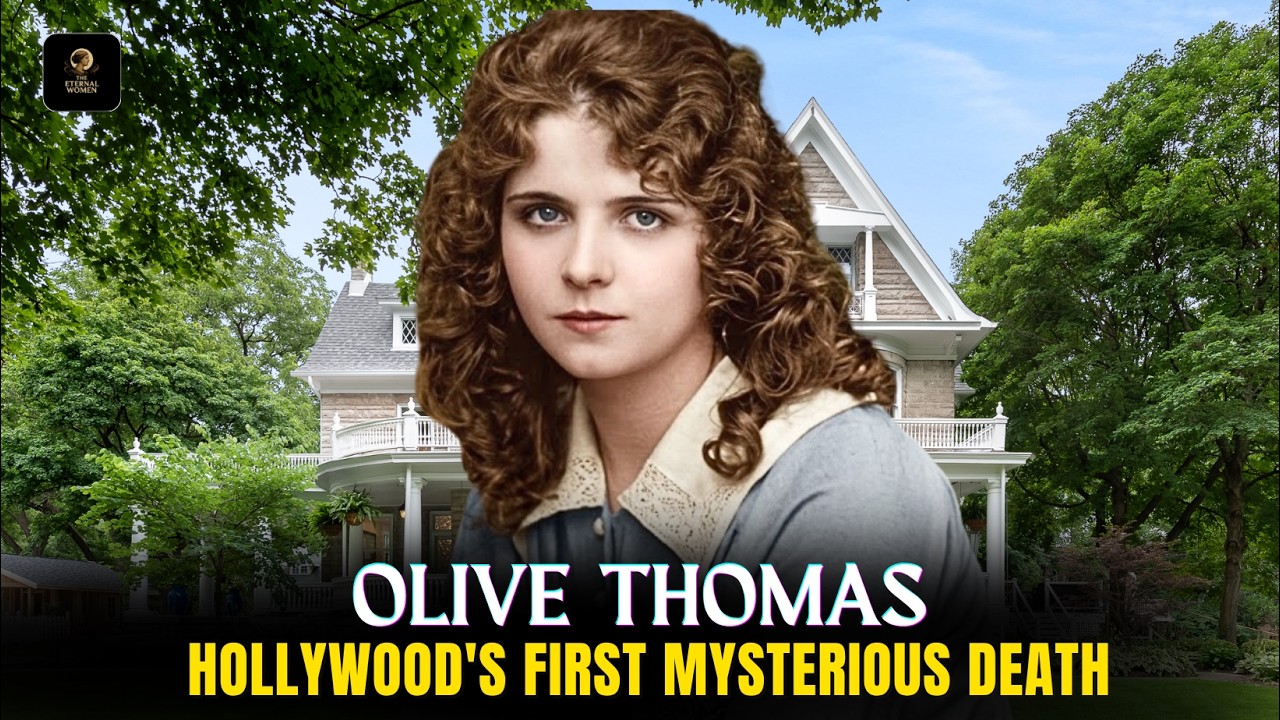
It was not. Her scream brought her husband running. He found her on the floor, an empty blue bottle in her hand. Five days later, at eleven o’clock on the morning of September 10, she was dead.
She was twenty-five years old. Her name was Olive Thomas, and no one in the official record ever asked her what she thought she was drinking while she was still alive and able to answer. Olive Thomas was born Oliva R. Duffy on October 20, 1894, in Charleroi, Pennsylvania, a steel town where the air smelled of smoke and the margin for failure was razor thin.
Her father, a bricklayer of Irish descent, died when she was young. The 1910 census records show the family had relocated to McKees Rocks, another industrial town outside Pittsburgh, where Olive’s widowed mother struggled to raise three children alone. At fourteen, Olive left school and went to work at Horn’s Department Store in Pittsburgh, selling gingham fabric across a counter to women who never thought to wonder about the girl serving them. At fifteen, she married Bernard Cruger Thomas, an older man.
The marriage was not a love story. It was what women in her position did when the opportunity presented itself and the alternative was more of the same. Within two years, she had separated from him. She kept his surname, Thomas, because Duffy was the name of Pennsylvania and poverty and everything behind her.
Thomas was the name of someone going forward. She arrived in New York City around 1913, nineteen years old, with no connections and no money. She found work as a department store clerk and began posing for illustrators. In 1914, she entered a contest called the Most Beautiful Girl in New York City and won.
That single victory cracked open a door she had been pressing against her whole life. Within a year, Florenz Ziegfeld came calling. By 1915, Ziegfeld was the most powerful man in American entertainment. His Ziegfeld Follies at the New Amsterdam Theatre on 42nd Street featured row after row of the most beautiful women in America, lavishly costumed and perfectly synchronized.
Olive Thomas became a Ziegfeld girl in 1915 and almost immediately stood out. Ziegfeld promoted her to his more exclusive late-night show, the Midnight Frolic, which ran after hours on the roof garden of the New Amsterdam for a mostly male, mostly wealthy audience. During her time in the Follies, Olive and Ziegfeld began an affair. He was married to actress Billie Burke, a marriage that did not prevent him from pursuing other Ziegfeld girls.
Olive was not naive about what the affair was. She was ambitious and strategic, and she understood that proximity to Ziegfeld was proximity to power. When she asked him to leave his wife and marry her, he refused. She ended the affair.
Ziegfeld reportedly never recovered. When Olive left the Follies in 1916, he commissioned his artist-in-residence Alberto Vargas to paint her portrait, which he kept in his office for the rest of his life. In 1916, Olive met Jack Pickford at a beach cafe on the Santa Monica Pier. Jack’s older sister was Mary Pickford, America’s Sweetheart, the most popular actress in the world at that moment.
Jack was charming, handsome, occasionally reckless, and fully aware that the Pickford name opened every door there was to open. Olive and Jack eloped in New Jersey in October 1916, but she kept the marriage secret for a year because she did not want anyone to think her film career was built on the Pickford connection. The Pickford family was not enthusiastic about the marriage. In her 1955 autobiography, Mary Pickford wrote that none of them approved.
But she also described Olive with words that cut through the family politics: the loveliest violet-blue eyes she had ever seen, fringed with long dark lashes that seemed darker because of the delicate translucent pallor of her skin. The marriage was a disaster in slow motion. Jack drank and was serially unfaithful. Their reconciliations reportedly involved lavish gifts, jewelry, and fur coats, the currency of a marriage running on guilt and glamour in equal measure.
By 1920, the relationship had been crumbling for years, and Jack Pickford had contracted syphilis. The claim comes from a contemporary newspaper account that some historians have questioned, but what is not disputed is that a bottle of mercury bichloride solution was found in the bathroom of their Hotel Ritz suite. Mercury bichloride was, in 1920, a standard topical treatment for syphilitic sores, not something carried for any casual reason. By the summer of 1920, Olive was at the peak of her career.
Her most celebrated film, The Flapper, released in May 1920, made history as the first film ever to portray a flapper character on screen. She was, at twenty-five, one of the most bankable actresses in silent film. She had just finished what would be her final film, Everybody’s Sweetheart, completed in August 1920. She and Jack sailed for France immediately after, calling the trip a second honeymoon.
They arrived in Paris on August 25 and checked into the Hotel Ritz. Paris received them with champagne and nightclubs. They went out every night, and by early September, the couple seemed to have found something resembling happiness again. On the night of September 4, they went out to the Montparnasse nightclubs and drank freely.
They returned to their suite at approximately three in the morning. Jack went almost immediately to bed. Olive sat down to write a letter to her mother. She wrote until the light bothered Jack, and he called to her to turn it off and come to bed.
She went into the bathroom. The bottle was labeled in French, which Olive likely could not read fluently. The bathroom was dark. She was intoxicated.
These three conditions, taken together, make an accident entirely plausible. She ingested mercury bichloride solution and screamed. Jack ran to her. He tried to get her to vomit and called a doctor, who arrived and pumped her stomach three times.
Five hours later, she was taken to the American Hospital in Neuilly-sur-Seine. She lingered for five days, conscious and speaking for most of that time. Dr. Warden, a poison specialist who attended her, told a reporter that the medical evidence indicated suicide.
He believed the investigation should have gone further, that the police should have interviewed Olive while she was still able to speak. They never did. Why a woman lying in a hospital bed for five days, still capable of speech, was never formally questioned by the investigating officer is a question the official record does not answer. The Pickford family’s considerable influence has been named as an unanswered question, not an established fact.
At eleven o’clock on the morning of September 10, 1920, her kidneys failed. She died. Her autopsy ruled the death accidental, the cause acute nephritis brought on by mercury bichloride absorption. Jack Pickford told reporters she had gone into the bathroom to mix a sleeping powder and, in the darkness and intoxication of the early morning hours, had reached for the wrong bottle.
The rumors were numerous and contradictory. Some papers claimed suicide after a fight about Jack’s infidelities. Others reported she had discovered Jack had given her syphilis and taken the poison in despair. There were reports of champagne and cocaine orgies.
A theory held that Jack had deliberately tricked Olive into drinking the poison to collect on her life insurance. None of these theories were ever substantiated. Hotel staff at the Ritz were unanimous that Olive had been of a happy disposition up to the night of the incident. On September 29, 1920, an Episcopal funeral was held at St.
Thomas Episcopal Church in New York City. Police escorts were required. Hundreds of actors attended. The crowds outside were so large that several women fainted.
The New York Times described the scene as unlike anything the city had seen for the death of a private citizen. She was interred at Woodlawn Cemetery in the Bronx, buried in a white dress trimmed in silver, her name on the mausoleum reading Pickford. Her estate was valued at $27,644, split between her mother, her two brothers, and Jack Pickford, who later relinquished his share to Olive’s mother. Jack Pickford crossed the Atlantic with Olive’s body.
One night during the voyage, he put on his trousers and jacket over his pajamas, went up to the deck, and began climbing over the rail. He intended to jump. He had one leg over when an internal voice said he could not do this to his mother and sisters. He climbed back down.
He married twice more, both times to Ziegfeld girls. Neither marriage lasted. In his final years, during his drunken episodes, he would call out Olive’s name. He died on January 3, 1933, at thirty-six, in a hospital in Paris, the same city and the same general constellation of circumstances.
Florenz Ziegfeld kept the Vargas portrait of Olive on his office wall for the rest of his life. Alberto Vargas went on to become one of the most famous commercial artists of the twentieth century, his pin-up girls owing something directly or indirectly to Olive Thomas, his first. Olive’s final film, Everybody’s Sweetheart, was released after her death. Several of her films have been lost entirely, the way so much of the silent era was lost through studio fires and the destruction of nitrate prints.
What survives shows an actress who was funny, expressive, and physically precise. There is one final chapter. The New Amsterdam Theatre, where Olive performed in the Follies and the Midnight Frolic, fell into disrepair and was condemned by the 1990s. During a 1997 renovation, a security guard working a night shift saw a woman on the stage wearing a beaded green gown, holding a blue bottle.
When he called out to her, she walked toward the street and through the wall. The guard resigned. Cast members of multiple productions at the theater, including the long-running Lion King, have reported encountering the same figure: a woman in a green dress holding a blue bottle. A tradition has established itself among the theater’s performers of touching a portrait of Olive Thomas as they leave through the stage door.
She was twenty-five years old when she died. She had done more in a quarter century than most people do in a lifetime: the modeling career built from a Pennsylvania department store, the Ziegfeld Follies, twenty-one films in four years, the invention of the flapper on screen, marriage into the most powerful family name in Hollywood. She walked into a darkened bathroom at three in the morning in Paris and reached for the wrong bottle. That is the clinical version of what ended her life.
The fuller version begins in a steel town with a fourteen-year-old girl selling fabric and passes through beauty contests and Ziegfeld stages and silent film sets and the Hotel Ritz and a Paris hospital and a cemetery in the Bronx. It is a story about everything a woman can build from nothing, and how completely a single night can dismantle it.