In February 1960, a maid entered a guest room in colonial Borneo and found the richest Englishwoman of her generation lying dead in bed. Scattered across the sheets beside her was a bundle of letters tied with a blue satin ribbon that had come undone during the night. Every letter was from the prime minister of India. Edwina Cynthia Annette Mountbatten, Countess Mountbatten of Burma, had died alone at the age of fifty-eight, reading love letters from another man.
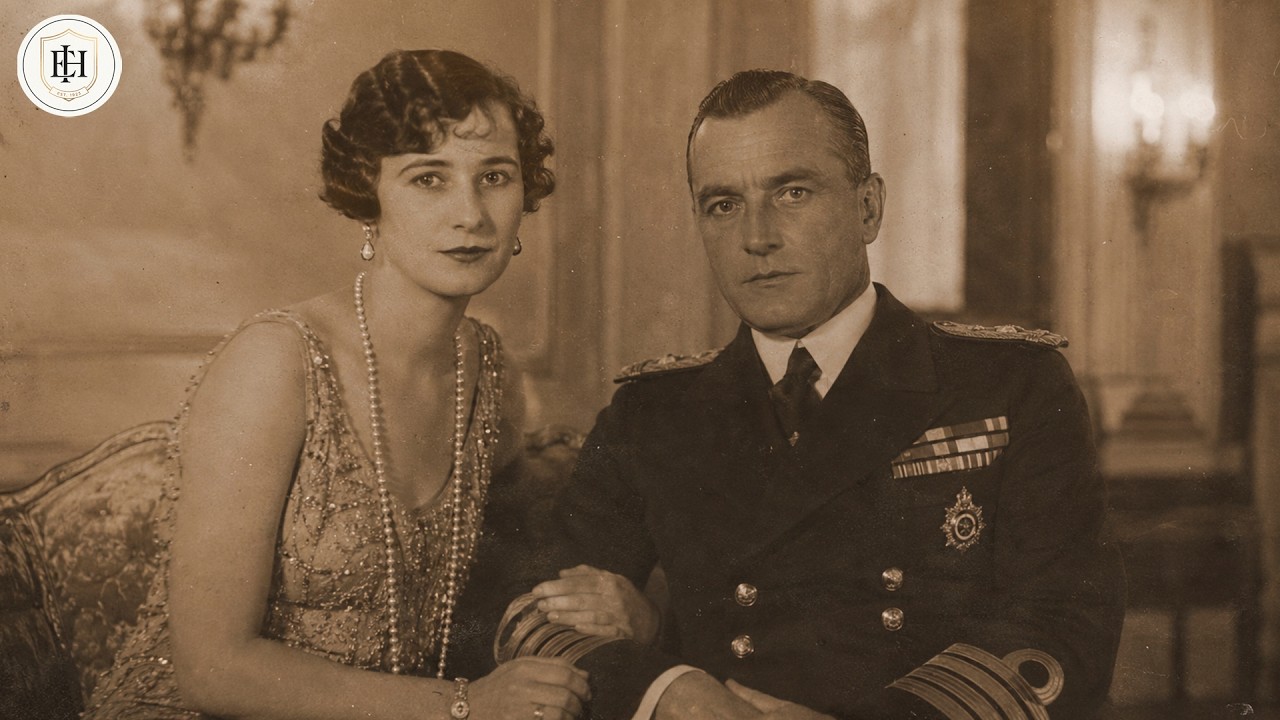
The discovery came shortly before eight in the morning of February 21, 1960, in the Government House at Jesselton, in North Borneo. The previous evening, Edwina had dined with her hosts, retired early complaining of fatigue, and asked not to be disturbed. Sometime during the night, her heart had given out. She had brought the letters with her across continents, from London to Cyprus, from Cyprus to Karachi, from Karachi to Delhi, from Delhi to Singapore, and finally to this remote outpost on the edge of the British Empire.
She had read them for the last time in the dark, in a country she barely knew, and had fallen asleep with them lying open beside her. The letters were from Jawaharlal Nehru, the prime minister of India. The ribbon was found near her lax hand, and the paper, thin from travel, was covered in his unmistakable handwriting. Within hours, the news was moving over the cables.
The wife of the last viceroy of India, a political cousin of the queen, had died of a heart attack during an inspection tour that everyone had begged her not to undertake. Her doctors had warned her. Her daughters had warned her. Her husband had warned her.
She had gone anyway. In London, Earl Mountbatten was woken with the news. In Delhi, Nehru received a slip of paper, entered a private room, and closed the door. The Cabinet Office in Whitehall began the careful, anxious work of managing the obituaries.
The letters were discreetly gathered up, the ribbon re-rolled, and the bundle removed from public view. But the story had already escaped. It had been escaping in fragments for the better part of a hundred years. Days later, something extraordinary occurred on the other side of the world.
The Indian Navy frigate INS Trishul changed course and sailed thousands of kilometers through the Suez Canal, past Gibraltar, and into the cold grey waters of the English Channel. On board were thousands of marigolds, the flower of mourning in Hindu tradition, scattered at funerals, weddings, and at the feet of the gods. The frigate had been sent on the personal orders of the prime minister of India. Its single purpose was to meet a British naval vessel off the southern coast of England and scatter those marigolds over the water where the countess would be buried at sea.
No Englishwoman had ever been mourned that way. No Englishwoman had ever lived a life that made it seem fitting. To understand the body in the bed, one first had to understand the fortune that made her life possible. The man who built it was Ernest Joseph Cassel, a German Jew born in Cologne in 1852, the youngest son of a minor banker.
He landed in Liverpool in 1869 with a suitcase, a few coins, and a letter of introduction to a grain merchant. He spoke almost no English. Within a decade, he was running the international department of one of the most powerful private banks in the City of London. By his thirties, he was placing bonds for governments.
By his fifties, he was lending money to kings. His greatest single triumph was the Aswan Dam, the first great barrier across the Nile. The project transformed Egyptian agriculture and transformed Cassel’s fortune. By the time the dam opened in 1902, he was one of the richest men in the empire.
He consolidated a Sheffield arms manufacturer into the backbone of British naval rearmament. He financed railways in Mexico and Sweden, owned mines in South Africa, and held shares in banks from Stockholm to Buenos Aires. His name appeared on the boards of more than a dozen of the world’s largest companies. Then there was King Edward VII.
When still Prince of Wales, Edward needed a financial adviser who could manage his money with discretion. He found his man in Cassel. The friendship became the deepest of the king’s life. Cassel assisted at Edward’s coronation, sat beside him at Marienbad, and wept openly at his bedside when the king died in 1910.
But the royal household disapproved of him, the court whispered, and the country called him by the anti-Semitic slur “Windsor Cassel,” because beneath the wealth and titles, Cassel was a German Jew. The respectable English world never let him forget it. In 1909, his beloved daughter Ma died of tuberculosis at the age of thirty-two, leaving behind a husband she did not seem to love and two small girls. The elder was a nine-year-old with wide eyes named Edwina.
Cassel was now in his sixties. He had buried his wife and his only child. All that remained in the world for him were two granddaughters. He fixed his attention on the elder.
Summer after summer, he installed her in his great London mansion on Park Lane, Brook House. He took her to Switzerland and the south of France. He kept her at his side during long political dinners where she sat silent and watchful, seeing prime ministers and generals defer to her grandfather. He led her through his libraries and strongrooms, showed her his account books, and told her plainly that everything he had built, he had built for her.
In 1920, he made it official, naming her his principal heir. She was eighteen. He was seventy, and his heart was failing. In September of the following year, almost without warning, his heart gave out.
Edwina, twenty years old, was about to inherit the equivalent of 390 million pounds. She was declared his principal heir on the basis of a will of astonishing precision. Sir Ernest Cassel left an estate valued at over seven million pounds in the money of 1921, a sum greater than the personal wealth of most of the kings of Europe. To Edwina personally, he left a three-hundred-thousand-pound share of the residue, a separate trust fund of one hundred and sixty thousand pounds beyond the reach of her father and untouchable by any future husband, Brook House itself, the country estate at Newmarket, and the cliff-top house on the Dorset coast.
The structure mattered as much as the size. Under the Married Women’s Property Act of 1882, a married woman in England could own property in her own name and keep her own income. Cassel had used the law with the cold precision of the banker he was. Every penny he left her was hers, not her husband’s, not her father’s, not her trustees’.
The suitors began arriving within weeks. Edwina chose a nearly penniless royal cousin, Lord Louis Mountbatten, great-grandson of Queen Victoria. They married on July 18, 1922, in a wedding of the year. The bride wore a dress of silver lamé.
The Prince of Wales served as best man. Inside the church sat the king and queen of England, the king and queen of Spain, the queen of Norway, and the crown princess of Sweden. Outside, police estimated eight thousand spectators pressed against the barriers. The papers called it the perfect English marriage: fortune and lineage, the dream of an empire that still told itself it was at the top of the world.
The dream lasted almost exactly twenty-four months. Within that time, Edwina had left her newborn daughter in the hands of a nanny and begun collecting lovers. The marriage settled into an arrangement that only a vast fortune could make possible: an open marriage, in the older aristocratic sense of mutual tolerance and discreet bookkeeping. The cruelties of the transaction were felt by her husband, who earned three hundred pounds a year while his wife could spend three hundred thousand on a single night at the Embassy Club without noticing.
The lovers themselves were a parade of the England of the 1920s: an American polo player, an Irish playboy, a Spanish aristocrat who later died at the wheel of a Ferrari in the Mille Miglia, and the longstanding affair with the steady, decent man her husband genuinely feared. Then came the most dangerous lover of all. He was Leslie Hutchinson, known to half the world as Hutch, a Grenadian-born cabaret singer and pianist who was the highest-paid cabaret performer in Britain. Edwina took him as a lover in 1927 or 1928.
The gifts she gave him became legend: a gold cigarette case inscribed, a diamond and platinum Cartier wristwatch, and, according to all accounts that have reached print, a piece of jewellery made to measure for Hutchinson’s personal use, designed to be worn over his penis, encrusted with diamonds or sapphires, set in platinum. It is the sort of detail that biographers have approached with caution for decades. Edwina’s husband discovered the affair. One night at Quaglino’s, after several drinks, Louis sat down at the table of a journalist friend and told the whole story, naming Hutchinson and describing the gifts.
The leak grew into a whisper, and by the spring of 1932 the whisper had reached a Sunday newspaper called The People. In May 1932, The People published a paragraph. It did not name Edwina or Hutchinson. It referred only to a great lady of high society and a man of colour whose name was known in every home on both sides of the Atlantic.
In the arithmetic of fame, the man it implied was not Hutchinson but Paul Robeson. The article was a libel, and it named the wrong man. The order came down from Buckingham Palace: Edwina must return home from Malta, must sue, must clear her name in an open court. The libel case was set for the morning of July 8, 1932, at nine o’clock, before the court reporters usually arrived.
The Montbattens hired Norman Birkett, the most formidable libel lawyer in England. On the stand, Edwina testified that she had never met Paul Robeson, never spoken to him, never been in the same room with him. Technically, she was telling the truth. The man she had loved was Leslie Hutchinson.
The People had no defence. The paper apologised, published a full retraction, and paid damages. By eleven o’clock that morning, the libel had been crushed. The following day, by order of the king, Edwina and Louis were photographed lunching at Buckingham Palace.
The image closed ranks. But the bill had not disappeared; it had been transferred. Leslie Hutchinson, who had not been named in the article and had not appeared in court, became overnight a marked man. The palace issued no order.
The producers of the Royal Command Performance simply stopped hiring him. The BBC quietly withdrew his recordings from its radio service. The great hotels stopped booking him. The erasure was slow and steady.
He died on August 18, 1969, having ended his career performing in small provincial clubs for fees that would not have covered the corkage at one of Edwina’s old dinners. Seventy people attended his funeral. The episode should have driven Edwina deeper into her gilded cage. It did the opposite.
In less than seven years, she would walk out of every drawing room she had ever sat in and enter, voluntarily, the worst bombing raids in the history of London. In 1939, she volunteered as an ordinary nursing auxiliary with the St John Ambulance Brigade. She learned to bandage wounds and to drive an ambulance. When the Blitz began on September 7, 1940, she was there from the first night, driving ambulances into the East End during the attacks, walking through bombed houses with first-aid teams, staying until the all-clear sounded at three in the morning.
By 1944, she was operationally responsible for an organisation of more than one hundred thousand volunteers across Britain. In August and September 1945, with the Japanese Empire collapsing, Allied prisoners began emerging from camps throughout Southeast Asia. Edwina, as Superintendent-in-Chief, assumed the task of inspecting the camps in person. She flew into places where Japanese garrisons had not fully surrendered, walked along the barbed wire, and worked with medical teams.
The official count of those repatriated under the operation she supervised exceeded ninety thousand human beings. In 1946, she returned to England a heroine, her grandfather’s fortune at last united with a public reputation of real weight. And then, in 1947, her husband was appointed the last viceroy of India. Edwina arrived in Delhi as the wife of the man dismantling the Raj, and within weeks she was in love with the man who would inherit it.
They had already met in Singapore in 1946. In Delhi, Edwina created an emergency relief council, visited refugee camps, and organised cholera vaccination campaigns. When Partition came in August, with millions displaced and as many as a million dead, she was in the camps day after day. The famous photograph of her at the great refugee camp at Rajpura shows a thin woman in a white garment moving among cholera patients lying on the ground.
The new prime minister, Jawaharlal Nehru, was beside her. The three of them became, in the heat of late summer 1947, an operating triangle of extraordinary intensity. And somewhere in that triangle, Edwina and Nehru fell in love. Edwina described the relationship to her husband in a famous note: it was, she told Louis, for the most part platonic.
For the most part, she added, but not always. Louis knew exactly what was happening and raised no objections. He later described Nehru to a biographer as “the great love of my wife’s life. ”
The viceroyalty ended in June 1948.
Nehru, a widower since 1936, stayed on the dock in Bombay and watched them leave. He would write to Edwina between three and five times a week for the rest of her life. The letters travelled by diplomatic bag, by air mail, and by slow sea post across the Indian Ocean. More than a thousand of his letters survived.
She visited India every winter, staying at the prime minister’s residence. They walked together through the rose gardens and talked late into the Delhi nights. The work continued. By her early fifties, Edwina was the most senior figure in the St John Ambulance Brigade, travelling without rest, inspecting posts in Africa, the Middle East, and the new Commonwealth countries.
Her body began to protest. In 1956, she was diagnosed with angina. In 1958, she suffered a minor stroke. The doctors advised rest.
She did not stop. In November 1959, Nehru came to London for his seventieth birthday. Edwina gave the principal tribute, speaking with an intimacy that moved seasoned journalists to understand, even without knowing a single piece of gossip, that the woman at the podium and the man honoured had loved each other for more than a decade. A week later, against the strongest possible medical advice, against the explicit pleas of her daughters, and against her husband’s contained concern, Edwina announced that she was undertaking a long inspection tour of the Eastern Commonwealth.
She would fly to Cyprus, then Karachi, then Delhi, then Malaya, then Singapore, then North Borneo. Her doctor said no. Her family said no. She bought the tickets.
She left London in mid-January 1960. In Delhi at the beginning of February, she stayed, as always, at the prime minister’s residence. Nehru cleared his agenda, and they had several days together. She told her daughter Pamela that he looked more tired than she had ever seen him.
He told his sister that Edwina looked more tired than he had ever seen her. On February 11, she left Delhi and flew to Malaya, then Singapore. On February 20, she arrived at Government House in Jesselton, North Borneo, exhausted but continuing under sheer will. She inspected the local brigade headquarters, visited a small hospital, and attended an official dinner that night.
She retired early, said goodnight, went upstairs slowly, and closed the door of the guest room. In that room, she opened the inner pocket of her travelling case, took out the bundle of letters, and untied the blue satin ribbon. She lay down on the bed and began to read. At some hour during the night, the heart attack came.
She did not call for help. The letters remained where they had been, scattered across the linen by her last movements. A letter from Nehru, written a few days earlier, was on its way to her. It would arrive at Government House in the days after her death.
When the household staff read the address, the woman to whom it was sent had been dead for almost a week. In London, the Queen Mother received the news at Clarence House. She listened, lit a cigarette, and said, with something almost like a smile, “Dear Edwina. She always did like to make a splash.
” It was the perfect epitaph, cruel and tender at once. The body was flown home. Edwina had requested in her will that she be buried at sea. The funeral took place on February 25, 1960, aboard the Royal Navy destroyer HMS Wakeful, with the Archbishop of Canterbury officiating.
The Duke of Edinburgh was among the official mourners representing the queen. Louis was there, and Patricia and Pamela. And beside the British destroyer, rocking on the same grey swell of the English Channel, lay the Indian Navy frigate INS Trishul, sent on the personal orders of Jawaharlal Nehru, its hold filled with marigolds. At the moment the coffin was committed to the sea, the sailors of the Trishul scattered thousands of marigolds, yellow and orange flowers floating on the cold water around the slowly sinking coffin.
It was the most public and most beautiful love letter the prime minister of India could write to the wife of the man who had once been the last viceroy of his country. After the funeral, the consequences were less graceful. The Cassel fortune had been eroded by inflation, death duties, and the cost of forty years of an extraordinary life. Louis complained that the death duties had left him with “one shilling per pound.
” He kept Broadlands, the family estate, and his own considerable income. He was not poor; he was simply no longer rich on a scale that exceeded imagination. On August 27, 1979, he was on holiday in Ireland, in his small wooden fishing boat off the coast of County Sligo, when the Provisional IRA detonated a bomb planted beneath the deck. He died instantly, aged seventy-nine, in the kind of violent political death toward which Edwina had spent her own life walking.
What, in the end, did the money buy? It bought the legacy of the St John Ambulance Brigade, the Cassel Hospital that still operates more than a century after its founding, and the Edwina Mountbatten Trust that still distributes grants for nursing and social welfare. It bought secrets, as well: the British Cabinet Office still resists full publication of the Mountbatten-Nehru correspondence. And what it could not buy was stillness.
Edwina worked herself to death because stopping was the only thing the Cassel fortune could not protect her from. Nehru came closest to filling the void, but Nehru had a country to govern, and the love between them was sustained on paper rather than in presence. It was not enough for a woman of fifty-eight with a damaged heart. It was simply not enough.
Between the wedding of the century in 1922 and the morning in Jesselton, the most expensive English freedom of the twentieth century had been spent on everything from the absurd to the magnificent. At the end, nothing remained to buy except the right to be remembered as a real and complicated human being, judged on her own terms. That, at least, she had earned.