In 1963, the Testors Corporation made a manufacturing decision inside its Rockford, Illinois plant that would quietly shape the hands-on education of generations of American children. The company invested in its first plastic injection molding equipment, bringing the entire production of model kits in-house. By controlling every step from raw plastic pellets to finished boxed product, Testors made the model airplane something a child could buy with pocket change. That price point, invisible in the brickwork but writ large across the factory’s later expansion, democratized a hobby that had once required significant disposable income.
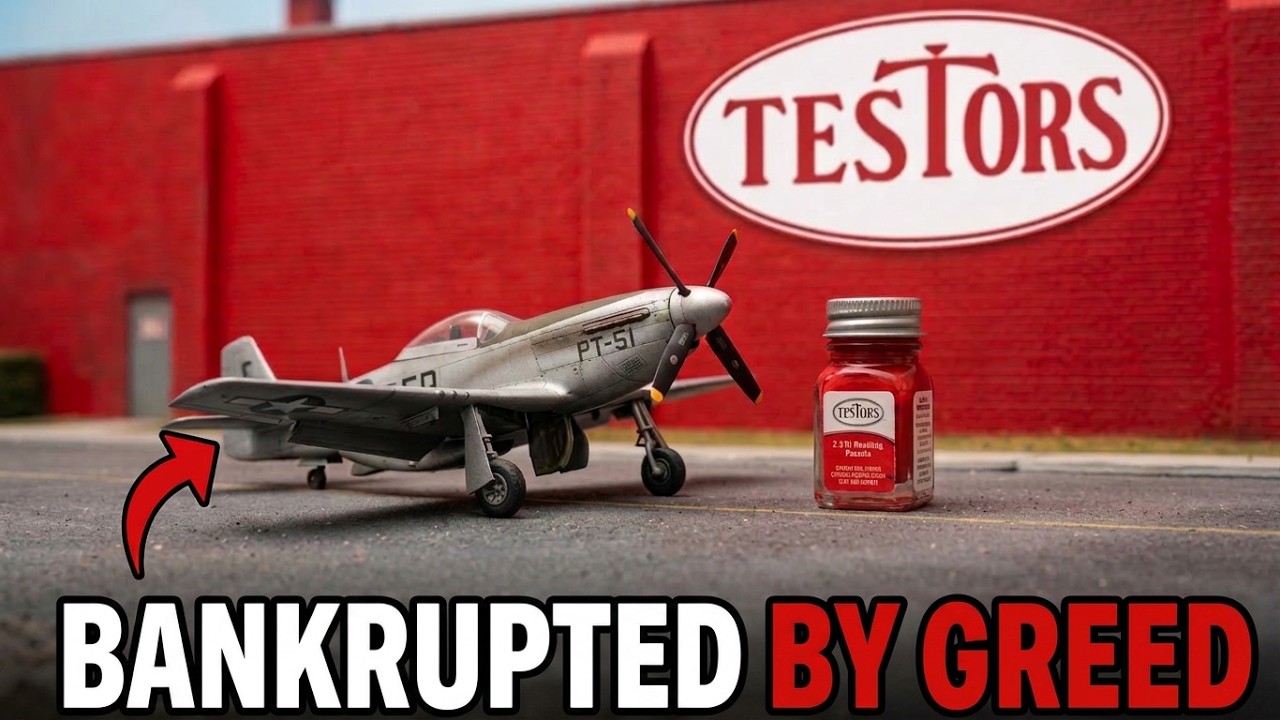
For the next four decades, this building would produce not just a product, but an access point, a door into a world of technical engagement. The building itself still stands, repurposed in part for light industrial use. The roof has not fallen in. The concrete remembers.
Anchor bolt patterns near the north wall mark where heavy injection molding presses were once fixed to the floor. Large-diameter ventilation ducts installed to manage solvent vapors from the enamel paint lines remain in place, their industrial scale evidence of a volume of production that was never small-batch. Worn edges on the loading dock’s concrete apron speak to decades of crates and pallets moving through the door. What is gone is the last physical address of a company that, for nearly sixty years, occupied an unusual position in American industrial and cultural life.
Testors began with a bottle of glue in 1929. The original Rockford plant was a modest structure for a modest adhesive business. The building that replaced it was shaped by catastrophe and war. In 1944, fire destroyed the facility.
During that era, the company had spent the war years supplying the United States Army Air Forces with precision scale models used for aircraft recognition training. The military contract carried more than revenue; it carried the institutional pressure to build infrastructure capable of meeting government specifications. The post-fire facility, erected in 1945 and 1946, was a deliberately engineered structure, reinforced concrete, fire doors, sprinkler systems, and dedicated rooms for research, mixing, and packaging. In a very real sense, it was a war-era industrial building, heavier and more carefully organized than anything that had come before.
By the 1950s, Testors had outgrown its identity as a glue company. The product line expanded to enamel paints, balsa wood kits, and eventually plastic injection molded models. Each expansion left its mark on the physical plant, new floor space, new ventilation, new storage. The post-fire core is still recognizable by its heavier concrete work and older ventilation hoods.
Later additions, lighter steel framing and broader windows, came in phases through the 1960s and 1970s as the company grew. At its peak, this facility produced kits and paint sets distributed to more than twelve thousand retail locations across the United States: hobby shops, department stores, five-and-dimes, hardware stores. The logistics of that distribution passed through the Rockford loading dock, and its worn concrete edge is quiet proof of how much product moved through that door for a very long time. The product that left the building was, in a true sense, raw material for a parallel education.
Not the formal kind measured in tests, but the kind that happens at a kitchen table on a Saturday afternoon when a child tries to figure out why the wing will not sit flush and a parent leans over and explains what a diagonal angle is. The model airplane hobby, at its height in the late 1960s and through the 1970s, was one of the most widely practiced forms of hands-on technical learning available to ordinary American families. Magazines like Model Airplane News circulated past two hundred thousand copies per issue. Small, specialized, community-anchored hobby shops numbered in the thousands, serving as social spaces where builders compared notes, traded parts, and developed a shared vocabulary around assembly technique and paint finish.
Testors products were the connective tissue of that culture. The square enamel bottles appeared everywhere, on workbenches, in kitchen junk drawers, lined up in color-coded rows behind hobby shop counters. A builder who wanted to replicate the exact camouflage of an RAF Spitfire from the summer of 1940 could find the precise color, referenced against documented military records, in a bottle that cost less than a school lunch. That specificity, the insistence on historical accuracy, was a deliberate company choice that set Testors apart from competitors satisfied with approximate colors and rough outlines.
The acquisition of the Model Master line in 1972 formalized that commitment. Model Master had built its reputation on military-accurate pigments and professional-grade finishes. Absorbing the line created a two-tier system, entry-level kits for beginners and a premium tier for those who wanted museum-level results, and in doing so created a pathway. A child could start with a simple kit at age eight and, years later, find themselves working with reference-grade paints toward a competition standard finish.
The F-19 stealth fighter kit of 1986 was the most famous single product this factory produced, not for the spectacle alone, though the spectacle was considerable. Twenty-five thousand kits sold out in weeks, generating national news coverage and morning show segments. The actual stealth aircraft the Air Force was developing, the F-117, had not been publicly revealed. Testors designers, working from published defense analyses, leaked photographs, and aerodynamic reasoning, produced a plausible interpretation of what the aircraft might look like.
It was informed speculation, honestly presented as such, and it connected with a public that had grown up building models of aircraft they knew well, suddenly given the chance to build one that nobody officially knew at all. Thirty thousand units moved in a second run alone. That moment, late 1986, is now generally regarded by historians of the hobby and industry veterans as the last great surge, the last time model airplane culture commanded broad public attention. What followed was not a sudden collapse but a convergence of pressures.
The first was retail. Hobby shops faced structural challenges by the late 1980s as rising commercial rents made small specialty retail difficult to sustain. Between 1990 and the mid-2000s, more than two thousand dedicated hobby shops closed across the United States. Those closures mattered commercially and culturally.
The hobby shop was the physical gathering space of the model building community, where knowledge transferred from experienced builders to beginners and from older generations to younger ones. When the shop closed, the community it had anchored often dispersed quietly. The second pressure was demographic and cultural. The generation that had grown up building models in the 1950s and 1960s was aging.
Their children faced a different landscape of leisure options: video games, cable television, personal computers, and eventually the internet offered forms of engagement that were immediate and required no patience, no drying time, no second attempt. The particular virtues of model building, its slowness, its demand for sustained attention, its tolerance for error, became less obviously compelling in a changed cultural context. The third pressure was chemical and regulatory. Beginning in the late 1980s and accelerating through the 1990s, increasingly stringent volatile organic compound regulations affected the formulation of enamel-based paints and solvent cements.
The concerns about solvent exposure were legitimate and well documented, but the regulatory pressure required investment in reformulation and compliance infrastructure. A company that had built its identity around specific chemical formulations found adapting genuinely difficult, and results were not always satisfactory to long-term users. By the early 2000s, these pressures had combined into something genuinely threatening. Testors was still producing, the Rockford factory still running, but the world the factory had been built to serve was substantially diminished.
Ownership had changed several times since the Chicago Chemical Conglomerate acquisition of 1965. The Rust-Oleum Corporation, itself a subsidiary of RPM International, acquired Testors in the late 1990s. These transitions brought financial stability and distribution capacity, but also the logic of a larger corporate parent into decisions about product lines, pricing, and manufacturing location. Responsiveness to the hobby community became harder to maintain when every product decision had to clear additional layers of institutional review.
In 2019, Rust-Oleum announced that Testors production would be discontinued. The Model Master line, the premium tier that had been the company’s most technically sophisticated product range for nearly fifty years, was to be retired. The enamel paints, the military-accurate colors, the fine-tipped applicator bottles that had sat on serious builders’ workbenches since the early 1970s, would no longer be manufactured. The announcement met with an unusually intense response.
Online forums filled with documentation projects: builders photographing remaining inventory, compiling color conversion charts, writing guides for replacement products. The reaction was less commercial anxiety, closer to grief. People were not primarily worried about where to buy paint; they were mourning the end of a specific language, a set of color references and formulations that had been a shared standard for half a century. The 2019 discontinuation of the Model Master line was followed in 2022 by news that production at the Rockford facility had effectively concluded.
The Testors name still exists; Rust-Oleum maintains the brand for a limited range of cement products and basic enamel colors. The building has been partially repurposed for light industrial and storage use by different tenants. Concrete and steel installed in the post-fire rebuild of 1945 and 1946 does not fail easily. It outlasts its purpose and waits for the next one.
What ended here was not just a production line but a capacity, the capacity to make a specific kind of thing at a specific level of quality and historical specificity that served a specific educational and cultural function nothing else has cleanly replaced. The Model Master paint line offered something genuinely unusual: color references so carefully matched to documented historical sources that a builder in Iowa could replicate the exact paint scheme applied to a specific aircraft at a specific point in the war. That required sustained investment in historical research, color science, and the maintenance of formulation standards over decades. On the production floor, the stenciled color codes near the mixing stations and the sequential numbering along the production line still remain faintly legible, a modest record of the work that was done here.
The building is still standing, the bones are good. What is less certain is whether what happened inside these walls, the particular combination of historical precision, accessible pricing, and hands-on engagement that defined Testors at its best, will find a physical home again, or whether it belongs now to a form of cultural memory that no longer requires a factory to sustain it.