More than thirty-three thousand of them were built, more than any other fighter aircraft in history. The Messerschmitt Bf 109 was Germany’s most iconic weapon of the air, the machine that turned young Luftwaffe pilots into legends or martyrs. It carved the path for the Luftwaffe’s terrifying early dominance, produced the highest individual kill counts ever recorded, and became the very symbol of Nazi air superiority. Sleek, fast, and radically advanced, it seemed unstoppable.
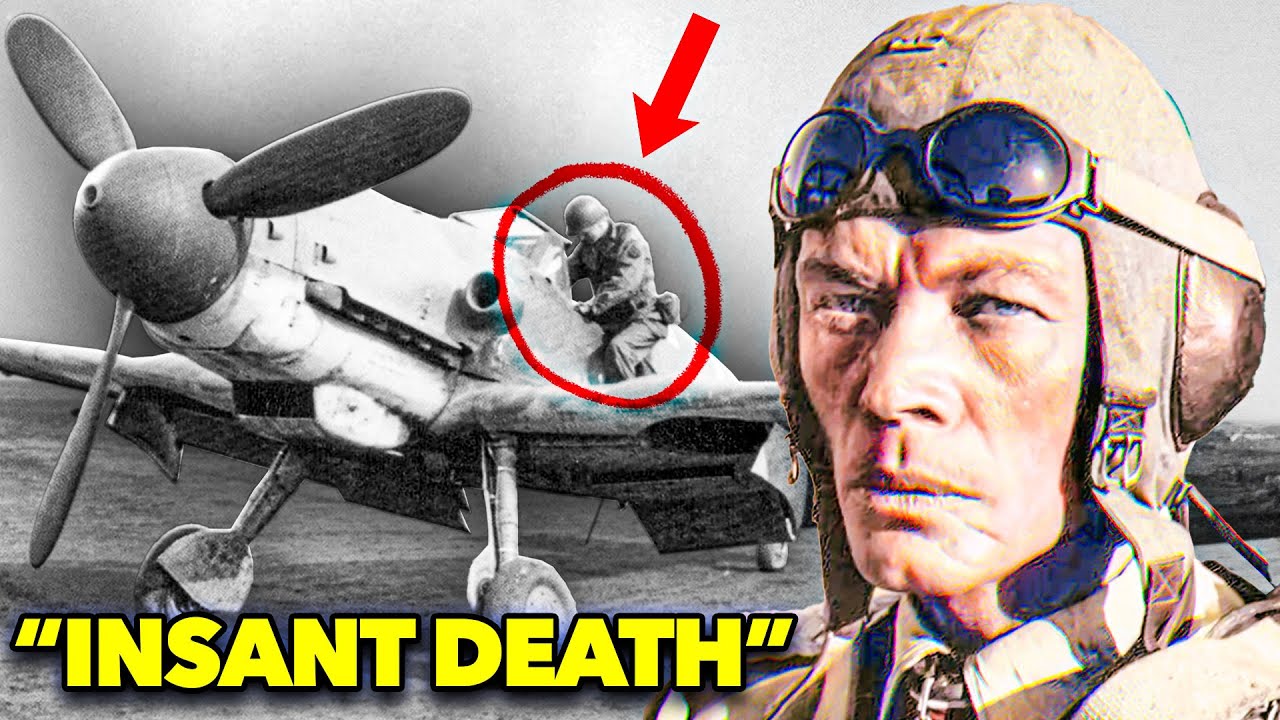
But it carried a flaw so deadly that it killed thousands of its own men before they ever faced the enemy. Over 1,700 German pilots died not from Allied fire, but from something baked directly into the aircraft’s design. After the First World War, the Treaty of Versailles stripped Germany of its air force. No combat aircraft.
No training programs. Not even the blueprint for a fighter. The Allies believed they had clipped Germany’s wings for good. What they did not grasp was that the silence was a disguise.
Behind locked factory doors, under the innocent label of civil aviation, Germany rearmed in plain sight. By the early 1930s, Adolf Hitler had risen to power, and the masks began to come off. At the center of this transformation was an ambitious Bavarian designer, Willy Messerschmitt, whose creation would become one of the deadliest symbols of Nazi power. The world’s first glimpse came in 1936, during the Berlin Olympics.
Amidst the orchestrated pageantry, Germany unveiled its new prototype by shattering the international speed record. What made it even more disturbing was that the record was set using a British-built Rolls-Royce Kestrel engine. Germany was not back. Germany was ahead, and it was using foreign technology to prove it.
By 1937, the Bf 109 was the most advanced single-seat fighter in the world. All-metal construction, a closed cockpit, retractable landing gear. Everything about it shouted speed. While other nations still flew wood-and-canvas biplanes, Germany had reinvented aerial warfare.
It was tested in the skies of the Spanish Civil War, where it tore through outdated Soviet aircraft and proved its worth against early monoplane rivals. By the invasion of Poland in 1939, the Bf 109 led the charge, dominating the skies with ruthless precision. Armed initially with two synchronized machine guns firing through the propeller arc, the aircraft was deadly even in its early form. When German intelligence learned the British Spitfire was entering service with eight wing-mounted guns, the arms race escalated.
The Bf 109 was fitted with two 20 mm cannon in the wings, firing high-explosive shells that detonated on impact. It kept evolving with each new front, gaining more powerful Daimler-Benz engines, better weapons, and a cannon that fired through the hollow propeller shaft. A marvel of engineering. But this evolution hid a deadly secret.
In the quest for speed and aerodynamics, Messerschmitt had made a crucial sacrifice. Instead of mounting the landing gear on the wings, as many fighters of the era did, the undercarriage was fixed directly to the narrow fuselage. The result was a sleek profile in flight and a death trap on the ground. The narrow wheelbase made the plane highly unstable during takeoff and landing.
A crosswind, a bump in the runway, a moment of hesitation, anything could flip the aircraft or send it careening into disaster. Even experienced pilots struggled. For rookies, it was a coin toss. Would the plane take off clean, or slam nose-first into the dirt?
The gamble cost Germany dearly. During training alone, over ten percent of all Bf 109s were destroyed in non-combat accidents. More than 1,750 Luftwaffe pilots died in crashes that had nothing to do with enemy fire. These were not battlefield casualties.
They were the results of structural flaws and fatal design choices that were never fully corrected, even as the war dragged on. By the summer of 1940, the Bf 109 had helped blitz through Poland, overrun France, and humiliate Allied air forces. Now it faced its greatest challenge: the Royal Air Force over Britain. The Battle of Britain tested endurance, range, and tactics.
Here, the 109’s strength became its weakness. Designed as a short-range interceptor, it was not built for long-distance escort missions. Yet that was exactly the task. Flying cover for German bombers from bases in France, across the English Channel, and back, the pilots had just fifteen minutes of combat time once they crossed into British airspace before they had to turn around.
There was no margin for error. A dogfight that dragged on too long, or pilots who lost their bearings, meant they would not make it back. And many did not. German bombers flew significantly slower than the fighters, forcing the 109s to slow down and stay in tight formation.
Spitfires and Hurricanes exploited this relentlessly, forcing the fighters to break off and leave the bombers exposed. Many German pilots died not in glorious battle, but simply because they ran out of fuel on the way home. By the end of the Battle of Britain, over 600 Bf 109s had been destroyed. The myth of German air invincibility had cracked.
After the losses over Britain, Germany turned to North Africa. The desert pushed the aircraft to its environmental limits. Sand got into everything. Engines choked.
Filters clogged. Hydraulics failed. The 109, designed for the skies of Europe, was not built for the Sahara. A tropical variant was developed, fitted with air filters, drop tanks, and desert camouflage.
But visibility during landing was poor, and in the heat, the narrow undercarriage became even more deadly. Rough desert strips and sudden crosswinds turned landings into roulette. Many pilots never survived them. Combat also introduced the 109 to the newer Spitfire Mark V, which matched it in power and agility.
Aces were made in the desert, but every kill came with a cost. As the Luftwaffe lost experienced pilots, younger and less trained recruits stepped into the cockpit. The margin for error vanished entirely. On June 22, 1941, Operation Barbarossa, the largest invasion in the history of warfare, sent over three million German troops into the Soviet Union.
The Bf 109 led from the sky, now updated to the F variant. Faster, lighter, more precise. It had dropped its wing-mounted cannons in favor of concentrating all firepower in the nose: two synchronized machine guns above the engine and a 20 mm motor cannon through the propeller shaft. Against outdated Soviet aircraft like the Polikarpov I-16, this layout turned the 109 into a sniper.
Dominance brought names that echoed through history. Erich Hartmann, known as the Blond Knight, would claim 352 aerial victories, the most of any pilot ever. Gerhard Barkhorn followed with 301. But there was a sinister truth behind those numbers.
Unlike Allied pilots, who rotated home after a set number of missions, Luftwaffe pilots stayed on the front lines indefinitely. No rest. No leave. If they survived, they flew again, and again, until they did not.
The policy created monsters of the sky, men who flew hundreds of missions and racked up hundreds of kills, but who burned out completely. Many did not survive the war. Some cracked. Others vanished into the Russian winter.
And all the while, the narrow undercarriage still claimed lives even after the most brutal dogfights, forcing pilots to fight their own aircraft on the way down to the runway. As the war entered its deadliest years, the G variant, known as the Gustav, became the most widely produced model, with more than 23,000 built. It featured a more powerful Daimler-Benz DB 605 engine, better climb rates, and higher top speeds. Firepower was upgraded with heavier machine guns, and some variants carried a 30 mm cannon capable of shredding Allied bombers in a single hit.
But with the power came devastating compromise. The new weapons, added armor, and extra fuel tanks made the Gustav significantly heavier. The wings and fuselage were not redesigned for the weight. Agility suffered.
Maneuverability worsened. Acceleration dropped. Underwing gun pods and unguided rocket launchers, designed to break up bomber formations, added even more drag and made the 109 a sluggish, floating target. Germany was desperate, and it was turning the Bf 109 into a hodgepodge of modifications.
By 1944, the situation was catastrophic. Allied bombing was hammering German industry. Ball-bearing plants, oil refineries, and aircraft factories were obliterated. Fuel was scarce.
Parts were delayed. And the pilots were gone. Most of the experienced aces were dead, missing, or burned out. The average pilot lifespan on the Western Front had shrunk to just a few weeks.
Young trainees, barely out of flight school, were shoved into cockpits and thrown into the sky against waves of P-51 Mustangs, Spitfire Mk IXs, and P-47 Thunderbolts. Training had been cut drastically. In the early war years, pilots logged over two hundred hours before combat. By 1944, it was often less than fifty.
Some rookies had never even fired their weapons in practice before facing live enemy formations. The Bf 109, already known for its tricky takeoffs and lethal landings, was completely unforgiving. The lack of rearward visibility meant novice pilots were often shot down before they even realized they were under attack. Luftwaffe instructors admitted that in some weeks they lost more aircraft in training crashes than in combat.
By the time the Allies crossed into France after D-Day, most surviving 109s were grounded for lack of fuel or experienced mechanics. As Berlin crumbled and Soviet tanks rolled into Germany, Luftwaffe pilots took to the skies in desperation. Some flew solo suicide missions. Others scrambled to defend cities already in ruins.
Many 109s were pulled from barns and roads, using autobahns as makeshift runways. The final versions, like the K-4 and the high-altitude H variants, were designed to be the ultimate fighters, with pressurized cockpits, advanced equipment, and efficient engines. On paper, they could challenge Allied jets. But they were too little, too late.
The factories building them were bombed out. The fuel was gone. The aces who could master them were dead or captured. In total, more than 1,700 German pilots died in training accidents with the Bf 109.
Thousands more died because of its short range, its stubborn handling, or its demand for expert skill. Hundreds of the aircraft were destroyed on the ground by Allied strafing runs. Others were abandoned. Some pilots defected or surrendered midair.
The Bf 109 did not go down in glory. It went down in desperation. It remains remembered not because it was perfect, but because it symbolized the brutal truth that even the most advanced machine cannot save you when the system behind it is broken.
It was both sword and shroud, a deadly marvel that killed its own masters.