On June 17, 1876, along Rosebud Creek in present-day Montana, Crazy Horse led roughly 1,500 Lakota and Cheyenne warriors in a fierce six-hour battle that halted the advance of Brigadier General George Crook’s army. That victory set the stage for the annihilation of Custer’s Seventh Cavalry at Little Bighorn just eight days later. The roots of this confrontation lay in the Black Hills, or Paha Sapa, sacred ground to the Lakota Sioux and Northern Cheyenne. The Fort Laramie Treaty of 1868 had promised these lands to the natives forever.
But in 1874, an expedition led by George Armstrong Custer discovered gold there, and the promise was quietly abandoned. Treaties became worthless as miners flooded into the region and the government began pressuring the tribes to sell their sacred lands. The Lakota refused. In late 1875, Washington issued an ultimatum.
All free native bands were ordered to move onto reservations by January 31, 1876, regardless of the treaty terms. For people living through winter storms with women, children, and the elderly, such a journey was impossible. When the deadline passed, the War Department launched a massive campaign to crush the last independent tribes on the Great Plains. The plan called for three military columns to converge from different directions and trap the natives.
General Alfred Terry advanced from the east, Colonel John Gibbon from the west, and from the south came the most experienced commander of them all, Brigadier General George Crook. Known to his soldiers for his toughness and called “Grey Wolf” by the natives, Crook had learned in the Apache wars that fighting natives required moving like them and using native scouts. His force consisted of about 1,050 regular soldiers, a long supply train, and more than 260 Crow and Shoshone scouts who served as guides and trackers. But the army was out of step with reality.
They expected scattered bands of warriors who would flee at the sight of soldiers. Instead, the spring of 1876 had brought an unprecedented gathering on the Great Plains. Under the spiritual leadership of Sitting Bull, the Lakota, Cheyenne, and Arapaho had formed a massive alliance. Thousands of tipis, tens of thousands of horses, and warriors eager for battle had assembled into a moving city, a nation fighting for its survival.
Commanding this force was Crazy Horse, an Oglala Lakota warrior of quiet demeanor and remarkable battlefield instincts. He had long studied the ways of the American military, its discipline, its firepower, and its arrogance. He knew the army expected the traditional hit-and-run tactics. He was determined to break that expectation and confront the soldiers head-on with organized aggression.
On June 16, Crook’s army reached the valley of Rosebud Creek and made camp. His scouts sensed danger and grew restless, but Crook, confident in his superiority, took their warnings lightly. That night, Crazy Horse moved his warriors into position. Instead of waiting to defend his village, he chose to strike first.
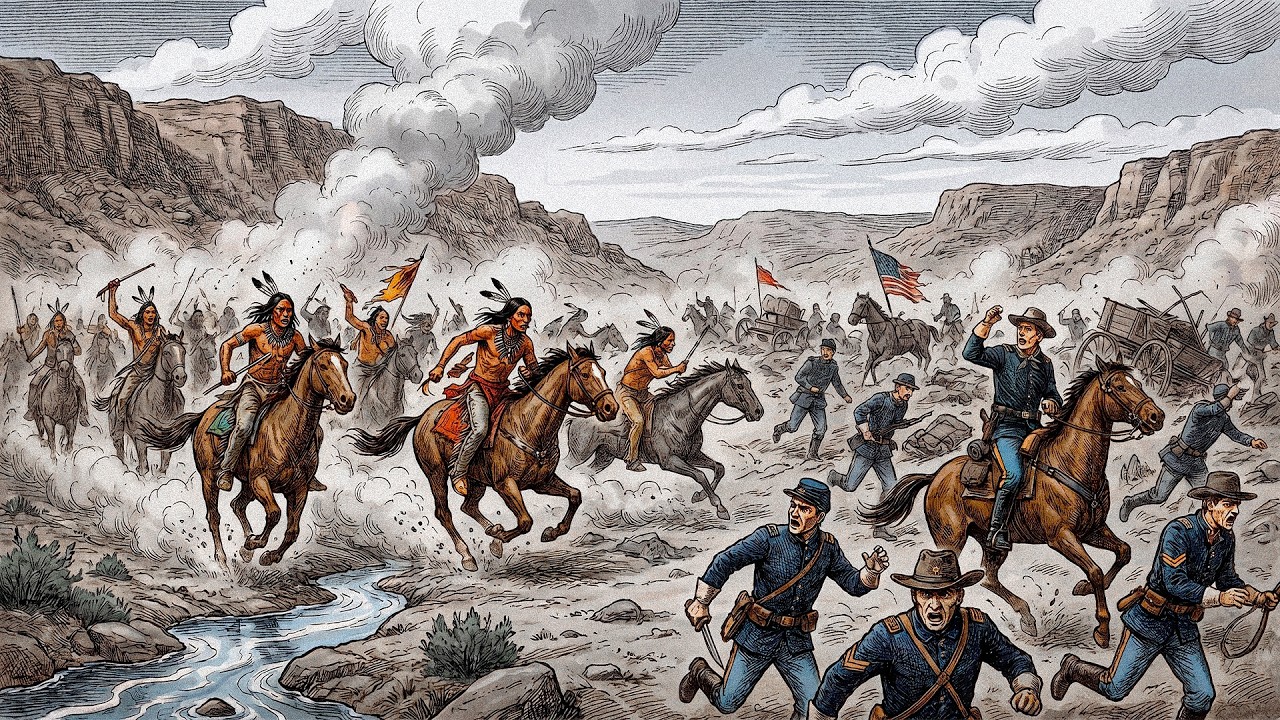
Around 8:30 the next morning, gunfire rang out from the hills above the camp. Within minutes, hundreds of mounted warriors swept down into the valley in organized waves, a sight American soldiers had never witnessed. They attacked with discipline and coordination, like a cavalry regiment. The camp erupted in chaos.
Soldiers scrambled for their weapons, horses broke loose, and officers shouted orders that were lost in the roar of battle. It was the Crow and Shoshone scouts who saved the army in those first desperate minutes. Rather than retreat, they charged directly into the attacking Lakota and Cheyenne warriors, buying twenty to thirty crucial minutes with their own blood. That delay allowed Crook to rally his scattered soldiers, form defense lines, and begin fighting back.
The terrain itself favored the natives. The valley was crossed by deep ravines, dry creek beds, and steep bluffs, which neutralized the army’s advantage in massed cavalry charges and long-range rifle fire. Crazy Horse divided his warriors into tactical groups. While some pressed the center, others struck at the flanks.
He appeared at every point of the battlefield, directing his men with a presence that lifted the spirits of his warriors and shook those of the soldiers. At a critical moment, Crook made a disastrous decision. He sent Captain Anson Mills with a large cavalry unit into a narrow canyon to find and capture what he believed was a hidden native village. There was no village.
Native warriors lay waiting in ambush, and Mills was heading into a trap that could have become a massacre. With Mills gone, Crook’s lines thinned dangerously. Lieutenant Colonel William Royall’s unit on the western flank found itself surrounded and isolated. His men fought desperately against relentless attacks, their single-shot Springfields overheating and jamming while the natives wielded rapid-firing Winchester rifles.
The soldiers were pushed back, suffering heavy casualties, and their line began to collapse. The battle reached its turning point through two events. First, a young Cheyenne woman named Buffalo Calf Road Woman rode into the middle of a deadly crossfire to rescue her brother, Comes in Sight, after his horse had been shot from under him. She pulled him onto her horse and carried him to safety under the astonished eyes of both sides.
The morale of the warriors exploded, and from that moment on, the Cheyenne would remember the battle not as the Rosebud, but as the battle where the girl saved her brother. Second, Crook sent a messenger riding through enemy fire to recall Mills from the canyon. The messenger reached him just as the trap was about to spring. Mills turned his cavalrymen around and rejoined the battle from the eastern flank, striking the Lakota forces that were closing in on Royall’s battered unit.
This intervention opened a corridor for Royall’s survivors to reach the main army, saving them from annihilation. The battle had lasted six hours, an extraordinarily long time for a conflict between the American army and native tribes, who typically fought in short, sharp engagements. In the afternoon, Crazy Horse chose to withdraw. His horses were exhausted, his ammunition was dangerously low, and he had achieved his strategic goals.
He had stopped Crook’s advance, kept the enemy away from the villages, and bloodied the army in a way no tribe had done before. His warriors withdrew with discipline, carrying their dead and wounded away with them. Crook declared victory because he held the field, but there was nothing to celebrate. His army had suffered dozens of dead and wounded, had spent roughly 25,000 rounds of ammunition, and was so shattered in morale and matériel that he was forced to retreat south to his camp at Goose Creek.
He would remain there for weeks, unable to move, waiting for reinforcements. The three-pronged campaign against the natives had collapsed in its southern arm, but Crook, humiliated and unwilling to admit defeat, did not communicate the disaster to the other commanders. The warriors returned to their camp in triumph. The victory validated Sitting Bull’s vision of soldiers falling from the sky, and it filled the tribes with unshakable confidence.
They moved their great gathering west to the valley they called Greasy Grass, known to the whites as the Little Bighorn. Eight days after Rosebud, on June 25, 1876, Custer led the Seventh Cavalry into the Little Bighorn Valley. He knew nothing of Crook’s defeat. He expected a scattering of panicked warriors.
Instead, he found a united, confident army that had perfected its tactics at Rosebud. In a few hours, Custer and all five companies under his direct command were wiped out, leaving no survivors. The Battle of the Rosebud has often been overlooked, overshadowed by the disaster that followed. But it was at Rosebud that the myth of American military invincibility was first shattered.
There, on the steep rocks of that valley, Crazy Horse demonstrated a strategic genius that matched any military academy. There, the native nations of the plains stood together as one and turned back the most feared commander of the American frontier. The victory was the proudest moment in their long history, and it remains a testament to those who fought not for conquest, but for the right to exist on their own lands.