Staff Sergeant Joe Toye was one of Easy Company’s toughest soldiers. Wounded multiple times across the war, he was finally torn out of the fight at Bastogne when a German shell blew off most of the lower portion of his right leg. The television series Band of Brothers shows him being carried away on a litter, and then he disappears from the story. What happened to him afterward is a quieter but no less remarkable chapter.
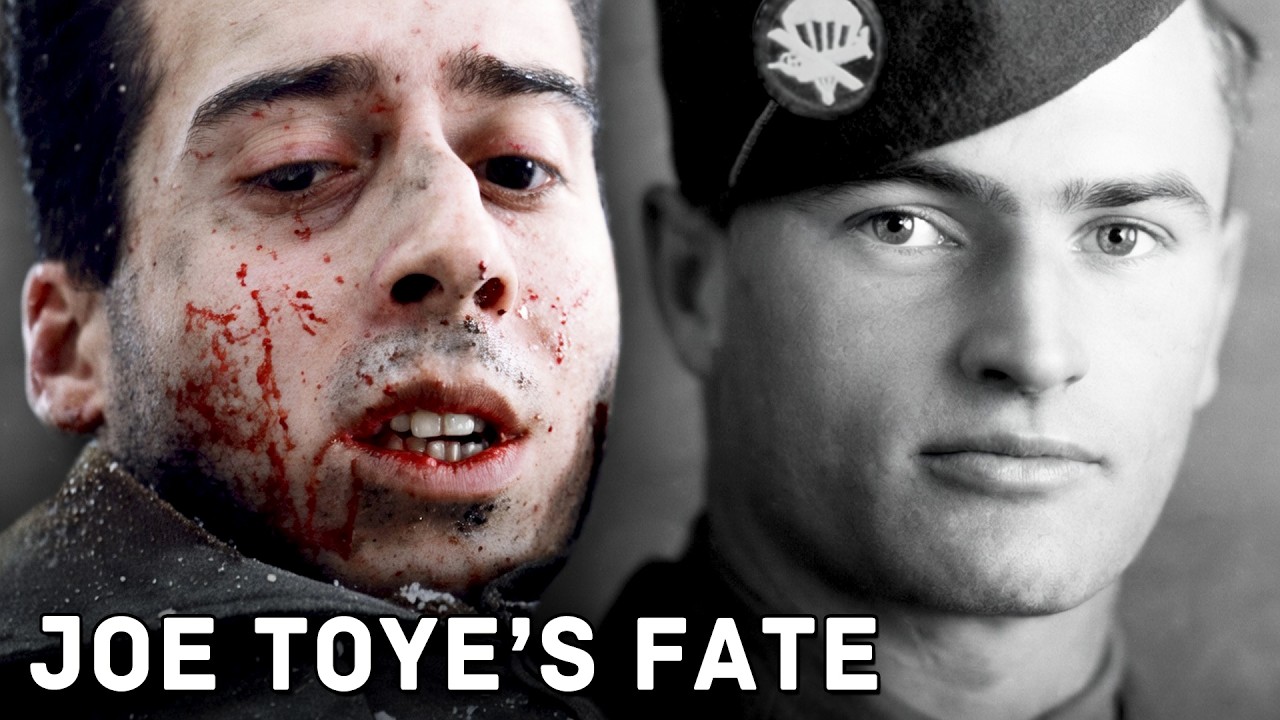
Joe Toye was born Joseph John Toy on March 14, 1919, in Hustontown, Pennsylvania, the youngest of nine children in a large Catholic family. His father died when Joe was thirteen, forcing him to leave school in the seventh grade and go to work in the coal mines to help support the family during the Great Depression. By the time he enlisted at age twenty-two, he was living in Reading, Pennsylvania, with his brother Thomas, a state policeman, and working at the Gray Iron Foundry. He joined the Army in the days after the attack on Pearl Harbor, originally in the Medic Corps, but volunteered for the paratroopers, enticed like many others by the higher pay.
He trained under Captain Herbert Sobel at Camp Toccoa, Georgia, and earned his jump wings at Fort Benning. During training at Camp McCall, North Carolina, on March 30, 1943, he broke his leg on his seventh jump when strong ground wind dragged him hard across the field. His platoon mates pooled their money and bought him a radio for the hospital. He rejoined the company and went on to become a squad sergeant.
Fellow veterans described him as the toughest of the tough, built like steel from the mines and from amateur boxing. Don Malarkey called him a great guy who always thought beyond himself and came across like Superman, but never let his strength go to his head. He was also a devout Christian with a good sense of humor, known to sing Irish songs to lift the men’s spirits in the worst moments. His closest brush with death before Bastogne came on D-Day at Brecourt Manor, where Easy Company assaulted German artillery positions.
During the attack, a German grenade known as a potato masher landed in the trench between his legs. Lieutenant Richard Winters yelled, “Joe, look out! ” Toye flipped over and scrambled away. The stock of his rifle took the brunt of the explosion, saving his life.
He was sprayed with wood splinters but largely unharmed. Winters held him in the highest regard. In his memoir, Winters wrote that next to Floyd Talbert, Sergeant Joe Toye was the best soldier in Easy Company. One moment absent from the series illustrates why.
Shortly after the liberation of Eindhoven, Easy Company ran into the German 107 Panzer Brigade near the town of Nuenen. Pinned down, Winters wanted to know what they were up against. He told Toye, “Joe, get me a live prisoner. ” Toye, a squad leader, left his squad behind and ventured out alone into no man’s land, returning with a live German prisoner.
Winters remarked, “Action like that in combat wins the respect for life of every man that was in the company. ”
Toye was wounded several more times. During Operation Market Garden, a German 88 shell exploded near him and fellow soldier James Campbell. The side of a house came crashing down, burying the men in chalk and debris.
Campbell was killed instantly. Toye stepped out of the cloud and told his friend Babe Heffron, “Don’t touch me. I’m hit all over. ” He was wounded in the back and legs, his neck chewed up with shrapnel.
He was evacuated to England and rejoined the company at Mourmelon, France, about two weeks before the breakout at Bastogne. In the Ardennes, he developed a severe case of trench foot in the freezing, wet conditions but refused evacuation. On January 2, 1945, a piece of bomb tail fin lodged in his wrist during a German air raid. He went to the aid station at Bastogne, and they put his arm in a sling.
Twelve hours later, he snuck out and returned to his men in the Bois Jacques. Winters reminded him he had been hit three times since Normandy and told him to take a couple days off, go back to Bastogne, sleep, and eat hot food. Toye replied, “If it’s all the same to you, sir, I’d just as soon be up here with the fellows. ” Winters saw no point in continuing the discussion.
Less than twenty-four hours later, on January 3, 1945, intense shelling hit the line. Toye was not in his foxhole because he was running around making sure all of his men were accounted for and under cover. A shell exploded near him, blowing off most of the lower portion of his right leg. His friend Bill Garnier ran out to help him but was hit in the right leg and severely wounded before reaching him.
Garnier never made it to Toye. Both men remained conscious and calm. Toye asked if someone could drag him into a hole. He later commented, “Geez, what’s a guy have to do to get killed around here?
”
Toye was taken to the aid station at Bastogne, where they cut off what remained of his right leg below the knee. He was sent to England, but by the time he arrived, gangrene had set in, and he underwent a second amputation above the knee. The blast had also hit him in the stomach, chest, his good leg, both arms, and his hands. Nerve damage left him with limited use of his right hand, and some shrapnel remained in his body for the rest of his life.
He had entered the Army at 175 to 180 pounds. He returned to the United States weighing just 110. He reconnected with Bill Garnier at the England General Hospital in Atlantic City, a major rehabilitation center for amputees. Garnier had also lost his right leg above the knee.
Joe spent about nine months recovering and learning to live with one leg. During that time, he met Eleanor “Ellie” Lux, a native of Philadelphia nearly three years his junior. They married in January 1946, and Joe was discharged from the Army the following month. He learned to use a wooden leg and managed to get around fine on it.
But finding work was harder. Disability payments were not enough to support a family, and his hopes of a military career were gone. He found full-time work in a textile plant, then in the mills for Bethlehem Steel, eventually landing a position as a drill bit grinder at Grace Mine, a job he could do sitting down. He worked there for more than twenty years until the mine closed and he took an early retirement package at age sixty.
He and Eleanor had four children: a daughter, Anita, and three sons, Pete, Steve, and Jonathan. Their youngest, Jonathan, born in 1959, was severely mentally and physically handicapped, likely with a severe form of cerebral palsy. He could not walk, talk, feed himself, or use the bathroom on his own. When he was three years old, he had to be placed in a state-run home for people with intellectual and developmental disabilities, the Hamburg Center, about an hour away.
Doctors did not expect him to survive much longer than childhood. The strain of caring for Jonathan, along with Joe’s drinking, which he used largely to cope with the effects of the war, broke the marriage. The couple divorced in 1963. The children lived with their mother in Philadelphia, and Joe saw them about once a month and for a two-week vacation each year.
But he never stopped visiting Jonathan. He made the nearly hour-long drive to the Hamburg Center almost every day. To the surprise of everyone, Jonathan survived well beyond childhood. Joe remarried in the late 1960s to a widow named Mary Vogel, who had four children of her own.
He was devoted to them, umpiring George’s baseball games and taking the family camping and fishing in Canada every summer. He walked down to the lake on a peg leg held on by a rope, took it off once he was in the water, and never considered anything in his life a handicap. He did not get a handicap placard until he needed a knee replacement in his good leg. He never accepted free hunting and fishing licenses to which he was entitled as a disabled veteran.
Mary told her stepson Steve she had never met a more Christian man than Joe Toy, and that his faith was constantly conveyed in his actions rather than just church attendance. George, his stepson, only learned of Joe’s four Purple Hearts when he found them buried in the back of a dresser. Joe wanted no special recognition. When the Band of Brothers book came out and people began learning about his war record, George said it was in some ways hard for Joe, a part of his life he had almost never shared.
In retirement, Joe took community college classes, enjoyed painting and cooking, walked a mile a day, and worked out with weights. One of his pleasures was the occasional visit with Richard Winters, who lived about an hour away. Winters’ daughter Jill said her father always talked about how deeply Joe cared for his family. Much of his retirement was still devoted to Jonathan.
He spent hours a day at the care home feeding his son and looking after him. After Mary died in 1987, Joe told Steve, “I just want to live long enough to bury Jonathan and then I’ll be happy. ” Because of his father’s love and constant presence, Jonathan lived to age thirty-two, three times longer than doctors had expected. Joe Toye died of pancreatic cancer on September 3, 1995, in Reading, Pennsylvania, at age seventy-six, a year and a half after Jonathan’s death.
Richard Winters delivered the eulogy and served as a pallbearer. Joe was buried at Gethsemane Cemetery in Laureldale, Pennsylvania. Before his death, Joe had told Steve that he did not feel he had done much with his life. Steve was taken aback and reminded him that the sacrifices he made for his country in a single year, most people never make in a lifetime.
But Joe Toye’s heroism was not confined to the battlefield. In a letter Winters sent on May 7, 1993, after Jonathan’s passing, he wrote: “No son ever had a father more dedicated and faithful. All of the above demonstrate true character, true love. As a soldier in training or in combat, you always did your best.
I never heard you complain. My respect for you over all these years has never mellowed. It has only grown stronger.
”