Six years after the battle, a Roman soldier stepped into a clearing in a German forest and stopped. His officer, Germanicus, had ordered him forward to scout the ground. What he saw were skulls. Human skulls nailed to tree trunks, whole rows of them.
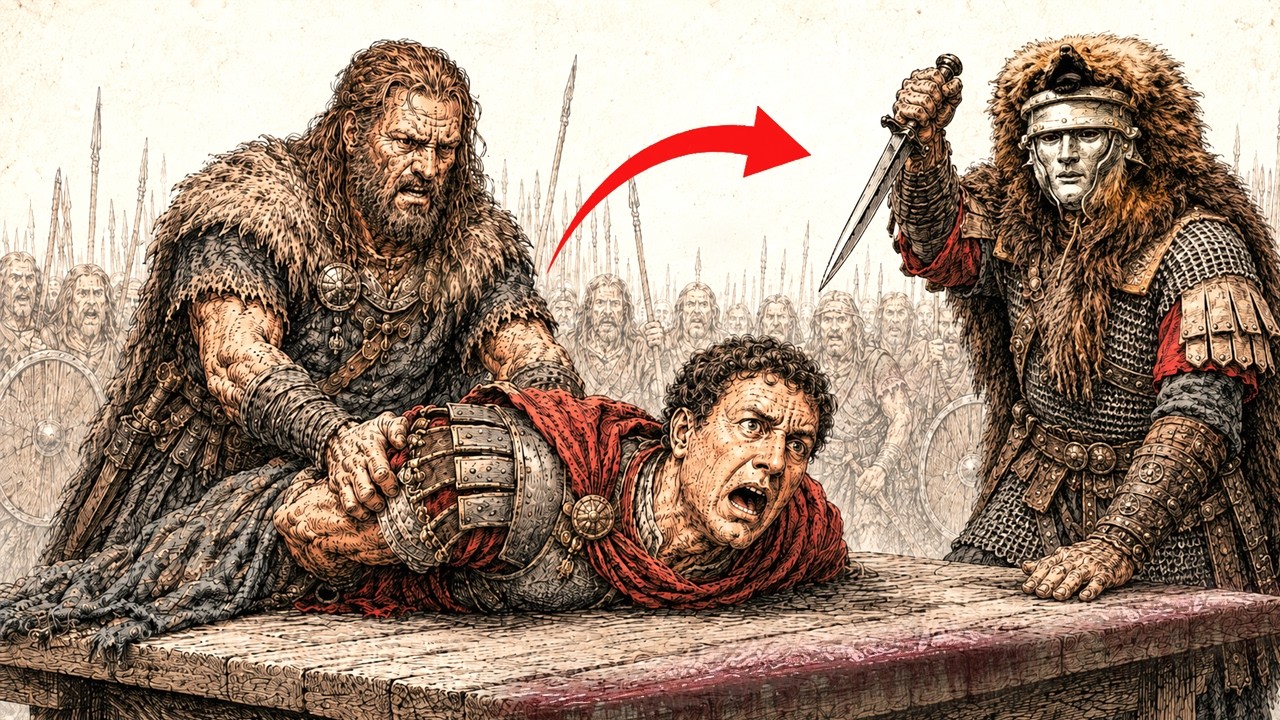
The bones of an entire Roman army lay scattered among the leaves like fallen fruit. Piles marked where men had fought bravely. Sparse skeletons marked where men had fled and been captured. And in pits at the edge of the clearing stood altars, because some of his comrades had not been killed in battle at all.
They had been kept alive, then used. Rome lost three legions in the Teutoburg Forest in 9 AD. That is the textbook sentence. But that sentence is misleading, because what Arminius and his Germanic alliance did to Publius Quinctilius Varus and his twenty thousand men over four autumn days was not merely a defeat.
It was something Rome could never fully admit. Within roughly ninety-six hours, the time of a normal work week, one-fifth of the Roman army’s fighting strength was erased from the face of the earth. The numbers of three legions, the Seventeenth, Eighteenth, and Nineteenth, were stricken from Roman records forever, because no unit that came after them was ever allowed to carry the shame of what happened there. When the last Roman line collapsed on the third day, Varus did not die fighting.
He fell on his sword, and so did his senior officers, one after another, in a sequence of deliberately taken lives that seems less like desperation and more like men who knew in advance what would happen to anyone captured alive. What did they know? What had they already seen the Germanic warriors do to the wounded on the first and second days? The survivors, the handful who crawled out of that forest and reached the Rhine, never spoke publicly about what happened in those pits.
Tacitus, writing a century later, offers fragments: skulls on trees, altars in the clearing, human sacrifice. To understand what happened in that forest, one must return to the man who led the legions into it. Publius Quinctilius Varus was fifty-five years old, a lawyer and politician who had married into Augustus’s family and used those connections to become governor of Syria, where he amassed a fortune and became notorious for turning tax courts into an instrument of greed. He was not sent to Germania to fight a war.
He was sent to administer one, to register households and impose Roman law on people who did not want it. Rome did not send a military commander. It sent a judge. Varus arrived in Germania believing the province had calmed down, that his task was paperwork rather than combat.
He held Roman-style court sessions in Germanic villages, humiliated tribal elders in front of their own people, and treated free warriors as defendants. The officer Velleius Paterculus later wrote that Varus was a man slow in mind and body, more suited to the comforts of city life than the rigors of military command. That judgment came after the disaster, when blame had to be assigned, but it rang disturbingly true. Varus had never fought a real war.
He was about to fight the last one of his life. The man who would destroy him was, at that very moment, riding beside him, eating at his table, giving him reports as his reconnaissance commander, and wearing the ring of a Roman equestrian. Rome had raised Arminius to be exactly this. He was in his late twenties, a Cheruscan prince, the son of Segimer, a Germanic noble taken to Rome as a hostage in his youth.
He had become Roman. He served as an auxiliary officer in the imperial army, received citizenship, and was granted equestrian rank. Varus trusted him completely. Arminius had spent his entire adult life being trained by Romans, learning precisely how the Roman army marched, camped, communicated, and fought.
The warriors Arminius was secretly recruiting into an alliance were not the faceless barbarians of Roman propaganda. They were farmers, hunters, fathers whose crops had been seized for taxes, elders dragged into Varus’s tax courts and forced to bow, and young men who had watched Roman soldiers enter their villages and take what they wanted. Some had even served in Roman auxiliary units. They knew the enemy, knew his habits, and knew exactly how a legion moved when it felt safe.
By late summer of 9 AD, Varus commanded a force unbeatable on any open field in the world. Three full Roman legions, the Seventeenth, Eighteenth, and Nineteenth, roughly fifteen thousand professional soldiers supported by six auxiliary cohorts and three cavalry units, bringing his total fighting strength to nearly twenty thousand men. Every soldier carried a gladius for close-quarters stabbing, a pair of heavy javelins, a large curved iron shield, a helmet, and a personal pack weighing forty to sixty pounds. This was a force built not for concealment but for open ground, straight lines, and organized combat on flat plains where a wall of shields could form in seconds.
Everything about it was about to become its weakness. Against them, Arminius was assembling something Rome had never seen. Not one tribe rising, but an alliance of Cheruscans, Bructeri, Marsi, Chatti, and elements of the Chaucans. Historians still debate the exact tribal composition.
What is certain is that Arminius, using his trusted position as Varus’s reconnaissance leader, spent months moving between villages, meeting nobles, and doing something unprecedented in Germania: persuading rival tribes to fight together on his signal, according to his timetable. He was not building an army in the Roman sense. There were no legions, no paid professionals. He was building thousands of individual warriors moving in war bands under local leaders, armed with spears and swords, light shields, and long daggers, fighting with speed and ferocity on ground they had all known since childhood.
The audacity of what Arminius was attempting is staggering. He was an active Roman officer in daily contact with a Roman governor commanding twenty thousand men. One conversation from a nervous ally, one message reaching Varus’s tent, and Arminius would be crucified before sunset. He was betting on that every day.
And that message nearly arrived. There was another Cheruscan noble, older and more influential by birth, a man named Segestes. Segestes hated Arminius, not because he loved Rome, though he favored accommodation, but because Arminius had run off with his daughter, Thusnelda, against his will. At some point in the weeks before the march, Segestes came to Varus.
According to Roman sources, he said plainly: Arminius is conspiring against you. He is stirring up the tribes against Rome. Arrest him and interrogate him. If you doubt me, arrest me too.
I will stand trial beside him. Just do not let him ride with your army. Picture Varus in his command tent. He was fifty-five years old, a Roman judge for thirty years.
Everything in his life, every promotion, every province, every piece of gold he had harvested, came from his faith in the success of the Roman system: that courts work, that client kings and citizen officers are loyal because Rome made them so. Arminius was a Roman knight. He had never given Varus a single reason for doubt. Varus made his choice.
He chose to believe the system. He chose to believe the young man he had promoted over the older man he found inconvenient. He chose the version of reality that kept him safe. Days later, when Arminius came to him with a story about a distant tribal rebellion requiring the legions to march through a forest to show Roman authority, Varus agreed.
He gave the order to march. The column broke camp at dawn. The forest was waiting. On the first morning, the army stretched along a narrow forest path, in some places only wide enough for two men to walk abreast.
Modern historians estimate the column stretched eleven to thirteen kilometers, seven to eight miles, from front to rear. If a soldier in the middle heard shouting from behind, getting the message to the front would take hours. The head and tail of the army were not fighting the same battle, and they were not fighting on the same day. Cassius Dio, writing two centuries later from earlier Roman histories, describes it exactly: Varus marched as if passing through friendly country.
No vanguard deep in the forest, no wings on the hills, no scouts combing the ground ahead. Just the routine order of a peacetime column that believed it was safe. And Arminius was still with them, riding in the column, answering questions, chatting with Varus’s staff. With every hour, he memorized the exact position of every unit.
At some point on the first morning, he asked Varus’s permission to ride ahead with a small force of Cheruscan cavalry to meet allied tribes and bring them into the column. Varus, still trusting him completely, waved him through. Arminius entered the forest. He did not stop at any Roman post.
He did not gather allies. He rode straight to the warriors of the alliance positioned along the road he had chosen, men who had waited there for days, watching the column crawl beneath them. He gave the signal. The rear of the Roman column had just entered the killing ground when the first attack came.
Then the sky opened. Cassius Dio writes that a violent storm broke with thunder, lightning, and heavy rain, cold autumn rain, and wind that broke branches and drove sheets of water through the trees. The Roman shields, made of layered wood and leather, absorbed water and doubled in weight. Iron weapons became slick.
Leather straps swelled and tightened. The narrow path turned to churning brown mud, and from among the trees, on both sides at once, the javelins came. They came from above, from fortifications and hills the Germanic warriors had prepared in advance. It was not a charge, not a wave of men rushing down a slope.
It was a barrage of iron falling on a column that could not turn, could not form a line, could not even see the men throwing. Soldiers fell where they stood. Pack animals bolted, dragging wagons off the path into the trees. Officers shouted orders that no one heard more than fifteen meters away above the storm, the war cries, and the groans of the wounded.
The Germans did not press their positions. That was the terrifying part. They attacked and vanished back into the trees, then attacked again further down the column. They were not trying to break the legions with one blow.
They were bleeding them. Somehow, Varus held them together long enough to reach high ground. His officers built a temporary marching camp, a ditch, an earthen wall, sharpened stakes. But it was a fraction of a real Roman fortification.
The wagons were burned or abandoned. Civilians, wives, servants, children, were pushed inside the perimeter with the soldiers. The rain continued all night. Inside that camp, Varus faced the truth he had refused to face in his tent.
Arminius had betrayed him. Segestes had been right. The column he commanded was tactically dead, because he could not redeploy it. He could not mass twenty thousand men into a tight fist inside a forest corridor.
All he could do was march, hoping to break through the enemy’s defenses and reach open ground before the Germans closed the trap. At dawn on the second day, Varus gave the order to move, and the Germans were waiting where he needed to pass. On that second day, the column stopped being an army. Entire cohorts became isolated.
Wagons were abandoned to lighten the march, and with them the wounded who could no longer walk. Men in segmented armor sank into bogs up to their thighs and could not pull themselves out fast enough. The cavalry could not maneuver. The trees were too dense for a charge, the ground too soft to bear the weight.
Legionaries who had spent twenty years training to form a shield wall discovered their entire style of fighting depended on ground they were not standing on. And they still did not know the worst was coming. The second day was not the day of killing. On the second day, Arminius herded his men like livestock through a narrow pass toward ground he had prepared in advance, toward a hill called Kalkriese and the wall he had built there while they slept.
On the third day, what remained of the Roman column, bleeding out, thousands dead, reached a corridor of ground Arminius had chosen months earlier. Modern archaeology has identified the site, called Kalkriese, a low hill north of what is now Osnabrück. On one side of the pass, the hill rose on the Romans’ left flank. On the other side lay open bog, waterlogged, impassable for armored men.
Between them ran a narrow strip of firmer ground, perhaps only a few dozen meters wide, stretching the length of the killing zone. And on the hillside stretched Arminius’s masterpiece: an earthen wall over four hundred meters long, covered with cut turf and topped with a wooden palisade, with a drainage ditch running along its base. He had built a wall in the middle of a forest, in the heart of what Varus believed was pacified Roman territory. Arminius and his warriors had spent weeks, perhaps months, moving earth with their hands to build a fortification the Romans literally could not see until they walked into it.
This was not a sudden ambush. It was a construction project. The Roman column, still moving forward because forward was the only direction available, entered the pass. On the Roman left, warriors stood behind the earthen wall on firm, elevated ground, hurling javelins into the column.
On the Roman right, legionaries who tried to push through were mired in mud up to their thighs and stabbed in place. The Roman formations that had won every battle across the Mediterranean, the testudo, the interlocking shields, the triple line, could not be applied. There was not enough dry ground for a hundred men to stand shoulder to shoulder. The terrain had split the column into a series of small, isolated Roman pockets, each being killed by warriors they could barely see.
Yet the legions did not collapse immediately. Legionaries in the isolated pockets locked their shields wherever they could. Centurions kept giving orders. Small groups of men, twenty, thirty at a time, fought side by side with gladii in the mud.
But there was no one coming to save them. There were no reserves. Even the reserves were being killed a mile down the road. Somewhere in the middle of that column, on high ground, Varus watched his army disintegrate around him.
The Roman historians who came later, Velleius, Florus, Cassius Dio, agree on what happened next, though none of them witnessed it. Varus gathered his senior officers, his legates, the men who had marched with him from Syria, the men who had believed until three days earlier that they commanded the greatest military machine in the world, performing routine duties in an ordinary province. He told them what was coming. If the Germans captured them alive, and every Roman in that forest now knew what had happened to the men captured alive on the first and second days, the end would not be quick.
Roman aristocratic culture had a specific answer to this specific problem. It was not spoken of as despair but as honor, a dignified end by one’s own hand, one’s own sword. Varus killed himself. Many of his senior officers did the same, one after another.
The cavalry commander, Vallius Numonius Vala, chose a different path. He tried to lead his horsemen in a breakout toward the forest, but he was hunted down and killed before he could get through it. The Romans who lived long enough to write history called him a coward. He was probably just a man who could not do what Varus did.
With Varus dead, what remained of Roman command collapsed. The eagles, the sacred standards of the legions, the material soul of each legion, things Romans were willing to die protecting and Rome would fight wars for years to recover, began to fall. One standard-bearer threw his eagle into the bog to keep it from Germanic hands. The Germans captured another.
A third disappeared among the trees. With the eagles fell everything the Roman soldier had been taught to believe. With Varus dead and command gone, the next few hours were not a battle. They were a harvest.
The Germanic warriors, thousands of them, came down from the wall, from the forest behind the column, from the reserve positions Arminius had held on the hill, onto the pass. Now the fighting was hand-to-hand in the mud between men who could see each other. Now every Germanic advantage doubled. Lighter armor meant faster movement on the soft ground.
Long spears outreached the short Roman swords. Knowledge of the terrain meant knowing where a soldier could stand and where the ground would swallow him. The Roman soldiers fought, isolated in their groups, until they could no longer lift their shields. Some died in the front lines.
Some tried to flee and were captured. Some were pushed into the bog and drowned in their armor. Some were captured alive. This is the part the Roman sources describe intermittently, in broken sentences, using euphemisms for what they could not write plainly.
Captured Romans were dragged from the ranks to the edge of the forest. Some were killed there, throats cut, bodies abandoned. But others, an unknown number, were taken alive to places the Germanic warriors had prepared in advance among the trees: altars, pits, trees stripped of their lower branches for a specific purpose. What happened in those places is what Germanicus’s men would find still clearly visible six years later.
The Romans killed in cold blood were the lucky ones. Legionaries begged their comrades to finish them rather than leave them wounded. Centurions used their last strength to make sure the sacred eagle in their keeping was buried in the mud where no Germanic hand could find it. The camp followers, wives, servants, merchants who had marched behind the legions for years, were killed alongside them or dragged into the trees to be sold or kept.
The animals too were slaughtered on the altars, stripped of their gear for the iron. The last Roman pocket held somewhere near the end of the pass, perhaps two hundred men, perhaps fewer, forming what a Roman soldier would have recognized as a ball, a defensive circle, shields facing outward. The Germans did not charge. They did not need to.
They surrounded the circle and hurled javelins into it from every direction, slowly, until no shield in the circle could be raised. By nightfall of the third day, of the twenty thousand men who had marched into the forest four days earlier, almost none were standing. Modern estimates put Roman dead at fifteen to twenty thousand, nearly the entire column. Cassius Dio records that the killing continued into the fourth day, but it was no longer a battle.
It was a hunt. Small groups of Roman survivors who had slipped into the forest during the collapse of the third day were tracked down and killed one by one. Some Romans hid under the bodies of their comrades and lay there all night listening to the sounds. Others crawled into the bog and covered themselves with mud and reeds.
A very few, a shockingly small number, eventually reached the Roman forts on the Rhine to tell what had happened. Most of their names are lost, and only fragments of their testimony survive, filtered through Roman historians who found what they said too horrible to record in detail. Then the Germans did what victors do: they stripped the dead. Every Roman helmet, every piece of segmented armor, every gladius and pila and belt buckle was pulled from a corpse or looted from a wagon.
Modern excavations at Kalkriese have revealed the residue of that stripping: Roman coins in the mud, silver ornaments cut from officers’ equipment, shattered cavalry face-masks buried in the earth, hobnails from Roman boots scattered along the base of the earthen wall. The captives, those not killed at the altars, were led into slavery. Some were kept as household slaves in Germanic villages. Some were sold to more distant tribes.
Decades later, Roman traders recognized them by their accents and ransomed them home, old men returned to a Rome that no longer welcomed them. Varus’s body was treated with deliberate cruelty. Part of his corpse had been burned by his surviving men before the position fell, a quick burning to prevent desecration. The Germanic warriors dug up what remained.
According to Roman sources, the head was cut off and sent as a gift to Maroboduus, king of the Marcomanni, in hopes of bringing him into the alliance. Maroboduus wisely refused and sent the head to Rome. Augustus received the head of his governor, packaged for travel, and buried it in secret. The sacred eagles of the three legions were in Germanic hands.
Germanicus and later commanders recovered two of them. The third eagle, of one of Varus’s legions, was never seen again. It is presumed still buried somewhere in the soil of northern Germany. Four days.
Twenty thousand men. An entire province lost. Arminius stood in the aftermath having done what no other man in the ancient world did to Rome again. In four days, Rome lost nearly one-fifth of its legionary strength across the entire frontier.
Not lost in the sense of defeat, but lost in the sense of gone, killed, enslaved, or their bones scattered in a forest they were never supposed to enter. The numbers of three legions, the Seventeenth, Eighteenth, and Nineteenth, were struck from the Roman army’s records. No unit that came after them in any later century was allowed to carry those numbers again. It was the closest thing to an official act of forgetting Rome ever performed, an implicit admission that what happened in that forest was too shameful for a future legion to bear its name.
The news spread through exhausted survivors and rumor along the roads to the Rhine forts. From there, messengers carried it to Rome, where Suetonius, writing a century later, records the moment the emperor received the report. Augustus, the man who had defeated Antony and Cleopatra, who had rebuilt Rome, the most powerful human being in the known world, heard the news and, according to Suetonius, tore his clothes, refused to cut his hair or shave his beard for months, and would from time to time turn to the wall of his palace and beat his head against it, crying out the same six words: “Quintilius Varus, give me back my legions. ” He said it in private, in the middle of the night, and he did not stop for the rest of his life.
Six years later, in 15 AD, Germanicus, Augustus’s adopted grandson, twenty-nine years old, popular with the legions and hungry for the reputation that would make him the next heir to the throne, led a Roman army back across the Rhine into the forest where Varus had died. He was not there to reclaim territory. He was there to bury, to recover the eagles, to perform the rites Roman civilization required when its dead were left exposed. Tacitus, in his Annals, records the scene.
He writes that Germanicus’s men uncovered the bones of the three legions, scattered or piled in heaps. They found fragments of weapons and horses’ limbs, and human heads nailed to tree trunks. Tacitus writes that Germanicus himself was filled with grief and anger, and ordered the bones collected and buried in a single mass grave, a duty Tacitus specifies Germanicus performed as if for his own family. It was the first time in six years that any of those men received the rites Rome owed them.
And there is a part of the story left out of every textbook. The name Teutoburg Forest, the name used for this battle, is probably wrong. The main battlefield was not in the Teutoburg Hills at all. Modern archaeology has located the decisive slaughter at Kalkriese, about seventy kilometers north of the actual Teutoburg Hills.
The name we use comes from an obscure line in Tacitus, written a century after the event, misread by later scholars, and cemented into modern memory by nineteenth-century German nationalism, which needed a specific, mythic location for its founding hero, Arminius. The battle you have always heard called one thing was fought somewhere else, under conditions we are still reconstructing from bones and coins buried in the clay. Arminius himself fought Germanicus’s campaigns to a bloody stalemate. He survived.
He held his fragile tribal alliance together for a few more years. Then, around 21 AD, about twelve years after his greatest victory, he was killed, not by Romans, but by rival Germanic nobles from his own extended family, who suspected he was seeking to make himself king. The man who refused to be a Roman client ruler died at the hands of his own countrymen because he had come to look, in the end, too much like them. Tacitus, whose ancestors had fought against him, would later describe him, with something between awe and reluctance, as the liberator of Germany.
Two words that would echo for two thousand years, adopted by every European movement that needed a hero against a larger empire. Six years after the battle, the Roman soldier who entered that clearing saw what had happened there. The skulls on the trees, the altars in the pits, the bones left where they fell because no Germanic hand would clean up what was left as a warning. Now the full measure of it is known.
Varus’s officers killed themselves one after another not out of despair but out of mercy, having seen what the alliance did to Romans captured alive on the first two days. Augustus beat his head against the wall for the rest of his life. Rome never used the numbers 17, 18, and 19 again. Not because Rome forgot, but because it could not forget.
Some battles end when the fighting stops. The Battle of the Teutoburg Forest never did.