The American Civil War produced more generals than any other conflict in American history. The Union commissioned roughly five hundred; the Confederacy roughly four hundred. Most of their names now appear only in footnotes—brigade commanders who held a hill for a single afternoon, division leaders who shone in one battle and were wounded out of the war before the next. History pressed them, sorted them, and kept only a handful.
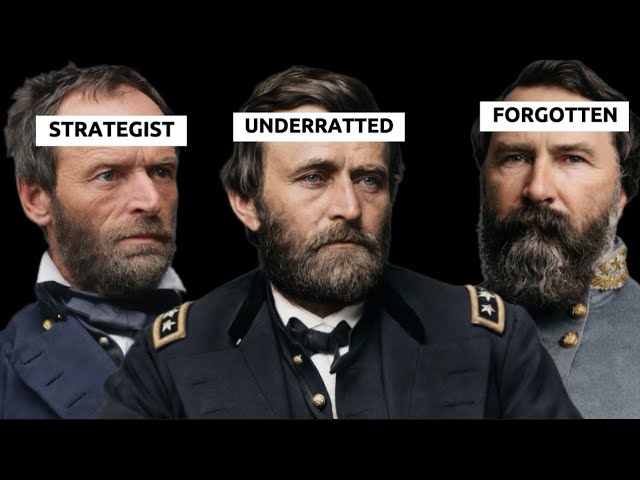
What separated the remembered from the forgotten was never simply rank or performance on the battlefield, for the generals who understand the war through their failures as much as their triumphs were not all victors. Many lost more than they won. Some presided over disasters so complete that the word catastrophe barely describes them. What they share is something different: each, in his own way, serves as a lens through which the war itself becomes legible—its logic, its failures, its rare flashes of brilliance, and the human cost when those things were absent.
The war ultimately ended because of Ulysses S. Grant. Not because he was the most skilled tactician in the field—he was not—but because he understood something about this particular conflict that most of his contemporaries took years to grasp. Grant realized that the Confederacy’s strategic problem was not geography but manpower, and that the only way to solve that problem was to stay in contact with the Confederate armies and keep fighting until the arithmetic of attrition ran out.
In April 1864, before the Overland Campaign began, he wrote to Sherman that his intention was to find Lee’s army wherever it was and fight it relentlessly. No pauses. No winter quarters. No falling back north to regroup.
The cost in human life was staggering, and the casualty lists from the spring of 1864 provoked a political crisis in the North that nearly ended the war on Confederate terms. Northern newspapers called Grant a butcher so often that the phrase became shorthand for what his critics believed he represented. What they missed was that his calculations were correct. The Confederacy could not replace its losses at the rate Grant was inflicting them, and he knew it.
He also knew no other approach would produce faster results. He was right on both counts, which made watching him from afar no easier but made him the right general for the moment the war had reached. Robert E. Lee, in the narrow sense of battlefield performance against a comparable opponent, was perhaps the most gifted operational commander the war produced.
His record between 1862 and 1863 defies ordinary military logic. At Second Bull Run, outnumbered and with his army dangerously divided, he shattered John Pope’s Army of Virginia so completely that Pope was relieved within days. At Chancellorsville, with sixty thousand men against Hooker’s one hundred thirty thousand, he divided an already outnumbered army and sent Jackson around Hooker’s flank in a maneuver that broke the Union line and drove a force twice his size off the field. The campaign is still studied as a model of what offensive maneuver can achieve with perfect timing.
The problem was that the framework those victories required—offensive action, bold maneuver, deep raids into enemy territory—was one the Confederacy could not sustain. Lee’s army bled itself through offensive operations at a rate the Southern manpower base could not replace indefinitely. Gettysburg, the culmination of his strategic approach rather than an exception to it, cost the Army of Northern Virginia more than twenty-eight thousand casualties in three days, about a third of the force that crossed into Pennsylvania. The army recovered enough to fight for nearly two more years, but it never regained the offensive power that had made it what it was at Chancellorsville.
Lee’s tactical brilliance and the Confederacy’s strategic survival requirements pulled in opposite directions, and the war was too long for that tension to resolve in his favor. Thomas Jackson, known as Stonewall after a stand at First Bull Run where a brigade commander compared his men to a stone wall, was the instrument that made Lee’s boldest operations possible. He was not a conventional tactical genius. His infantry attacks were sometimes uncoordinated, his orders maddeningly vague.
Instead he possessed something that cannot be taught and cannot be faked: the capacity to move infantry farther and faster than anyone believed possible, and to strike the enemy at a moment and from a direction for which he was unprepared. His 1862 Valley Campaign—seventeen thousand men, six battles, thirty-seven days, roughly three hundred fifty miles of marching—remains the standard by which mobile operations of that era are measured. He neutralized thirty thousand Union troops who should have reinforced McClellan’s advance on Richmond, not through superior numbers but through superior speed and the psychological effect of appearing where he was not expected. When his own men shot him in the darkness at Chancellorsville on the night of May 2, 1863, he died eight days later, and the Army of Northern Virginia lost something it could not replace.
Two months later at Gettysburg, Lee issued orders on the second day that Jackson would have executed routinely; Longstreet, Richard Ewell, and A. P. Hill executed them poorly, slowly, or not at all. After Chancellorsville, Lee’s operational options narrowed.
James Longstreet, in the judgment of many historians who have worked closely with primary sources, was the most effective corps commander in the conflict. His defensive instincts were nearly perfect. At Chickamauga in September 1863, serving in the western theater under Braxton Bragg, Longstreet found a gap in the Union line and exploited it with power and precision that collapsed the entire Federal army and sent the survivors fleeing to Chattanooga in chaos. It was one of the most complete Confederate tactical victories of the war.
His problem was that he understood something about the nature of the conflict Lee was not always willing to hear. Before Gettysburg, Longstreet argued that the Army of Northern Virginia should maneuver around Meade’s left flank, force the Union army to attack the Confederates in a strong defensive position, and let Federal infantry break against Southern fortifications rather than the reverse. Lee refused. Pickett’s-Pettigrew’s assault on the third day, which produced more than six thousand Confederate casualties in under an hour, was, by Longstreet’s later account, an order he executed in the full belief that it would fail.
He was right. After the war, Longstreet made the political error of joining the Republican Party and publicly suggesting Lee had erred at Gettysburg. The Confederate veterans’ community never forgave him, and his historical reputation was systematically dismantled by former comrades who had reasons beyond accuracy to destroy him. William Tecumseh Sherman understood what the war had become before anyone else in a position to act on that understanding.
He grasped that the Confederacy was not merely a set of armies to be defeated in the field. It was a society organized around and sustained by assumptions about resources, geography, and political will, and all three were vulnerable to pressures beyond military engagement. His March to the Sea in the fall of 1864—sixty thousand men cutting through Georgia from Atlanta to Savannah—was not primarily a military operation. It was a demonstration of power.
Sherman wanted to show Confederate citizens, and more specifically Confederate soldiers watching their homeland penetrated at the invader’s will, that their government was powerless to protect them. The psychological effect on Confederate morale and desertion rates was significant and well-documented. Sherman later said that war is cruelty and you cannot refine it. The professional military institutions of Europe studied his campaigns closely in the decades after the war.
The approach he pioneered—attacking the enemy’s capacity and will to continue war rather than merely his army in the field—became the dominant framework of strategic theory in the twentieth century. George McClellan is the necessary counterpoint to Grant, and the contrast explains nearly everything. McClellan was perhaps the most gifted organizational general on either side. He took the shattered, demoralized, poorly supplied Army of the Potomac after First Bull Run and turned it into an effective military force in about four months.
His men adored him. He understood logistics, training, and the administrative machinery of military organization better than almost any contemporary. Then, when it came time to use what he had built, he could not do it. The Peninsula Campaign is the case study historians return to most often.
McClellan moved nearly one hundred thousand men across the Virginia Peninsula toward Richmond, the largest and best-equipped army in the Western Hemisphere. Facing him at Yorktown was a Confederate force of about thirteen thousand under John Magruder, who used theatrical tricks—marching the same troops in circles to simulate greater numbers, lighting extra campfires at night—to convince McClellan the position was unassailable. McClellan besieged Yorktown for a month. The delay gave Johnston time to concentrate and Lee time to plan the Seven Days battles that drove McClellan away from Richmond entirely.
He was finally relieved of command for the second and last time after Antietam, where he failed to pursue Lee’s battered army across the Potomac at a moment when such a pursuit could have ended the war. George Meade commanded the Army of the Potomac at Gettysburg and for the rest of the war, meaning he led the Union’s largest army for nearly two years and spent most of that time operating under Grant after Grant came east in 1864. Meade took command three days before Gettysburg, replacing Hooker in a decision that gave him no time to prepare and placed him immediately in the war’s most important battle. His management of the fight was sound.
He positioned the army well, seized the high ground, and made the defensive decisions on July 2 and 3 that gave Union infantry the position they needed to break the Confederate assault. His failure to pursue Lee after Gettysburg frustrated Lincoln and led to a congressional investigation. Meade argued that his army was too damaged to pursue effectively and that a failed pursuit would have been worse than none. The argument was reasonable and supported by later analysis.
His reputation never fully recovered from Lincoln’s disappointment, and Grant’s arrival in 1864 reduced Meade’s role to something between corps commander and administrative officer, though he technically retained command of the army until the end of the war. Philip Sheridan was to the last year of the war what Jackson had been to its middle. A commander whose aggressiveness and speed made the operations he led exceed the sum of their tactical parts. In the Shenandoah Valley in the fall of 1864, Sheridan carried out a systematic destruction of the valley’s agricultural capacity, aiming to eliminate it as a Confederate supply source and as an avenue of operations threatening Washington.
The destruction was comprehensive and deliberate, and Sheridan articulated his intent in terms that made him a controversial figure then and after. He meant to leave the valley so devastated that a crow flying over it would have to carry its own provisions. At Cedar Creek in October 1864, Sheridan’s army was surprised and defeated in the early morning while he was returning from Washington. He rode twenty miles from Winchester to the battlefield, rallied the retreating men through the force of his presence, and converted the retreat into a counterattack that won the battle by evening.
The story became one of the war’s most famous, almost certainly embellished in the telling, but its core was real enough. George Thomas is the general most specialists place above anyone else on the Union side when assessing full records, and the one least known to the public that has not studied the subject closely. Thomas was a Virginian who remained loyal to the Union when his state seceded, a decision that cost him his family relationships and shadowed his reputation in some Union command circles for the rest of the war. His nickname, the Rock of Chickamauga, came from his performance on the second day of that battle, when the Union line collapsed around him and Thomas held his position on Horseshoe Ridge with a collection of units gathered from the shattered army, covering the retreat to Chattanooga and preventing the complete destruction of the Army of the Cumberland.
At Nashville in December 1864, Thomas waited two weeks before attacking John Bell Hood’s Army of Tennessee, ignoring Grant’s increasingly furious demands to move immediately. He waited because he wanted the ground suitable, the men ready, and the operation planned to his satisfaction. When he finally attacked, he achieved one of the most complete victories of the war—the only time a Confederate army was not merely defeated in battle but effectively destroyed as a fighting force. Hood’s Army of Tennessee ceased to exist as an active unit after Nashville.
Thomas was right to wait. Grant, who had been preparing to relieve him on the day the attack began, afterward acknowledged that Thomas had been right. Nathan Bedford Forrest presents the most uncomfortable historical judgment of any general in the war. His military record was exceptional.
He received no formal military training and rose from private to lieutenant general entirely on demonstrated effectiveness in battle. His tactical instincts, by the testimony of the opponents who faced him and the superiors who commanded him, approached genius. Sherman called him the most remarkable soldier the war produced. He had a formula for winning cavalry engagements that he expressed in simple terms: get there first with the most men.
The formula sounds simple because it is simple. Executing it consistently under combat conditions is not. Forrest was also personally responsible for the Fort Pillow massacre in April 1864, where Union soldiers, a large portion of them Black, were killed after attempting to surrender. The historical evidence that this was a massacre rather than legitimate military action is clear.
Forrest led the attack, and the killings occurred under his command. His military genius and his moral responsibility coexist in the same biography and cannot be separated. He is not a figure history can simply celebrate or condemn; he is a figure history is obligated to look at whole. Joseph Johnston commanded Confederate forces in the western theater for most of the middle and late war, and his strategy remains a subject of genuine historical debate.
Johnston believed the survival of the Confederate army was the strategic objective in itself, that as long as the Army of Tennessee existed as a fighting force the Confederacy remained viable, and that accepting battle under unfavorable conditions to hold ground was a mistake. He traded ground for time with a steadiness that exhausted Jefferson Davis’s patience, leading ultimately to his relief before Atlanta in July 1864 and replacement by John Bell Hood. Hood attacked Grant’s forces immediately and repeatedly suffered heavy losses, and Atlanta fell anyway. Johnston’s defenders argue, with some historical support, that his removal was one of the worst decisions Davis made during the war.
Braxton Bragg commanded the Army of Tennessee before Johnston, and his record is the most difficult to interpret positively. He won Chickamauga, though the credit belongs largely to Longstreet’s corps, and squandered the victory by failing to pursue the defeated Union army. He lost Chattanooga to Grant in November 1863 despite holding the high ground, which should have been a military advantage but was not due to Bragg’s poor organization of the defense. He was widely hated by his subordinates, who openly quarreled with him and petitioned for his removal.
Davis kept him in command long after the decision was defensible, partly because Bragg was personally loyal to Davis in ways more capable commanders were not. J. E. B.
Stuart was the war’s most famous cavalry commander, and perhaps the most important moment of his career was the one when he was not where Lee needed him. In the days before Gettysburg, Stuart took his cavalry on a ride around the Union army covering two hundred fifty miles, capturing a supply train and receiving considerable press attention. The ride also left Lee blind in Pennsylvania. Stuart’s role was to protect the infantry, gather intelligence on Union movements, and deliver that information to army headquarters.
For eight days before the war’s largest battle, Lee received almost no information about where the Army of the Potomac was or what it was doing. Whether Stuart’s absence directly caused the Confederate defeat at Gettysburg is a debate historians have waged since 1863 and have never settled conclusively. What is clear is that it mattered. Winfield Scott Hancock commanded the Second Corps of the Army of the Potomac with a steadiness and aggressiveness that made him unquestionably the best corps commander the Union produced.
He was in the right place at the right time at Gettysburg on July 1, riding to the battlefield ahead of his corps and organizing the defense of Cemetery Hill when Union positions were on the verge of collapse. He did it through the force of personality and the fact that men under pressure respond to someone who appears utterly unafraid. The wounds he suffered at Gettysburg plagued him through every subsequent campaign. Patrick Cleburne, who commanded a Confederate division in the western theater, was considered by many who witnessed his work the best division commander the war produced on either side.
An Irish immigrant who served in the British army before emigrating, his tactical handling of troops and defensive positions was exceptional. In January 1864 he proposed that the Confederacy arm and free its enslaved population in exchange for military service, arguing that the manpower problem was already fatal and the only solution was to change the social basis of the Confederate war effort. The proposal was suppressed by Davis and provoked fury within the Confederate officer corps. Cleburne was killed at Franklin in November 1864, one of six Confederate generals killed in a single day during Hood’s assault on Union positions at Carter House.
What these men share when placed together and viewed across the full range of what they did is that each was responding to the same problem from radically different angles: what it meant to fight an industrial war with armies raised from civilians across geography never surveyed for military purposes, with supply systems never designed for what was demanded of them. Those who solved that problem, or part of it, won. Those who could not lost, sometimes catastrophically. The difference was not always courage or intelligence.
More often it was something more specific: whether a given commander understood what kind of war he was actually fighting. Grant understood it. Sherman understood it. Lee understood parts of it, and the parts he did not understand defeated him.
Jackson understood the element of speed perfectly and died before the rest became clear. McClellan understood the organizational element and never absorbed anything else. Forrest understood combat on an instinctive level in ways formal military education never produced and perhaps never can. The Civil War is, among other things, the story of what happens when a society that has never fought a war of this scale—huge armies, industrial logistics, political endurance—is forced to produce military leadership rapidly enough to carry it through.
Most of what those five hundred Union generals and four hundred Confederate generals learned, they learned in the field from the results of decisions made under pressure with incomplete information. Those whom history remembers are those whose learning was most visible and most consequential, and in almost every case the most expensive to obtain. They paid the price, and so did every man under their command.