On December 9, 1864, the Union army reached a black-water creek in southeastern Georgia called Ebenezer Creek. Behind the army came hundreds of Black people who had fled slavery and followed the columns for days. They were not soldiers. They had no wagons of their own, no reserve of food, and no alternate road to freedom.
Ahead of them lay a pontoon bridge. Union troops crossed, wagons crossed, animals crossed. Then the bridge was removed. Those still on the far bank tried to cross the creek anyway.
Some made it. Many drowned. Others were captured by Confederate cavalry and returned to the system they had been fleeing. The exact death toll remains disputed, but what happened next is not: the column had to keep moving, and the army was not prepared to carry everyone who joined it.
Twelve days later, the Union army entered Savannah itself. On December 22, William Tecumseh Sherman sent Abraham Lincoln a Christmas gift: the captured city, 150 heavy guns, ammunition, and 25,000 bales of cotton. The telegram did not mention the people at Ebenezer Creek, the emptied farms along the route, the seized animals, the burned mills, or the railroad tracks bent into what the soldiers called Sherman’s neckties. Understanding how both stories belong to the same campaign requires tracing the supply line, not the railroad behind the army, but the line that ran through Georgia’s farms, smokehouses, corn cribs, workshops, and homes.
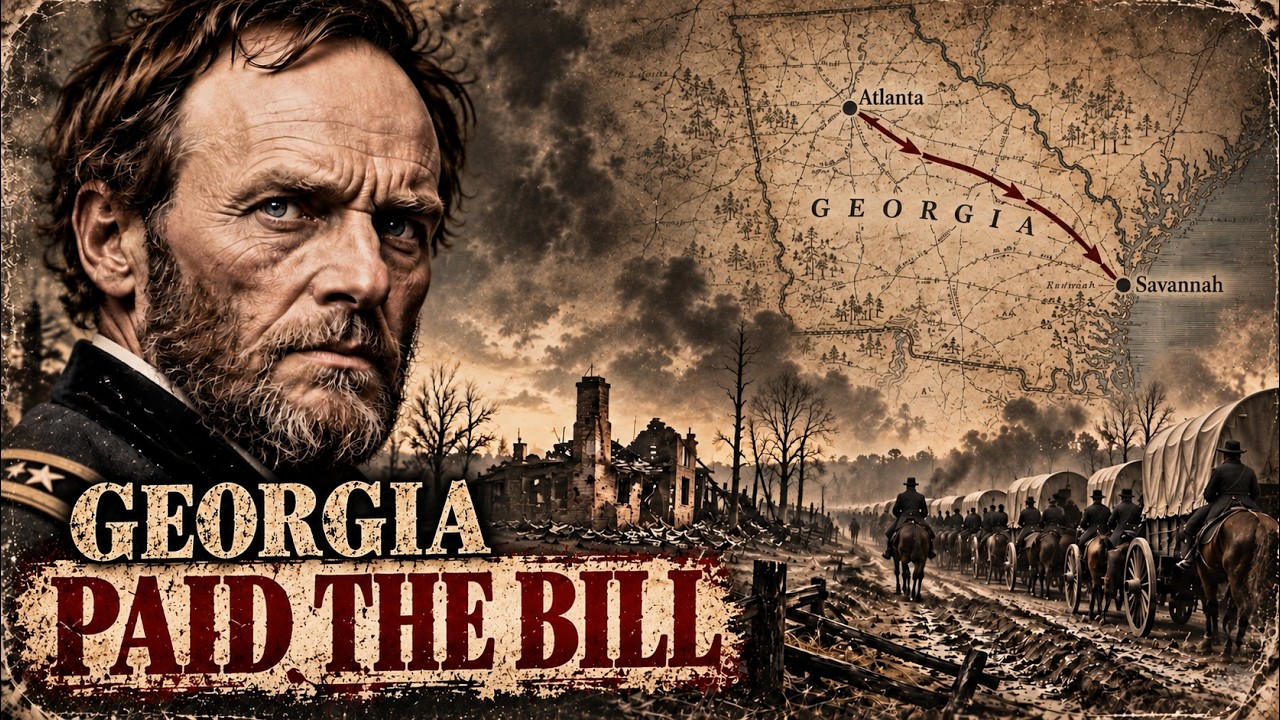
Twenty-four days before Ebenezer Creek, Sherman made a decision that looked like military madness. He took roughly 62,000 men, destroyed the railroad behind them, cut the telegraph lines, and marched into Confederate territory with no secure road back north. The army would not be supplied from the rear. It would feed itself as it moved.
That was the gamble, and this is how it ran. On September 2, 1864, Union forces occupied Atlanta. It was a decisive Northern victory. Atlanta was a major railroad hub, an industrial center, and one of the Confederacy’s most important military cities.
Its fall helped Abraham Lincoln win a second term and gave the Union a forward base deep in the South. But a city is not useful merely because an army holds it. The army still needed food. Sherman’s forces had depended on a single railroad line running north through Chattanooga and Nashville.
That one line carried rations, ammunition, clothing, medical supplies, horseshoes, replacement animals, and everything else a large army required. It was the campaign’s lifeline, and it was exposed for hundreds of miles. Confederate cavalry did not need to defeat Sherman in a major battle. They could burn a bridge, tear up track, cut a telegraph pole, or destroy a water station.
Every interruption forced Union engineers to stop and repair the line while the army waited. The railroad had become a second army that Sherman had to defend every day. Then John Bell Hood moved. His Confederate Army of Tennessee had been beaten outside Atlanta, but it had not surrendered.
Hood marched north and began attacking the railroad. His plan was to pull Sherman away from Atlanta. If Sherman chased him, the Union army would give up the city. If Sherman stayed, Hood could threaten the line behind him and perhaps trap Union forces in Georgia.
Sherman pursued Hood for a time. He fought to keep the railroad open and sent troops after Hood’s raiders, but the chase exposed the real problem. Sherman could spend the winter guarding the railroad and responding to Confederate moves, or he could stop treating the railroad as a permanent lifeline. He chose the second option.
George H. Thomas would remain in Tennessee with the forces needed to deal with Hood. Sherman would lead the main mobile army east toward Savannah. The plan was not to take Savannah because the city alone would end the war.
The plan was to make the Confederacy feel the war at home. Sherman wanted to weaken the resources that fed Confederate armies and prove that the government could not protect the state that fed them. He was not planning to march through a barren wilderness. He was planning to march through a functioning food system.
That distinction would decide everything. Sherman’s army numbered 62,204 officers and men of infantry, cavalry, and artillery. The army had to cover roughly 285 miles in about 37 days. At first glance the problem looked simple: 62,000 soldiers needed food for 37 days, about 2.
3 million man-days. Sherman did not carry 2. 3 million full rations. He carried about 1.
2 million, roughly enough for twenty days. The rest had to come from the countryside, from cattle driven with the army and food collected by foraging parties. That was already a tight calculation, but soldiers were not the biggest consumers. The army moved with about 2,500 wagons, most pulled by six mules each.
That meant roughly 15,000 mules for the wagons alone, before counting cavalry horses, artillery teams, ambulance horses, spare animals, and the cattle driven for meat. A soldier consumed a ration. A mule consumed the army’s ability to move the next day. If the mules weakened, the wagons stopped.
If the wagons stopped, ammunition and food stayed behind. If artillery horses failed, the army lost its heavy guns. If cavalry horses failed, the army lost its eyes. Sherman had enough oats and corn for only about five days of forage.
After that, the animals would have to eat what Georgia had stored. For this reason, the phrase living off the land is misleading. The army was not going to survive on berries and whatever soldiers found in the woods. It needed organized access to corn, forage, meat, cattle, mills, roads, bridges, and labor.
The army was not abandoning logistics. It was moving logistics into enemy territory. It remained a massive force with wagons, hospitals, artillery, engineers, ammunition, pontoon bridges, and a chain of command. It was simply carrying a reserve instead of the entire journey’s burden.
If the reserve ran out before the columns reached the coast, the operation collapsed. If the animals died, the army might still have food but no way to move it. If the column slowed, Confederate cavalry would have time to concentrate. So before Sherman asked whether Georgia could feed 62,000 soldiers, he had to ask a harder question: could Georgia feed the force that carried them?
Sherman’s answer was not a miracle. It was a high-risk wager. On November 8, Sherman told the army it was about to leave its current base on a long, arduous march to a new base, without revealing the destination. The next day, at Kingston, Georgia, he issued Special Field Orders No.
120. The order divided the army into two wings. Oliver O. Howard commanded the right wing, composed of the Fifteenth and Seventeenth Corps.
Henry Slocum commanded the left wing, composed of the Fourteenth and Twentieth Corps. Judson Kilpatrick’s cavalry received separate orders and screened the army’s movements. The army was to march, whenever possible, on four roughly parallel roads. This formation was not for show.
One road could not sustain a city of 62,000 people and thousands of animals. Four roads spread the army across a wider area, allowed it to collect food from multiple farms, and kept the Confederacy from knowing which road carried the real objective. The price was dispersal. Columns could be separated by miles of forest, rivers, mud, and rough roads.
Each commander had to move his own wagons, protect his own bridges, and keep pace with the other columns without seeing the entire army. The orders directed brigades to step off at seven in the morning and cover about fifteen miles a day unless ordered otherwise. There would be no single general supply train. Each corps carried its own ammunition and provisions in its own wagons.
The foraging orders set the campaign’s method: the army would forage liberally on the country during the march. That phrase sounds loose, but the order was more organized than that. Each brigade was to organize a foraging party under responsible officers to collect corn, meat, vegetables, flour, and anything the command needed. Wagons were to carry at least ten days of provisions and three days of forage.
Soldiers were forbidden from entering private homes or molesting private property. The destruction of mills, houses, cotton gins, and similar property was assigned to corps commanders. If the army was not harmed, destruction was not automatic. Where guerillas attacked, bridges burned, roads were blocked, or local resistance appeared, commanders could intensify destruction.
In theory, there was a line between supply and destruction. On a farm occupied by armed soldiers, that line was not easy to see. A corn crib might be Confederate stock, a family’s winter food, or both. A mule might have been used by the Confederate army and still be the only animal that could plow the field in spring.
A mill might supply soldiers and civilians at the same time. The campaign would turn those blurred categories into daily decisions, and those decisions would be made by thousands of men, often far from the officers who wrote the rules. The first of these men were preparing to move before dawn. They were called bummers.
A foraging party usually left before daylight. A brigade might send about fifty men with one or two officers several miles off the road. They searched farms, plantations, barns, smokehouses, mills, and fields. They returned before the main train arrived, carrying whatever could keep the brigade moving: corn, bacon, sweet potatoes, molasses, chickens, horses, mules, and cattle.
The provisions were supposed to go into the brigade storehouse, not into the pockets of whoever found them. That was the official system. The unofficial system was more complicated. The word bummer could mean an authorized forager, a straggler, or a soldier who realized that moving an army through hostile country offered opportunities no quartermaster could fully control.
The best bummers were scouts, thieves, and supply officers at once. They knew where a family hid its corn. They found bacon in smokehouses and cattle driven into the woods. They borrowed or seized a wagon, loaded it, and returned to the column before the road closed for the next day’s march.
A distant farm was both a supply depot and a potential ambush. A hidden storehouse might be army food or a family’s last winter supply. The army needed food and still committed robbery. Those two facts do not contradict each other.
They are one truth seen from two directions. Sherman later admitted that jewelry and other property disappeared, that some soldiers kept what never reached the storehouse, and that looting occurred. He also insisted the army could not carry enough food and forage for a 300-mile march and that some kind of foraging was necessary. That distinction mattered to commanders.
It did not matter to the farmer whose storehouse was emptied. The army was not the only population moving through Georgia. On November 15, the army began leaving Atlanta. The right wing and Kilpatrick’s cavalry moved southeast toward Jonesboro and McDonough.
The left wing moved east through Decatur toward Stone Mountain and Madison. The paths deliberately diverged. Sherman wanted Confederate observers to guess whether the army was heading for Macon, Augusta, Milledgeville, or Savannah. If the Confederates could not determine the destination, they could not concentrate forces in front of it.
The first objective was Milledgeville, Georgia’s capital, about a hundred miles from Atlanta. The army would spread out, collect what it needed, destroy some infrastructure, then regroup. This was the rhythm of the march: disperse, forage, seize, destroy, and reform. The left wing crossed the Oconee River and moved toward Milledgeville.
The right wing crossed the Ocmulgee and advanced through the country to the south. Kilpatrick’s cavalry protected the flanks and tried to keep Confederate cavalry from seeing the army’s true direction. The roads were rough, bridges had to be repaired, and rivers required pontoon bridges or improvised crossings. A delay in one column could force another to wait, because the army’s movement depended on thousands of wagons reaching the next camp in order.
The land served two functions at once: it fed the army, and it slowed the army down. The first serious engagement came at Griswoldville on November 22. A Confederate force, mostly Georgia militia, attacked a Union brigade near the road and railroad. Many of the Georgians had limited combat experience.
The Union soldiers were veterans, some carrying Spencer repeating rifles capable of far faster fire than the common single-shot muskets. The militia advanced under concentrated fire and was repulsed with heavy losses. Griswoldville was not a battle between Sherman’s main army and Hood’s Army of Tennessee; Hood was in Tennessee. It was a warning that local resistance could hurt supply trains but would not stop them by itself.
The next day, Union troops entered Milledgeville. The governor, state officials, and legislature had fled. The state capital was occupied without a major battle. Union soldiers staged a mock legislative session in the capitol building, turning the symbolic center of Georgia into a military theater.
Sherman was not merely passing through farmland. He was demonstrating that the Confederate government had lost control of its capital and that the army was now further from Atlanta, further from its old supply line, and closer to the rivers that could stop it. Whenever Union columns entered a plantation district, enslaved people had to decide: stay and risk the old order returning after the army passed, hide and wait for the army to move on, or follow the soldiers toward freedom. Some were young and healthy.
Some were elderly. Some carried children. Some had spent their entire lives on the same farm and had no food except what they could carry. The Union army on the road was not just a military formation.
It was a possible exit from slavery. But for the army, everyone who joined the column became a supply problem. The wagons were designed for soldiers, not for a growing civilian population. A family walking behind a regiment still needed food, water, shelter, and protection.
A child could not keep pace with a wagon train. An elderly person could not cross a river once engineers began dismantling a bridge. Sherman’s orders reflected that struggle. An earlier order warned against encouraging refugees to impede the march.
A later order allowed commanders to enlist able-bodied Black men into the ranks and directed them to organize Black pioneers where possible. That policy was purely practical. It favored those the army could use and provided far less protection for those the army could not support. But the people who followed the army did not know where that line would be drawn.
They followed anyway. Thousands joined the columns at various points. Some turned back or fell away from the army. Others stayed near the wagons and the rearguard, hoping Union soldiers would carry them out of Confederate territory.
The closer the columns came to Savannah, the more dangerous that hope became. Confederate cavalry under Joseph Wheeler attacked the rear, the roads narrowed, streams and swamps slowed the wagons, and the army approached the Savannah River and the waterways around the city. The refugees found themselves caught between two moving forces. The Union army wanted to keep advancing.
The Confederate cavalry wanted to catch those who could not keep up. On December 9, the Fourteenth Corps reached Ebenezer Creek, a black-water tributary north of Savannah. The creek was not an ocean and not an impossible obstacle, but it was wide and dangerous enough to stop an army moving wagons, artillery, animals, and thousands of people. Confederate cavalry under Joseph Wheeler was close enough to threaten and shell the rear of the Union position.
Engineers began building a pontoon bridge. Union troops crossed, wagons crossed, animals crossed, and the people following the army gathered at the water. They had spent days behind the columns believing that reaching the Union army meant reaching freedom. Now the only way forward was a military bridge controlled by officers trying to keep the column moving.
The bridge was removed before everyone crossed. The exact sequence of orders and the exact number of people at the creek remain debated. The result was clear. Hundreds of formerly enslaved people were left on the wrong bank.
Many tried to cross the creek. Some succeeded. Others drowned. Others were captured by Confederate forces, returned to slavery, or disappeared in the chaos.
The incident is often called the Ebenezer Creek massacre. Whatever the name, the human reality is unambiguous. The people who followed the army toward freedom were left exposed because the army decided it could not carry them with the column. From the Union command’s perspective, removing the bridge protected the crossing from Confederate cavalry and kept the column moving.
From the perspective of the people left behind, the bridge was the difference between freedom and capture, between life and death. Before Ebenezer Creek, logistics were measured in quantities: 62,000 soldiers, 15,000 wagon mules, twenty days of rations, ten days in the wagons, three days of forage. At Ebenezer Creek, the most important number was the number of people the army decided it could not carry. The Union army was dismantling the infrastructure of slavery while refusing, in that moment, to carry everyone slavery had produced.
The contradiction was not outside the operation. It was part of it. Sherman had not yet reached the sea. While part of the army collected resources, another part destroyed them.
Engineers focused on the railroad. The railroad was not just two iron rails. It was bridges, stations, water tanks, telegraph poles, locomotives, repair shops, workers, and timetables connecting farms to armies. Breaking one rail could delay a train.
Destroying a bridge, burning a station, wrecking a machine shop, or cutting a telegraph line could make the entire system useless. Soldiers pulled up rails, built fires from wooden ties, heated the iron until soft, then carried the rails to a tree and bent them around the trunk. When the iron cooled, it was a twisted ribbon. Soldiers called the result Sherman’s neckties.
The nickname sounds playful. The method was industrial. A straight rail could be re-laid. A rail wrapped around a tree required a forge, skilled workers, time, and a safe workshop.
If the workshop and bridge disappeared together, repair became a long-term problem instead of a morning’s work. The army cut telegraph wires, burned cotton gins and mills, destroyed bridges, and seized animals. Cotton bales were burned because cotton was traded for credit, weapons, clothing, and supplies. By removing the crop, the gin, and the transport network, the economic system behind the Confederate army lost its ability to function.
But no army could destroy only the part of society that served the enemy. A mill that supplied soldiers also ground wheat for civilians. A wagon used to haul Confederate freight might be the only wagon a family owned. A mule taken from a military contractor might be the animal needed to plow next year’s field.
A bridge that carried military traffic might be the only crossing in the county. The target was civilian and military at the same time. That is why the campaign was so destructive. The army was not just fighting soldiers.
It was attacking the connections that allowed the state to produce, move, and replace military power. Farms became depots. Railroads became targets. Georgia was being consumed and dismantled at the same time.
Sherman’s greatest protection was not a fort or a river. It was the absence of the Confederate Army of Tennessee. Hood had moved north into Tennessee hoping to draw Sherman out of Georgia. Instead, Sherman left George Thomas to deal with him and led the main Union force east.
Hood could not be in two places at once. On November 30, he attacked at Franklin and suffered heavy losses. On December 15 and 16, Thomas destroyed Hood’s army at Nashville. While Hood was being beaten in Tennessee, Sherman was advancing through central Georgia.
That did not make the march safe. Wheeler’s cavalry attacked the rear, captured stragglers, and gathered intelligence. Georgia militia fought at Griswoldville and elsewhere. Local resistance could delay a bridge, burn a storehouse, or direct cavalry toward a weak wagon train.
But the Confederacy no longer had a large field army capable of standing in front of Sherman and forcing a major battle on ground of its choosing. The march became a struggle between an army and a state. The Confederacy could defend points, but it could not defend everything. Every time Sherman threatened two roads, Confederate commanders had to guess.
Every time they concentrated on one column, another could go around them. The four-road formation spread the Union army’s risk and multiplied the defenders’ options. It was a supply system and a deception system at once. By the first week of December, the columns were approaching the coastal plain.
The reserve had not run out. The wagons were still moving. The animals were still alive. The gamble had passed its most dangerous test, but the army still lacked reliable contact with the outside world.
Savannah was ahead. The Atlantic Ocean was close enough to see on a map, but still practically out of reach. Between Sherman and the fleet stood Fort McAllister. On December 10, Union troops reached Savannah’s outer defenses.
The city was not undefended. It had forts, batteries, swamps, rivers, and a Confederate garrison under William Hardee. But Sherman still could not use the sea. Union ships waited offshore loaded with food, ammunition, clothing, and mail.
The army had gone five weeks without reliable news from the North. The only thing preventing the army from using the Ogeechee River to reach the fleet was Fort McAllister, an earthwork guarding the river. Sherman did not send a telegram. He sent men across the river.
A small Union boat reached the fleet and established contact, but the river was still closed by the fort. Until Fort McAllister fell, the army could see its new supply line without being able to use it. On December 13, a division under William B. Hazen of the Fifteenth Corps attacked.
The garrison was small, but the fort was a serious obstacle. Its earthworks, trenches, abatis, and cannon made a direct assault risky. Hazen’s troops crossed the obstacles and reached the parapet. The attack was short and violent.
Fort McAllister fell, and its defenders were captured or killed. The fort was not the campaign’s largest battle. It was its hinge. Once it fell, Union ships could move up the Ogeechee.
Sherman could receive supplies, send reports, and reconnect the army to the broader Union war machine. The march had not succeeded in doing without logistics. It had succeeded in replacing one supply line with another. For five weeks, Georgia had been the supply line.
Now the Atlantic could be. With Fort McAllister in Union hands, Savannah’s defenses began to look like a box with its lid closing. Sherman had arrived by land, and the Union navy controlled the water approaches. No large Confederate relief army was nearby.
Sherman demanded the city’s surrender on December 17. Hardee refused, but he did not have to wait for a direct assault. The river routes were closing, and the Confederate positions could not be supplied indefinitely. During the night of December 20, Hardee evacuated the city across the Savannah River into South Carolina.
On December 21, Union troops entered the city. There was no dramatic storming of Savannah. The city fell because the march had made its defense strategically pointless. Sherman had not destroyed all the defenders.
He had forced them to leave. The army had covered roughly 285 miles in 37 days. The railroad behind it was broken. Georgia’s government had fled.
The Union navy was its new base. On December 22, Sherman sent his famous telegram to Lincoln: I beg to present you, as a Christmas gift, the city of Savannah, with 150 heavy guns and plenty of ammunition, also about 25,000 bales of cotton. That telegram was a perfect receipt for the final delivery. But it was not the complete transaction.
Sherman’s army reported capturing roughly 5,000 horses, 4,000 mules, 13,000 head of cattle, 9. 5 million pounds of corn, and 10. 5 million pounds of fodder, and capturing or destroying 300 miles of railroad. Sherman himself estimated the damage done to Georgia at one hundred million dollars in 1864 value.
That was his personal estimate, not the result of an independent audit. In his accounting, Sherman considered about eighty million dollars to be pure waste and destruction rather than supplies consumed by the Union army. Union military losses were usually recorded as 103 killed, 428 wounded, and 278 missing, roughly 809 casualties. That figure is remarkable for an army of 62,000 crossing a state in five weeks.
It is also incomplete as a measure of the campaign. It counts only Union losses. It does not include emptied smokehouses, seized animals, destroyed mills, burned cotton, displaced families, or the people who drowned or were captured at Ebenezer Creek. Sherman had designed the campaign to avoid fighting the Confederate field army.
He replaced a series of large battles with pressure on the enemy’s economy and confidence. In that narrow military sense, the plan was effective. But an operation can be effective for an army and catastrophic for the society it passes through. The absence of a large battlefield does not mean the absence of violence.
It means the violence is distributed across farms, towns, workshops, railroads, and homes instead of concentrated in one place. A battle has a front. An army living off the land has a geographic scope. The march to the sea did not win the war by itself.
It did not capture Richmond or destroy Robert E. Lee’s army. The Confederacy did not surrender the morning Savannah fell. Its effect was cumulative.
The march damaged Georgia’s ability to supply Confederate forces, captured a major port, reconnected Sherman’s army to the Union navy, freed tens of thousands of Union soldiers for the next campaign, and demonstrated that the Confederate government could demand sacrifices while failing to protect the society that financed it. Then Sherman turned north. In early 1865, the same army moved through South Carolina and North Carolina. The terrain was worse, the rivers harder, and the political implications more dangerous.
The campaign that began with cutting a single railroad line was now threatening the heart of the Confederacy. It would be wrong to claim that Sherman starved Lee simply by taking Georgia. Lee’s crisis around Petersburg had many causes: the blockade, the loss of railroads and ports, industrial destruction, and Union pressure around Richmond. But Sherman helped create the conditions in which those failures could no longer be repaired.
The South could still fight battles. It could no longer protect the system behind those battles. How did 62,000 men survive after cutting their railroad? They did not survive on nothing.
They carried a reserve. They lightened the army. They spread across several roads. They organized foraging parties.
They protected the animals that pulled the wagons. They relied on Thomas to handle Hood. They destroyed the railroads that could have brought a Confederate army against them. And they took Fort McAllister before the gamble became a catastrophe.
Farms became depots. Foragers became the trains. Corn cribs became temporary storehouses. Cattle became transport or meat or both.
Then the Atlantic became the next base. That is what made the operation successful. But there is another equation. The army’s freedom of movement was purchased by shifting part of its logistical burden onto the civilian population.
Soldiers ate the food Georgia had stored. They took the animals Georgia needed to work the land. They burned the infrastructure Georgia needed to process and move its crops. They carried some enslaved people toward freedom and left others behind when the army decided it could not support them.
The march succeeded because the Union army reached the sea. It was a catastrophe because Georgia’s ability to recover was a deliberate target. Both facts are worth recording.