In 1973, Dale Marsden, a county surveyor, walked into a hollow behind Seneca Rocks, West Virginia, carrying a transit level and a leather notebook. He had been contracted to map drainage paths for a proposed logging road and had spent months walking terrain so remote that the nearest paved road was eleven miles behind him. He never finished the survey. What he brought back instead was a notebook filled with observations so disturbing that the West Virginia Division of Highways quietly buried the project, reassigned the road corridor, and transferred Marsden to a desk position in Charleston, where he spent the next fourteen years pushing paper until he retired.
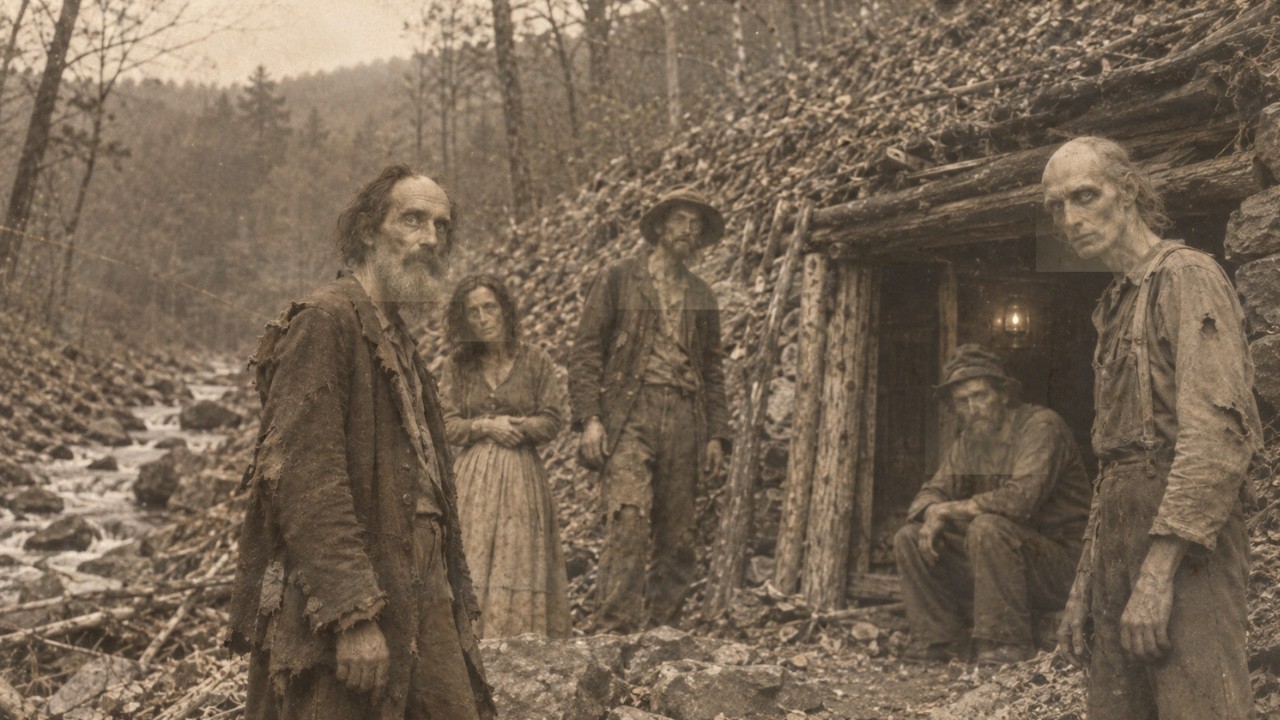
The notebook did not surface publicly until 2004, when a researcher named Patricia Hulcom found it cataloged in a forgotten records box at the state archives. The entries described a progression of encounters over nine days in a hollow so deep that sunlight only reached the floor for about two hours each afternoon. Marsden wrote about sounds at first, then tracks, then something he could only describe as figures that moved across the slope above his camp in a way that no animal and no human being could replicate. He called them crawlers.
That word, crawler, did not originate with internet forums or paranormal television shows. It originated with people like Marsden: surveyors, hunters, timber cruisers. People who spent weeks alone in terrain so isolated that the hollows themselves had no official names on any map. These were practical outdoor professionals who had no reason to fabricate stories that would jeopardize their reputations and livelihoods.
And yet across more than a century of records, journals, and local oral histories from the central and southern Appalachian range, the same description appears again and again. Pale, elongated, moving on all fours in a way no known quadruped moves. Silent in a way that is wrong, for the forest itself goes quiet around them. And always in the hollows, the places where the mountains fold inward and the canopy closes overhead.
The Appalachian Mountains themselves are ancient beyond comprehension, roughly 480 million years old. When they were young, they were taller than the Himalayas are today. Hundreds of millions of years of erosion have ground them down, but erosion did something else that matters far more for this story. The limestone beds that form the foundation of the range have been dissolving ever since the mountains rose.
That gives groundwater somewhere between 300 and 400 million years to eat through the stone, creating voids, chambers, and entire subterranean river systems beneath the surface landscape. These spaces have their own ecology. They are dark, enclosed, and stable. And the hollows above them are different from open valleys.
A hollow is a crease in the mountain, deeper than it is wide, shadowed for most of the day, often choked with old growth vegetation. Sound behaves differently there, as does light. The deep hollows exist in a state of perpetual twilight, and the indigenous peoples who inhabited the region learned long ago to stay away from them. The Cherokee maintained a classification system for landscape features that went beyond the topographic.
Certain places were categorized by their ecological status, and the deep hollows occupied a specific category that is often translated as places where the old ones remain. Some researchers interpret this as a reference to ancestral spirits, but an alternative reading is more literal. The old ones are not spirits of the dead. They are beings that were already present when the Cherokee arrived, beings that predated human habitation.
The Shawnee expressed a similar concept, describing the hollows as places where the ground listens. The Cherokee prohibition against entering these hollows was specific, naming places and describing the consequences of violation. The consequences described were not spiritual punishment. They were physical.
People did not come back, or they came back changed, damaged, unable or unwilling to describe what they had experienced. European settlers pushing into the Appalachian interior in the 1700s did not initially understand these warnings. The hollows were sheltered and attractive for homesteading. But certain hollows developed reputations that persisted across generations.
Livestock refused to graze past a certain point. Dogs would not follow a trail into the deeper reaches. And every few years, someone who went into one of these hollows did not come back. Not lost in the sense of taking a wrong turn.
Gone in the sense that a thorough search turned up nothing. Not a boot, not a scrap of clothing, not a bone. The earliest written reference to the phenomenon comes from a 1768 journal entry by a Presbyterian minister named Josiah Harlon. Traveling through southwestern Virginia, he spent a night in a hollow along the Clinch River drainage.
He heard what he described as a dragging sound on the slope above his fire, something heavy pulling itself along the ground with a rhythm too regular to be natural. In the darkness, he saw a shape moving laterally across the slope. He described it as pale, long in the body, moving with its belly close to the earth but elevated on limbs that bent at angles he called unnatural. He left the hollow before dawn and concluded his journal entry with the sentence, I have seen that which I do not believe, and I shall not speak of it beyond this page.
Similar accounts accumulated in the margins of Appalachian life for the next century, in family journals, in letters, in the quiet oral traditions of families who lived closest to the hollows. In 1784, a Methodist circuit rider named Elijah Cranle was forced to shelter overnight in a hollow in the Kanawha Valley region after his horse threw a shoe. Around midnight, his horse began pulling against its tether, not spooked and loud, but trying to be quiet, its ears flat against its skull. Cranle saw a white shape low to the earth moving across the slope with a smoothness that reminded him of a snake, except that it had four limbs splayed outward, each one finding its own path while the body glided between them.
In the morning he found marks in the leaf litter, a path roughly three feet wide brushed aside, with long marks pressed into the underlying clay. This culture of silence means the documentary record that survives is almost certainly a fraction of the actual encounters. The people who saw these things overwhelmingly chose to say nothing. But the accounts we do have come from individuals unusually literate, unusually brave, or so disturbed that they could not keep silent.
In 1891, a timber cruiser named Thomas Beckley was working in Mingo County, West Virginia, surveying old growth timber for the Norfolk and Western Railway. Timber cruisers walked the most remote terrain alone for weeks at a time. On his second night in an unusually deep hollow, Beckley heard rhythmic breathing that seemed to come from somewhere above him on the hollow wall, wet and amplified in a way that suggested a chest cavity much larger than a human being would possess. On the third night, he saw three pale figures descend the west wall of the hollow.
He watched them for approximately fifteen minutes as they moved along the far wall. He wrote that it turned its head in his direction. He could not see features, but he knew with a certainty he described as physical rather than intellectual that it was aware of him. He did not sleep until dawn, then gathered his equipment and walked eleven miles back to camp.
His field notes ended with a recommendation that the hollow be excluded from the timber survey, citing unstable terrain as the reason. The real reason was in the margins, written in pencil: they are real. In 1912, a surveyor named Franklin Bogs led a crew mapping a section of McDowell County, West Virginia. Over ten days, his crew experienced a series of encounters that Bogs documented with the precision of a trained surveyor.
They heard rhythmic clicking from the hollow wall. They observed two pale figures moving horizontally across the slope at a height of roughly sixty feet, moving with complete silence as the forest around them went entirely still. And on the morning of October 11th, they found tracks pressed into soft mud along a seep. Each print showed four elongated digits, between six and eight inches long, curved slightly inward, with no palm or heel impression.
Bogs measured the stride length at approximately four feet and noted an asymmetry that did not match any known quadruped. The crew abandoned the station the next day. His final entry read, We have encountered something in this drainage that I cannot classify. I have 30 years of field experience, and I have seen every animal this range produces.
This is not any of them. In 1997, a geologist at Virginia Tech named Dr. Margaret Callaway noticed something in her data on Appalachian karst formations. The deep, narrow, steep-walled hollows that correspond to the type described in crawler accounts were disproportionately likely to sit above significant subsurface cavities.
Of the 47 locations showing significant subsurface voids, 31 were within three miles of a documented crawler encounter. Seven were exact matches. One hypothesis emerged, carefully hedged, that the crawlers might be a troglobitic species, an organism adapted to living exclusively in subterranean environments. Cave fish, cave salamanders, and cave spiders all exist, adapted to permanent darkness with depigmented skin and modified limbs.
Every one of those adaptations is consistent with the physical descriptions of crawlers. A researcher in 2008, exploring an unmapped extension of a cave system in Pendleton County, West Virginia, broke through a calcite flowstone barrier at a depth of approximately 240 feet and entered a chamber whose floor was covered in bones. Hundreds, possibly thousands, of disarticulated bones from deer, raccoons, and other medium-sized mammals. Some still had dried tissue attached.
Whatever had brought them into this chamber had done so recently. The explorers also found smooth polished areas on the limestone walls at the height a large body would make passing through. On a second visit two years later, they found additional bones that had not been there before. The accumulation was still growing.
The Appalachian range has the highest rate of missing person cases per square mile of any mountain range in the United States. Most disappearances have conventional explanations. But a subset of cases show a consistent pattern. Experienced outdoors people vanish in good weather.
Search teams find nothing. Search dogs lose the scent at the edge of deep hollows, sometimes refusing to enter at all. In one case from 2003, a retired forestry worker vanished while walking a trail he had walked every week for nineteen years near Spruce Knob, West Virginia. His walking stick was found leaning against a tree, his jacket folded neatly over a branch, as if he had set down his things before stepping off the trail to investigate something.
The search lasted eleven days. The dogs tracked his scent to a rock outcrop at the edge of a hollow, where it ended completely. His body was never found. The evidence, taken collectively, defies easy dismissal.
The tracks are consistent across decades. The descriptions match across witnesses who had no contact with each other. The silence response is real, and trained search dogs do not refuse to track without cause. A documented bone chamber deep underground, sealed from the surface, filled with the remains of animals that could not have gotten there on their own, demonstrates that something large navigates that terrain.
The exact circumstances of what Marsden saw on that ninth day are unknown. He died in 2001 without ever explaining it. But the final entry in his notebook was three words, written larger than everything else on the page, pressed into the paper hard enough to leave an impression on the page beneath.
Do not return.