Adolf Hitler’s public image was a carefully constructed performance. From his sculpted speeches to his rehearsed gestures, every detail was designed to project an iron-willed leader devoted to Germany’s renewal. Beneath that surface lay a private world of contradictions, fears, and obsessions that his regime worked hard to conceal. Only decades later, through medical reports, intelligence files, and the accounts of those who served him closely, did a fuller picture emerge.
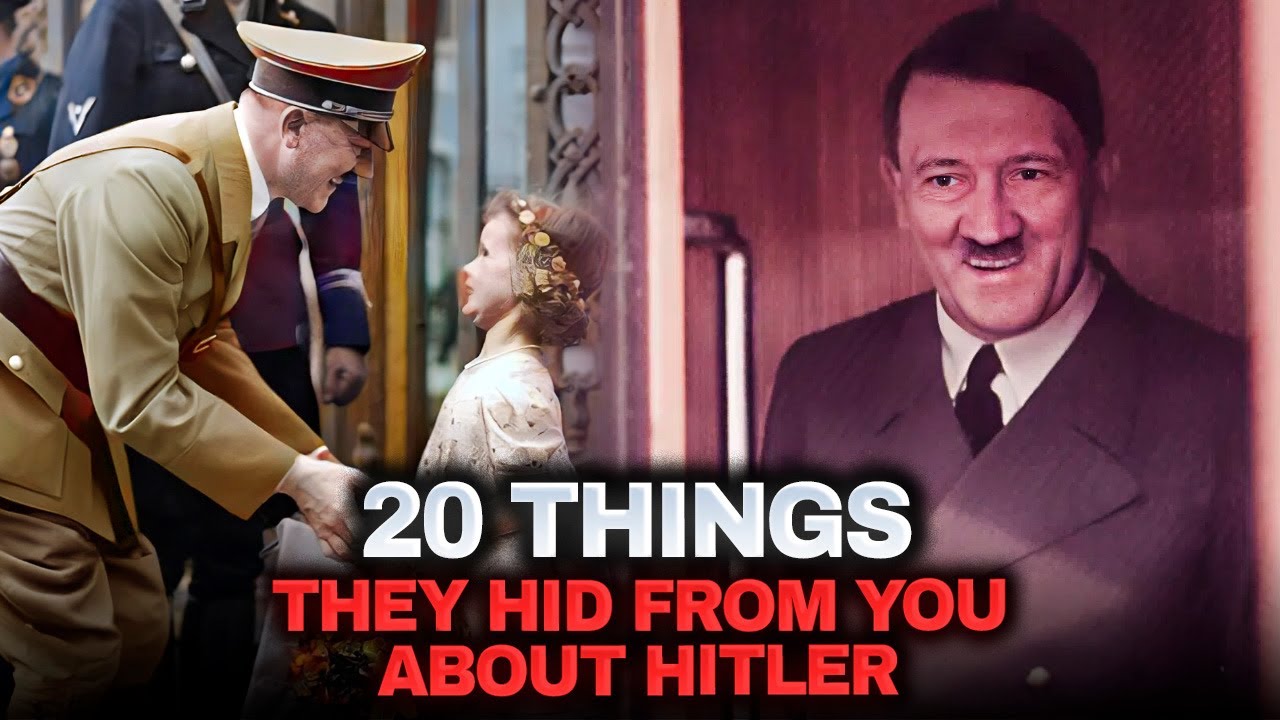
One of the most striking contradictions was Hitler’s early life. A mediocre student, he dropped out of school in 1904 at age sixteen with little to show beyond a passing grade in drawing. For the next three years, he drifted around Linz without seeking work or further study. He later called those years the happiest of his life.
In 1907, he traveled to Vienna, convinced he would be admitted to the Academy of Fine Arts. He failed the entrance examination. When he tried again the following year, he was rejected outright and barred from reapplying. A professor suggested he pursue architecture, since his drawings focused on buildings rather than people, but without a high school diploma that path was closed.
Rather than return home empty-handed, he stayed in Vienna, selling postcards and painted views of the city to survive. Many of his buyers were Jewish merchants, which did not temper the resentment that took root in those years. He later acknowledged that it was in Vienna that his hatred of Jews began to take shape. His relationship with his own family added another layer of contradiction.
When his mother, Klara, fell ill with breast cancer, he remained by her side, tending to minor chores and attending to her every detail. Her death devastated him. Witnesses remembered that he could not contain his tears, even at the funeral. For weeks afterward, he refused to speak to anyone.
It was one of the only times in his life that he openly showed affection. Yet the same man later ordered the mass deportation of entire families, systematically separating mothers from their children at train stations and sorting ramps. He never visited the locations, never saw the tears, never heard the screams. He signed orders from closed offices.
In internal reports, the regime spoke of efficiency, not human consequences. Mothers became numbers, decisions became statistics. In the private letters that survive, there is no mention of any contradiction between the boy who had mourned his mother and the leader who broke apart millions of families. His personal habits were equally paradoxical.
Hitler never drank alcohol and never smoked, and he enforced this standard around him. At his Alpine residence, the Berghof, the rule was clear: no smoke, no drinks. He believed the body should be kept free of harmful substances, and this conviction extended into government policy. His regime ran anti-smoking campaigns, raised cigarette taxes, restricted advertising, and warned about the dangers of smoking, particularly for pregnant women.
He never toasted at official events, even as other senior officials drank wine and liquor. He stuck to herbal teas and water. In his final months, his doctor treated him with unconventional methods, but even then he did not touch alcohol or tobacco. While he sent millions to the front and to the camps, he pursued a meticulous, vice-free personal routine.
His public speaking, one of his most effective weapons, was not natural at all. In 1925, he locked himself in a room alone and rehearsed before a mirror. He repeated phrases, moved his arms, changed his facial expressions, and listened to recordings of his own voice to correct mistakes. He had his personal photographer take pictures of him mid-gesture, then reviewed each image, discarding poses that looked bad and memorizing those that worked.
Every pause was measured, every word weighed. The gestures that seemed so spontaneous at mass rallies had been practiced in private, often for hours, until they were perfect. His diet was another carefully maintained image. During the war years, he presented himself as a committed vegetarian, linking the practice to ideas of German spiritual renewal and moral superiority.
He reproached those who ate meat and told companions that humanity would one day stop eating animal flesh. His cook prepared meat-free dishes, and Martin Bormann had a greenhouse built to guarantee a steady supply of fruits and vegetables. But the reality was more complicated. His secretary recalled that he avoided animal products but that his cook secretly added broth or fat, often causing him physical discomfort.
His nutritionist added bone marrow to his dishes, and his personal physician gave him daily injections derived from animal organs. His vegetarianism was genuine in intention but never fully achieved in practice. Health problems shadowed him throughout his life. A medical report from 1923, written while he was imprisoned in Landsberg after the failed Munich putsch, noted that he suffered from cryptorchidism, meaning only one testicle had descended.
The document, signed by Dr. Joseph Brinsteiner, remained hidden for decades and only came to light in 2010. During the war, he developed Parkinson’s disease. The diagnosis was made in early 1945 by Dr.
Max de Crinis, who notified the SS high command. The SS leadership considered a treatment plan but never administered it, leading some to believe they were considering setting aside a leader already severely damaged by illness. His rigid thinking, obsessive attention to detail, inability to accept other opinions, and emotional outbursts were consistent with the disease’s effects combined with his existing personality. In the final months of his life, his movements became clumsy, his gestures less controlled, and his behavior increasingly withdrawn and dangerous.
The war intensified his routines and his fears. He slept little and worked at night, beginning his day late and continuing into the early hours, sometimes until three or four in the morning. He relied on medication to stay awake and to rest. Allied intelligence documents noted that he sustained himself on just three or four hours of sleep, with the constant help of stimulants and sedatives.
Everything around him, command meetings, reports, internal tasks, adjusted to his nocturnal rhythm. That pattern held even in the final days, when he was locked underground in the Berlin bunker. His obsession with personal security was extreme. At the Wolf’s Lair, his headquarters in East Prussia, he lived in constant fear of poisoning.
A group of about fifteen young women from nearby villages was assigned to taste every meal before he ate it. They had to wait to ensure nothing happened before he sat down. The system was absolute; no one bypassed it. During his lifetime, he never saw most of these women, and after the July 1944 assassination attempt, the security measures only became stricter.
His fear of bombing extended even to the Alps. Though his residences were far from major cities, he ordered tunnels and underground bunkers built wherever he stayed. The most famous was the Führerbunker beneath the Reich Chancellery in Berlin, which became his last command post. He also ordered the construction of the Riese project in southern Poland, enormous underground corridors dug beneath the Owl Mountains.
Every shelter had thick concrete walls, secret passages, protected exits, independent ventilation, and command rooms so he could continue governing even if everything above ground collapsed. Hitler’s relationship with physical contact was almost entirely avoidant. He disliked handshakes and rarely reciprocated gestures of affection. At official events, he limited greetings to nods or the Nazi salute.
At the Berghof, seating arrangements were designed so no one sat next to him. He treated Eva Braun coldly in public, never hugging or kissing her, and for years their relationship remained secret. Even his personal assistants knew to maintain their distance. He designed his living quarters for isolation, with his bedroom and office in a separate wing.
When he gave speeches, he did not greet anyone upon entering the podium. He took his position, spoke, and left without physical contact. His fear of noise was equally controlling. At the Berghof, doors could not be slammed, and staff moved with soft steps, some wearing rubber-soled shoes so their heels would not echo.
Conversations were kept at low volume, and any loud laugh or dropped plate brought noticeable tension. He watched films with the sound off or at minimum volume, and he would interrupt screenings if they became too loud. Political meetings followed the same rules: voices were kept low, and anyone who spoke too loudly was excluded from future invitations. His library revealed the intellectual roots of his ideology.
In 1945, near Berchtesgaden, the 101st Airborne Division discovered some three thousand books belonging to Hitler inside a salt mine. After review, about twelve hundred were stored at the Library of Congress. His entire collection once numbered around seventeen thousand volumes. Many appeared unread, but others showed marked passages and pencil notes in his slanted handwriting.
He had underlined a passage in Paul de Lagarde’s writings about relocating Polish and Austrian Jews to Palestine. He owned an English translation of Henry Ford’s anti-Semitic text The International Jew, works of racial theory, and a copy of Tacitus’s Germania. Among his most worn books was a tactical manual on tanks that featured the concept of blitzkrieg. He also kept esoteric texts that attracted the attention of Heinrich Himmler.
He had a special edition of Shakespeare’s works, bound in brown leather with his initials on the spine. His favorite play was Julius Caesar, and he often repeated the phrase “We’ll meet again at Philippi” as a threat. He never learned to drive. From his earliest days as a politician, he always traveled as a passenger, using cars provided by the party.
His first was a Selve, followed by a series of Mercedes. He preferred to ride in the front seat beside his chauffeur. His cars were modified with raised platforms so he could stand and wave at crowds. According to his long-serving driver Erich Kempka, Hitler never showed any interest in getting behind the wheel.
He checked routes, demanded punctuality, and insisted on meticulous driving. He boasted that he had never had an accident, not because he drove carefully, but because he demanded careful driving from his chauffeurs. British intelligence once used his identity as a weapon. During the war, the Special Operations Executive, created at the initiative of Winston Churchill and Hugh Dalton, forged a passport in Hitler’s name.
Inside, he was described as a painter, with his physical details and characteristic short mustache. The document bore a large red J, the symbol identifying Jews in Germany, and a forged visa supposedly issued by the immigration department of the British mandate for Palestine, dated July 19, 1941. The purpose remains unclear; some believe it was simple provocation, others think it was meant to demonstrate the level of detail British forgers could achieve. It was never used in a concrete operation, but it became one of the most notable examples of psychological warfare.
His Alpine residences reflected his shifting relationship with both power and distance. The Kehlsteinhaus, known as the Eagle’s Nest, was built as a birthday present for Hitler by Martin Bormann. Construction was carried out at enormous cost, with non-stop shifts working through the night, a six-kilometer road carved into the mountain, and an elevator built up a vertical tunnel inside the rock. Twelve workers died during the build, and the total expenditure, adjusted to modern values, is estimated to have exceeded one hundred fifty million dollars.
Albert Speer later wrote that the project reflected Hitler’s growing isolation. The name Eagle’s Nest came from the French ambassador André François-Poncet, who was impressed by both the view and the technical feat. It was one of the few properties linked to Hitler that still stands. There was no significant aspect of his life that was not managed.
His routines, his gestures, his diet, his distance from others, his silence, all of it was arranged to project an image of control and discipline. He planned the extermination of millions of people and never once set foot in a concentration camp. He received reports, delegated logistics to Himmler, and avoided any direct confrontation with the human consequences of his orders. He remained inside offices, residences, and bunkers, issuing orders and waiting for them to be carried out.
When the regime fell, documents, medical records, testimony, and artifacts gradually exposed the man behind the performance. The rehearsed speeches, the guarded silences, the obsessive routines, and the hidden fears revealed a leader who had constructed his entire public existence as a stage production. What had seemed solid was largely a setup. Yet even with all that has come to light, parts of his story remain incomplete, details still buried in archives, and moments that were never recorded.
The full measure of the man behind the persona has never been entirely recovered.