Ten years after the pass at Thermopylae ran red, a man walked the streets of a small Greek town, his head carrying a price. His name was Ephialtes. To understand how a man could return to his homeland only to end up hunted by an entire civilization, you have to go back to a narrow corridor between mountain and sea, and to the moment a local farmer decided that a king’s gold was worth more than every life guarding the line above. In the summer of 480 BC, King Leonidas of Sparta marched north with three hundred carefully chosen men, each one a father, because Sparta refused to let any bloodline end at Thermopylae.
The Persian army that awaited him was not a faceless wave. Many of the men marching under King Xerxes were conscripts—Medes, Bactrians, Lydians, farmers and shepherds and craftsmen gathered from dozens of subject peoples, forced to cover hundreds of miles under the August sun. Most of them had no quarrel with any Greek. They would die in a pass they could not pronounce, for a king they would never see, on the word of a man they would never meet: a Malian named Ephialtes.
The Greeks took position at the narrowest point of the pass, where the road between mountain and sea shrank to perhaps fifty meters. An old defensive wall, half-ruined, stood there; they rebuilt it. In front of it, the ground forced any advancing enemy into a killing zone no wider than a village street. Behind it, the Greeks cooked, slept, and sharpened their bronze.
Crucially, Leonidas identified the one weakness in his position: a mountain path called Anopaea that wound over the slopes of Kallidromos and descended behind the Greek line. He sent the Phocian contingent, about a thousand men, to guard it. This was no oversight. He had already imagined the catastrophe before it arrived.
Xerxes waited several days, camped opposite the pass, sending emissaries and expecting the Greeks to see his army’s size and slip away quietly. They did not. They sat at their wall and sharpened their spears. So he sent the Medes.
They came in waves, the terrain squeezing them into a front only a few dozen men wide. The Greek phalanx, with its interlocking bronze shields and extended spears, the second rank pushing the first, met them like a mute machine. Persian arrows glanced off Greek bronze. Persian spears, shorter and lighter, could not penetrate the wall.
By the end of the first day, hundreds of Persian corpses lay before the Greek wall, the Greeks rotating their units to keep fresh men at the front. Herodotus records that Xerxes, watching from a throne on a hillside, leapt to his feet three times in fear for his army. The King of Kings, commanding more soldiers than any ruler in the known world, jumped from a golden chair because a single line of Greeks in a fifty-meter pass would not break. The next day Xerxes sent his best troops, the Immortals, the elite force of ten thousand.
They fared no better. Terrain does not care about elite status. In a pass fifty meters wide, ten thousand men became a hundred at a time, and those hundred died on Spartan spears. Persian losses over those two days numbered in the thousands.
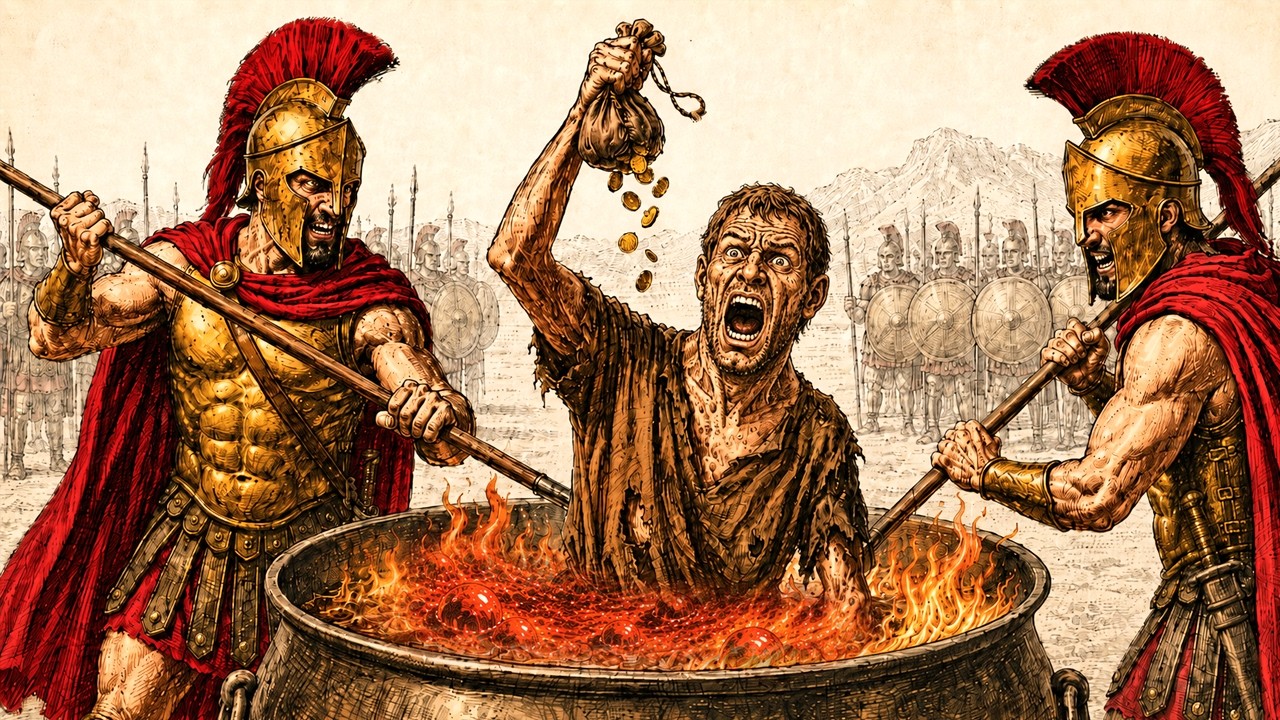
The pass before the Greek wall became a scene of bronze and blood. The Greeks even practiced feigned retreats, pulling back in apparent disorder before turning and cutting down the pursuers who broke formation. And then, on the second night, a Malian farmer named Ephialtes, son of Eurydemus, came to Xerxes, expecting a great reward. He told the king about the path that led over the mountain to Thermopylae.
That single piece of information changed the course of the battle. A local man entered the enemy camp, traded a piece of geography for a piece of gold, and the fate of Greece was decided in a conversation we cannot even fully reconstruct. He could not simply say there was a path. He had to describe it, convince a suspicious king that he was not leading the Persians into a trap, explain the terrain, the timing, and the presence of the Phocian guards, and offer himself as guide, because no Persian could find that route in the dark without him.
Xerxes listened, agreed, and summoned Hydarnes and the Immortals—the ten thousand who had failed to break the pass by force would now break it by geography. They marched that very night, Ephialtes walking ahead, torch in hand, leading an empire around the back of a king. Leonidas had imagined this exact moment. He had placed a thousand Phocians on that mountain precisely to prevent it.
But when the Immortals reached the ridge where the Phocians camped in the early hours before dawn, the Phocians heard them—the tread of feet on dry leaves, the clatter of equipment—and reasonably assumed they were the target of a night attack. They seized their weapons, formed ranks, and prepared to defend their position. The Immortals simply walked past them. They did not stop to fight.
They had a guide, and the guide knew where he was going. The target was not the men on the ridge. The target was the king below. Somehow, the news reached Leonidas before the third day’s light touched the pass: a runner arrived gasping, telling the Spartan king that the Persians were behind him.
At dawn of the third day, Leonidas called his commanders together. Herodotus records that there was disagreement—some wanted immediate withdrawal, others wanted to hold. The council did not last long. What Leonidas did next is why his name endured.
He dismissed most of the allied Greeks, the Locrians and Corinthians. Then he did not wait behind the wall. He did the opposite. He ordered his men to advance beyond the narrow choke point, into a wider part of the pass where they could kill more Persians before being overwhelmed.
This was not defense. This was chosen death, executed with maximum ferocity. The Persian army in front could hardly believe it. Herodotus tells us that Persian officers had to whip their men forward to face the oncoming Greeks.
Men who had spent two days watching their comrades slaughtered at the choke point were now driven toward those same Greeks on open ground. The killing that followed stunned ancient observers. The Greeks fought until their spears shattered, then drew their swords, then fought with hands and teeth. Persian corpses piled so densely before the Greek line that men were trampled under their own advancing comrades.
Some Persians were pushed off the road toward the sea and drowned under the weight of their armor. Leonidas fell in the thick of the fighting. We do not know how—an arrow, a spear, a sword thrust. He was one of the first Spartan commanders to fall.
When he dropped, the fight took on a new shape. His men saw their king dead on the ground. Every Spartan and Thespian in that pass made the same instinctive decision: they fought to reach him, not to save him, but to recover his body. The Spartans formed a ring around Leonidas’s corpse.
The Persians surged forward to seize it, because the body of an enemy king was a prize of enormous value to the Persian king. The Greeks pushed them back. The Persians reorganized and pushed again. This exchange, according to Herodotus, happened four times—four separate attacks, four desperate defenses around the body of a man who was already dead.
Men on both sides died for a corpse, and the Greeks, though outnumbered and exhausted, managed to drag their king back toward their own lines each time. Then Hydarnes arrived. The Immortals, the ten thousand who had marched all night up the mountain path led by Ephialtes, descended onto the road behind the Greek position. The pass was closed.
There was no direction a Greek could face without finding a Persian. The surviving Greeks withdrew to a small rise, a hillock in the pass, and formed a final cluster. They had no spears. They fought with swords, then daggers, then the butts of their weapons, then with stones wrenched from the ground.
Herodotus records that they fought with hands and teeth until finally the Persian archers were ordered to stand back and simply shoot arrows at the hill until every man on it was dead. Xerxes walked the field afterward. He found the body of Leonidas. What he did next reveals how deeply the Spartans had wounded him, not tactically, but personally.
He ordered the king’s head cut off. He ordered the body crucified. This was not standard Persian practice for defeated enemy commanders. Herodotus notes it pointedly.
Some say the Greeks recovered the remains after the war and buried them in Sparta. The emotional truth is indisputable either way: the most respected king in Greece had his head severed in a Persian camp because a farmer accepted a bribe. Ephialtes is absent from every account of the third day at Thermopylae. He is not in the pass.
He is not with Hydarnes’s Immortals descending the mountain. He is not standing beside Xerxes on the hillside watching the end. He had done his job, walked the Persians through the path in the dark, delivered them behind Greek lines, and now he simply disappears from the story. Herodotus tells us nothing about where he was during the final battle.
Perhaps he was somewhere in the Persian camp waiting for his reward, waiting for the gold and honors promised in Xerxes’s tent. Perhaps he was already beginning to understand what he had done—because at some point that day, news must have reached him. The King of Sparta was dead. The pass had fallen.
The final battle was over. And then another thought must have followed: the Greeks who escaped were still alive. The Greek cities to the south still stood. The war was not over.
And far too many angry Spartans now knew his name. Herodotus tells us that Ephialtes, out of fear of the Spartans, fled to Thessaly. Not celebration, not settling into the Persian court. Flight.
And when he fled, the Amphictyonic League, the council of Greek states meeting at Pylae, declared a reward for his head. He was no longer just hunted by one state; he was hunted by an entire civilization. He could not go to Delphi, could not attend the major Greek festivals, could not enter any temple, could not appear in any public gathering. Every road was a risk, every stranger a potential executioner, every drink offered a possible poison.
The reward was not just a proclamation—it was a slow strangulation of every social space a Greek man was expected to inhabit. Ephialtes waited in Thessaly. Herodotus says he remained there for some time, which most modern scholars interpret as several years, perhaps as long as a decade. He waited for the anger to cool.
He waited for the generations who fought at Thermopylae to age. He waited for the world to forget. The world did not forget, but he apparently convinced himself it had. At some point, likely in the late 470s BC, perhaps a full ten years after the battle, he made the decision that ended his life: he returned home.
Not to Malis specifically, but to Anticyra, a town in Phocis near his original region. Perhaps he had family there. Perhaps he could no longer bear another day in exile. Perhaps he calculated that the actual pursuit of a reward for a war a decade old had faded.
He was wrong about that last part, but right in a strange way too, because what killed Ephialtes was not the reward. Not exactly. Herodotus is again our source. His exact words: then after a time, and after returning to Anticyra, he was killed by Athenades, a man of Trachis.
It was for another reason that Athenades killed Ephialtes, which I will relate in the later part of my history, but he was nevertheless honored by the Lacedaemonians for it. Read that carefully. Athenades killed Ephialtes not for Thermopylae, not for the Amphictyonic decree, but for another reason—a personal quarrel, a private dispute, a matter Herodotus intended to explain elsewhere, and either never did or that portion of his text was lost. A local man from Trachis, the same region as Ephialtes himself, killed the traitor of Thermopylae in what appears to have been an ordinary personal vendetta: a dispute over money, or land, or a woman, or an insult.
We do not know. We will never know. What we know is that when the traitor of Greece finally died, he did not die as a symbol. He died as a neighbor.
The Spartans learned of it. Word reached Sparta that Ephialtes was dead, killed by a man of Trachis in a private quarrel. Sparta did not care that Athenades had acted for personal reasons. Sparta did not care that the killing had nothing to do with Thermopylae.
Sparta honored him. Herodotus is explicit: the Lacedaemonians honored Athenades for killing Ephialtes. The traitor was dead, and the man who killed him, whatever his reasons, had done what a coalition of Greek states had spent a decade trying to achieve. That was enough.
That was more than enough. Sparta’s way of settling debts was not a hired assassin, not a public execution, not a formal trial, but patience and institutions, and the certainty that if you made a man’s life impossible long enough, he would eventually make himself an enemy who would do the job for you. Ephialtes’s real punishment was not his death. It was the ten years he spent waiting for it.
Modern retellings often portray Ephialtes as physically deformed—hunchbacked, grotesque, an outcast whose betrayal is explained as a psychological reaction to social rejection. This image has absolutely no basis in Herodotus. The historical Ephialtes, by every available indication, was an ordinary Malian farmer, middle-aged, unremarkable in appearance. No ancient source mentions any deformity.
His motive was money, not psychological injury, not exclusion, not revenge for a lifetime of denied love. The hunchback of the movies is a modern invention, a narrative shortcut that makes betrayal easier to explain by making the traitor visibly different. The real story is far more unsettling: an ordinary man walking ordinary hills sold seven thousand of his countrymen for a bag of gold. There was nothing wrong with him.
That is the point. Sparta did not chase Ephialtes down. Sparta did not send assassins across borders. What Sparta did was more cunning, and in a way, more terrible: they pressed for the decree at Pylae.
They turned his life into currency. They waited. And when a man in Trachis killed Ephialtes over a quarrel unrelated to the battle, Sparta stepped forward and blessed the killing after the fact. A private dispute became history because Sparta chose to make it history.
That was what state vengeance looked like in the ancient world: not an assassination squad, but a patient, institutional suffocation of a human life. Return to the image that began the story. A man walking in Anticyra, ten years after Thermopylae, on a day he probably believed was safe. He had spent a decade waiting for the anger to subside.
He had returned home. He was thinking about ordinary things—a debt, a neighbor, a piece of land. He did not know that his death was about to be painted with two meanings: the private reason, supplied by Athenades, a grievance we will never recover, and the public reason, supplied by Sparta, of delayed justice for a king who died ten years earlier. His name had already begun to become a Greek word meaning nightmare.
It still is. In modern Greek, the word ephialtes means exactly that: a troubled dream. A man became language. That was a punishment Sparta did not need to design.
But every culture has a word for nightmare, and if you trace its origin far enough, you find a Malian farmer, a mountain path, a reward proclaimed at a sanctuary, and a personal quarrel in a small town called Anticyra.