On the night of 15 October 1946, Fritz Sauckel paced his cell in Nuremberg prison, restless in the knowledge that his execution was only hours away. Journalists observing the condemned men noted his agitation. He had been found guilty of war crimes and crimes against humanity for the forced deportation of some five million workers from occupied territories into German factories. As midnight approached, he faced the consequence of those crimes.
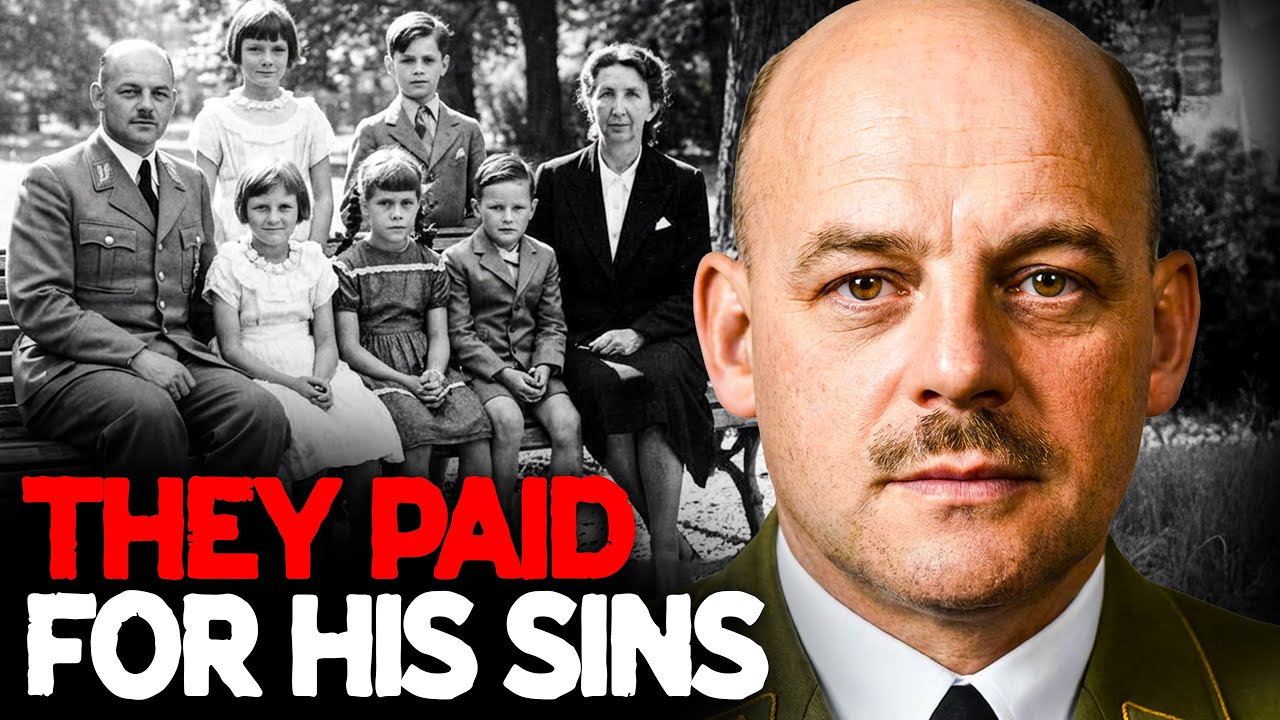
His death would close a chapter for him, but for his wife Elisabeth and their surviving children, the ordeal had only begun. In the early hours of 16 October 1946, Sauckel climbed the thirteen wooden steps to the gallows in the Nuremberg prison gymnasium. Looking wildly around the converted execution chamber, he shouted his final words: “I am dying innocent. The sentence is wrong.
God protect Germany and make Germany great again. God protect my family. ” Minutes later, the man chief prosecutor Robert Jackson had called the organizer of the largest slave labor program since the pharaohs was dead. His body, along with those of the nine other condemned Nazi leaders, was cremated and the ashes scattered in the Isar River to prevent any future shrine.
Fritz Sauckel had built his empire in Thuringia over two decades. Born on 27 October 1894 in Hassfurt, Bavaria, the only child of a postman and a seamstress, he had gone to sea at fifteen, working on Norwegian and Swedish merchant vessels until the outbreak of the First World War, when his ship was captured and he was interned in France for five years. Those years radicalized him. Returning to Germany in 1919, he joined the anti-Semitic Deutschvölkischer Schutz- und Trutzbund before finding his way to the Nazi Party in 1923, becoming member number 1,395.
His rise was steady and relentless. As Gauleiter of Thuringia from 1927 and Reichsstatthalter from 1933, he transformed the region into what he proudly called a model Nazi district. In Weimar, the city of Goethe and Schiller, he built a castle-like villa for his large family between 1938 and 1939. Elisabeth, whom he married in 1924, had given him ten children, and Nazi propaganda celebrated them as the ideal German family.
Sauckel’s influence extended far beyond his role as Gauleiter. He founded the Wilhelm Gustloff Foundation using assets confiscated from the Jewish company Simson in Suhl and built it into a powerful industrial conglomerate. The Fritz Sauckel Werk in Weimar became the centerpiece of his economic empire, eventually employing thousands, including concentration camp prisoners from nearby Buchenwald. He collaborated closely with the SS, helping to establish Buchenwald concentration camp just eight kilometers from the city center in 1937.
By April 1945, that world was collapsing. On 10 April, only one day after declaring Weimar a fortress city and ordering his Volkssturm forces to resist the approaching American army, Sauckel fled by car. The man who had exhorted others to fight to the death abandoned his post. Weimar fell to the US 80th Infantry Division on 12 April, and residents were soon forced to walk through Buchenwald to witness the horrors committed just kilometers from their homes.
The Sauckel family’s comfortable existence ended abruptly. American forces occupied the villa, and Elisabeth found herself without the status, protection, or resources she had enjoyed for over a decade. The servants were gone, the privileges had vanished overnight. Sauckel’s flight took him toward Austria, but on 12 May 1945 members of the US Army Counter Intelligence Corps arrested him in Salzburg.
He was transferred first to the Seventh Army Interrogation Center in Augsburg, then to Camp King in Oberwössen, and finally to Nuremberg. As General Plenipotentiary for Labor Employment from March 1942 until the end of the war, he had been responsible for deporting some five million foreign workers to Germany. The methods his administration employed were brutal: manhunts, village burnings, family separations, and outright kidnapping. His own written orders laid bare the exploitation.
In a letter to Alfred Rosenberg dated 20 April 1942, Sauckel wrote that foreign workers must be fed, sheltered, and treated in such a way as to exploit them to the highest possible extent at the lowest conceivable degree of expenditure. At a meeting of the Central Planning Board in March 1944, he admitted that of the five million foreign workers who arrived in Germany, not even 200,000 came voluntarily. The family had already suffered tragedy during the war. Two of the Sauckel children died in the conflict, though the circumstances remain obscure.
Sauckel referenced the loss in his final statement at Nuremberg, speaking of following his sons to death. Elisabeth faced the post-war period with eight surviving children rather than ten. The Nuremberg trial brought global attention to the crimes of the Nazi leadership, and Sauckel’s role placed him among the most reviled defendants. Robert Jackson assembled overwhelming evidence against him.
Documents showed he had personally approved the use of force for labor recruitment. His own memoranda revealed his philosophy of exploitation. Eyewitnesses described him as nervous and agitated, a sharp contrast to defendants like Göring who maintained an air of defiance. He seemed unable to comprehend how his administrative decisions had translated into massive suffering.
His lawyer, Robert Servatius, attempted to portray him as a representative of the German working class, contrasting him with Albert Speer, whom he characterized as an elite technocrat. The strategy was clear: if blame was to be assigned, it should fall on Speer, who had demanded the workers rather than Sauckel, who had merely supplied them. The tribunal was unconvinced. On 1 October 1946, the verdict came down: guilty on counts three and four, war crimes and crimes against humanity.
The sentence was death. The execution itself was brutal even by the standards of judicial hanging. Wearing a sweater with no coat and looking wild-eyed, Sauckel proved to be the most defiant of the condemned except Julius Streicher, according to journalist Kingsbury Smith, who witnessed the executions. After Sauckel’s body dropped through the trap, witnesses reported hearing groans from within the scaffold, suggesting death was not instantaneous.
By three in the morning, all ten condemned men had been hanged. Their bodies were photographed to document that justice had been done, then transported to Munich for cremation. For Elisabeth Sauckel, the period after her husband’s execution brought the humiliation of denazification. In June 1947, she appeared before a German denazification court, the first of the major Nazi leaders’ widows to be tried.
Newspapers from Sydney to London reported on the case. The court found her guilty of being a lesser Nazi, or Minderbelastete, and fined her twenty-five pounds. She could best atone for her sins, the court reportedly told her, by going home and educating her children democratically. The judgment reflected the genuine ambiguity of such cases.
Elisabeth had held no official position and signed no orders, but she had lived in privilege and borne ten children celebrated by regime propaganda. Some felt the judgment too lenient; others argued wives should not be punished for their husbands’ crimes. The Soviet occupation zone, which became the German Democratic Republic in 1949, was no place for the widow and children of a prominent Nazi. Properties were seized under land reform programs that targeted former Nazis.
The Villa Sauckel was confiscated. The family could not reclaim their property, could not easily find employment, and faced the hostility of a population that had been forced to confront the crimes committed at Buchenwald, where over 56,000 people had died. Likely in the late 1940s, Elisabeth and at least some of her children made their way to the western zones, where conditions offered somewhat more opportunity for former Nazi families to rebuild. In the West, the Sauckels joined thousands of others attempting to disappear into the anonymity of post-war German society.
But the name remained toxic. West Germany in the 1950s was a study in contradictions. Reconstruction led to the quiet reintegration of thousands of former Nazis into government, business, and professional life. But families of executed war criminals could not benefit from such accommodations.
Their relatives had been publicly tried, convicted, and put to death. Unlike some families of Nazi leaders, the Sauckels largely avoided public attention in the decades after the war. There were no memoirs published defending Fritz Sauckel’s actions, no prominent children speaking out either to condemn or excuse their father. They retreated into a privacy that has largely been respected.
The contrast between Sauckel and Albert Speer in the post-war imagination remained a controversy for decades. Speer, who had demanded the slave workers Sauckel provided, received a twenty-year prison sentence rather than death. He served his time, emerged in 1966, wrote best-selling memoirs, and died peacefully in 1981. Sauckel, the man who fulfilled Speer’s demands, received no such posthumous rehabilitation.
He remained what he had been at Nuremberg: the brutal overseer of the largest slave labor program in modern history. Elisabeth Sauckel lived into the post-war period, though the exact date of her death remains unclear. The surviving children grew up marked by their father’s legacy. They ranged from young adults to small children when the war ended.
All of them carried a surname that identified them as the offspring of a man hanged for crimes against humanity. Their fate reflects the broader patterns of how Germany dealt with the Nazi past: from initial accountability through decades of silence to more recent efforts at historical reckoning. Today, the Villa Sauckel still stands in Weimar, a physical reminder of the Gauleiter who once ruled Thuringia. The Buchenwald Memorial serves as a permanent reminder of the crimes committed just kilometers from the classical monuments.
Somewhere, perhaps, descendants of Fritz Sauckel still carry his name, living with an inheritance that time has not erased.