The interrogation of Hermann Göring at the Nuremberg Tribunal unfolded across several days in March 1946, and from the start it carried an extraordinary weight. Here was the most powerful man of the Third Reich after Hitler, stripped of his rank, his medals, and his empire, forced to answer for the regime he had helped build. The prison psychiatrist Dr. Douglas Kelly considered Göring the most physically fit man in Germany, and in the courtroom he was composed, even dignified, accepting his fate with the bearing of a man who still believed history would judge him kindly.
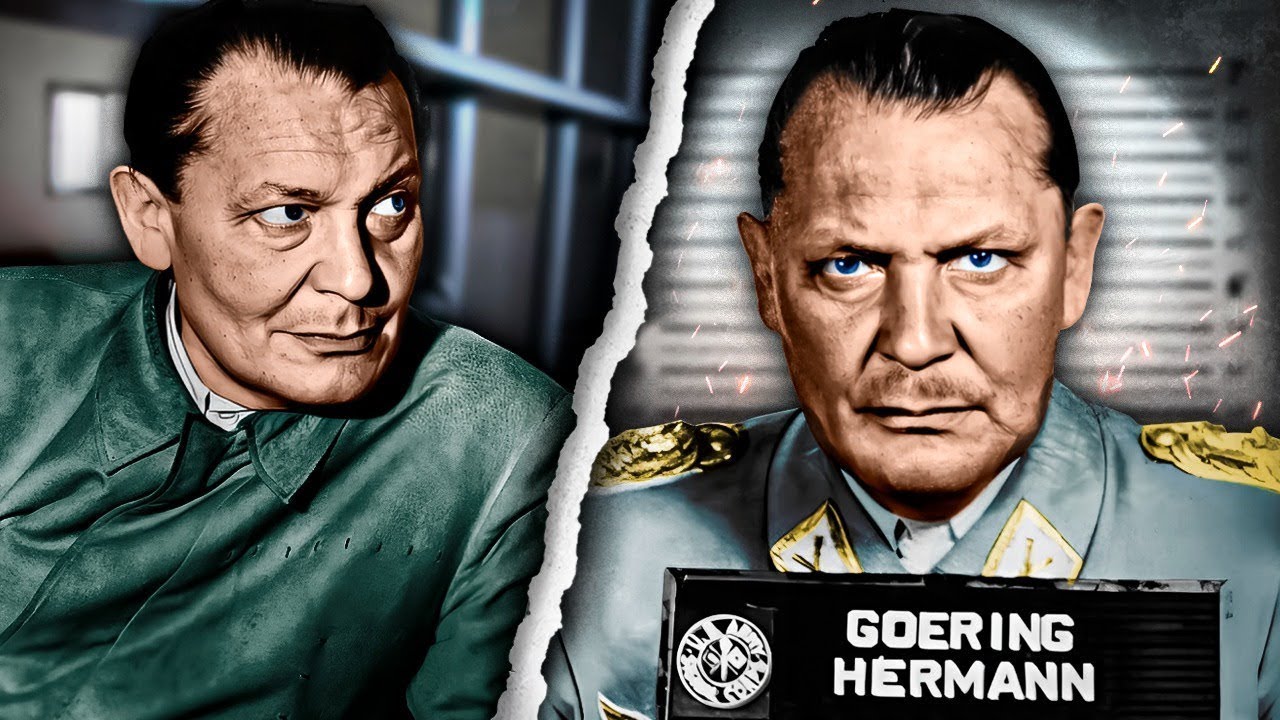
When asked about his possible execution, Göring declared that he was prepared to be hanged, but that he was determined to go down in German history as a great man. He insisted that everything he had done was for the German Reich, and he predicted that in fifty or sixty years statues of him would stand all over Germany. The questioning first took up his early life and his path into the Nazi movement. Born in Rosenheim, Bavaria, on January 12, 1893, Göring came from a family with colonial connections, his father having served as governor of German Southwest Africa.
He spent part of his youth in Austria, attended cadet school, and became an officer. In the First World War he served first in an infantry regiment, then as an altitude adjuster, before becoming a pilot. He was severely wounded in aerial combat, recovered, commanded a fighter squadron, and after the death of Manfred von Richthofen took command of the famous Richthofen Squadron. His decorations included the Iron Cross both classes and the Pour le Mérite, the highest military honor.
After the war, he refused to serve in the Reichswehr because he opposed the republic that had emerged from the revolution. He went abroad, then returned, spending time at a hunting lodge and studying history and political science at the University of Munich. It was in late October or early November 1922 that he first heard Hitler speak, at a protest meeting against Allied demands for the extradition of German military leaders. Göring had come as a spectator, but Hitler’s refusal to speak to the crowd impressed him deeply.
Hitler argued that empty protests were pointless and that a protest was only valid when it had real support. This matched Göring’s own thinking exactly. A few days later Göring went to the NSDAP headquarters, met Hitler, and offered his help. Hitler saw the meeting as a sign of fate, and the conversation turned to the Treaty of Versailles and the need for German renewal.
Göring was soon given command of the SA, tasked with turning it from a loose club of activists into a disciplined, reliable force. He worked to recruit idealistic young party members, built the organization’s strength, and faced fierce clashes with communist opponents. By 1923 tensions between Bavaria and the Reich were rising, and Göring, like many nationalists, opposed the Bavarian government’s drift toward separation. When Hitler launched the attempted putsch on November 9, 1923, Göring took part.
He was seriously wounded, hospitalized in Austria, and arrested by Bavarian police when he returned. After recovering, he spent about a year in Italy and abroad. A general amnesty allowed him to return to Germany in 1927, and he met Hitler again in Berlin that year. He stayed at a distance from party work until May 1928, when Hitler put him first on the Reichstag candidate list for the National Socialists.
From 1928 until the seizure of power, Göring held no official party position. He was a Reichstag deputy and a traveling party representative, working to broaden the movement’s appeal, in particular trying to draw communist and Marxist supporters toward the Nazis. Toward the end of 1931, Hitler asked him to act as a personal representative for political negotiations, independent of party structures. Göring accepted, and his election as president of the Reichstag in 1932 gave him a platform in the center of German politics.
In that role he negotiated with party leaders and regularly met Reich President Paul von Hindenburg, who had known Göring since the world war. Göring described the chaotic political situation of 1932, when parliamentary majorities were impossible and emergency decrees had suspended much of the constitution. Chancellor Franz von Papen had proposed making Hitler vice chancellor, but Göring insisted that Hitler could never accept a secondary role. When von Papen’s government later faced a vote of no confidence, Göring, as Reichstag president, helped bring it down.
The vote went overwhelmingly against von Papen, and the government fell. By the end, Hitler’s appointment as Reich chancellor in January 1933 was hemmed in by restrictions demanded by Hindenburg. Von Papen was to be vice chancellor, foreign policy remained in independent hands, the Prussian prime minister’s post went to a von Papen man, and General Werner von Blomberg was appointed defense minister. Göring insisted that the party came to power legally, called by the Reich president under the constitution.
Once in power, Göring held a succession of offices. He remained president of the Reichstag, became minister and Reich commissar for aviation, and in April 1933 also prime minister of Prussia. He handed over the Prussian interior ministry in early 1934 as part of the consolidation of state power. He described the creation of the Gestapo as a purely state institution, built from the existing political police, which he renamed and reorganized to defend the state against enemies, primarily communists.
He ordered the arrest of communist officials and leaders, and because prisons were unsuitable, he established camps for preventive detention. He admitted that there were excesses at the beginning, beatings and brutalities, but he argued that compared with other revolutions, the German revolution had been remarkably bloodless. He claimed that he gave orders that such abuses should not happen, and that he personally took an interest in the camps in the spring of 1934. At Christmas 1933 he ordered the release of about five thousand prisoners in minor cases, and a further two thousand were released in November 1934, but his authority over the Gestapo ended in early 1934 when it passed to Heinrich Himmler.
The cross-examination by the American prosecutor Robert Jackson took aim at the contradictions of Göring’s testimony. Göring denied any connection to the SS, insisted he had never been an SS general, and claimed ignorance of the term master race, saying that if one is a gentleman, one need not pay attention to it. He tried to explain the fÜhrer principle as a natural German response to a weak and fragmented democracy, arguing that Germany, with centuries of monarchy behind it, needed leadership from above with responsibility from below. When Jackson pressed him on the concentration camps, Göring maintained that these things were kept secret from him.
He acknowledged that some workers were brought to Germany and that not all came voluntarily, but he disputed the scale presented by the prosecution. He denied knowledge of mass murder, saying he knew nothing about the extermination of millions of Jews. He claimed that even Hitler did not know the full extent of what Himmler was doing. He objected to being called a friend of Himmler and insisted he had never intended to place one race above another.
The questioning moved to the war against the Soviet Union. Göring admitted that plans for an air operation against the USSR were drawn up in November 1940, more than six months before the German attack that June. He tried to frame it as preparation for a possible conflict, driven by Hitler’s conviction that Soviet Russia was a mortal threat. He denied that the regime had a premeditated plan to destroy the Soviet population, insisting that the orders and directives issued before the invasion were responses to an anticipated brutal struggle.
He said he knew nothing of an order to destroy Leningrad or Moscow in the sense presented by the prosecution. At the end of Jackson’s questioning, the prosecutor asked a direct question. As the second man in Germany, did Göring consider himself responsible for the organized, state-sponsored murder of millions of innocent people, even independently of his knowledge? Göring answered no.
He said he could not be responsible for things he did not know about, and he disputed the claim that millions of Germans knew about the crimes. He admitted that Hitler’s government had led Germany to prosperity before the war, but insisted the catastrophe came only after the war was lost. In later reexamination, Göring was asked to explain his personal responsibility. He drew a distinction between formal and actual responsibility.
Formal responsibility meant answering for what happened in his departments and institutions, even if he could not see or know everything in advance. Actual responsibility lay where he personally gave orders or signed directives. He said his aim had been to prepare for the seizure of power, establish firm authority, and make Germany free and great. He claimed he had done everything possible to prevent war, but once it began, his duty was to do everything possible for victory.
The tribunal’s president cut him off when his answers turned into speeches. The question of his responsibility had been raised repeatedly, the court observed, and it was not going to hear the same account again. With that, Göring was permitted to return to his seat. The tribunal would go on to convict him on all four counts of the indictment, and he would be sentenced to death.
He would cheat the hangman by taking cyanide the night before his scheduled execution. But at that moment in the courtroom, the former Reich Marshal had given his final testimony to history, insisting to the very end that he had acted for the great German Reich.